Skip to content

KLOW Transdermal Serum Research Blend
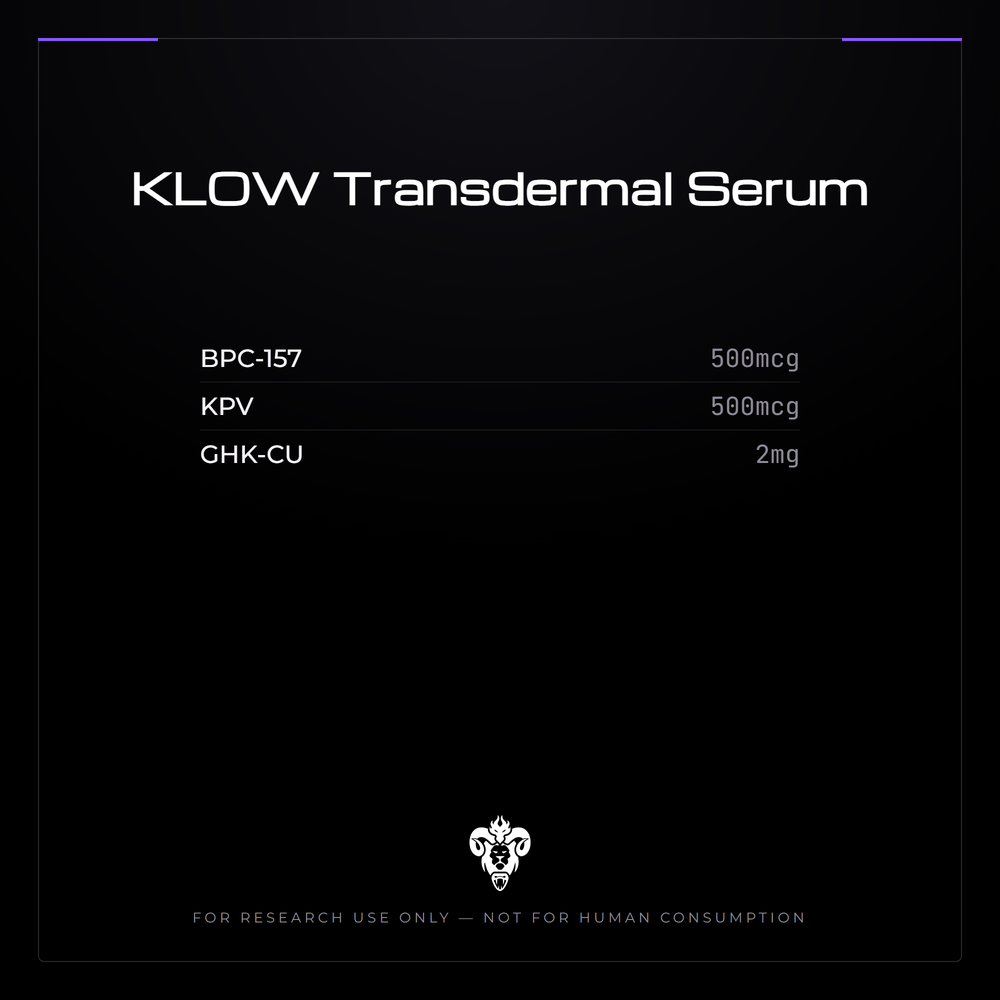
A three-component topical-grade research solution delivering BPC-157 500 mcg, KPV 500 mcg and GHK-Cu 2 mg per 1 mL pump, 50 mL total. Supplied for in vitro and ex vivo laboratory work.
The components
-
BPC-157 is a 15-residue partial sequence of body protection compound, isolated from human gastric juice. Its best in vitro characterisation is in tendon fibroblasts: it accelerated outgrowth from tendon explants, increased survival under H2O2 stress, and dose-dependently increased migration and spreading, with F-actin formation induced and FAK and paxillin phosphorylation raised dose-dependently while total protein was unchanged. Notably it did not directly affect fibroblast proliferation by MTT assay — the effect is on migration and survival, not cell number.[1]
-
KPV is the C-terminal tripeptide of α-MSH, residues 11–13. Most of α-MSH’s anti-inflammatory activity is attributable to it. It binds MC-1R and modulates antigen-presenting cell function; the parent peptide downregulates IL-1, IL-6, TNF-α, IL-2, IFN-γ, IL-4 and IL-13 and the costimulatory molecules CD86, CD40 and ICAM-1, while upregulating IL-10, via inhibition of NF-κB activation.[3,4]
-
GHK-Cu is an endogenous copper(II)-binding tripeptide. It stimulates collagen synthesis in cultured fibroblasts between 10−12 and 10−9 M,[5] and raises MMP-2 alongside TIMP-1 and TIMP-2 — bidirectional matrix turnover rather than one-way collagen accumulation. Copper ions alone reproduced the MMP-2 effect while GHK alone did not.[6] Bound Cu(II) is redox-attenuated relative to free copper.[7]
What is not established
No published study tests these components in combination. Each is characterised alone, and the sections above describe them that way. There is no interaction data and no demonstration of additive or synergistic behaviour for this blend. That makes single-component control arms the difference between an interpretable experiment and an uninterpretable one.
How strong is the evidence. Worth stating plainly, because BPC-157 is described online with more confidence than its literature supports. The review above notes that the majority of studies are in small rodent models, efficacy is yet to be confirmed in humans, only a handful of research groups have worked on it in two decades, and the precise healing mechanisms remain unresolved. The in vitro fibroblast work is solid and specific; the broader claims rest on a narrow base.[2]
On the word transdermal. None of the references here studied dermal penetration of these peptides. The format is a topical solution; whether and to what extent any component crosses skin is an open experimental question rather than an established property, and ex vivo skin models are the way to settle it. Treat permeation as something to measure.
Research Applications
-
Multi-analyte method development resolving the components in one sample.
-
Combination pharmacology against single-component arms — the open question.
-
Extracellular matrix and migration assays where more than one mechanism is deliberately in play.
-
Comparative profiling of blend against each constituent at matched concentration.
Analytical Documentation
Purity, identity and composition vary by manufacturing lot. Kimera Chems does not publish a single fixed purity figure for this item; refer to the batch-specific Certificate of Analysis (COA) issued for the lot received, which reflects third-party analytical testing for that lot.
References
- Chang CH, Tsai WC, Lin MS, Hsu YH, Pang JHS. The promoting effect of pentadecapeptide BPC 157 on tendon healing involves tendon outgrowth, cell survival, and cell migration. J Appl Physiol. 2011;110(3):774–780. doi:10.1152/japplphysiol.00945.2010
- Gwyer D, Wragg NM, Wilson SL. Gastric pentadecapeptide body protection compound BPC 157 and its role in accelerating musculoskeletal soft tissue healing. Cell Tissue Res. 2019;377(2):153–159. doi:10.1007/s00441-019-03016-8
- Luger TA, Scholzen TE, Brzoska T, Böhm M. New insights into the functions of alpha-MSH and related peptides in the immune system. Ann N Y Acad Sci. 2003;994:133–140. doi:10.1111/j.1749-6632.2003.tb03172.x
- Luger TA, Brzoska T. alpha-MSH related peptides: a new class of anti-inflammatory and immunomodulating drugs. Ann Rheum Dis. 2007;66(Suppl 3):iii52–iii55. doi:10.1136/ard.2007.079780
- Maquart FX, Pickart L, Laurent M, et al. Stimulation of collagen synthesis in fibroblast cultures by the tripeptide-copper complex glycyl-L-histidyl-L-lysine-Cu2+. FEBS Lett. 1988;238(2):343–346. doi:10.1016/0014-5793(88)80509-x
- Siméon A, Emonard H, Hornebeck W, Maquart FX. The tripeptide-copper complex glycyl-L-histidyl-L-lysine-Cu2+ stimulates matrix metalloproteinase-2 expression by fibroblast cultures. Life Sci. 2000;67(18):2257–2265. doi:10.1016/s0024-3205(00)00803-1
- Min JH, Sarlus H, Harris RA. Glycyl-L-histidyl-L-lysine prevents copper- and zinc-induced protein aggregation and central nervous system cell death in vitro. Metallomics. 2024;16(5):mfae019. doi:10.1093/mtomcs/mfae019
Storage & Handling
Store at controlled room temperature. Keep tightly closed.
Storage guidance is a house recommendation. Analytical documentation is per-lot release testing.
Related Research Compounds
Research Use Only Disclaimer: This product is labeled and sold “For Research Use Only – NOT FOR HUMAN CONSUMPTION.” It is not a drug, dietary supplement, food, cosmetic, or medical device, and it is not approved by the FDA or any other regulator for human or veterinary use. It is supplied to approved account holders as a research chemical for laboratory use and must be handled in accordance with applicable law.