
Give this decapeptide in hourly pulses and the pituitary starts making gonadotropins. Give exactly the same amount continuously and it stops.
That is not a dose effect. Belchetz and colleagues showed this in 1978, working in monkeys whose own hypothalamic signal no longer functioned. They stated it plainly: the result belongs to the pattern of delivery rather than the quantity delivered [1].
Almost everything about Gonadorelin follows from that single fact, including two entire drug classes built on opposite sides of it.
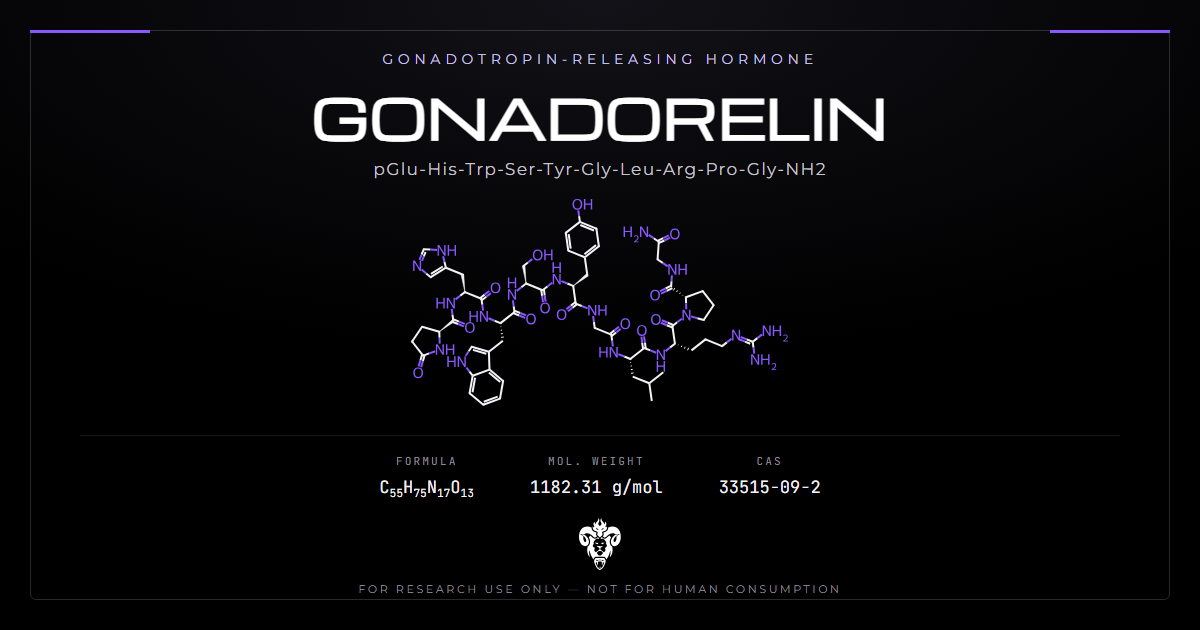
Chemical identity
The native hypothalamic releasing hormone, made synthetically. Ten residues, blocked at both ends.
| Property | Value |
|---|---|
| Sequence | pGlu-His-Trp-Ser-Tyr-Gly-Leu-Arg-Pro-Gly-NH2 |
| Common names | Gonadorelin, GnRH, LHRH, luliberin |
| Molecular formula | C55H75N17O13 |
| Molecular weight | 1,182.3 g/mol |
| Monoisotopic mass | 1,181.5730 Da |
| PubChem CID | 638793 |
| InChIKey | XLXSAKCOAKORKW-AQJXLSMYSA-N |
| Residues | 10 |
| N-terminus | Pyroglutamate |
| C-terminus | Glycinamide |
| Receptor | GnRHR, a class A GPCR on pituitary gonadotropes |
| Plasma half-life | Minutes |
Reading the sequence
Both ends carry a cap. The enzymes attack the middle instead.
Cyclisation turns the N-terminal glutamine into pyroglutamate, and an amide caps the C-terminal glycine. Those two modifications block the exopeptidases that would otherwise trim the chain from either end.
What they do not block is cleavage in the middle. The Gly6-Leu7 bond is the principal target. Every long-acting analogue in clinical use replaces that glycine with a bulky D-amino acid for exactly that reason.
Why the half-life is minutes
A short half-life looks like a design flaw until you consider what the molecule is for.
Gonadorelin delivers a pulse and then disappears. Frequency of arrival carries the information, not the concentration reached, and a hormone that lingered could not encode a pulse at all.
The consequence is practical. Restoring physiological signalling with the native peptide takes a pump rather than an injection. That is why the clinical literature below is a pump literature.
The experiment that defined the field
One paper from 1978 anchors everything written since, and its design is unusually clean.
Belchetz 1978
Belchetz and colleagues worked in rhesus monkeys with hypothalamic lesions that abolished pituitary gonadotropin release (PMID 100883).
Constant infusion of the synthetic decapeptide failed to restore sustained gonadotropin secretion. Intermittent administration once per hour, matching the physiological frequency in that species, re-established it [1].
Then they ran the reverse. They took animals already restored by intermittent delivery and switched them to continuous infusion. The response desensitised and down-regulated [1].
Their conclusion attributes the phenomenon to the pattern of delivery rather than to the amounts reaching the pituitary [1].
What the pulse generator looks like
Knobil’s group then recorded the upstream signal directly, which is rarer than it sounds.
Rhythmic bursts of multiunit electrical activity in the mediobasal hypothalamus correspond one-to-one with luteinizing hormone pulses in the circulation [2]. Those volleys are the pulse generator firing.
A detail from that work constrains how the pulse operates. The group varied volley duration from 23 minutes down to 4 without changing frequency, and pulse magnitude did not track duration. That indicates the entire pulse leaves at volley onset [2].
Same molecule, opposite outcome
Two clinical drug classes exist because a GnRH receptor responds to frequency, and both are downstream of the 1978 result.
Pulses restore
Delivered in pulses, Gonadorelin drives the axis it belongs to rather than shutting it down.
The pump literature is consistent about the pattern used: roughly 10 µg subcutaneously every 90 minutes in the published series [4][6]. That interval approximates the follicular-phase frequency in an unaffected person rather than being an arbitrary schedule.
Response is measurable within a week. Five women with idiopathic hypogonadotropic hypogonadism took it for seven days. Luteinizing hormone rose from 2.2 to 5.4 U/L and estradiol from 58 to 260 pmol/L [4].
Continuous suppresses
Delivered without interruption, the same receptor stops answering Gonadorelin at all.
That is the mechanism behind the GnRH agonist class used to suppress the axis deliberately. Long-acting analogues occupy the receptor continuously, produce an initial flare as the pituitary empties, and then shut the axis down.
Antagonists reach the same endpoint by a different route and avoid the flare. A network meta-analysis set relugolix against degarelix in advanced prostate cancer. It compared them on castration rate, meaning testosterone at or below 50 ng/dL [8].
Note what that means for reading the literature. A paper reporting profound suppression and a paper reporting restored fertility can both be about the same decapeptide acting at the same receptor.
What sets the pulse
The generator is not autonomous. Two inputs dominate, and researchers identified one of them only in the last twenty years.
Kisspeptin upstream
Kisspeptin neurons signal through KISS1R to drive GnRH release, and loss-of-function mutations in that receptor cause hypogonadotropic hypogonadism.
One case tests the hierarchy directly. One woman carried a homozygous inactivating KISS1R mutation, confirmed non-functional in transfected cells (PMID 30124894). On pulsatile GnRH therapy she produced an LH surge, ovulated and conceived.
That places kisspeptin strictly upstream [5]. Supplying Gonadorelin directly bypasses a receptor defect that would otherwise stop the axis running.
The kisspeptin layer is not confined to the hypothalamus. Kisspeptin receptors also appear in ovarian follicles across species, and intraovarian kisspeptin acts directly on receptors expressed in oocytes to promote maturation and ovulation [14]. Gonadal steroids regulate kisspeptin secretion centrally, while gonadotropins raise ovarian kisspeptin expression in granulosa cells [14].
That matters for interpreting an axis experiment. A pulse of Gonadorelin acts at one defined point, the pituitary gonadotrope, while kisspeptin acts at several, so the two are not interchangeable probes even though they sit on the same axis.
Steroid feedback
Gonadal steroids act back on the generator itself rather than only on the pituitary.
Ordög and Knobil recorded 23 single units associated with the pulse generator in ovariectomised rhesus monkeys and gave estradiol [3]. Bursting stopped in all 23 within four hours while baseline firing continued.
Read the distinction carefully. Estradiol did not desynchronise the neurons, it inhibited the bursting phenomenon [3]. One unit remained inhibited for the 43 days of the study.
Growth hormone and IGF-1 also feed in, stimulating GnRH and kisspeptin neurons, with sex steroids potentiating GH secretion in return [12].
Where GnRH neurons come from
The developmental biology explains a clinical association that otherwise looks arbitrary.
GnRH neurons do not originate in the brain. They arise in the olfactory placode and migrate into the forebrain during development, alongside the olfactory axons [10].
When that migration fails, both systems fail together. Kallmann syndrome pairs hypogonadotropic hypogonadism with anosmia or hyposmia, and the two travel together because the neurons shared a route [9][10].
Several genes carry the blame, and case reports keep adding to the list. KAL-1 follows X-linked recessive inheritance [9]. One report describes a heterozygous intron mutation in SEMA7A in a female patient [6], and AXL with its ligand Gas6 also regulates that migration [10].
Why the origin matters for the pump
A migration failure produces a specific kind of deficiency, and that shapes what replacement can achieve.
The neurons never arrive, so the hypothalamic signal is absent while the pituitary below it stays intact and capable. Gonadorelin delivered on a pump substitutes for the missing signal at exactly the level where the signal went missing.
That is why the pump series recruit congenital hypogonadotropic hypogonadism and Kallmann syndrome specifically [6][7][9][11]. The design assumes a responsive gonadotrope, and a pituitary that cannot answer would make the same protocol useless.
The diagnostic application
Replacement is not the only clinical use. A second one exploits the short half-life rather than working around it.
The stimulation test
Give a single dose of Gonadorelin, then watch what the pituitary does with it.
A gonadotrope capable of responding releases luteinizing hormone and follicle stimulating hormone within the hour. One that cannot stays quiet, and the shape of the response separates a hypothalamic problem from a pituitary one.
That test remains the diagnostic standard for establishing whether the hypothalamic-pituitary-gonadal axis has activated [13]. Its invasiveness is the main argument against it. One cohort of 593 children underwent pituitary imaging alongside stimulation testing. Peak LH and the LH to FSH ratio served as the reference measures [13].
It appears in the workup of the opposite problem too. The Kallmann case described above ran the decapeptide stimulation test and found FSH and LH secretion delayed rather than absent [9].
Why the short half-life helps here
A diagnostic challenge agent wants precisely the properties that make replacement awkward.
The peptide arrives, provokes a measurable response and clears. The readout is therefore one defined stimulus rather than a steady state. A long-acting analogue would suppress the very axis it set out to interrogate.
One property, read two ways. Minutes of exposure force pump hardware on anyone attempting replacement, and make a clean challenge test possible for anyone attempting diagnosis.
The pump literature
Restoring the native pattern requires hardware, and the published series are small but consistent.
| Study | Population | Regimen | Outcome |
|---|---|---|---|
| Liu 2015 [4] | 5 women, idiopathic HH | 10 µg per 90 min, 12 wk | LH 2.2 to 5.4 U/L, two natural pregnancies |
| Hugon-Rodin 2018 [5] | 1 woman, KISS1R mutation | Pulsatile, several cycles | LH surge, ovulation, pregnancy |
| Zhao 2020 [6] | 1 woman, SEMA7A Kallmann | 10 µg per 90 min | Menarche at about 43 days |
| Hao 2021 [7] | 28 men, congenital HH | Pump, 7 days | LH 2.66 IU/L, FSH 5.05 IU/L |
| Jiang 2025 [11] | 54 men, congenital HH | Pump, 3 to 40 months | Testosterone 234 to 381 ng/dL at 2 years |
What the series show
The largest and longest is a retrospective study of 54 adult men with congenital hypogonadotropic hypogonadism [11].
Mean testicular volume rose from 6.22 mL to 8.90 mL at one year and 9.73 mL at two. Serum testosterone rose from 234 ng/dL to 361 and then 381 ng/dL across the same interval [11].
A seven-day multicentre trial in 28 men checked that the delivery hardware performs as specified. Luteinizing hormone and follicle stimulating hormone both rose over the week [7].
Frequency as the adjustable variable
One finding from the female series says something the group averages hide.
A constant pulse frequency suited most patients in that cohort, and one woman produced no menstrual bleeding on it at all [4]. The authors set their interval by matching endogenous secretion during the follicular phase of unaffected women, then noted that adjusting frequency to imitate the physiological rhythm is the option left for non-responders [4].
Read that against the founding experiment. Belchetz varied pattern and held amount constant to show the receptor reads frequency [1], and the clinic arrives at the same lever from the other end, tuning interval rather than dose when a patient fails to respond.
Their limits
Read the denominators before the effect sizes.
These are 1, 5, 28 and 54 participants. Two are single case reports, one is a seven-day device study, and the largest is retrospective with a mean follow-up under 16 months [4][5][7][11].
None is placebo-controlled, which is defensible in a deficiency state where the deficiency itself is measurable, and still limits what the numbers establish.
Geography narrows them further. Four of the five series come from Chinese centres, three of them from overlapping hospital networks [4][7][11]. That concentration does not make the results wrong, and it does mean the pump protocol has been validated by a small number of groups working to similar conventions rather than by independent replication across systems.
What Gonadorelin is not
Three confusions recur, and each involves a different molecule.
It is not a long-acting analogue. Leuprolide, triptorelin and goserelin substitute the position 6 glycine to resist cleavage. Clinicians use them to suppress the axis, which is the opposite application [8].
It is not an antagonist. Degarelix and relugolix block the receptor without the initial flare, reaching suppression from the other direction [8].
It is not a gonadotropin. Gonadorelin acts on the pituitary and asks it to release LH and FSH, so the response depends on a gonadotrope capable of answering. A gonadotropin acts on the gonad directly and carries no such requirement.
How to read a Gonadorelin study
Four questions decide what a result means, and the first one decides the direction of the effect.
Pulsatile or continuous?
The same peptide at the same receptor stimulates in pulses and suppresses continuously [1]. Answer this one first, because no other question about the study means anything until you have.
What frequency?
The published pump series cluster at 90-minute intervals [4][6], and the original monkey work used hourly [1]. Frequency is the variable that carries the signal, so it belongs in the methods rather than the discussion.
Native peptide or analogue?
Papers about leuprolide, triptorelin, degarelix and relugolix are about different molecules with different half-lives and, in the antagonist case, the opposite pharmacology [8].
Is the pituitary intact?
Gonadorelin only works if gonadotropes can respond. The 1978 experiment used animals with hypothalamic lesions and an intact pituitary on purpose [1], and results from that design say nothing about pituitary failure.
Verifying research material
A ten-residue peptide with two blocked termini and no cysteine is straightforward to characterise, and the modifications are the things to confirm.
Identity
Intact mass runs 1,182.3 average and 1,181.573 monoisotopic. Ten residues make full sequence confirmation by tandem mass spectrometry routine rather than ambitious.
Both terminal modifications carry mass consequences worth checking. An unmodified N-terminal glutamine instead of pyroglutamate adds 17 Da. A free C-terminal acid instead of the amide adds 1 Da, small but resolvable on a modern instrument.
The absence of cysteine simplifies everything. There is no disulfide to scramble and no free thiol to oxidise, which removes the failure modes that dominate larger peptides.
Purity and related substances
Deletion sequences are the expected impurity from solid-phase synthesis at this length.
Tryptophan is the residue to ask about specifically. It oxidises readily, adding 16 Da, and cleavage from resin damages it more often than any other residue here.
Peptide content is a separate question from chromatographic purity. Lyophilised material carries counterions and water, so acetate or trifluoroacetate content belongs on the certificate alongside the HPLC number.
Handling
Store Gonadorelin lyophilised, cold, dry and dark, and reconstitute close to the point of use.
Peptidases in any biological matrix act on this molecule quickly. A minutes-long circulating half-life reflects real enzymatic vulnerability at Gly6-Leu7, so treat serum-containing media as actively degrading rather than neutral.
Adsorption to plastic is the routine loss at working concentrations. Aliquot on reconstitution, since a decapeptide at low concentration loses a meaningful fraction to surfaces on each transfer.
Kimera publishes third-party certificates of analysis for every lot in its COA database. Laboratories source Gonadorelin as the native GnRH decapeptide reference. It appears alongside kisspeptin-10, the upstream signal in the same axis, and with enclomiphene, which acts on the same axis through oestrogen feedback. It also pairs with CJC-1295 where the growth hormone axis crosstalk is the subject [12]. Related work appears in the peptides category.
Common questions about Gonadorelin
Why does pulsatile delivery stimulate and continuous delivery suppress? The receptor responds to frequency. Belchetz showed the effect belongs to the pattern of delivery, not the amount [1].
What frequency does the literature use? Roughly 10 µg every 90 minutes in the published pump series [4][6], and hourly in the original rhesus experiments [1].
How does it differ from leuprolide or triptorelin? Those substitute the position 6 glycine to resist cleavage, giving continuous occupancy and axis suppression [8].
Is kisspeptin required for it to work? No. A woman with a completely inactivating KISS1R mutation ovulated and conceived on pulsatile GnRH [5].
Why is the half-life so short? Cleavage at Gly6-Leu7, and a signalling peptide encoding frequency has to clear between pulses to encode anything.
What is the largest published pump series? 54 men with congenital hypogonadotropic hypogonadism, retrospective, mean follow-up 15.9 months [11].
Summary of the evidence
Identity: pGlu-His-Trp-Ser-Tyr-Gly-Leu-Arg-Pro-Gly-NH2, C55H75N17O13, 1,182.3 g/mol. Both termini blocked, no cysteine, half-life in minutes.
The founding result: continuous infusion failed to restore gonadotropin secretion in lesioned rhesus monkeys while hourly pulses restored it. Switching restored animals back to continuous infusion desensitised them [1].
The pulse generator: hypothalamic multiunit volleys map one-to-one onto LH pulses, and the whole pulse leaves at volley onset [2].
Upstream control: kisspeptin drives the generator through KISS1R, and supplying the decapeptide directly bypasses a completely inactivating KISS1R mutation [5]. Estradiol arrests bursting in all recorded units within four hours [3].
Development: GnRH neurons migrate from the olfactory placode into the forebrain, which is why Kallmann syndrome pairs hypogonadism with anosmia [6][9][10].
Clinical use of pulses: series of 1 to 54 participants at roughly 10 µg per 90 minutes. Testosterone rose from 234 to 381 ng/dL over two years in the largest [4][6][7][11].
Clinical use of continuous exposure: the GnRH agonist and antagonist classes, compared on castration rate at testosterone of 50 ng/dL or below [8].
Limits: small, mostly uncontrolled series, no placebo comparison, and a literature that uses the same receptor for opposite purposes.
Status: supplied for laboratory research use only.
References
- Belchetz PE, Plant TM, Nakai Y, Keogh EJ, Knobil E. Hypophysial responses to continuous and intermittent delivery of hypothalamic gonadotropin-releasing hormone. Science. 1978;202(4368):631-633. PMID 100883. DOI
- Williams CL, Thalabard JC, O’Byrne KT, Grosser PM, Nishihara M, Hotchkiss J, Knobil E. Duration of phasic electrical activity of the hypothalamic gonadotropin-releasing hormone pulse generator and dynamics of luteinizing hormone pulses in the rhesus monkey. Proc Natl Acad Sci U S A. 1990;87(21):8580-8582. PMID 2236069. DOI
- Ordög T, Knobil E. Estradiol and the inhibition of hypothalamic gonadotropin-releasing hormone pulse generator activity in the rhesus monkey. Proc Natl Acad Sci U S A. 1995;92(13):5813-5816. PMID 7597033. DOI
- Liu Z, Mao J, Wu X, Nie M, Huang B, Xu H, Wang X, Zheng J. Effectiveness and safety of pulsatile GnRH pump therapy on female patients with IHH. Zhonghua Yi Xue Za Zhi. 2015;95(42):3432-3435. PMID 26813133.
- Hugon-Rodin J, Yoshii K, Lahlou N, Flandrin J, Gompel A, de Roux N. Complete kisspeptin receptor inactivation does not impede exogenous GnRH-induced LH surge in humans. J Clin Endocrinol Metab. 2018;103(12):4482-4490. PMID 30124894. DOI
- Zhao Y, Yang F, Qiu L, Wang L, Che H. A novel heterozygous intron mutation in SEMA7A causing Kallmann syndrome in a female. Gynecol Endocrinol. 2020;36(3):218-221. PMID 31650878. DOI
- Hao M, Mao JF, Guan QB, Tian L, Han H, Lei HE, et al. Efficacy and safety of pulsatile gonadotropin-releasing hormone therapy in patients with congenital hypogonadotropic hypogonadism: a multicentre clinical study. Ann Transl Med. 2021;9(12):962. PMID 34277762. DOI
- Sari Motlagh R, Abufaraj M, Mori K, Aydh A, Rajwa P, Katayama S, et al. The efficacy and safety of relugolix compared with degarelix in advanced prostate cancer patients: a network meta-analysis of randomized trials. Eur Urol Oncol. 2022;5(2):138-145. PMID 34301529. DOI
- Zhang P, Fu JY. X-linked recessive Kallmann syndrome: a case report. World J Clin Cases. 2022;10(25):8990-8997. PMID 36157645. DOI
- Mohammadzadeh P, Amberg GC. AXL/Gas6 signaling mechanisms in the hypothalamic-pituitary-gonadal axis. Front Endocrinol (Lausanne). 2023;14:1212104. PMID 37396176. DOI
- Jiang H, Li BJ, Jin DC, Zhong QL, Zhu T, Li YF. Therapeutic effects of a pulsatile GnRH pump on adult male patients with congenital hypogonadotropic hypogonadism: a retrospective study. Transl Androl Urol. 2025;14(7):2043-2058. PMID 40800099. DOI
- Lages AS, Lopes V, Anderson R. GH and GnRH-gonadotropin secretion. Vitam Horm. 2026;131:25-40. PMID 41912296. DOI
- Gao S, Zhao Y, Liu WV, Liu D, Cai J, Cai L, et al. Magnetic resonance imaging-based adenohypophyseal volume for diagnosing hypothalamic-pituitary-gonadal axis activation in pre- and at-puberty children. Quant Imaging Med Surg. 2026;16(2):151. PMID 41669417. DOI
- Masumi S, Lee EB, Dilower I, Upadhyaya S, Chakravarthi VP, Fields PE, Rumi MAK. The role of kisspeptin signaling in oocyte maturation. Front Endocrinol (Lausanne). 2022;13:917464. PMID 36072937. DOI
Gonadorelin is sold for laboratory research use only. Not for human consumption, nor medical, veterinary, or household uses.
Literature retrieved from PubMed.