
Most drug programmes fail because the endpoint does not move. This one has the opposite problem. Across four randomised trials, Larazotide separated from placebo on patient-reported symptoms while the permeability biomarker built into its own mechanism did not [1].
The pattern repeats. In the 2013 gluten-challenge study, lactulose-to-mannitol ratios showed no difference against placebo, and the symptom scale reached P = 0.002 [2]. A 2015 trial in 342 adults met its primary symptom endpoint [3]. The biomarker stayed flat throughout.
That disconnect, plus a dose-response that runs backwards, is what makes this octapeptide worth reading carefully rather than summarising.
Chemical identity
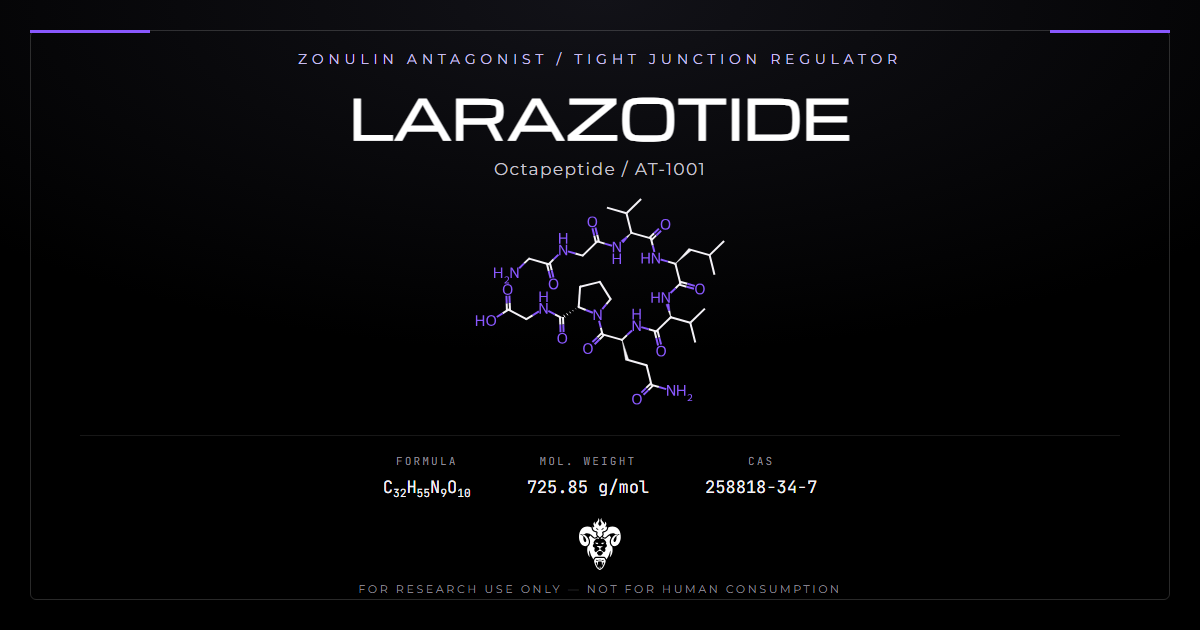
Eight residues, no cyclisation, no unnatural amino acids. The simplicity is the point.
| Property | Value |
|---|---|
| Sequence | Gly-Gly-Val-Leu-Val-Gln-Pro-Gly |
| Common names | Larazotide, AT-1001, INN-202, FZI/0 |
| Molecular formula | C32H55N9O10 |
| Molecular weight | 725.8 |
| CAS | 258818-34-7 |
| PubChem CID | 9810532 |
| InChIKey | ORFLZNAGUTZRLQ-ZMBVWFSWSA-N |
Kimera supplies the material as Larazotide, 500 mcg per dry-fill capsule.
Reading the sequence
All eight residues are standard L-amino acids in their natural configuration. There is no D-substitution, no ring, no cap. Compare that to the melanocortin and GHRH analogues, where stability engineering dominates the structure.
The octapeptide has no such armour because it does not need it. Its site of action sits in the gut lumen, on the same side of the epithelium as an oral dose.
The cholera connection
The sequence derives from a protein secreted by Vibrio cholerae [4]. That protein opens tight junctions. The peptide fragment does the reverse, which is the unusual part: a sequence lifted from a permeability-opening toxin behaves as an antagonist at the same pathway.
Larazotide acts on the space between cells
Nearly every research peptide in a catalogue binds a cell-surface receptor. This one targets the paracellular space, the gap between adjacent epithelial cells that tight junctions seal.
Zonulin and the tight junction
Zonulin regulates the competency of intercellular tight junctions, and raised zonulin signalling increases epithelial and endothelial permeability across a range of inflammatory conditions [5]. Reviews of the pathway treat it as a control point rather than a bystander [6].
Antagonising that pathway associates with redistribution of tight junction proteins and actin filaments, restoring barrier function rather than blocking a signal outright [7].
A second mechanism appeared later
The same 2021 review links the peptide to inhibition of myosin light chain kinase [7]. Reduced tension on actin filaments would let tight junctions close, which is a different route to the same endpoint.
Two candidate mechanisms for one compound is not a contradiction. It does mean a paper attributing an effect purely to zonulin antagonism has chosen between them rather than demonstrated one.
Why systemic exposure is not the goal
An orally dosed peptide reaching the bloodstream intact would be the exception. Here that limitation is the design. The target sits luminally, so minimal absorption keeps the compound where the tight junctions are.
That property shapes every experiment. A cell-culture study applying the peptide basolaterally is not modelling the intended geometry.
The trials, in order
Four randomised controlled trials underpin the compound, comprising 626 patients against 161 on placebo in the pooled analysis [1].
| Year | Design | n | Primary endpoint | Result |
|---|---|---|---|---|
| 2007 | Single-dose safety, gluten challenge | 21 | Safety, permeability exploratory | No permeability rise on drug, 70% rise on placebo [4] |
| 2012 | Dose-ranging, gluten challenge | 86 | Lactulose/mannitol ratio | Biomarker not met [8] |
| 2013 | Gluten challenge, 6 weeks | 184 | Permeability and symptoms | No biomarker difference, symptoms met at 1 mg [2] |
| 2015 | Persistent symptoms on gluten-free diet | 342 | Symptom rating scale | Met at 0.5 mg [3] |
| 2022 | Meta-analysis of the four | 626 | Pooled | Biomarker null, symptom signal present [1] |
2007: the proof of concept
An inpatient double-blind study gave 12 mg doses against placebo under gluten challenge [4]. The placebo group showed a 70% rise in intestinal permeability. The treated group showed none.
Interferon-gamma rose in four of seven placebo patients and four of fourteen treated patients. This is the one study where the permeability measure behaved as the mechanism predicts, and it is the smallest.
2012 and 2013: the biomarker stops cooperating
The 2012 dose-ranging trial randomised 86 patients across four dose levels with gluten challenge, taking the lactulose/mannitol ratio as its primary efficacy outcome [8]. The 2013 study ran 184 patients for six weeks [2].
Neither produced a permeability separation. The 2013 trial did produce a symptom result, at the 1 mg dose, with anti-transglutaminase antibody movement alongside.
2015: the largest trial
A multicentre trial enrolled 342 adults already on a gluten-free diet for a year or longer, with a placebo run-in, twelve weeks of treatment and a placebo run-out [3]. The primary endpoint was symptom score.
It was met at 0.5 mg, the lowest dose studied. Exploratory endpoints moved in the same direction, including a 26% reduction in symptomatic days.
The dose-response runs backwards
Read the four trials together and the pattern is hard to miss. The 2013 study worked at 1 mg with 4 mg and 8 mg arms alongside. The 2015 study worked at 0.5 mg with 1 mg and 2 mg arms alongside.
In both, the lowest dose tested produced the result and the higher doses did not.
What that usually means
An inverted dose-response has three common explanations, and the literature does not settle between them. A genuine bell-shaped curve is one, plausible for a peptide that self-associates at higher concentration. Chance is another, since these are multi-arm trials where one arm reaching significance is less surprising than it looks. Differential dropout is the third.
Reviews of the programme note the finding without resolving it [9][10]. Anyone designing an experiment around a published dose should know they are building on the lowest arm of a study whose higher arms did not replicate it.
The biomarker problem is worth stating precisely
Lactulose and mannitol are sugars of different sizes. The ratio of their urinary excretion after an oral load estimates paracellular permeability. A larger lactulose fraction implies a leakier junction.
Why a null result here is awkward
The compound’s entire proposed mechanism is tight junction regulation. If the symptom benefit is real and the permeability measure is flat, then either the measure lacks sensitivity in this setting, or the benefit arrives by some other route.
The 2026 review of coeliac barrier therapeutics takes the first position, calling explicitly for reliable biomarkers of intestinal permeability and treating the current ones as inadequate [11]. That is a fair reading. It is also an unfalsified assumption.
What this means for a bench experiment
Do not adopt lactulose/mannitol as a positive control for this peptide. Four trials say it will not separate. Transepithelial electrical resistance and direct imaging of junction protein distribution have better track records in the mechanistic literature [7].
The one place the ratio did work
Worth noting the exception, because it shapes how much weight the null results carry. The 2007 study detected a 70% permeability rise in its placebo arm [4]. The measure was not insensitive there.
What differed was the setting. That trial used a single acute gluten challenge in an inpatient unit, with tight control over timing and diet. The later trials ran for weeks in outpatients. Ratio measurements degrade badly under those conditions, since renal function, transit time and background diet all move the number.
So the biomarker may be sound and the protocol unworkable at trial scale. That reading fits the data better than declaring the mechanism wrong, and it is the position the 2026 barrier review takes when it calls for better permeability markers [11].
Designing around the gap
Larazotide is a good compound for method development on exactly this problem. The mechanism is specific, the human dose range is published, and the failure mode of the standard assay is documented across four trials. A bench study comparing permeability readouts has a rare thing here: a compound with a known direction of effect and a known-unreliable reference method.
Larazotide outside coeliac disease
The zonulin pathway appears in many inflammatory conditions, so the peptide has been applied well beyond its original indication [5]. All of this work is preclinical.
Rodent models
Zonulin transgenic mice show greater permeability at baseline, and DSS colitis produced 40 to 70% mortality against zero in wild type [12]. Adding AT-1001 to drinking water was the intervention that linked barrier function to the outcome.
A rat acute liver failure model gave the peptide by drinking water and by gavage before thioacetamide, then examined intestinal tissue by light and electron microscopy alongside serum ammonia, AST and ALT [13].
Large animal work
The mechanism review records collagen-induced arthritis in mice and intestinal ischaemic injury in pigs [7]. Porcine intestine is the closer model to human gut, so that second result carries more weight than its citation count suggests.
None of this transfers to the coeliac trial population. Read-across from a rodent barrier model to a 342-patient symptom endpoint does not hold, and the reviews that cover both keep them separate [14][15].
The breadth is a warning as much as a promise
Larazotide has been proposed for type 1 diabetes, inflammatory bowel disease, Kawasaki disease and respiratory conditions [5]. A single mechanism claimed across that many unrelated diseases deserves scepticism by default.
The honest reading is that zonulin-mediated permeability appears in many inflammatory states, so a junction regulator is testable in all of them. Testable is not the same as tested. Only coeliac disease has randomised human data.
Where the compound stands
The peptide entered phase 3 study for coeliac disease [7]. No approval has followed, and the gluten-free diet remains the standard of care in every review covering the field [16][17].
The 2026 barrier review lists it among experimental agents rather than established ones [11]. That is the current status, stated plainly.
The barrier hypothesis the peptide was built on
Larazotide is a test of an idea as much as a compound. The idea holds that a leaky epithelium lets gluten peptides reach the lamina propria, where the immune response begins [8]. Close the junctions and you interrupt the sequence upstream of the immune event.
The case for it
Increased intestinal permeability sits at the centre of coeliac pathophysiology in every current review of the field [11][14]. Zonulin transgenic animals are leakier at baseline and fare worse under challenge [12]. The mechanism is coherent and the animal work supports it.
Larazotide is the cleanest available probe of that hypothesis, because it acts on the junction and on very little else.
The case against it
Permeability may be a consequence rather than a cause. Inflammation opens junctions on its own, so a leaky barrier in an inflamed gut does not establish direction. Reviews covering the pathogenesis are careful about this and do not claim it settled [15].
The trial record is what makes the question live. Larazotide closed the biomarker in one small study and never again, while symptoms moved anyway. Both halves of that result cut against a simple causal chain.
Why the reagent outlives the programme
A compound that fails to reach approval can still be the best tool for the question it was built to ask. Larazotide has a defined target, oral luminal activity, a published safety record across 626 trial patients, and no confounding receptor pharmacology [1][7]. Those are reagent properties, and they do not depend on regulatory outcome.
How to read a Larazotide study
Four questions separate a usable paper from a misleading one.
Which endpoint?
Symptom scales and permeability ratios disagree in this literature. A summary reporting “efficacy” without naming the endpoint has hidden the interesting part.
Which dose?
The active arms were 0.5 mg and 1 mg. A paper citing 8 mg is citing an arm that did not produce the result.
Gluten challenge or free diet?
The 2012 and 2013 trials challenged patients with gluten. Larazotide faced a different question in 2015, where participants stayed on a gluten-free diet throughout. Pooled analysis stratified on exactly this split and found the two subgroups behave differently [1].
Provoked and unprovoked barrier states are not the same experiment. A protocol borrowed from one and applied to the other will not reproduce the published result.
Luminal or basolateral?
An in vitro study applying the peptide to the wrong face of a monolayer has inverted the geometry the compound depends on.
Verifying research material
The octapeptide is a defined chemical entity with published identifiers, so verification is arithmetic rather than judgement. Batch documentation sits on the certificates of analysis page.
Identity
Formula C32H55N9O10 and InChIKey ORFLZNAGUTZRLQ-ZMBVWFSWSA-N. Mass spectrometry should return a molecular weight near 725.8.
At eight residues with no unusual chemistry, sequencing by tandem mass spectrometry is straightforward, and the Val-Leu-Val run is the region worth reading carefully because those residues are close in mass.
Leucine and isoleucine are the classic trap in that region. They are isomers, identical at 113.08 daltons, and standard fragmentation does not separate them. A synthesis error substituting Ile for Leu at position four produces a peptide that passes every mass check and is not Larazotide. Amino acid analysis after hydrolysis, or a chromatographic comparison against a reference lot, is what answers it.
The two glycine pairs at each end are the other feature worth noting. Glycine residues give the backbone flexibility, and the terminal Gly-Gly and Pro-Gly motifs are both common protease targets, which is one reason the assay window after reconstitution is short.
Purity and stereochemistry
All eight residues are L-configured, which removes the D-amino acid check that dominates verification of the melanocortin and GHRP peptides. It does not remove the need for chiral analysis: racemisation during synthesis produces epimers with identical mass.
Glutamine deamidation is the degradation route to watch. It converts Gln to Glu and adds one dalton, which a low-resolution instrument will miss on a 725.8 parent.
Handling
The sequence has no tryptophan, tyrosine or cysteine, so it lacks the photodegradation and disulfide-scrambling routes that complicate storage of peptides like LL-37 and Thymosin Alpha-1. Lyophilised material stored cold and dry is stable by peptide standards.
Aqueous solutions are the weak point. Proline-glycine sequences at a C-terminus are prone to hydrolysis over time, so freshly reconstituted material and month-old material are not equivalent inputs.
Common questions about Larazotide
What does it target? The paracellular space between epithelial cells, not a cell-surface receptor. It regulates tight junction permeability [7].
Is it the same as AT-1001? Yes. AT-1001, INN-202 and FZI/0 all name the same octapeptide.
Why is it derived from a cholera protein? The parent protein opens tight junctions. This fragment antagonises the same pathway [4].
Did the trials work? Two of four met a symptom endpoint. None met a permeability endpoint after the first small study [1].
Is it approved? No. The gluten-free diet remains the standard of care, and 2026 reviews still list the peptide as experimental [11][16].
Which dose appears in the positive trials? 0.5 mg in the 2015 study and 1 mg in 2013, both the lowest arm tested [2][3].
Why does Larazotide need no stability engineering? Its target is luminal, so an oral dose reaches it without crossing the epithelium. Systemic exposure is not the objective.
What degradation route matters most? Glutamine deamidation, which adds one dalton and converts Gln to Glu. Low-resolution mass spectrometry will miss it on a 725.8 parent.
Is there a good positive control for permeability work? Not lactulose/mannitol, on this compound. Four trials failed to separate on it [1]. Transepithelial electrical resistance has the better record [7].
Summary of the evidence
Strongest evidence: four randomised placebo-controlled trials pooled at 626 patients [1], the largest enrolling 342 adults and meeting its primary symptom endpoint [3], plus a mechanistic account with two candidate routes and animal work across three species [7].
Weakest evidence: the permeability biomarker, which separated from placebo only in the 21-patient first study [4] and in none of the larger ones. The dose-response, which runs backwards without explanation. Every non-coeliac application, all of which stop at animal models [12][13].
Read plainly, Larazotide is a well-characterised peptide with a plausible mechanism, a real but modest symptom signal, and a mechanistic biomarker that has never confirmed the story. That combination is unusual, and it is the reason the compound is more interesting in a laboratory than its regulatory status suggests.
The rest of the peptide literature sits in the peptides category.
Status: supplied for laboratory research use only.
References
- Hoilat GJ, Altowairqi AK, Ayas MF, Alhaddab NT, Alnujaidi RA, Alharbi HA, Alyahyawi N, Kamal A, et al. Larazotide acetate for treatment of celiac disease: a systematic review and meta-analysis of randomized controlled trials. Clin Res Hepatol Gastroenterol. 2022;46(1):101782. PMID 34339872. DOI
- Kelly CP, Green PH, Murray JA, DiMarino A, Colatrella A, Leffler DA, Alexander T, Arsenescu R, et al. Larazotide acetate in patients with coeliac disease undergoing a gluten challenge: a randomised placebo-controlled study. Aliment Pharmacol Ther. 2013;37(2):252-262. PMID 23163616. DOI
- Leffler DA, Kelly CP, Green PH, Fedorak RN, DiMarino A, Perrow W, Rasmussen H, Wang C, et al. Larazotide acetate for persistent symptoms of celiac disease despite a gluten-free diet: a randomized controlled trial. Gastroenterology. 2015;148(7):1311-1319.e6. PMID 25683116. DOI
- Paterson BM, Lammers KM, Arrieta MC, Fasano A, Meddings JB. The safety, tolerance, pharmacokinetic and pharmacodynamic effects of single doses of AT-1001 in coeliac disease subjects: a proof of concept study. Aliment Pharmacol Ther. 2007;26(5):757-766. PMID 17697209. DOI
- Troisi J, Venutolo G, Terracciano C, Carri MD, Di Micco S, Landolfi A, Fasano A. The therapeutic use of the zonulin inhibitor AT-1001 (larazotide) for a variety of acute and chronic inflammatory diseases. Curr Med Chem. 2021;28(28):5788-5807. PMID 33397225. DOI
- Mohammadi-Kordkhayli M, Mousavi MJ, Camara-Lemarroy CR, Noorbakhsh F, Saboor-Yaraghi AA. Elucidating the significance of zonulin in the pathogenesis of chronic inflammatory disorders: emphasis on intestinal barrier function and tight junction regulation. Curr Med Chem. 2025;32(30):6547-6562. PMID 39252622. DOI
- Slifer ZM, Krishnan BR, Madan J, Blikslager AT. Larazotide acetate: a pharmacological peptide approach to tight junction regulation. Am J Physiol Gastrointest Liver Physiol. 2021;320(6):G983-G989. PMID 33881350. DOI
- Leffler DA, Kelly CP, Abdallah HZ, Colatrella AM, Harris LA, Leon F, Arterburn LA, Paterson BM, et al. A randomized, double-blind study of larazotide acetate to prevent the activation of celiac disease during gluten challenge. Am J Gastroenterol. 2012;107(10):1554-1562. PMID 22825365. DOI
- Khaleghi S, Ju JM, Lamba A, Murray JA. The potential utility of tight junction regulation in celiac disease: focus on larazotide acetate. Therap Adv Gastroenterol. 2016;9(1):37-49. PMID 26770266. DOI
- Kulkarni A, Patel S, Khanna D, Parmar MS. Current pharmacological approaches and potential future therapies for celiac disease. Eur J Pharmacol. 2021;909:174434. PMID 34418405. DOI
- Damianos JA, Bledsoe A, Camilleri M, Murray JA. Coeliac disease and the intestinal barrier: mechanisms of disruption and strategies for restoration. Gut. 2026;75(4):826-838. PMID 40579122. DOI
- Sturgeon C, Lan J, Fasano A. Zonulin transgenic mice show altered gut permeability and increased morbidity/mortality in the DSS colitis model. Ann N Y Acad Sci. 2017;1397(1):130-142. PMID 28423466. DOI
- Caliskan AR, Gul M, Yilmaz I, Otlu B, Uremis N, Uremis MM, Kilicaslan I, Gul S, et al. Effects of larazotide acetate, a tight junction regulator, on the liver and intestinal damage in acute liver failure in rats. Hum Exp Toxicol. 2021;40(12_suppl):S693-S701. PMID 34791921. DOI
- Jauregi-Miguel A. The tight junction and the epithelial barrier in coeliac disease. Int Rev Cell Mol Biol. 2021;358:105-132. PMID 33707052. DOI
- Valitutti F, Fasano A. Breaking down barriers: how understanding celiac disease pathogenesis informed the development of novel treatments. Dig Dis Sci. 2019;64(7):1748-1758. PMID 31076989. DOI
- D’heedene M, Vanuytsel T, Wauters L. Celiac disease: hope for new treatments beyond a gluten-free diet. Clin Nutr. 2024;43(6):1240-1249. PMID 38648685. DOI
- Serena G, Kelly CP, Fasano A. Nondietary therapies for celiac disease. Gastroenterol Clin North Am. 2019;48(1):145-163. PMID 30711207. DOI
Larazotide is sold for laboratory research use only. Not for human consumption, nor medical, veterinary, or household uses.