
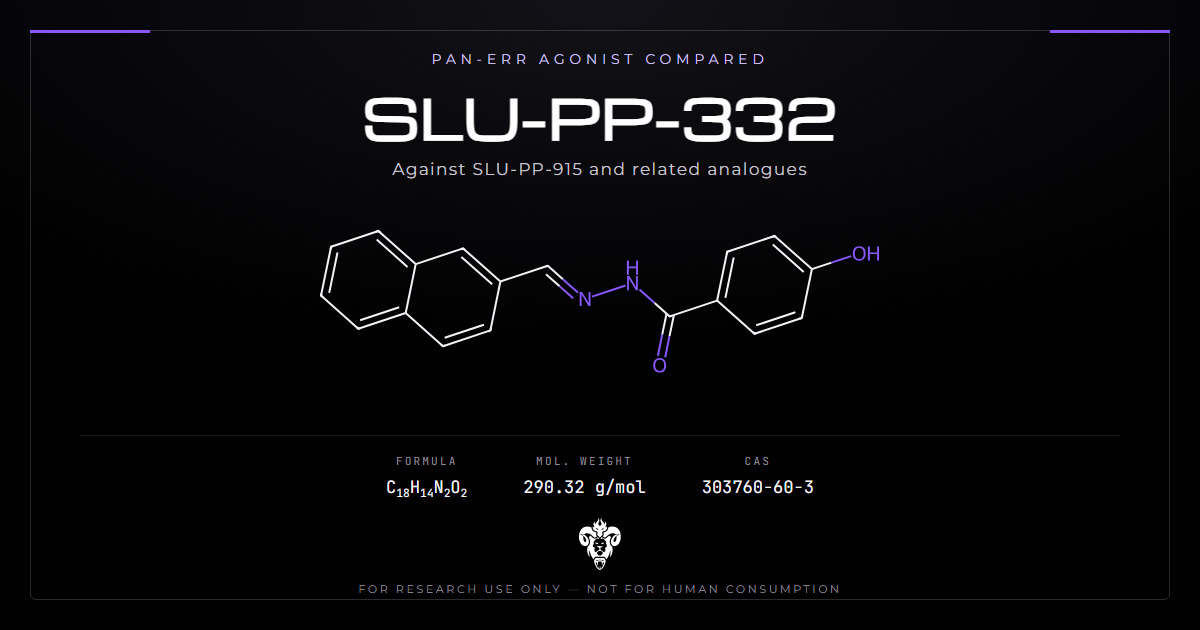
SLU-PP-332 is the reference compound for pharmacological activation of the estrogen-related receptors. It is also a compound its own developers replaced, for a reason they state plainly.
That makes SLU-PP-332 vs Other Analogs a narrower question than it sounds. The published comparative record is one systematic structure-activity study, one successor compound, and one analytical characterisation of the two side by side. Everything else is inference.
Three findings do most of the work. The successor is not an analogue at all but a different chemical series. The original lacks oral bioavailability, which is why the series exists. And no analogue in the systematic study is simply better.
What the compounds are
| Property | SLU-PP-332 | SLU-PP-915 |
|---|---|---|
| Scaffold | Naphthalene benzohydrazide | 2,5-disubstituted thiophene |
| Molecular formula | C18H14N2O2 | C17H13BFNO3S |
| Molecular weight | 290.32 g/mol | 341.16 g/mol |
| CAS | 303760-60-3 | 2285432-92-8 |
| Distinguishing group | Phenol | Boronic acid |
| Receptor profile | Pan-ERR, highest potency at ERRα | Pan-ERR |
| Oral bioavailability | No | Yes |
| In vitro metabolites | 9 (6 Phase-I, 3 Phase-II) | 7 (Phase-I only) |
The catalogue carries both, as SLU-PP-332 and SLU-PP-915.
Where SLU-PP-332 came from
Billon and colleagues reported the compound as a synthetic pan agonist covering all three ERR subtypes, with the highest potency at ERRα [5]. Designing ERRα agonists had been the hard part of the field, and the paper says so plainly.
In a skeletal muscle cell line the compound raised mitochondrial function and cellular respiration. In mice it increased type IIa oxidative fibres and enhanced endurance. The genetic control is the part worth keeping: the effect on endurance required ERRα, so the phenotype is on-target rather than incidental.
Why the target was worth pursuing
Perry and colleagues had already established the receptor’s role by deletion [4]. ERRα-null animals are hypoactive, show reduced exercise tolerance, and develop lactatemia at exhaustion.
Their gene profiling maps the programme onto substrate transport, the tricarboxylic acid cycle and oxidative metabolism. That independent work, from a different laboratory than the compound series, is what makes ERRα a defensible target rather than a fashionable one.
SLU-PP-332 vs Other Analogs on scaffold
Here the old framing of this comparison fails, and the correction matters.
The successor is a different series
Most write-ups describe SLU-PP-915 as an analogue. Hampton and colleagues report its discovery, and the account does not support that description [6]. The series was designed for ERRγ starting from the acyl hydrazide template and GSK-4716, using structure-based design, and produced 2,5-disubstituted thiophenes.
Optimisation then swapped the phenol or aniline for a boronic acid, which held activity and improved metabolic stability in microsomal assays. The resulting compound turned out to be roughly equipotent across ERRα and ERRβ as well, giving a pan-agonist profile by a different route.
So SLU-PP-332 vs Other Analogs, read strictly, compares a naphthalene benzohydrazide against a boron-containing thiophene. They share a receptor, not a scaffold.
What a true analogue series shows
Okda and colleagues published the first systematic structure-activity analysis of the SLU-PP-332 scaffold itself [11]. That study is the only genuine SLU-PP-332 vs Other Analogs dataset in the literature.
Its conclusion is careful rather than triumphant. SLU-PP-332 remains a strong benchmark for ERR activation. Several analogues achieve comparable or context-dependent transcriptional responses, with improved ligand efficiency, solubility or metabolic stability. Comparable is the operative word, and context-dependent is the caveat.
SLU-PP-332 vs Other Analogs on exposure
The single most consequential difference between the two lead compounds is not potency.
Billon and colleagues state it directly: SLU-PP-332 improves aerobic performance in mice but lacks oral bioavailability [9]. SLU-PP-915 was characterised because of that gap.
Their comparison is unusually disciplined. Compound 915 enhanced exercise distance and duration to a similar extent as 332 when both went by the intraperitoneal route. Given orally, 915 maintained comparable efficacy adjusted for systemic exposure. That qualifier is what separates a real pharmacokinetic claim from a marketing one.
Both compounds induced Ddit4, a gene switched on by acute aerobic exercise, at levels matching or exceeding treadmill running depending on the muscle. The newer compound also synergised with exercise training on Ddit4 and mitochondrial gene expression, which the older one was not reported to do.
What the metabolism data separate
Möller and colleagues characterised both compounds by liquid chromatography with high-resolution tandem mass spectrometry, then profiled their in vitro metabolism in human liver S9 fraction and microsomes [10].
The counts differ in a way that matters analytically. SLU-PP-332 produced nine metabolites: six Phase-I products and three Phase-II conjugates. SLU-PP-915 produced seven, all Phase-I, with no conjugates identified. Chemical synthesis and NMR confirmed three of the 915 metabolites.
That study serves anti-doping purposes, which tells you where this class is heading regulatorily. It also gives the practical detection answer for anyone working with either compound.
The direction problem
An assumption sits under most discussion of this class: activating ERR is the beneficial direction. The older pharmacology does not support that cleanly.
The inverse agonist did something useful too
XCT-790 is an ERRα inverse agonist, and it was the field’s main chemical tool before these agonists existed. Chen and Wong applied it to L6 myotubes and found it reduced PGC-1α expression and suppressed mitochondrial biogenesis, as expected [3]. It also raised reactive oxygen species, induced glucose transporters and increased glucose uptake.
Nie and Wong found the same pattern in 3T3-L1 adipocytes [2]. Suppressing ERRα cut mitochondrial biogenesis, adipogenesis and lipogenesis, and simultaneously enhanced glycolysis and basal glucose uptake.
So pushing the receptor down improved a metabolic readout, by a different mechanism, in two cell systems. Any SLU-PP-332 vs Other Analogs comparison that treats more ERR activity as self-evidently better is skipping that literature.
The receptor may not be empty
ERRs are called orphan receptors because no endogenous ligand was known. Shuai and colleagues report indole and skatole, both gut microbial products, binding the ERRγ ligand-binding domain with a dissociation constant near 1 to 2 µM [8].
The functional consequence is the interesting part. Both neutralised the agonist activity of GSK4716. Indole additionally cut the antagonist activity of 4-hydroxytamoxifen. An endogenous pool that modulates drug binding is a variable nobody controls for in these comparisons.
The wider set of chemical tools
Ariazi and Jordan catalogued what binds these receptors well before the current series [1]. Phytoestrogens including genistein and daidzein act as ERRα agonists. The acyl hydrazones GSK4716 and GSK9089 are selective for ERRβ and ERRγ.
| Compound | Effect | Subtype | Reference |
|---|---|---|---|
| SLU-PP-332 | Agonist | Pan, ERRα preferred | [5] |
| SLU-PP-915 | Agonist, orally active | Pan | [6][9] |
| GSK4716 | Agonist | ERRβ, ERRγ | [1] |
| GSK9089 | Agonist | ERRβ, ERRγ | [1] |
| Genistein, daidzein | Agonist | ERRα | [1] |
| XCT-790 | Inverse agonist | ERRα | [1][3] |
| 4-Hydroxytamoxifen | Antagonist | ERRγ | [1] |
| Toxaphene, chlordane | Antagonist | ERRα | [1] |
| Indole, skatole | Endogenous modulator | ERRγ | [8] |
That table is the honest context for this comparison. Most entries predate the current series. Several push the receptor downward rather than upward, and two are environmental contaminants rather than designed tools. A field with nine listed ligands across three subtypes is small, and most cross-compound claims rest on single papers.
Two entries in that list are worth flagging. The organochlorine pesticides toxaphene and chlordane antagonise ERRα, so environmental exposure is a live confounder. And 4-Hydroxytamoxifen antagonises ERRγ, which makes a familiar SERM a usable counter-tool in the same system.
What the metabolic studies add
Billon and colleagues took SLU-PP-332 into diet-induced obese mice and a metabolic syndrome model [7]. Energy expenditure and fatty acid oxidation rose, fat mass accumulation fell, and insulin sensitivity improved.
A 2026 systematic review pulled the preclinical picture together across both compounds [12]. It reports the ERRα-dependent gene programme through Ddit4 and Slc25a25, increased type IIa fibres, reduced adiposity and improved glycaemic control, with restored mitochondrial function in aging kidneys and no evident toxicity.
That review closes by calling for clinical trials to confirm efficacy and safety in humans. No human trial of either compound appears in the indexed literature. Every number in this article comes from a cell line or a rodent.
What the obesity model actually measured
Diet-induced obese animals received the compound and a panel of metabolic parameters followed. Whole-body energy expenditure rose. Fatty acid oxidation rose. Fat mass accumulation fell, and insulin sensitivity improved in the metabolic syndrome model [7].
Read that list carefully and one absence stands out. Energy expenditure and substrate oxidation are the endpoints an exercise mimetic should move, and they moved. Food intake is not reported in the abstract, so the fat-mass result cannot be assigned between expenditure and intake from that summary alone. The distinction matters, because a compound that reduces adiposity by suppressing appetite is a different drug from one that does it by raising expenditure.
The genes the class runs through
Two transcripts recur across both compounds and the review literature: Ddit4 and Slc25a25 [9][12]. Ddit4 is induced by acute aerobic exercise and functions as a negative regulator of mTOR signalling. Slc25a25 is a mitochondrial carrier.
Using an exercise-induced gene as the primary pharmacodynamic marker is efficient and it carries a risk. Induction demonstrates that the compound reaches muscle and engages the receptor. It does not demonstrate that the downstream physiology follows, and the two compounds were compared partly on that marker rather than only on performance [9].
What a conclusive comparison would need
The current record supports narrow claims. A stronger SLU-PP-332 vs Other Analogs comparison would need four things that do not yet exist in the indexed literature.
Matched chronic dosing
Every published in vivo result covers acute or short-term administration. The 2026 review calls SLU-PP-915 a valuable tool for exploring chronic therapeutic potential, which concedes that the chronic work is still ahead [9][12].
A shared endpoint panel
Different papers report distance, duration, fibre type, gene induction, fat mass and insulin sensitivity in different combinations. No two compounds have been run through an identical battery, so cross-paper comparison compounds real differences with protocol differences.
Subtype-resolved data
Both leads are pan agonists, and the endurance phenotype depends on ERRalpha [5]. Whether ERRbeta and ERRgamma activity contributes, adds nothing, or costs something is unresolved. The endogenous ERRgamma ligands complicate that further, since a receptor with a partially occupied binding site behaves differently from an empty one [8].
Comparison against the opposite direction
No study runs an ERR agonist against an ERR inverse agonist on the same metabolic endpoints in the same animals. Given that XCT-790 improved glucose uptake while suppressing mitochondrial biogenesis [2][3], that experiment would settle whether direction of receptor modulation predicts direction of metabolic benefit.
Where the two compounds have not been compared
Three gaps sit inside the SLU-PP-332 vs Other Analogs record, and naming them is more useful than filling them with inference.
Safety has been reported as an absence
The 2026 systematic review states that neither compound produced evident toxicity across the preclinical models surveyed [12]. That is a reassuring sentence and a weak one. No dedicated toxicology study appears for either compound, so the claim rests on adverse findings not being reported rather than on their having been sought.
The receptors sit in tissues other than muscle
ERRs regulate mitochondrial genes broadly, and the review notes restored mitochondrial function in aging kidneys alongside the muscle work [12]. A pan agonist acting on all three subtypes in every tissue that expresses them is a wide intervention. The published endpoint panels are narrow by comparison, concentrating on skeletal muscle and adipose.
Ariazi and Jordan flagged the other side of that breadth two decades ago, describing ERRs as prognostic markers in breast and other cancers and as targets for oncology as well as metabolic disease [1]. A compound class with a proliferation-adjacent target profile carries questions that endurance endpoints do not answer.
Potency numbers are not directly comparable across papers
The identification paper reports SLU-PP-332 as most potent at ERRalpha [5]. The discovery paper for the newer series reports roughly equivalent activity across subtypes [6]. Those assessments come from different co-transfection assays in different laboratories.
Reading them as a potency ranking is a mistake of the kind this catalogue keeps meeting. Assay format, cell background and reporter construct all move an EC50, so the honest comparison is within a paper rather than between them. The systematic structure-activity study is the only place where analogues were measured against each other under one protocol [11].
How to read a SLU-PP-332 vs Other Analogs study
Five questions separate a real comparison from a restatement. They matter more here than in most compound families, because the SLU-PP-332 vs Other Analogs literature is small enough that a single ambiguous paper can set the received view. Vendor copy and secondary summaries have already propagated one error, describing the successor compound as a structural analogue when its own discovery paper describes a separate design campaign from a different template [6]. Checking these five points against the methods section catches that class of drift before it reaches a protocol.
Which route was used?
Intraperitoneal and oral dosing are not interchangeable here, and that gap is the entire reason the second compound exists [9]. A study that dosed intraperitoneally has said nothing about oral performance.
Was exposure matched?
The careful comparison adjusts efficacy for systemic exposure [9]. Two compounds at the same milligram dose with different bioavailability do not test pharmacology against pharmacology.
Is the analogue actually an analogue?
SLU-PP-915 comes from a different template and carries a boronic acid [6]. Calling it an analogue of SLU-PP-332 obscures that a whole separate design effort produced it.
Which subtype does the endpoint depend on?
The compound is a pan agonist but the endurance phenotype required ERRα specifically [5]. Subtype selectivity claims need a knockout or a subtype-selective comparator behind them.
Is the endpoint transcriptional or physiological?
Much of the SLU-PP-332 vs Other Analogs data is gene expression, often Ddit4. Gene induction is a proximate readout and it is not the same claim as a performance or body composition result.
Verifying research material
Both compounds are defined entities with published identifiers, so verification is measurement. Batch documentation sits on the certificates of analysis page.
Identity
SLU-PP-332 resolves to InChIKey RNZIMBFHRXYRLL-XDHOZWIPSA-N, formula C18H14N2O2, 290.32, CAS 303760-60-3. SLU-PP-915 resolves to CKROIKQTGRZRKF-UHFFFAOYSA-N, formula C17H13BFNO3S, 341.16, CAS 2285432-92-8. The boron atom in the second yields a distinctive isotope pattern, which confirms identity quickly in mass spectrometry.
Purity and stereochemistry
The benzohydrazide carries a C=N double bond whose geometry is specified in the (E) configuration. Mass spectrometry does not see that geometry. Chromatographic behaviour against a characterised reference answers it instead. The published metabolite maps give a second handle, since the Phase-II conjugates seen for one compound and not the other are diagnostic [10].
Handling
Boronic acids undergo protodeboronation and form reversible complexes with diols. That formulation constraint applies to the newer compound and not the older one. For mitochondrial work more broadly, the catalogue also carries TND1128 as an unrelated chemotype.
Common questions about SLU-PP-332 vs Other Analogs
Is SLU-PP-915 simply a better SLU-PP-332? It is orally bioavailable where the older compound is not [9]. On potency the systematic analogue work says comparable rather than better [11].
Which analogue is most potent? The published SAR does not name one as uniformly superior. It reports improvements in ligand efficiency, solubility or metabolic stability with comparable or context-dependent transcriptional output [11].
Has either compound been tested in humans? No indexed clinical trial exists for either. The 2026 systematic review calls for trials rather than summarising them [12].
Are these detectable in doping control? Methods now exist. Nine metabolites are characterised for one compound and seven for the other, by LC-HRMS/MS [10].
Does activating ERR always help metabolically? Not by the older literature. An ERRα inverse agonist raised glucose uptake in myotubes and adipocytes while lowering mitochondrial biogenesis [2][3].
Summary of the evidence
Strongest evidence sits in three places. The compound’s identification paper ties the endurance phenotype to ERRα by genetic requirement [5]. An independent knockout study validates the receptor’s role in exercise tolerance [4]. And a disciplined head-to-head compares the two leads with exposure adjustment stated [9].
Weakest evidence is everything implied about analogues beyond the one systematic study [11]. There is no human data on either compound, no chronic dosing study in the indexed literature, and no comparison against the older inverse agonists on the same endpoints.
One standing reading question follows. Any SLU-PP-332 vs Other Analogs claim that does not name the route, the exposure and the assay has compared two labels rather than two compounds, and in a field this small that distinction decides whether a protocol is grounded or borrowed.
Read plainly, SLU-PP-332 vs Other Analogs resolves into a small, well-executed preclinical record rather than a broad comparative field. More of the metabolic literature sits in the metabolic category.
Status: supplied for laboratory research use only.
References
- Ariazi EA, Jordan VC. Estrogen-related receptors as emerging targets in cancer and metabolic disorders. Curr Top Med Chem. 2006;6(3):203-215. PMID 16515477. DOI
- Nie Y, Wong C. Suppressing the activity of ERRalpha in 3T3-L1 adipocytes reduces mitochondrial biogenesis but enhances glycolysis and basal glucose uptake. J Cell Mol Med. 2009;13(9B):3051-3060. PMID 18544047. DOI
- Chen L, Wong C. Estrogen-related receptor alpha inverse agonist enhances basal glucose uptake in myotubes through reactive oxygen species. Biol Pharm Bull. 2009;32(7):1199-1203. PMID 19571385. DOI
- Perry MC, Dufour CR, Tam IS, B’chir W, Giguère V. Estrogen-related receptor-alpha coordinates transcriptional programs essential for exercise tolerance and muscle fitness. Mol Endocrinol. 2014;28(12):2060-2071. PMID 25361393. DOI
- Billon C, Sitaula S, Banerjee S, Welch R, Elgendy B, Hegazy L, Oh TG, Kazantzis M, Chatterjee A, Chrivia J, Hayes ME, Xu W, Hamilton A, Huss JM, Zhang L, Walker JK, Downes M, Evans RM, Burris TP. Synthetic ERRalpha/beta/gamma agonist induces an ERRalpha-dependent acute aerobic exercise response and enhances exercise capacity. ACS Chem Biol. 2023;18(4):756-771. PMID 36988910. DOI
- Hampton CS, Sitaula S, Billon C, Haynes K, Avdagic A, Wanninayake U, Adeyemi CM, Chatterjee A, Griffett K, Banerjee S, Burris SL, Schoepke E, Boehm T, Bess A, de Vera IMS, Burris TP, Walker JK. Development and pharmacological evaluation of a new chemical series of potent pan-ERR agonists, identification of SLU-PP-915. Eur J Med Chem. 2023;258:115582. PMID 37421886. DOI
- Billon C, Schoepke E, Avdagic A, Chatterjee A, Butler AA, Elgendy B, Walker JK, Burris TP. A synthetic ERR agonist alleviates metabolic syndrome. J Pharmacol Exp Ther. 2024;388(2):232-240. PMID 37739806. DOI
- Shuai YY, Zhang HY, Chen R, Wang BL, Ding P, Dong Y, Sun MZ, Wu XS, Xu Y, Zhang Y, Liu JS, Wang N, Xu TT. Identification of indoles as potential endogenous ligands of ERRgamma and their modulation on drug binding. Acta Pharmacol Sin. 2025;46(9):2574-2582. PMID 40200124. DOI
- Billon C, Appourchaux K, Côté I, Burris TP. An orally active estrogen receptor-related receptor agonist, SLU-PP-915, enhances aerobic exercise capacity. J Pharmacol Exp Ther. 2025;393(1):103787. PMID 41421047. DOI
- Möller T, Krug O, Thevis M. In vitro metabolism and analytical characterization of SLU-PP-332 and SLU-PP-915: novel pan-ERR agonists with doping potential. Rapid Commun Mass Spectrom. 2026;40(8):e70039. PMID 41588687. DOI
- Okda HE, Zhao P, Hayes M, Duvall C, Quillin E, Fang H, Mohammed BM, Hegazy L, Burris TP, Elgendy B. Chemical optimization of the exercise mimetic SLU-PP-332 enables insight into estrogen-related receptor signaling. Int J Biol Macromol. 2026;355:151450. PMID 41850449. DOI
- de Souza-Lima J, Astrosa-Martin BD, Galaz-Rodríguez CA, Silva-Bernal JE, Orellana-Pizarro LI, Mena-Díaz CA. Pharmacological activation of ERRalpha/beta/gamma as an exercise mimetic: potential therapeutic applications. Rev Med Chil. 2026;154(2):237-245. PMID 42024694. DOI
SLU-PP-332 is sold for laboratory research use only. Not for human consumption, nor medical, veterinary, or household uses.
Literature retrieved from PubMed.