Skip to content
Third-party verified
Independent Lab Verification
Every batch is analyzed by a laboratory with no stake in the sale, and the certificate is published where anyone can read it before buying. This page explains what that testing establishes, which method answers which question, and how to pull the report for the batch in your hands.
Kimera Chems does not operate its own laboratory. That is deliberate. A supplier that tests its own material and grades its own results is asserting quality rather than demonstrating it. Analytical work is contracted to independent third-party laboratories, and critical lots go to more than one, so identity and purity are confirmed across separate facilities, instrument sets, and analysts.
The archive, in numbers
Batches
306
Every batch that has come back from a lab and been published, each tied to the code printed on its label.
Individual reports
513
Separate laboratory documents, not summaries. These are counts of files you can open, not a marketing figure.
Cross-checked
153
Batches carrying reports from more than one laboratory, so the result does not rest on a single facility.
The laboratories
Mass spectrometry
MZ Biolabs
Molecular weight confirmation. Answers the identity question: is the molecule in the vial the one named on the label?
NMR & CHN elemental
NuMega
Structural confirmation by nuclear magnetic resonance, plus elemental analysis for carbon, hydrogen and nitrogen content.
HPLC & bioanalytical
Vanguard
Purity quantification and impurity profiling by high-performance liquid chromatography, alongside broader bioanalytical work.
Testing rotates across several independent labs and is not limited to these three. The network includes a laboratory accredited to ISO/IEC 17025 by A2LA, a standard that measures testing competence directly rather than quality management. A2LA publishes a public directory, so that accreditation can be checked without asking Kimera for anything.
What each method actually proves
Four questions, four instruments. Reading a certificate means knowing which question each page answers, and where each method stops being able to answer. Open any card below for the limitation that method carries.
Question one
Identity
Mass spectrometry measures the mass-to-charge ratio of the ionized sample and confirms the molecular weight matches the expected value. It is decisive against a substitution.
Where it stops
It is not decisive against an isomer. Two compounds can share a molecular formula and an exact mass while differing in how the atoms are arranged, and mass alone cannot separate them.
Question two
Structure
Nuclear magnetic resonance maps the chemical environment of individual nuclei, which is what distinguishes the isomers mass spectrometry cannot. Proton NMR is routine, with carbon-13 or fluorine-19 where the structure calls for it.
Where it stops
NMR confirms what is there but is weak at quantifying trace impurities. It closes the gap mass spectrometry leaves open without answering how clean the material is.
Question three
Purity
HPLC separates a sample into its components and quantifies each one, usually reported as area percent. It is the number most people mean when they say a compound is 99% pure.
Where it stops
HPLC purity is relative to what the detector can see. An impurity that does not absorb at the detection wavelength never appears in the chromatogram, so a single high figure taken alone can hide it.
Question four
Composition
CHN elemental analysis measures carbon, hydrogen and nitrogen content directly. It matters most for lyophilized peptides, where the mass in the vial includes counter-ions, residual solvent and absorbed water.
Why it matters
A peptide can read above 99% by HPLC while net peptide content sits well below the vial weight, because HPLC measures the ratio of peptide to other peptide-like species, not the ratio of peptide to everything else.
The short version. Mass spectrometry says what it is. NMR says how it is built. HPLC says how clean it is. CHN says how much of it you have. A certificate answering only one of those has answered one question, not all four.
The methodology, in depth
Browse the research library
HPLC, Mass Spectrometry and NMR: Three Lenses on the Same Molecule
Why no single instrument tells the whole story, and what each one is actually measuring when it reports a number.
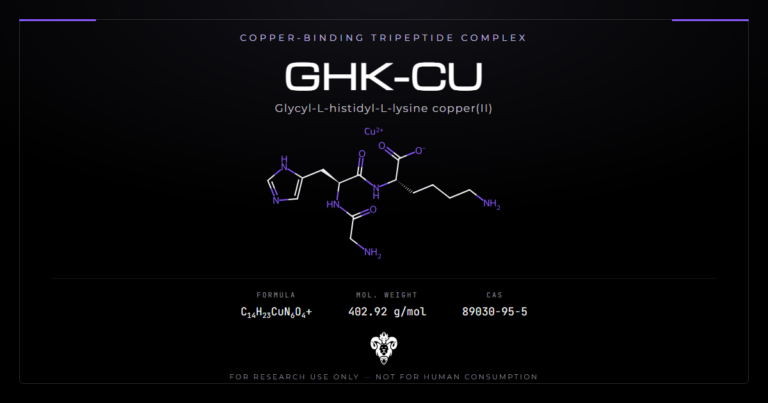
GHK-Cu: The Copper Tripeptide and What Its Evidence Actually Shows
Two molecules share one name, and the literature moves between them freely. A worked example of why identity testing matters.
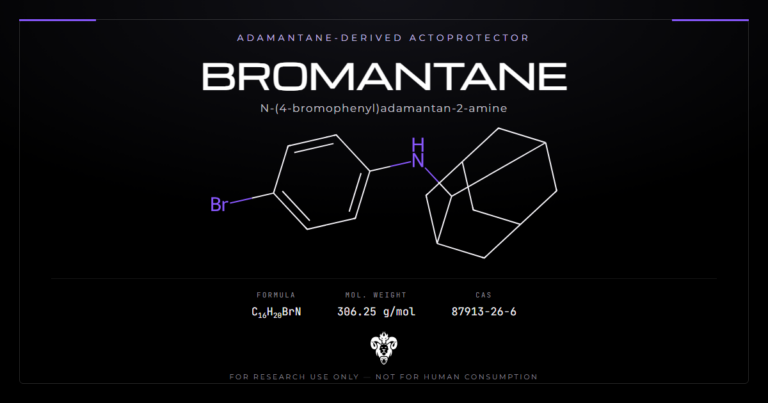
Bromantane: Mechanism, Clinical Evidence and Purity Verification
A compound whose mechanism genuinely breaks the mold, and what verifying it required.
Look up a batch
Step one
Find the code
The batch code is printed on the label in the form KC-XXX-NN. Scanning the QR code on the label goes to the same place.
Step two
Open the record
Go to kimerachems.co/coa/ followed by that code. For example, /coa/KC-ENX-01
Step three
Check it matches
Confirm the compound name and batch code on the certificate match the label exactly. If they do not, that is worth an email before anything else happens.
Research use only
Everything in the catalog is supplied for laboratory and pre-clinical research use only. These materials are not drugs, dietary supplements, food, cosmetics or veterinary products, and they are not for human or animal consumption. Nothing published on this site is dosing guidance or a therapeutic claim.
Kimera Chems LLC is a chemical supplier. It is not a compounding pharmacy or chemical compounding facility as defined under Section 503A of the Federal Food, Drug, and Cosmetic Act, and it is not an outsourcing facility as defined under Section 503B of that Act.
The catalog is account-gated rather than open. Applicants confirm in writing how the material will be used, which is the Intended-Use Attestation, and accounts are reviewed before approval. Applications go through the research account application.
Checking us out
Anyone evaluating a supplier they have not used before is asking a reasonable question, and it deserves a direct answer rather than a testimonial.
- The company. Kimera Chems LLC, a US-based research-use-only compound supplier, fulfilling and shipping domestically. Background is on the about page, including a note from the founder.
- The lab work. Independent, third-party and rotated across facilities. One laboratory in the network holds ISO/IEC 17025 accreditation from A2LA, verifiable in the public A2LA directory.
- The evidence. The COA archive is public and needs no account to read. Verification that cannot be inspected is not verification.
- The reviews. The Trustpilot profile is claimed, and critical reviews get answered rather than buried.
- The terms. Fulfillment, delivery, returns and dispute handling are set out in the shipping, refunds and returns policy, alongside the terms and conditions and the privacy policy.
- The support. Questions about a compound, a certificate or a specific batch go through the contact page, and answering them is treated as part of the job.
Where to go next
A few starting points in the catalog. Common questions are collected on the FAQ page.
Browse the catalog