
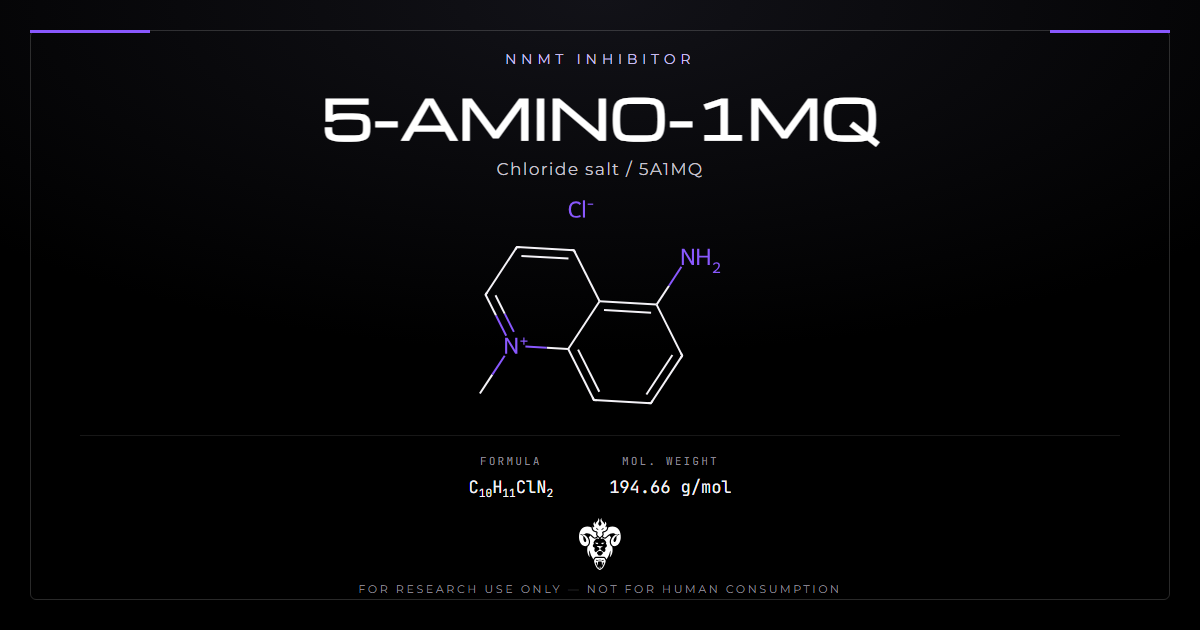
5-Amino-1MQ is one of the most frequently misdescribed compounds in the research supply space. It is routinely sold as a “peptide” when it contains no amide backbone at all. It is routinely labeled by gross salt mass when the active species is a cation representing barely half that mass. And it is routinely credited with human outcomes that have never been measured, because no clinical trial of the compound has been published.
What follows is a technical treatment of what 5-Amino-1MQ actually is, what the enzyme it targets actually does, what the published literature actually shows, and — most practically — how to read a certificate of analysis for it without being misled by the counterion.
Chemical Identity: What You Are Actually Handling
5-Amino-1MQ is shorthand for 5-amino-1-methylquinolinium, a small-molecule quaternary heteroaromatic cation. It is not a peptide, not a peptidomimetic, and not a nucleotide precursor.
| Property | Value |
|---|---|
| IUPAC name | 1-Methylquinolin-1-ium-5-amine |
| Common synonyms | 5-amino-1MQ, 5A1MQ, NNMTi |
| CAS (iodide salt) | 42464-96-0 |
| Cation formula | C₁₀H₁₁N₂⁺ |
| Cation MW | 159.21 g/mol |
| Iodide salt formula | C₁₀H₁₁IN₂ |
| Iodide salt MW | 286.12 g/mol |
| Chloride salt MW | 194.67 g/mol |
| PubChem CID (cation) | 950107 |
| Molecular target | Nicotinamide N-methyltransferase (NNMT) |
The structural core is quinoline — a benzo-fused pyridine — with a methyl group installed on the ring nitrogen and a primary amine at position 5 on the carbocyclic ring. Methylating the ring nitrogen converts it to a permanently charged quaternary ammonium. This single feature drives most of the compound’s practical behavior: it cannot be neutralized by pH, it must be isolated as a salt, it is highly water-soluble, and it is a poor candidate for passive blood–brain barrier transit. Any narrative positioning 5-Amino-1MQ as a nootropic is fighting basic physical chemistry.
Because the cation carries a fixed positive charge, 5-Amino-1MQ never exists as a free base. Every vial of it in existence is a salt — most commonly the iodide, occasionally the chloride. That fact has consequences we return to below, and it is the single most common source of quantitative error in this compound class.
The Enzyme: Why NNMT Became a Metabolic Target
Nicotinamide N-methyltransferase is a cytosolic Class I methyltransferase. Its reaction is deceptively simple:
nicotinamide + S-adenosyl-L-methionine → 1-methylnicotinamide + S-adenosyl-L-homocysteine
Two things happen simultaneously. Nicotinamide — the salvage-pathway precursor to NAD⁺ — is consumed and excreted as 1-methylnicotinamide (1-MNA). And S-adenosylmethionine (SAM), the cell’s universal methyl donor, is spent. NNMT therefore sits at the intersection of two of the most consequential currencies in cellular metabolism: the NAD⁺ pool and the methyl pool. When NNMT is overexpressed, it functions as a methyl sink, draining SAM and diverting nicotinamide away from NAD⁺ regeneration.
The target-validation moment came in 2014. Kraus and colleagues, publishing in Nature, showed that Nnmt was the most strongly reciprocally regulated gene in white adipose tissue across adipose-specific Glut4-knockout and Glut4-overexpressing mice. Antisense knockdown of Nnmt in white adipose tissue and liver protected mice against diet-induced obesity, and the authors attributed the effect to altered availability of adipose SAM and NAD⁺, with downstream consequences for histone methylation, polyamine flux, and NAD⁺-dependent SIRT1 signaling [1].
That paper established NNMT as a genetic target. It did not establish that a drug could reproduce the effect. Producing a selective, cell-permeable small-molecule inhibitor was the next problem — and that is the problem 5-Amino-1MQ was built to solve.
How 5-Amino-1MQ Inhibits NNMT
The medicinal chemistry
The compound emerged from a systematic structure–activity campaign at the University of Texas Medical Branch and UT San Antonio. Neelakantan and colleagues screened N-methylated quinolinium, isoquinolinium, pyridinium, and benzimidazolium/benzothiazolium scaffolds, spanning a greater-than-1,000-fold range of activity. Quinoliniums emerged as the most promising chemotype, with the best analogues reaching low-micromolar inhibition [2].
Computational docking against the NNMT substrate-binding site produced a defensible correlation between predicted ligand–enzyme interaction energy and measured IC₅₀ values, and the predicted binding orientation placed the quinolinium analogues squarely in the nicotinamide (substrate) pocket rather than the SAM pocket [2]. That distinction matters enormously for selectivity, which we address next.
The design logic behind the quinolinium series is worth stating plainly: the inhibitor is a substrate mimic. It resembles the N-methylated product of the reaction closely enough to occupy the site, but cannot itself be turned over.
Reported potency
Published and vendor-technical characterization of 5-Amino-1MQ places enzymatic inhibition at IC₅₀ ≈ 1.2 µM under defined assay conditions (50 µM SAM, 100 µM nicotinamide). In differentiated 3T3-L1 adipocytes, suppression of cellular 1-MNA production — the direct readout of target engagement — occurs at EC₅₀ ≈ 2.3 µM, while the downstream lipogenesis phenotype requires substantially higher exposure at EC₅₀ ≈ 30 µM [3].
The gap between those two numbers is the most useful piece of information in this entire section, and it is almost never discussed. Target engagement and phenotype are separated by roughly an order of magnitude. Any experiment run at a concentration that inhibits the enzyme but does not shift the phenotype is not a failed experiment — it is an experiment that landed in the gap.
Selectivity
SAM is used by dozens of methyltransferases. A non-selective SAM-pathway agent would be a blunt instrument with unreadable results. The selectivity data reported for 5-Amino-1MQ during the discovery program is therefore load-bearing:
- DNMT1 and PRMT3 — no significant inhibition at tested concentrations; no fittable dose–response could be obtained.
- COMT — approximately 10% inhibition at 600 µM, with no clear concentration-dependent trend.
- NAMPT — no inhibition observed; confirmed with the non-interfering analogue 5-amino-6-fluoro-1MQ across 30–600 µM.
- SIRT1 — no meaningful inhibition from 10 nM to 300 µM [4].
Taken together, this supports selectivity for NNMT at pharmacologically relevant concentrations. It does not support selectivity at the 100 µM-plus concentrations sometimes used casually in cell work — a caution worth building into any protocol.
The nuance most write-ups skip
Inhibiting NNMT raises intracellular nicotinamide. It is tempting to treat that as equivalent to raising NAD⁺. It is not. Nicotinamide is itself a product-inhibitor of sirtuins at elevated concentrations, and the net effect on NAD⁺-dependent signaling depends on flux through NAMPT, not merely on substrate abundance. Similarly, sparing SAM raises the SAM/SAH ratio, which influences global methylation potential — a genuinely pleiotropic effect, not a targeted one. 5-Amino-1MQ is a metabolic perturbation, not a switch. Experiments that measure only one node will produce a partial picture.
The Preclinical Record
Every finding below is from an animal or cell model. There are no published human trials of 5-Amino-1MQ.
Diet-induced obesity
The foundational pharmacological study appeared in Biochemical Pharmacology in 2018. Neelakantan and colleagues administered the selective, membrane-permeable NNMT inhibitor to C57BL/6 mice maintained on a 60% kcal-from-fat diet and reported concentration-dependent reductions in fat mass and in adipose-tissue NNMT enzymatic activity, with no significant change in food intake and preservation of lean mass [5]. The unchanged food intake is the mechanistically important detail: it argues against a simple anorectic explanation and for an energetic one.
A 2024 study in Diabetes, Obesity and Metabolism extended this substantially. Babula and colleagues dosed diet-induced obese mice once daily for 28 days and reported dose-dependent limitation of body-weight and fat-mass gain, improved oral glucose tolerance and insulin sensitivity, and suppression of hyperinsulinaemia. Liver histology showed attenuated hepatic steatosis and macrophage infiltration alongside reduced liver weight and triglyceride content, and circulating ALT, AST, and ketone bodies normalized. The same paper characterized plasma pharmacokinetics and tissue distribution after intravenous, oral, and subcutaneous administration, reporting distribution into adipose, muscle, and liver [6].
That PK dataset is the most useful practical contribution in the 5-Amino-1MQ literature, because it is the only study that tells you where the compound goes rather than only what happens after it is given.
Combination with dietary intervention
Sampson and colleagues reported in Scientific Reports in 2021 that pairing NNMT inhibition with a reduced-calorie dietary substitution in obese mice produced greater normalization of body composition and greater improvement in hepatic steatosis than the dietary intervention alone [7]. The relevant read is not “it works better with diet” but that the two interventions appear to act through partially non-overlapping mechanisms.
Aged skeletal muscle
The 2019 study in the same journal is arguably more interesting than the obesity work. Aged skeletal muscle accumulates NNMT and loses NAD⁺, with corresponding decline in satellite-cell (muscle stem cell) function. Neelakantan and colleagues treated aged mice with the NNMT inhibitor and reported increased muscle stem cell proliferation and fusion, larger regenerating myofiber cross-sectional area after induced injury, and an approximately 70% increase in peak tibialis anterior torque relative to vehicle controls. The findings were recapitulated in vitro in C2C12 myoblasts, with supporting shifts in the cellular NAD⁺/NADH redox state [8].
Oncology and the tumor microenvironment
NNMT is overexpressed in multiple malignancies. Eckert and colleagues identified NNMT as a master metabolic regulator of cancer-associated fibroblasts in high-grade serous ovarian cancer, and used 5-Amino-1MQ as the pharmacological tool to demonstrate that inhibition restores histone methylation in CAFs and reduces tumor burden in a HeyA8 intraperitoneal model [9]. A 2025 Nature paper extended the mechanism, showing that NNMT-driven H3K27me3 hypomethylation in CAFs drives complement secretion and recruitment of immunosuppressive myeloid-derived suppressor cells, and that NNMT inhibition restores CD8⁺ T-cell activation and immune-checkpoint-blockade efficacy in mouse models [10].
For anyone working with 5-Amino-1MQ in metabolic contexts, the oncology literature is not a tangent. It is the best available evidence that the compound engages NNMT in intact tissue and produces measurable epigenetic consequences.
Where translation stands
A 2026 review in Trends in Pharmacological Sciences surveys the clinical-translation landscape for NNMT inhibitors across chemotypes, including the quinolinium series, bisubstrate analogues, and nicotinamide-analogue programs [11]. The honest summary is that NNMT remains a well-validated preclinical target with no compound of any chemotype yet reported through a published human trial.
The Salt-Form Problem: Why “100 mg” Is Rarely 100 mg
This is the section that matters most operationally, and it is the one the category almost universally ignores.
5-Amino-1MQ is a permanent cation. It ships as a salt. The counterion contributes mass — and in the case of iodide, it contributes a lot of mass.
| Form | MW (g/mol) | Cation fraction | Cation in a nominal 100 mg |
|---|---|---|---|
| 5-Amino-1MQ cation | 159.21 | 100% | 100.0 mg |
| Iodide salt | 286.12 | 55.6% | 55.6 mg |
| Chloride salt | 194.67 | 81.8% | 81.8 mg |
The arithmetic is straightforward: 286.12 ÷ 159.21 = 1.797, so 1.80 mg of the iodide salt contains 1.00 mg of 5-Amino-1MQ cation. For the chloride, the factor is 1.22.
The implication is stark. Two vials each honestly labeled “100 mg, 99% pure by HPLC” can differ by 47% in active content purely because one is the iodide and the other is the chloride. Neither vendor lied. Neither COA is fraudulent. The number simply does not mean what the reader assumes.
Two further cautions:
- Some circulating technical documentation lists a conversion factor of 1.89 for the iodide. That figure does not reconcile with the formula weights (1.797). Where a conversion factor is provided rather than derived, verify it against the molecular weights before you build a normalization on top of it.
- Reported potency values are cation-referenced. An IC₅₀ of 1.2 µM refers to the cation. If you weigh iodide salt and calculate molarity using 159.21, your true concentration is 44% lower than you believe.
This is precisely why we treat counterion identification and salt stoichiometry as first-class COA parameters rather than footnotes. Every batch in our public COA archive is published so this arithmetic can be performed by the researcher rather than assumed.
What a Rigorous 5-Amino-1MQ COA Should Contain
Purity alone is insufficient for a quaternary salt. A defensible analytical package answers four separate questions:
1. Is it the right molecule? Mass spectrometry confirming the m/z 159 cation. HPLC retention alone does not establish identity, and for a compound with close structural relatives — quinoline, 5-aminoquinoline, positional isomers — identity confirmation is not optional.
2. How pure is the organic fraction? HPLC-UV area percent against a defined method. Critically, area% is not mass%. It reports the proportion of UV-absorbing species, and it says nothing about inorganic content, residual solvent, or water.
3. What is the counterion, and in what stoichiometry? This is the step almost nobody performs. Ion chromatography or argentometric titration identifies and quantifies the halide. CHN elemental analysis independently constrains the salt stoichiometry: because C, H, and N percentages differ measurably between the iodide (C 41.98%, H 3.87%, N 9.79%) and the chloride (C 61.70%, H 5.70%, N 14.39%), elemental analysis functions as an orthogonal check that the material is the salt form the label claims.
4. What else is in the vial? Residual solvent by GC headspace, water content by Karl Fischer, and — specific to this chemistry — screening for residual iodomethane, the methylating agent used to quaternize the ring nitrogen. Its presence at meaningful levels is a synthesis-quality signal, not a trivia item.
Orthogonal methods exist because single methods fail in predictable, correlated ways. HPLC purity and mass balance can both look excellent on material whose salt stoichiometry is wrong. Our 5-Amino-1MQ listings are supported by third-party COA verification across multiple independent laboratories for exactly this reason.
Common Misclassifications
“5-Amino-1MQ peptide.” It contains no peptide bond. It is a 159 Da heteroaromatic cation. The phrase appears constantly in retail copy and in search queries; it is simply wrong, and it tends to travel alongside other errors — chiefly the assumption that it requires bacteriostatic reconstitution and cold-chain handling identical to a lyophilized peptide.
“It’s an NAD⁺ precursor.” It is not. Nicotinamide riboside and NMN are precursors — they feed the salvage pathway directly. 5-Amino-1MQ is an inhibitor of nicotinamide disposal. The mechanisms are complementary but distinct, and conflating them makes experimental results uninterpretable.
“NNMT inhibition equals more NAD⁺.” As discussed above, the relationship is indirect and flux-dependent. Measure NAD⁺ if you want to claim NAD⁺.
“It crosses the blood–brain barrier.” A permanent quaternary cation is a poor candidate for passive CNS penetration. Absent transporter-mediated uptake data, this should not be assumed.
Experimental Design Considerations
Confirm target engagement directly. 1-MNA is the enzymatic product of NNMT and the cleanest pharmacodynamic biomarker available. Quantifying 1-MNA by LC-MS/MS tells you whether the enzyme is inhibited. Phenotypic endpoints alone do not.
Normalize on the cation. Every published potency figure is cation-referenced. Weigh salt, calculate cation, document the conversion in your methods.
Choose the model to match NNMT expression. NNMT is expressed most highly in liver and adipose, with tissue-specific differences across species. Systems with low baseline NNMT expression will show little response regardless of exposure, and that null is a design artifact rather than a result.
Include a vehicle control and, where feasible, a structural control. The 5-amino-6-fluoro analogue used in the original selectivity work exists precisely because assay interference is a real hazard with this chemotype.
Account for the salt in solubility work. The iodide and chloride behave differently in aqueous buffer, and iodide-containing solutions are photosensitive; iodide oxidation to triiodide will produce visible yellowing that is unrelated to the cation’s integrity.
Published rodent studies have used subcutaneous and intraperitoneal routes in mouse models; specific parameters should be taken directly from the primary literature cited below rather than inferred.
Regulatory and Compliance Status
5-Amino-1MQ has no marketing approval from any governmental regulatory health authority anywhere in the world, for any indication. It is not a dietary supplement ingredient, not an approved drug, and not a food additive. It is supplied strictly for laboratory research use.
For sport-testing contexts: 5-Amino-1MQ is not enumerated by name on the WADA Prohibited List, but Section S0 (Non-Approved Substances) prohibits at all times any pharmacological substance not addressed elsewhere on the List and with no current approval by a governmental regulatory health authority for human therapeutic use. A compound in 5-Amino-1MQ’s regulatory position falls within that description.
All Kimera Chems material is sold for laboratory research use only — not for human consumption, nor for medical, veterinary, diagnostic, or household use.
Where 5-Amino-1MQ Sits Among Metabolic Research Tools
5-Amino-1MQ occupies a specific mechanistic niche: it acts upstream, on methyl-group and nicotinamide disposal, rather than on receptor signaling or transcriptional programs. That makes it mechanistically orthogonal to most of the metabolic research catalog.
SLU-PP-332, for example, is a pan-ERR agonist acting through nuclear-receptor-driven transcription of oxidative metabolism genes — a completely different node. MOTS-c is a mitochondrial-derived peptide operating through AMPK and folate–methionine cycle interactions, which places it closer to 5-Amino-1MQ in one-carbon metabolism but nowhere near it in molecular class. And 5-Amino/MIC combines the compound with methionine, inositol, choline bitartrate, and carnitine in a single research formulation for groups studying combined lipotropic and methylation-pathway effects.
Compounds that act on genuinely different nodes are the ones worth studying together. Further reading across this class is collected in our metabolic research library.
Frequently Asked Questions
Is 5-Amino-1MQ a peptide? No. It is a small-molecule quaternary quinolinium cation with a molecular weight of 159.21 g/mol for the cation. It contains no amino acids and no peptide bonds. The “peptide” label is a category error that has propagated through retail listings.
How is 5-Amino-1MQ different from NMN or nicotinamide riboside? NMN and NR are NAD⁺ precursors that feed the salvage pathway. 5-Amino-1MQ is an inhibitor of NNMT, the enzyme that removes nicotinamide from the salvage pathway by methylating it. One adds substrate; the other reduces substrate loss. They are complementary rather than interchangeable.
Why do different 5-Amino-1MQ products list different molecular weights? Because they are different salts. The cation is 159.21 g/mol, the iodide salt is 286.12, and the chloride salt is 194.67. A nominal 100 mg of iodide salt contains about 55.6 mg of cation; the same mass of chloride salt contains about 81.8 mg. Always confirm which form the COA describes.
Has 5-Amino-1MQ been studied in humans? No published clinical trial of 5-Amino-1MQ exists. The entire evidence base is preclinical — rodent models and cell culture. Human pharmacokinetics, safety, and efficacy are unknown.
What does a complete COA for 5-Amino-1MQ look like? At minimum: MS identity confirmation of the cation, HPLC-UV purity with a stated method, counterion identification and quantification, elemental analysis constraining salt stoichiometry, residual solvent by GC headspace, and water content. Purity percentage alone is insufficient for a salt.
How should 5-Amino-1MQ be stored? Iodide salts are photosensitive and hygroscopic, so dark, desiccated storage at controlled room temperature in the original sealed container is the sensible default; refer to the batch-specific documentation supplied with the material. Storage guidance is a house recommendation. Analytical documentation is per-lot release testing.
References
- Kraus D, Yang Q, Kong D, et al. Nicotinamide N-methyltransferase knockdown protects against diet-induced obesity. Nature. 2014;508(7495):258–262. doi:10.1038/nature13198 · PMID 24717514
- Neelakantan H, Wang HY, Vance V, Hommel JD, McHardy SF, Watowich SJ. Structure–activity relationship for small molecule inhibitors of nicotinamide N-methyltransferase. J Med Chem. 2017;60(12):5015–5028. doi:10.1021/acs.jmedchem.7b00389 · PMID 28548833
- Merck/Sigma-Aldrich. 5-Amino-1-methylquinolinium iodide (SML2832) technical documentation — reported NNMT IC₅₀, 3T3-L1 lipogenesis and 1-MNA EC₅₀ values. Product page
- Watowich SJ, McHardy SF, Neelakantan H, et al. Quinoline-derived small molecule inhibitors of nicotinamide N-methyltransferase (NNMT) and uses thereof. US Patent 11,401,243 — comparative selectivity data against DNMT1, PRMT3, COMT, NAMPT, and SIRT1.
- Neelakantan H, Vance V, Wetzel MD, Wang HYL, McHardy SF, Finnerty CC, Hommel JD, Watowich SJ. Selective and membrane-permeable small molecule inhibitors of nicotinamide N-methyltransferase reverse high fat diet-induced obesity in mice. Biochem Pharmacol. 2018;147:141–152. doi:10.1016/j.bcp.2017.11.007 · PMID 29155147
- Babula JJ, Bui D, Stevenson HL, Watowich SJ, Neelakantan H. Nicotinamide N-methyltransferase inhibition mitigates obesity-related metabolic dysfunction. Diabetes Obes Metab. 2024;26(11):5272–5282. doi:10.1111/dom.15879
- Sampson CM, Dimet AL, Neelakantan H, et al. Combined nicotinamide N-methyltransferase inhibition and reduced-calorie diet normalizes body composition and enhances metabolic benefits in obese mice. Sci Rep. 2021;11(1):5637. doi:10.1038/s41598-021-85051-6 · PMID 33707534
- Neelakantan H, Brightwell CR, Graber TG, Maroto R, Wang HYL, McHardy SF, Papaconstantinou J, Fry CS, Watowich SJ. Small molecule nicotinamide N-methyltransferase inhibitor activates senescent muscle stem cells and improves regenerative capacity of aged skeletal muscle. Biochem Pharmacol. 2019;163:481–492. doi:10.1016/j.bcp.2019.02.008 · PMID 30753815
- Eckert MA, Coscia F, Chryplewicz A, et al. Proteomics reveals NNMT as a master metabolic regulator of cancer-associated fibroblasts. Nature. 2019;569(7758):723–728. doi:10.1038/s41586-019-1173-8 · PMID 31043742
- NNMT inhibition in cancer-associated fibroblasts restores antitumour immunity. Nature. 2025;645:1051. doi:10.1038/s41586-025-09303-5
- Emerging opportunities for nicotinamide N-methyltransferase (NNMT) inhibitor clinical translation. Trends Pharmacol Sci. 2026. Article
- National Center for Biotechnology Information. PubChem Compound Summary for CID 950107, 5-Amino-1-methylquinolinium. PubChem
5-Amino-1MQ is supplied by Kimera Chems for laboratory research use only. It is not for human consumption, nor for medical, veterinary, diagnostic, or household use. Nothing in this article constitutes medical advice or guidance for administration to humans or animals. Purchasers must review and accept our Terms and Conditions prior to ordering.