
Everything below reports findings from cell cultures, isolated tissue, animal models and one registered clinical trial. This material is for research use only, not for human or veterinary use.
AICAR is one of the most commonly used pharmacological tools for switching on AMP-activated protein kinase (AMPK) inside intact cells. Many searches pair it with the word peptide. The compound is a purine nucleoside, and it has to be phosphorylated inside the cell before it acts on AMPK.
Most early studies of AMPK relied on it as their only activator. A 2021 systematic review asked researchers to read that generation of results with caution [1].
What is AICAR?
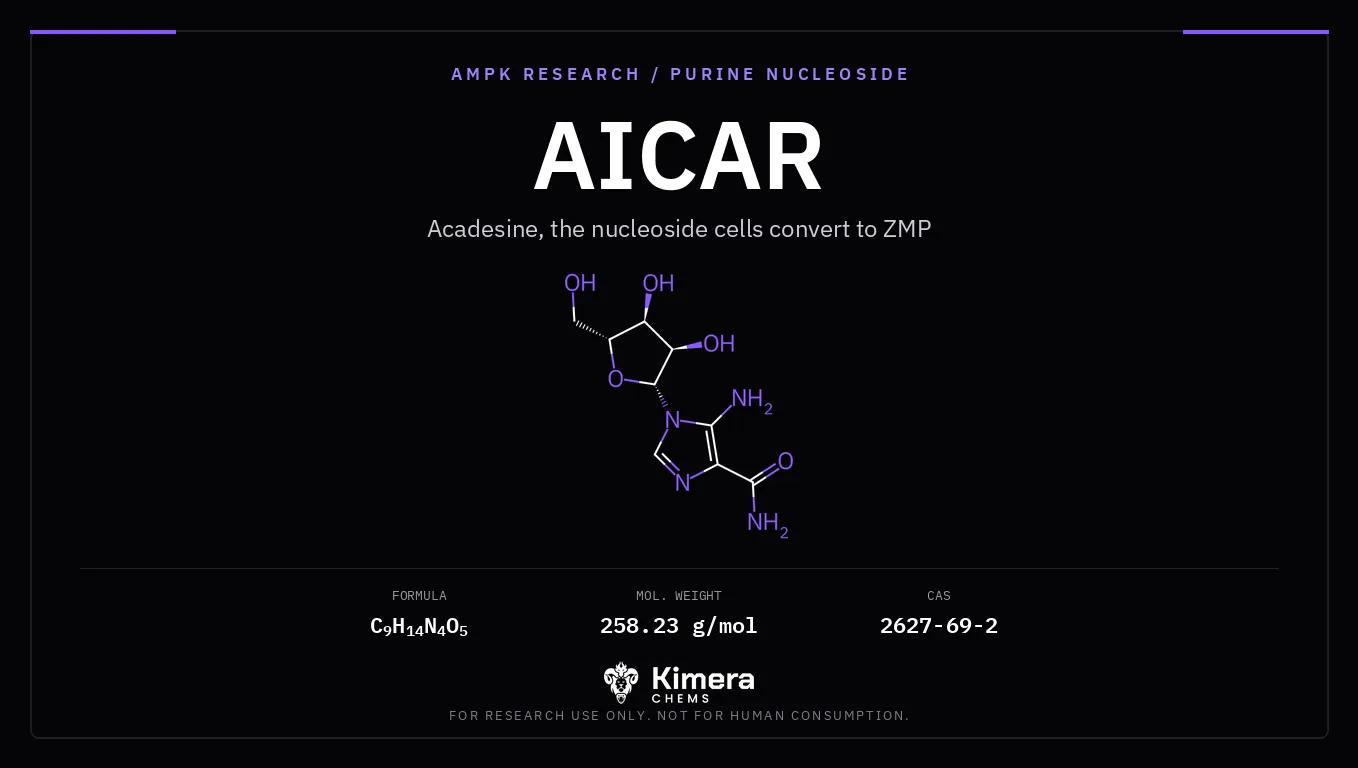
AICAR here means 5-aminoimidazole-4-carboxamide ribonucleoside, also listed as acadesine and AICA riboside. ChEMBL records it as a small molecule, and the structure contains no amino acid residues (ChEMBL).
| Property | Value |
|---|---|
| Name | 5-Aminoimidazole-4-carboxamide 1-beta-D-ribofuranoside (acadesine) |
| Class | Purine nucleoside, AMP analogue precursor |
| Molecular formula | C9H14N4O5 |
| Molecular weight | 258.23 |
| CAS | 2627-69-2 |
| ChEMBL ID | CHEMBL1551724 |
| InChIKey | RTRQQBHATOEIAF-UUOKFMHZSA-N |
| Other codes | GP-1-110, NSC-105823 |
| Calculated ALogP | -2.82 |
| Polar surface area | 156.85 Å2 |
| H-bond donors / acceptors | 5 / 8 |
One acronym, two molecules
Older papers use “AICAR” for a different compound. A 1991 hepatocyte study defines AICA ribotide, the phosphorylated form, as “AICAR or ZMP”, and calls the nucleoside AICA riboside [2]. By 1995 the Dundee group was using AICAR for the nucleoside and ZMP for the monophosphate [3]. The 2021 review writes AICAr for the nucleoside to keep them apart [1].
Check the formula whenever the acronym appears. The nucleoside is C9H14N4O5 at 258.23. ZMP carries a phosphate group. A listing that pairs the name AICAR with a phosphorylated structure describes the intracellular metabolite, which is a different compound from the reagent added to culture medium.
AICAR mechanism of action: the ZMP step
The founding tool paper came from a Dundee biochemistry group in 1995. Rat hepatocytes incubated with the nucleoside accumulated ZMP. ZMP reproduced both activating effects of AMP on AMPK: direct allosteric activation, and promotion of phosphorylation by the upstream AMPK kinase [3].
The advantage the authors reported was what stayed the same. Existing methods of activating AMPK in cells included fructose and heat shock. Unlike them, the nucleoside did not perturb cellular ATP, ADP or AMP in those hepatocytes [3].
The downstream readouts matched a working kinase. HMG-CoA reductase, a known AMPK substrate, was phosphorylated and inactivated, and fatty acid and sterol synthesis almost stopped. The authors proposed it as a tool for identifying new pathways regulated by the kinase cascade [3].
Uptake and phosphorylation are both required
Two experiments pin the activity to that conversion. In rat hepatocytes, 5-iodotubercidin, an adenosine kinase inhibitor, suppressed the nucleoside’s effects on gluconeogenesis [2]. In human B-cell chronic lymphocytic leukemia (B-CLL) cells, the nucleoside transport inhibitor NBTI, 5-iodotubercidin and adenosine each completely blocked both AMPK phosphorylation and apoptosis [4].
Those inhibitors make useful controls. A result that persists under 5-iodotubercidin points away from ZMP.
Preclinical research findings by model
Isolated rat adipocytes
A 1994 study from ZENECA described the compound as a cell-permeable AMPK activator. In isolated rat adipocytes it activated AMPK in a time- and dose-dependent manner. It left basal hormone-sensitive lipase activity unchanged, reduced the cells’ response to the lipolytic agent isoprenaline, and inhibited lipogenesis through increased acetyl-CoA carboxylase (ACC) phosphorylation [5]. The 1995 hepatocyte paper reported the same antagonism of isoprenaline-stimulated lipolysis in adipocytes [3].
Perfused rat hindlimb
Merrill and colleagues perfused rat hindlimbs with medium containing 0.5 to 2.0 mM of the nucleoside. AMPK in skeletal muscle was activated, ACC was inactivated and malonyl-CoA fell. At 2 mM for 45 minutes, fatty acid oxidation rose 2.8-fold and glucose uptake increased significantly. Oxygen uptake did not differ from control [6].
Isolated rat hepatocytes and gluconeogenesis
Vincent and colleagues found that the nucleoside inhibited glucose production from lactate-pyruvate in isolated rat hepatocytes, half-maximally near 100 micromolar and completely at 500 micromolar. Output from fructose, dihydroxyacetone and L-proline fell as well [2].
Their explanation ran through a different enzyme. After 20 minutes at 500 micromolar, ZMP reached 3 micromol per gram of cells. ZMP also inhibited rat liver fructose-1,6-bisphosphatase with an apparent Ki of 370 micromolar. The authors attributed the effect to that enzyme [2]. ATP held steady with lactate-pyruvate as substrate but fell with fructose or dihydroxyacetone, so the “nucleotides unchanged” property depends on the conditions [2].
Human leukemia cells in culture
Campàs and colleagues exposed B-CLL cells from 70 samples. Every sample underwent caspase-dependent apoptosis, with an EC50 of 380 ± 60 micromolar. Normal B lymphocytes were as sensitive. T cells were only slightly affected at up to 4 mM and showed no AMPK phosphorylation. At 0.5 mM they accumulated less ZMP than B-CLL cells [4].
AMPK-independent effects of AICAR
The same leukemia group tested whether AMPK was the route. Two other AMPK activators, phenformin and A-769662, failed to induce apoptosis in CLL cells. The nucleoside still induced apoptosis in B lymphocytes from mice lacking AMPK alpha1. Cell death was preceded by up-regulation of the BH3-only proteins BIM, NOXA and PUMA. B cells from mice lacking both Noxa and Bim resisted it [7].
That result is one of many. The 2021 systematic review notes that most early AMPK studies relied on this compound alone as the activator. It then documents a growing number of effects once credited to AMPK that turned out to be AMPK-independent. They span metabolism, hypoxia, exercise, nucleotide synthesis and cancer [1].
What that means for experimental design
ZMP acts on more than one enzyme. The fructose-1,6-bisphosphatase result shows one target besides AMPK [2]. The review’s authors call for caution in interpreting studies built on this compound [1]. The papers above show three controls that answer that call: a structurally unrelated AMPK activator [7], an adenosine kinase inhibitor [2][4], and an AMPK knockout [7].
Other metabolic research tools in the catalog work at different targets. BAM15 is classed as a mitochondrial protonophore uncoupler, and 5-Amino-1MQ as a nicotinamide N-methyltransferase inhibitor. More compound profiles sit in the research compounds library.
Development history of acadesine
Acadesine began as a clinical candidate. It was initially developed as a cardioprotective agent, with metabolic effects that include adenosine release as well as AMPK activation [8]. ChEMBL lists its highest development phase as 3.
The phase 3 RED-CABG trial tested it in patients undergoing coronary artery bypass surgery. A prespecified futility analysis stopped the trial after 3,080 of a projected 7,500 participants. The composite primary outcome occurred in 5.0% of the placebo group and 5.1% of the acadesine group. Key secondary end points did not differ [9]. In that population, acadesine did not reduce the composite outcome [9].
Analytical characterization and quality
Identity for this compound rests on three checks that do not depend on the name: the formula C9H14N4O5, the molecular weight of 258.23, and the InChIKey in the table above. Each one separates the nucleoside from ZMP, which differs by a phosphate.
The AICAR Kimera Chems supplies is the nucleoside, CAS 2627-69-2. Kimera Chems certificates of analysis carry multi-lab third-party COA verification and are published in the COA database.
Frequently asked questions
Is AICAR a peptide?
No. It is a purine nucleoside with the formula C9H14N4O5. ChEMBL classifies it as a small molecule. It contains no amino acids.
What is AICAR used for in research?
It is a pharmacological tool for activating AMPK in intact cells and tissue preparations, first proposed for identifying pathways the kinase regulates [3]. It is also studied in leukemia cell models [4][7].
Does AICAR activate AMPK directly?
No. Cells take it up and adenosine kinase phosphorylates it to ZMP, which acts as the AMP mimic. Blocking transport or adenosine kinase blocks the effect [2][4].
Is AICAR the same as ZMP?
No. ZMP is the monophosphate formed inside the cell. Some older papers used the acronym AICAR for ZMP itself, so check the structure in any source [2].
Are all AICAR effects mediated by AMPK?
No. Apoptosis in B lymphocytes persisted without AMPK alpha1, and ZMP inhibits fructose-1,6-bisphosphatase directly [7][2]. A 2021 systematic review catalogs many more AMPK-independent effects [1].
What is acadesine?
Acadesine is another name for the same nucleoside, and ChEMBL records a USAN assignment in 1992. It reached phase 3 testing, and the RED-CABG trial was stopped for futility [9].
References
- Višnjić D, Lalić H, Dembitz V, Tomić B, Smoljo T. AICAr, a widely used AMPK activator with important AMPK-independent effects: a systematic review. Cells. 2021;10(5):1095. PMID 34064363. doi:10.3390/cells10051095
- Vincent MF, Marangos PJ, Gruber HE, Van den Berghe G. Inhibition by AICA riboside of gluconeogenesis in isolated rat hepatocytes. Diabetes. 1991;40(10):1259-66. PMID 1657665. doi:10.2337/diab.40.10.1259
- Corton JM, Gillespie JG, Hawley SA, Hardie DG. 5-aminoimidazole-4-carboxamide ribonucleoside. A specific method for activating AMP-activated protein kinase in intact cells? Eur J Biochem. 1995;229(2):558-65. PMID 7744080. doi:10.1111/j.1432-1033.1995.tb20498.x
- Campàs C, Lopez JM, Santidrián AF, et al. Acadesine activates AMPK and induces apoptosis in B-cell chronic lymphocytic leukemia cells but not in T lymphocytes. Blood. 2003;101(9):3674-80. PMID 12522004. doi:10.1182/blood-2002-07-2339
- Sullivan JE, Brocklehurst KJ, Marley AE, Carey F, Carling D, Beri RK. Inhibition of lipolysis and lipogenesis in isolated rat adipocytes with AICAR, a cell-permeable activator of AMP-activated protein kinase. FEBS Lett. 1994;353(1):33-6. PMID 7926017. doi:10.1016/0014-5793(94)01006-4
- Merrill GF, Kurth EJ, Hardie DG, Winder WW. AICA riboside increases AMP-activated protein kinase, fatty acid oxidation, and glucose uptake in rat muscle. Am J Physiol. 1997;273(6):E1107-12. PMID 9435525. doi:10.1152/ajpendo.1997.273.6.E1107
- Santidrián AF, González-Gironès DM, Iglesias-Serret D, et al. AICAR induces apoptosis independently of AMPK and p53 through up-regulation of the BH3-only proteins BIM and NOXA in chronic lymphocytic leukemia cells. Blood. 2010;116(16):3023-32. PMID 20664053. doi:10.1182/blood-2010-05-283960
- Van Den Neste E, Van den Berghe G, Bontemps F. AICA-riboside (acadesine), an activator of AMP-activated protein kinase with potential for application in hematologic malignancies. Expert Opin Investig Drugs. 2010;19(4):571-8. PMID 20367195. doi:10.1517/13543781003703694
- Newman MF, Ferguson TB, White JA, et al. Effect of adenosine-regulating agent acadesine on morbidity and mortality associated with coronary artery bypass grafting: the RED-CABG randomized controlled trial. JAMA. 2012;308(2):157-64. PMID 22782417. doi:10.1001/jama.2012.7633
For research use only. Not for human or veterinary use.