
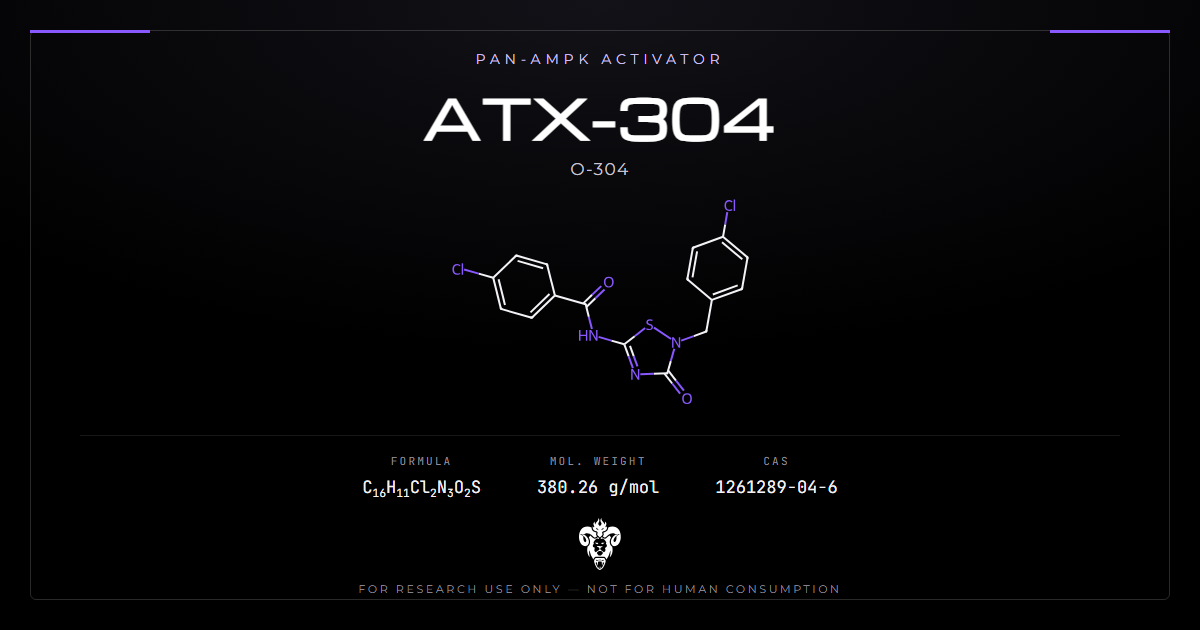
ATX-304 occupies an unusual position in the research compound landscape. AMPK has been a drug target for nearly thirty years without a single direct activator reaching approval, and most compounds sold as “AMPK activators” are either indirect (metformin, berberine) or never advanced past rodent work. ATX-304 is the exception on both counts: it activates AMPK directly, and as of June 2026 it is the only direct AMPK activator with published human translational data.
That distinction matters for anyone designing experiments around this compound. The clinical dataset constrains what is plausible, the mechanistic literature is specific enough to break assays if it is ignored, and the material circulating outside clinical channels is chemically not the same thing being dosed in trials. This article covers all three.
Research Use Only. ATX-304 is an investigational compound. It is not approved for human or veterinary use anywhere. Everything below describes published laboratory and clinical findings and is intended for qualified investigators designing in vitro and preclinical work.
Naming: O-304, O304, ATX-304, and the OS-01 collision
The compound was developed by Betagenon AB in Umeå, Sweden, and appears in the founding literature as O304 or O-304. After licensing into Amplifier Therapeutics, a Cambrian Bio pipeline company, it was redesignated ATX-304. Both designations refer to the identical molecule, CAS 1261289-04-6. Papers published from roughly 2024 onward use ATX-304; papers from 2018 to 2023 use O304. Any literature search that covers only one name will miss half the dataset.
A third label, OS-01, has been applied to ATX-304 by at least one retail vendor. This is worth flagging because OS-01 is already an established name for an unrelated senolytic skincare peptide. If you are searching under OS-01, you will pull results for a completely different molecule. Use CAS 1261289-04-6 or InChIKey WEDWLYRQKUTOAX-UHFFFAOYSA-N as the anchor.
Chemical identity
| Property | Value |
|---|---|
| CAS Number | 1261289-04-6 |
| PubChem CID | 50923806 |
| Molecular Formula | C₁₆H₁₁Cl₂N₃O₂S |
| Molar Mass | 380.25 g/mol |
| InChIKey | WEDWLYRQKUTOAX-UHFFFAOYSA-N |
| IUPAC Name | 4-chloro-N-[2-[(4-chlorophenyl)methyl]-3-oxo-2,3-dihydro-1,2,4-thiadiazol-5-yl]benzamide |
| Core scaffold | 1,2,4-thiadiazol-3(2H)-one |
| Appearance | Crystalline solid, white to off-white |
| λmax | 256 nm, 320 nm |
A structural correction worth making
A substantial amount of vendor copy describes ATX-304 as having a benzothiazole core. It does not. Benzothiazole is a fused bicyclic system, a benzene ring sharing an edge with a thiazole. ATX-304 contains no fused bicycle. Its heterocycle is a monocyclic 1,2,4-thiadiazolone, an isolated five-membered ring carrying sulfur and two nitrogens with a ring carbonyl, connected on one side to a benzamide and on the other to a 4-chlorobenzyl group through the ring nitrogen.
This is not pedantry. The two scaffolds have different electronic character, different metabolic liabilities, and different retention behavior. Anyone building an HPLC method, running a substructure search, or comparing ATX-304 to a literature analog series will get the wrong answer starting from a benzothiazole assumption. The IUPAC name on any correctly populated spec sheet resolves it: “1,2,4-thiadiazol-5-yl” is unambiguous.
Mechanism: why ATX-304 is not interchangeable with other AMPK activators
AMPK is a heterotrimer of α, β, and γ subunits. Twelve isoform combinations exist. Activity is governed principally by phosphorylation of threonine 172 on the α subunit, which upstream kinases LKB1 and CaMKKβ install and protein phosphatase 2C (PP2C) removes. Most pharmacology aimed at AMPK works by pushing on one of two levers: raising the AMP:ATP ratio so the phosphorylated state is protected, or binding the allosteric drug and metabolite (AdAM) site between the α and β subunits.
ATX-304 does neither.
The dephosphorylation-protection mechanism
Steneberg and colleagues showed that ATX-304 suppresses PP2C-mediated dephosphorylation of p-T172 on recombinant α, β, and γ trimers, and does so without inhibiting PP2C enzymatic activity itself. The protective effect persists in the presence of excess ATP. In parallel controls, ATX-304 did not allosterically activate AMPK, meaning it is not an AdAM-site ligand.
Functionally, this makes ATX-304 an ADP mimic rather than an AMP mimic. ADP protects p-T172 from dephosphorylation but does not allosterically stimulate the kinase; AMP does both. ATX-304 reproduces the ADP half of that behavior and acts additively with ADP. In Wi-38 human lung fibroblasts, it raised p-T172 AMPK and downstream p-S79 ACC dose dependently while the ATP-to-protein ratio went up, not down.
The “pan” designation is earned rather than assumed. ATX-304 increased pAMPK across cell types expressing either β1 or β2 subunits, including human skeletal myotubes and hepatocytes, which preferentially carry β2.
The LKB1 dependency, and why it will break your assay
This is the single most consequential detail for in vitro design and it is almost entirely absent from secondary sources.
ATX-304 cannot create phosphorylation. It only prevents removal of phosphate already installed. In a cell with no upstream kinase activity, there is nothing to protect. Steneberg’s group demonstrated this directly in HeLa cells, which are phenotypically LKB1 null: ATX-304 failed to raise pAMPK or pACC above baseline, while ionomycin, which routes through the CaMKKβ arm, activated AMPK in the same cells without difficulty.
The practical consequences:
- HeLa is an invalid model for ATX-304. So is any LKB1-deficient line, which includes a number of commonly used lung and cervical cancer lines. Confirm LKB1 status before committing.
- Negative results in a quiescent system are uninformative. ATX-304 amplifies existing AMPK tone. A cell under no energetic demand has little tone to amplify.
- A CaMKKβ-driven positive control does not validate an ATX-304 experiment. The two mechanisms have different prerequisites.
Steneberg’s group framed this as a feature rather than a limitation: ATX-304 only further increases AMPK activity in physiologically relevant cells that already have intrinsic AMPK activity. That is a plausible explanation for the compound’s tolerability, but in a dish it means the model choice determines whether you see anything at all.
The mitochondrial arm
Work published after the original characterization added a second mechanism. Katerelos and colleagues observed increased basal oxygen consumption in renal tubular epithelial cells treated with ATX-304, consistent with metabolic uncoupling, and independently found that ATX-304 decreased AMP levels, implying reduced energy stress. That is the opposite of metformin’s signature.
Zhang and colleagues characterized the uncoupling directly, reporting dose-dependent increases in oxygen consumption rate in A10 vascular smooth muscle and HepG2 cells after ATP synthase inhibition, alongside reduced mitochondrial membrane potential.
The mechanistic poster presented at ADA 2026 refined the picture and is important for interpreting the older uncoupler literature. In isolated mouse skeletal muscle mitochondria, ATX-304 raised OCR and lowered both membrane potential and ROS emission, consistent with increased proton leak. But in intact mouse embryonic fibroblasts, it reduced ROS without reducing membrane potential, unlike the FCCP positive control. ATX-304 did not reduce ATP in human hepatocytes at any concentration tested up to 20 µM, and it activated both wild type and RG mutant AMPK in HEK-293T cells to a similar extent, whereas the 2-deoxyglucose control showed the expected reduced activation of the RG mutant.
The conclusion drawn was that AMPK activation by ATX-304 is not secondary to a fall in cellular ATP. If you are designing experiments around a classical uncoupler model, that assumption will mislead you.
Comparison to the alternatives
| Compound | Route to AMPK | Key limitation |
|---|---|---|
| Metformin | Indirect, complex I inhibition raises AMP:ATP | Requires OCT transporters; confounded by energy stress |
| AICAR | Converted intracellularly to ZMP, an AMP mimic | Poor oral bioavailability; broad ZMP off-target effects |
| MK-8722 | AdAM-site allosteric, ~10x β1 preference | Cardiac hypertrophy and glycogen accumulation across preclinical species |
| PF-739 / PF-793 | AdAM-site allosteric | Limited chronic effect on blood glucose |
| ATX-304 | Protects p-T172 from PP2C dephosphorylation; adds mitochondrial proton leak | Requires LKB1 tone; binding site still unresolved |
The MK-8722 contrast is the one that shaped ATX-304’s development. MK-8722 produced cardiac hypertrophy and glycogen accumulation in multiple species. ATX-304 activated cardiac AMPK, increased cardiac glucose uptake, reduced cardiac glycogen, and improved left ventricular stroke volume by roughly 20% in mice without increasing heart weight. Rats gavaged for six months at up to 600 mg/kg/day showed no increase in heart or brain weight.
Preclinical evidence
Metabolic and cardiovascular characterization (2018)
The founding paper is dense. Highlights from the mouse work:
- In diet-induced obese mice, ATX-304 at 100 mg/kg/day prevented high-fat-diet-driven rises in fasted glucose and insulin, and prevented insulin resistance by HOMA-IR. Metformin alone did not. The combination was most effective.
- In hIAPP transgenic DIO mice, a model combining insulin resistance with β cell dysfunction, ATX-304 both prevented and reverted established diabetes. Islet amyloid deposition fell, and the effect was reproduced in isolated islets cultured at 22 mM glucose, indicating a direct islet action rather than a purely secondary one. Blocking autophagy with 3-MA significantly attenuated it.
- Arginine-stimulated insulin secretion doubled, indicating preserved functional β cell reserve.
- Energy expenditure rose, respiratory exchange ratio fell (a shift toward fatty acid oxidation), and weight loss occurred despite increased food intake. It persisted at thermoneutrality, with only a nonsignificant 0.2 °C core temperature difference.
- At a lower dose that produced no weight or fat loss at all, glucose and HOMA-IR still improved, separating the metabolic effect from the weight effect.
- In rodents ATX-304 is orally available with a long plasma half-life and does not cross the blood-brain barrier, which is the basis for the “peripherally restricted” descriptor now used in clinical materials.
Aging and exercise capacity (2021)
Ericsson and colleagues fed F1 hybrid mice ATX-304 from six months of age for twelve months. The compound prevented and reverted age-associated hyperinsulinemia and insulin resistance and improved cardiac function by echocardiography. In a separate arm, 14-month-old lean mice on regular diet given 20 mg/kg/day for 30 days ran significantly further to exhaustion with a significantly smaller rise in blood lactate, indicating a shift toward oxidative metabolism. This is the study most often cited for the “exercise mimetic” framing, and it is the strongest support for it.
Glucose effectiveness and β cell preservation (2023)
Norlin and colleagues dissected the glucose-lowering effect into two components, showing that ATX-304 both promotes muscle glucose effectiveness (insulin-independent disposal) and preserves β cell function. A companion transcriptomic and chromatin study found that ATX-304 largely prevented the genome-wide expression changes that high-fat feeding induces in pancreatic islets, with corresponding remodeling of active and repressive chromatin marks, including complete abrogation of the β cell stress marker Aldh1a3.
Renal protection (2024)
Katerelos and colleagues tested ATX-304 pretreatment against cisplatin-induced acute kidney injury in C57Bl/6 mice and primary tubular epithelial cell cultures. ATX-304 reduced markers of kidney injury and drove broad metabolic reprogramming, reducing fatty acid accumulation and raising basal respiration. This is also the paper that first connected the AMPK effect to mitochondrial uncoupling in a non-muscle tissue.
MASLD (2025)
In a choline-deficient high-fat-diet mouse model of progressive fatty liver disease, ATX-304 reduced body fat mass, lowered blood cholesterol, and mitigated both steatosis and fibrosis development. The mechanism tracked with a shift in hepatic metabolic programming: increased fatty acid oxidation, reduced lipid synthesis, and remodeling of cholesterol and lipid transport. The authors noted pronounced local heterogeneity in the response across liver regions, which is a caveat worth carrying forward rather than dropping.
Lifespan and vascular tone (2025)
Zhang and colleagues extended C. elegans lifespan with ATX-304 at 100 µmol/L through the AMPK-mTOR axis and autophagy-driven lipid catabolism, and reported anti-aging effects in mouse embryonic fibroblasts at 2 to 5 µmol/L. The same paper showed dose-dependent, endothelium-independent relaxation of pre-constricted rat mesenteric arteries. Note the scope: nematode lifespan extension is a mechanistic finding, not a mammalian longevity result.
Body composition and incretin combination (ENDO 2025)
Schneider and colleagues reported DIO mouse data with direct bearing on the current interest in this compound. ATX-304 monotherapy produced 21% weight loss over 28 days. Combined with semaglutide, weight loss reached 27% at 15 days. EchoMRI at day 32 showed that weight loss in both ATX-304 arms was attributable to fat mass with no reduction in lean mass, while semaglutide alone produced 20% weight loss with reductions in both fat and lean mass.
The withdrawal arm is the more interesting one. After semaglutide discontinuation, animals became hyperphagic. Fourteen days of ATX-304 produced dose-dependent prevention of weight regain, with the highest dose group continuing to lose weight (26% versus baseline) without further lean mass loss.
Human clinical data
TELLUS, Phase IIa (2018)
A randomized, parallel-group, double-blind, placebo-controlled 28-day study in 65 type 2 diabetes patients stably on metformin, dosed at 1,000 mg/day as a suspension.
| Endpoint | ATX-304 | Placebo |
|---|---|---|
| Fasting plasma glucose, day 1 to 28 | -0.60 mM | -0.10 mM |
| HOMA-IR | Significant reduction (p = 0.0097 absolute) | Not significant |
| Systolic BP | -5.8 mmHg | +1.2 mmHg |
| Diastolic BP | -3.8 mmHg | +0.9 mmHg |
| Microvascular perfusion (calf, MRI T2*) | Significant increase | No change |
| Heart rate | -1.6 bpm | -0.48 bpm |
The perfusion finding was concentrated in patients with lower baseline perfusion, which is mechanistically coherent but was a post hoc stratification.
The authors were unusually candid about limitations, and those limitations are more useful than the headline numbers. The FPG result came from a post hoc subgroup. Randomization left the placebo group roughly 8 kg heavier at baseline (BMI 31 versus 28). Because plasma steady state is not reached until day 14 given the long half-life, and the FPG separation only appeared between day 21 and day 28, a 28-day study was probably too short to show the full effect. And the authors stated plainly that ATX-304 was administered as a suspension and that work on a more efficacious formulation had been initiated. Hold onto that last point.
One practical note for anyone attempting registry verification: the trial identifiers listed in the 2018 paper do not map cleanly onto a 2016-2017 study, so cross-referencing TELLUS in ClinicalTrials.gov by those numbers may not resolve.
Phase 1b (ADA 2026)
Presented at the American Diabetes Association’s 86th Scientific Sessions in June 2026. Twenty-three adults with obesity and prediabetes, randomized double-blind placebo-controlled, ATX-304 400 mg once daily or placebo for 8 weeks, followed by an 8-week open-label extension.
| Endpoint | Result |
|---|---|
| Plasma adiponectin | Increased, p < 0.01 |
| Plasma triglycerides | Decreased, p < 0.01 |
| Liver fat (MRI-PDFF) | Decreased, p < 0.05 |
| Visceral adipose tissue | Decreased, p < 0.05 |
| Resting metabolic rate | +8%, p < 0.01 |
| Body weight | Minimal change at this exposure |
| Tolerability | TEAEs predominantly mild, frequency similar to placebo |
The safety detail that carries the most weight is negative: no adverse events indicative of mitochondrial failure, specifically no increase in continuously monitored core body temperature and no increase in 24-hour heart rate. For a compound that increases energy expenditure through a mitochondrial mechanism, that is the finding the field has historically failed to deliver. It also aligns with the 0.2 °C nonsignificant core temperature difference seen in mice at thermoneutrality seven years earlier.
The minimal weight loss is equally informative and is being widely misreported. It was expected at this exposure and consistent with preclinical dose-response prediction. The Phase 1b was not powered or dosed as a weight loss study.
What comes next
Two Phase 2 studies are planned. REWIRE-1 will evaluate higher exposures against muscle function and lipid metabolism; REWIRE-2 targets proof of concept in weight loss.
The formulation question: free acid versus sodium salt
This is the part of the ATX-304 discussion that is most often skipped, and it is the part that actually determines whether a given lot is comparable to published work.
The 2018 Phase IIa used a suspension, and the authors flagged formulation development as an open task. Current clinical work uses an ATX-304 sodium salt tablet, with animal data supporting improved oral bioavailability over the earlier suspension. The salt identity is publicly disclosed in trial documentation; what is proprietary is the specific solid-state composition.
Two things follow that are easy to get wrong:
This is not a new compound. The sodium salt is the same pharmacophore in a different solid form. Anyone describing the clinical material as a “newer, more potent analog” is overstating it. The gap is formulation, not chemistry.
Material circulating outside clinical channels is almost certainly the parent free acid. That is what commercial synthesis routes deliver by default, and it is what reference standards from analytical suppliers are.
If you need to know which form a lot actually contains, standard identity and purity panels will not tell you. HPLC, MS, and NMR cannot reliably distinguish free acid from sodium salt, because the counterion is invisible to all three. You need counterion-specific analysis:
| Parameter | Free acid | Mono-sodium salt |
|---|---|---|
| Formula | C₁₆H₁₁Cl₂N₃O₂S | C₁₆H₁₀Cl₂N₃NaO₂S |
| Molar mass | 380.25 | 402.24 |
| Carbon | 50.54% | 47.78% |
| Hydrogen | 2.92% | 2.51% |
| Nitrogen | 11.05% | 10.45% |
| Sodium | 0% | 5.72% |
A CHN elemental analysis run against both theoreticals separates them without requiring a new method: 50.5% versus 47.8% carbon is a comfortable margin. For definitive counterion identity, ICP, AAS, or ion chromatography quantifying sodium against the theoretical 5.72 wt% is the direct answer.
Mass equivalence also matters for anyone comparing dosing across sources. The free acid is 94.5% of the salt by mass, so 1.058 mg of sodium salt supplies 1.00 mg of free-acid equivalent. Ignoring this introduces a systematic 5.5% error into any cross-form comparison.
Analytical and handling considerations
Solubility. Roughly 10 mg/mL in DMSO and DMF. In aqueous buffer it drops sharply: approximately 0.03 mg/mL in a 1:30 DMSO:PBS dilution at pH 7.2. Slightly soluble in ethanol. The free acid is a genuinely poorly soluble compound in aqueous systems, which is precisely why the salt form was developed. Prepare concentrated DMSO stocks and dilute immediately before use.
Concentration ceiling. The ADA 2026 mechanistic work was bounded at 20 µM by the solubility limit. Cell-based work reporting effects above that range should be treated skeptically unless the solubilization approach is documented.
UV detection. λmax at 256 nm and 320 nm. The 320 nm band is useful for HPLC-UV method development because it sits clear of most common matrix interference.
Storage. Powder at controlled room temperature. Protect from light using amber vials or opaque containers. Seal tightly between uses. Storage guidance is a house recommendation. Analytical documentation is per-lot release testing.
Working range. Published in vitro concentrations cluster at 2 to 10 µM for cell work, with dose-response typically run from 2.5 to 20 µM.
What the literature does not support
Being accurate about the gaps is what separates a useful compound profile from marketing copy.
- No approved direct AMPK activator exists. ATX-304 is in Phase 2 planning, not registration.
- The binding site is unresolved. The 2018 authors explicitly left open whether ATX-304 protects p-T172 by the same mechanism as ADP or binds a distinct site on the trimer. That question is still open eight years later.
- No published human PK compares free acid to sodium salt. The bioavailability improvement is supported by animal data and patent filings, not by a head-to-head human study.
- Human weight loss has not been demonstrated. The 400 mg Phase 1b produced minimal weight change by design. The 21% and 27% figures are mouse data.
- Lifespan extension is nematode data. C. elegans plus MEF results are mechanistically interesting and are not a mammalian longevity claim.
- Vendor citations for this compound are unusually unreliable. Several widely copied reference lists attribute non-human-primate AMPK work to ATX-304 that actually describes PF-739 and MK-8722 from an entirely different research group. If a citation cannot be resolved by DOI or PMID, treat it as absent.
Sourcing and verification
Because ATX-304 sits at the intersection of an active clinical program and heavy retail interest, material quality varies widely. A defensible verification package should establish:
- Identity by MS and ¹H NMR against the 1,2,4-thiadiazolone structure, not a benzothiazole reference.
- Purity by HPLC with UV detection at 256 nm or 320 nm, with the impurity profile reported rather than a bare purity figure.
- Salt form by elemental analysis or ICP, since the standard panel cannot distinguish free acid from sodium salt.
- Batch traceability linking the certificate to the lot actually shipped.
ATX-304 (O-304) is available from Kimera Chems with third-party analytical verification. Batch-level certificates for every lot are published in the Kimera Chems COA database.
For adjacent mechanisms, SLU-PP-332 reaches an overlapping metabolic phenotype through ERR-driven transcription rather than kinase activation, covered in more depth in our SLU-PP-332 laboratory guide. 5-Amino-1MQ targets NNMT in the same broad metabolic space through an unrelated route. Additional compound profiles are in the Kimera Chems Research Compound Library.
References
- Steneberg P, Lindahl E, Dahl U, et al. PAN-AMPK activator O304 improves glucose homeostasis and microvascular perfusion in mice and type 2 diabetes patients. JCI Insight. 2018;3(12):e99114. doi:10.1172/jci.insight.99114. PMID 29925691.
- Ericsson M, Steneberg P, Nyrén R, Edlund H. AMPK activator O304 improves metabolic and cardiac function, and exercise capacity in aged mice. Communications Biology. 2021;4(1):1306. doi:10.1038/s42003-021-02837-0. PMID 34795407.
- Norlin S, Axelsson J, Ericsson M, Edlund H. O304 ameliorates hyperglycemia in mice by dually promoting muscle glucose effectiveness and preserving beta-cell function. Communications Biology. 2023;6(1):877.
- Pan-AMPK activator O304 prevents gene expression changes and remobilisation of histone marks in islets of diet-induced obese mice. Scientific Reports. 2021;11. doi:10.1038/s41598-021-03567-3.
- Katerelos M, et al. The AMPK activator ATX-304 alters cellular metabolism to protect against cisplatin-induced acute kidney injury. Biomedicine & Pharmacotherapy. 2024. PII S0753332224006140.
- AMPK activator ATX-304 reduces oxidative stress and improves MASLD via metabolic switching. JCI Insight. 2025;10(7):e179990. doi:10.1172/jci.insight.179990.
- Zhang YD, Lang J, Zhao MK, et al. O304 is a mitochondrial uncoupler which extends C. elegans lifespan and induces vasorelaxation of rat mesenteric arteries. Chemico-Biological Interactions. 2025. PII S0009279725004181.
- Schneider EJ, Hall JA, Bor G, Jacobs D, Peyer JG, Thieroff-Ekerdt R. OR22-05 Weight loss and change in body composition in a DIO mouse model by the combined AMPK and mitochondrial activator, ATX-304, alone, in combination with semaglutide, and after semaglutide withdrawal. Journal of the Endocrine Society. 2025;9(Suppl 1):bvaf149.080. doi:10.1210/jendso/bvaf149.080.
- Schneider EJ, Thieroff-Ekerdt RI, Peyer J, et al. 1788-P: AMPK activation by ATX-304 is not secondary to changes in ATP levels. Diabetes. 2026;75(Suppl 1):1788-P. doi:10.2337/db26-1788-P.
- Abstract 1782-P: Phase 1b study results of AMPK/mitochondrial activator ATX-304 in prediabetic obese participants. Diabetes. 2026;75(Suppl 1). American Diabetes Association 86th Scientific Sessions, New Orleans, LA, June 5-8, 2026.
- Cambrian Bio. Cambrian Bio presents positive human translational data for ATX-304, the first AMPK Network Activator, at the American Diabetes Association’s 86th Scientific Sessions. Press release, June 18, 2026.
- Myers RW, Guan HP, Ehrhart J, et al. Systemic pan-AMPK activator MK-8722 improves glucose homeostasis but induces cardiac hypertrophy. Science. 2017;357(6350):507-511. doi:10.1126/science.aah5582.
- Cokorinos EC, et al. Activation of skeletal muscle AMPK promotes glucose disposal and glucose lowering in non-human primates and mice. Cell Metabolism. 2017;25(5):1147-1159.e10. doi:10.1016/j.cmet.2017.04.010.
- Hardie DG, Carling D, Gamblin SJ. AMP-activated protein kinase: also regulated by ADP? Trends in Biochemical Sciences. 2011;36(9):470-477. doi:10.1016/j.tibs.2011.06.004.
- Cayman Chemical. O-304 product data sheet, item 26186. Solubility and λmax data.
- National Center for Biotechnology Information. PubChem Compound Summary for CID 50923806, O-304.