
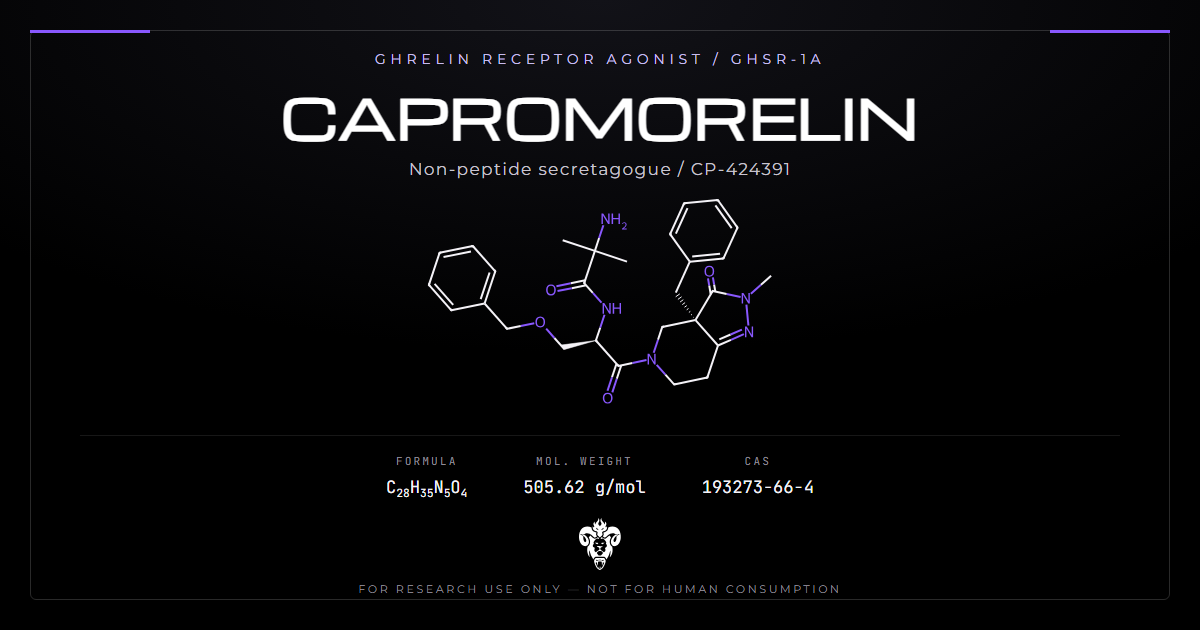
Everything below reports findings from cell cultures, isolated tissue and animals. This material is for research use only, not for human or veterinary use.
Growth hormone secretagogues are mostly peptides. Capromorelin is a small molecule at the same receptor, GHSR-1a. Oral activity is the practical difference.
Published work covers dogs, cats, macaques, birds and rabbits. Indexed papers that mention people exist [3]. Those human endpoints sit outside this profile.
One finding runs through the animal file. Wherever an intake readout moves, a glucose readout often moves with it. That pairing is receptor chemistry, not an appetite product story.
Chemical identity
A non-peptide small molecule, despite acting at a receptor whose natural ligand is a 28-residue peptide.
| Property | Value |
|---|---|
| Common names | Capromorelin, CP-424391, capimorelin |
| Molecular formula | C28H35N5O4 |
| Molecular weight | 505.6 |
| CAS | 193273-66-4 |
| PubChem CID | 216208 |
| InChIKey | KVLLHLWBPNCVNR-SKCUWOTOSA-N |
| Stereocentres | 2 |
| Development code | CP-424391 |
Kimera supplies the material as Capromorelin.
Reading the structure
A fused pyrazolone-piperidine bicycle sits at one end, carrying a benzyl group at the ring-fusion carbon. The side chain carries a benzyl ether. The far end is a 2-amino-2-methylpropanamide cap. Two defined stereocentres fix the geometry.
Nothing about it resembles ghrelin. That is the interesting part. The next section explains why it matters for anyone designing an experiment.
What the bicycle has to get right
The fused pyrazolone-piperidine is the rigid core. A benzyl group sits at the ring-fusion carbon. A second benzyl ether hangs off the side chain. The 2-amino-2-methylpropanamide caps the far end.
Two stereocentres lock that geometry. Invert either one and the lot is a different reagent with the same formula. Mass spectrometry will not see the swap. Chiral chromatography against a reference standard will.
Ghrelin itself is 28 residues with an n-octanoyl on Ser3. Capromorelin copies none of that. It is a mimetic at the receptor, not a fragment of the hormone. A search that treats it as a peptide will miss the metabolite papers [2].
Macimorelin and tabimorelin share the non-peptide secretagogue idea. Shared class is not shared mass. Keep the three names on separate labels when a method is tuned for one of them. A lot that returns 505.6 and the correct InChIKey is Capromorelin. A lot that does not is a different reagent, whatever the bottle says.
Why a non-peptide agonist matters
Ghrelin is a peptide. Peptide agonists at its receptor need parenteral administration. A small molecule does not.
Oral activity is what separates this compound from the peptide agonists in the same class, such as Hexarelin and GHRP-6. The receptor is shared. Delivery is the difference.
Amide bonds are the hydrolysis liability. Both flank the pyrazolinone core. Extreme pH will clip them in water. Buffer near neutral if a stock has to sit.
A salt form is not the free-base mass. Weighing a salt as if it were C28H35N5O4 silently changes every later molarity. The certificate should name the counterion.
The receptor and the class
Growth hormone release runs through a G-protein coupled receptor, GHSR-1a, expressed in the hypothalamus and elsewhere [1].
What GHSR-1a does
Ghrelin, released from the stomach, is the endogenous ligand. Beyond appetite and growth hormone release it touches gut motility, gastric acid secretion, taste, circadian rhythm, glucose metabolism and more [1]. A receptor with that breadth does not produce a clean single effect when an agonist engages it.
Capromorelin is an agonist at that receptor. It is not growth hormone. Ghrelin is a different ligand. An androgen-receptor ligand is a different class. Those four facts keep getting filed together in catalogues. They are four different reagents.
The class is crowded
Capromorelin sits alongside macimorelin, tabimorelin, and the peptide agonists. Analytical work characterising metabolites treats the three non-peptide mimetics together as a group [2].
Related compounds in the catalogue include MK-777, an ester of a different secretagogue. Mechanistic proximity does not make them interchangeable in an experiment.
Peptide neighbours at the same receptor include Hexarelin and GHRP-6. Those write-ups sit at Hexarelin and GHRP-6. MK-677 is the other common non-peptide name in this class. That page is MK-677.
What a cell assay can report
A GHSR-1a-expressing cell line can report calcium or a Gq readout. That is a potency pair against ghrelin, not a use claim.
Name the species of the receptor. A dog receptor and a cat receptor are not a human assay. Capromorelin is orally active in several hosts. That fact does not make those hosts interchangeable.
Indexed papers and what they do not decide
Indexed papers that mention people exist [3]. Human endpoints from those papers sit outside the scope of this profile.
What the citation is for
Reference [3] is a 2009 programme paper in older adults. Use it to find the record. Do not use this page as a use document.
A development programme does not turn a ghrelin-receptor agonist into a laboratory dosing recipe. Identity, GHSR-1a chemistry and animal systems remain the useful questions.
What a laboratory can take from the paper trail
The papers confirm that CP-424391 entered formal study. They do not prove that a research-grade lot matches any historical programme lot. They do not replace a glucose endpoint in a metabolic animal model.
Reviews that discuss veterinary programmes exist as well [1][6]. Those reviews are maps of names and chronology. They are not a product story for this page.
Species chemistry in animals
Field papers in dogs and cats sit beside laboratory work in Beagles, macaques, birds and rabbits [4][5] and [8][12]. This page uses them as host chemistry. It does not treat any named veterinary presentation as a product.
Dogs
A prospective, randomised, masked, placebo-controlled study enrolled 244 client-owned dogs reported inappetent for at least two days, with 177 in the effectiveness analysis [5]. Owners assessed appetite at day 0 and day 3.
A separate laboratory study in healthy Beagles measured food consumption and body weight over four consecutive days [4]. Long-term daily oral work in dogs has its own published evaluation [7]. A review covers the discovery route [6].
Those papers show oral engagement of GHSR-1a in that host. They do not specify a research-lot dose. They do not turn Capromorelin into a veterinary product on this page.
Cats
A 2025 multicentre randomised masked placebo-controlled field study enrolled 176 client-owned cats, dosed once daily for 55 days [8]. Body weight was the recorded endpoint.
That paper is the longest published cat file in this list. Treat it as evidence that the receptor is orally accessible in that species. Do not treat it as a dosing recipe.
Other hosts
Rhesus macaques have a small published file on weight and IGF-I [12]. Broiler chickens show feed-intake and weight-gain readouts [13]. Budgerigars and pigeons add avian intake work [14][15].
The receptor is conserved enough that birds and mammals both appear in the table. Conservation is not identity. A chicken result does not license a dog claim.
Glucose travels with GHSR-1a engagement
This is the through-line, and it holds in the species where anyone looked properly.
Indexed papers that mention people
Reference [3] records glucose-handling readouts alongside composition endpoints. Those human figures sit outside this profile. The cat work below is the measurement this page will quote.
In cats
A dedicated study dosed seven healthy cats with Capromorelin for 30 days [9]. After the first day fasting blood glucose rose by 13 mg/dL and insulin fell. An intravenous glucose tolerance test showed blunting of the first-phase insulin response, from 17,437 to 4,931 ng/L per 15 minutes.
At day 30 the first-phase response was still blunted at 9,993 ng/L per 15 minutes. The effect attenuated without disappearing.
Why this is the finding worth carrying
Two research groups, two decades apart, two different measurement approaches, and the same direction of effect on glucose handling.
The proposed mechanism is coherent. GHSR-1a sits on pancreatic delta cells. Agonism there affects somatostatin signalling, which feeds back onto insulin secretion [9]. This is receptor pharmacology rather than an incidental finding.
For experimental design the implication is direct. Any study using this compound in a metabolic model needs glucose endpoints. The compound moves them whether or not they are the subject.
Capromorelin is therefore a poor choice if the model must hold glucose still. It is a useful choice if the question is whether GHSR-1a engagement moves both intake and insulin timing.
Where the effect does not appear
Negative results are thin on the ground in this literature. The ones that exist are worth naming.
The rabbit disagreement
Two published studies dosed rabbits and disagreed. One compared capromorelin against mirtazapine for appetite in New Zealand White rabbits [10]. Another tested four prokinetic drugs including this one in healthy New Zealand rabbits and found no increase in fecal output or food intake [11].
The second used a single dose in a crossover design. The first ran a comparison against an active drug. Different designs answering different questions is the ordinary explanation. Neither result cancels the other.
The species range is unusually wide
| Species | Design | Outcome |
|---|---|---|
| Dog, n=244 | RCT, owner-assessed, 3 days | Appetite improved [5] |
| Dog, Beagle | Controlled, 4 days | Food consumption and weight up [4] |
| Cat, n=176 | RCT, 55 days | Body weight moved [8] |
| Cat, n=7 | Open, 30 days | Glucose up, first-phase insulin blunted [9] |
| Rhesus macaque, n=6 | Laboratory file | Weight and IGF-I assessed [12] |
| Broiler chicken | Controlled | Feed intake and weight gain up [13] |
| Rabbit | Crossover, single dose | No increase in intake or output [11] |
| Rabbit | Versus mirtazapine | Appetite compared [10] |
| Budgerigar | Versus two comparators | Food intake compared [14] |
| Pigeon | Controlled | Appetite and weight gain [15] |
Very few research compounds have a comparative dataset this broad. The list exists because the receptor is conserved and the molecule is orally active. It does not exist because anyone built a phylogenetic comparison on purpose.
What the breadth is good for, and what it is not
As a source of cross-species pharmacology this file is useful. The receptor is conserved. Direction of effect is consistent in most mammals and birds. Oral activity holds across those hosts.
As a basis for predicting a new species it is weaker than it looks. The rabbit results already disagree with each other. The avian studies are small. Breadth of species is not depth of evidence. A long list reads as thorough. It is not.
Analytical chemistry
Detection work treats Capromorelin alongside macimorelin and tabimorelin, characterising metabolites as potential markers [2]. That work exists for doping control. The relevant question there is whether an administered compound can be shown after the parent has cleared.
For laboratory verification the useful consequence is that metabolite profiles for this compound are published rather than inferred.
Why that matters more than it sounds
Most catalogue compounds have no published metabolite map. Detection then depends on finding the parent. That limits the useful window to hours.
A characterised metabolite extends that window. It also gives a second identity check. A sample producing the parent mass but none of the expected metabolites in a biological system is worth a second look.
The class shares a detection problem
The three non-peptide mimetics are structurally related. Their metabolites overlap [2]. A method tuned for one can respond to another.
That is why the published work characterises all three together rather than singly. Anyone adapting a method from that literature should keep the comparators in the run.
Capromorelin is the 505.6 Da member of that trio. Confirm mass before trusting a shared method. A peak at the wrong mass is a different mimetic, not a weak lot of this one.
Related secretagogues that are not this molecule
Most confusion about Capromorelin comes from treating every GHSR-1a name as one reagent.
Peptide agonists
Hexarelin and GHRP-6 are peptides. They share the receptor and not the delivery problem. They also carry photodegradation and proteolysis liabilities that this small molecule does not.
A protocol written for a hexapeptide does not transfer. A certificate written for a hexapeptide does not identify this lot.
Other non-peptides
Macimorelin and tabimorelin sit in the same metabolite paper [2]. MK-677 is the name most catalogues file next to this one. Same receptor. Different molecule. Different mass.
MK-777 is an ester of a different secretagogue. Do not treat an ester as Capromorelin.
Why read-across fails
Oral activity is a shared practical fact, not a shared identity. A Beagle intake result [4] does not identify an unknown vial. A cat glucose result [9] does not license a claim about another host.
Write the name, the mass and the receptor on the first line of a notebook page. Everything else in this profile is a check on those three facts.
How to read a Capromorelin study
Four questions separate a transferable result from a species-specific one.
Which species?
Capromorelin is studied across at least nine species. A dog experiment and a macaque experiment are not the same design. The rabbit literature already disagrees with itself [10][11].
Which endpoint?
Owner-assessed appetite [5], measured food consumption [6], and body weight over 55 days [8] are three different measures. The first is subjective by design and appropriate for its purpose.
Over what duration?
Effects change with time. The cat glucose work shows first-phase insulin blunting attenuating between day 1 and day 30 without resolving [9]. A single-day result and a 30-day result describe different states.
Was glucose measured?
If not, the study has an uncontrolled variable, given the feline findings [9]. Indexed papers that mention people record the same direction [3].
This applies well beyond metabolic work. Appetite, activity and body composition all interact with glucose handling. A study measuring any of those without a glucose endpoint has left a known effect unobserved.
Was the comparator active or placebo?
Both appear in this literature and they answer different questions. The dog and cat field papers used placebo controls [5][8]. The rabbit and budgerigar work compared against mirtazapine and cyproheptadine [10][14].
An active comparator tells you which reagent performed better in that setting. It does not establish that either beat no treatment. Reading a comparative result as an absolute one is the most common error this literature invites.
Verifying research material
Capromorelin is a defined chemical entity with published identifiers, so verification is arithmetic rather than judgement. Batch documentation sits on the certificates of analysis page.
Identity
Formula C28H35N5O4, molecular weight 505.6, InChIKey KVLLHLWBPNCVNR-SKCUWOTOSA-N. Mass spectrometry should land near 505.6. CP-424391 is the development code that appears in older literature.
Stereochemistry
Two defined stereocentres carry the activity. Mass spectrometry cannot see either. A diastereomer shares the formula and the mass exactly.
Chiral chromatography against a reference standard is the check that answers it. For a small molecule this is more tractable than the equivalent problem in a peptide, where hydrolysis and amino acid analysis are needed.
Handling
A small molecule of this size is more forgiving than the peptide agonists in the same class. It does not carry the photodegradation and proteolysis liabilities that make GHRP-6 and its relatives awkward to store.
Ordinary practice applies. Store the lyophilised powder cold, dry and dark, and reconstitute close to the point of use.
Storage guidance is a house recommendation. Analytical documentation is per-lot release testing.
The amide bonds are the hydrolysis risk. Both flank the pyrazolinone core. Aqueous solutions at extreme pH will cleave them over time. Buffer near neutral if a stock has to sit.
A second handling question is the salt form. Research lots arrive as free base or as a salt. The certificate should name the counterion, because that mass is not the 505.6 free-base figure. Weighing a salt as if it were free base silently changes the molarity of every later dilution.
What a certificate should show
Three numbers and one technique. Mass near 505.6, a purity figure with its method named, and a chromatographic trace rather than a bare percentage.
Ask whether the method separates diastereomers. Many routine purity assays do not. Capromorelin has two stereocentres to get wrong. A certificate reporting 99% by a method blind to stereochemistry is answering a narrower question than it appears to.
Intact mass, then a chiral check, then a reversed-phase trace. That order finds the failures that a single HPLC area percent hides.
Common questions about Capromorelin
Class and identity
Is Capromorelin a SARM? No. It is a ghrelin receptor agonist and growth hormone secretagogue, acting at GHSR-1a. It has no androgen receptor activity. The two mechanisms are unrelated.
Does this page report human outcomes? No. Indexed papers that mention people are listed so they can be found [3]. This profile stops at identity, receptor chemistry and animal systems.
Which hosts have published files? Dogs and cats, with laboratory support in Beagles [4][5] and [8]. Birds, rabbits and macaques add breadth [10][11], [12][13] and [14][15].
Mechanism and evidence
Why does it need no injection? It is a non-peptide small molecule, unlike ghrelin itself and unlike the peptide agonists in the class.
Does it affect blood sugar? Yes, in the species where it was measured properly. Fasting glucose rose and first-phase insulin blunted in cats [9]. Indexed papers that mention people record the same direction [3].
What is CP-424391? The development code. Older papers use it.
Is it related to MK-677? Same receptor, same class, different molecule. Both are non-peptide growth hormone secretagogues at GHSR-1a. Neither is an androgen receptor modulator, despite how the two are often filed together.
Which species has the longest published file? Cats, on current evidence. The 176-cat paper ran 55 days with a placebo control and a body-weight endpoint [8]. The dog data are larger in total but shorter per study.
Does it raise growth hormone directly? It triggers release rather than supplying hormone. Indexed papers that mention people recorded nocturnal growth hormone readouts [3]. This profile does not quote those figures.
Analysis
Is there a published metabolite profile? Yes, characterised alongside macimorelin and tabimorelin [2]. That is unusual for a compound at this scale and useful for identity work.
Summary of the evidence
Write the name, the mass and the receptor on the first line of a notebook page. Capromorelin is C28H35N5O4, 505.6 Da, InChIKey KVLLHLWBPNCVNR-SKCUWOTOSA-N, agonist at GHSR-1a.
Strongest animal file: dogs and cats, with Beagle laboratory support [4][5], [6][7] and [8]. The cat glucose work is the cleanest receptor-pharmacology result in that set [9].
Also strong, and easy to overlook: metabolite maps that treat this molecule with macimorelin and tabimorelin [2]. Use those maps for identity. Do not use them as a use document.
Weakest evidence: everything outside dogs and cats. The macaque [12], poultry [13] and avian [14][15] studies are small. The two rabbit studies disagree [10][11].
Indexed papers that mention people remain in the list so a reader can find them [3]. Human endpoints stay out.
The rest of this class sits in the endocrine category.
Status: supplied for laboratory research use only.
References
- Rathore M, Das N, Ghosh N, Guha R. Insights on discovery, efficacy, safety and clinical applications of ghrelin receptor agonist capromorelin in veterinary medicine. Vet Res Commun. 2024;48(1):1-10. PMID 37493940. DOI
- Lange T, Thomas A, Görgens C, Bidlingmaier M, Schilbach K, Fichant E, Delahaut P, Thevis M. Comprehensive insights into the formation of metabolites of the ghrelin mimetics capromorelin, macimorelin and tabimorelin as potential markers for doping control purposes. Biomed Chromatogr. 2021;35(6):e5075. PMID 33458843. DOI
- White HK, Petrie CD, Landschulz W, MacLean D, Taylor A, Lyles K, Wei JY, Hoffman AR, et al. Effects of an oral growth hormone secretagogue in older adults. J Clin Endocrinol Metab. 2009;94(4):1198-1206. PMID 19174493. DOI
- Zollers B, Rhodes L, Heinen E. Capromorelin oral solution (ENTYCE) increases food consumption and body weight when administered for 4 consecutive days to healthy adult Beagle dogs in a randomized, masked, placebo controlled study. BMC Vet Res. 2017;13(1):10. PMID 28056951. DOI
- Zollers B, Wofford JA, Heinen E, Huebner M, Rhodes L. A prospective, randomized, masked, placebo-controlled clinical study of capromorelin in dogs with reduced appetite. J Vet Intern Med. 2016;30(6):1851-1857. PMID 27859746. DOI
- Rhodes L, Zollers B, Wofford JA, Heinen E. Capromorelin: a ghrelin receptor agonist and novel therapy for stimulation of appetite in dogs. Vet Med Sci. 2018;4(1):3-16. PMID 29468076. DOI
- Zollers B, Huebner M, Armintrout G, Rausch-Derra LC, Rhodes L. Evaluation of the safety in dogs of long-term, daily oral administration of capromorelin, a novel drug for stimulation of appetite. J Vet Pharmacol Ther. 2017;40(3):248-255. PMID 27665742. DOI
- Wofford JA, Milliken MacKinnon A, Heinen E. Capromorelin promotes weight gain in cats with unintended weight loss: a randomized, masked, placebo-controlled clinical trial. J Feline Med Surg. 2025;27(11):1098612X251379924. PMID 41204815. DOI
- Pires J, Greathouse RL, Quach N, Huising MO, Crakes KR, Miller M, Gilor C. The effect of the ghrelin-receptor agonist capromorelin on glucose metabolism in healthy cats. Domest Anim Endocrinol. 2021;74:106484. PMID 32619812. DOI
- Draper JM, Savson DJ, Lavin ES, Feldman ER, Singh B, Martin-Flores M, Daugherity EK. Comparison of effects of capromorelin and mirtazapine on appetite in New Zealand White rabbits (Oryctolagus cuniculus). J Am Assoc Lab Anim Sci. 2022;61(5):495-505. PMID 35981857. DOI
- Di Girolamo N, Maranville RE, Pathak D, Womble W, Hanzlicek A, Sypniewski L, Brandão J. The 4 prokinetic drugs metoclopramide, cisapride, pyridostigmine, and capromorelin do not increase fecal output or food intake in healthy New Zealand rabbits (Oryctolagus cuniculus). J Am Vet Med Assoc. 2025;263(6):755-761. PMID 40179972. DOI
- Campellone GA, Easley KA, Jenkins JB, Jean SM. Evaluating the safety and efficacy of capromorelin in rhesus macaques (Macaca mulatta). J Am Assoc Lab Anim Sci. 2024;63(3):268-278. PMID 38423529. DOI
- Ceron-Romero N, Taofeek N, Thomas A, Vroonland E, Sanmartin K, Verghese M, Heinen E, Vizcarra JA. Capromorelin, a ghrelin receptor agonist, increases feed intake and body weight gain in broiler chickens (Gallus gallus domesticus). Poult Sci. 2021;100(8):101204. PMID 34182219. DOI
- Titel C, Doss G, Mans C. Effects of capromorelin, mirtazapine, and cyproheptadine on food intake in budgerigars (Melopsittacus undulatus). J Avian Med Surg. 2025;39(2):68-74. PMID 40638135. DOI
- Trumpp K, Burns L, Jacobson C, Divers SJ. Effect of capromorelin on appetite and weight gain of domestic pigeons (Columba livia domestica). J Avian Med Surg. 2025;38(4):197-201. PMID 39772380. DOI
Capromorelin is sold for laboratory research use only. Not for human consumption, nor medical, veterinary, or household uses.