
Everything below reports findings from cell cultures, isolated tissue and animals. This material is for research use only, not for human or veterinary use.
CJC-1295 is a tetrasubstituted analog of human growth hormone-releasing factor 1-29, built at ConjuChem to bind covalently to circulating albumin. That albumin bond is the entire point of the molecule. It is also the thing most often stripped out by the name as catalogues use it.
Laboratories buying under this name are buying one of two different peptides. The split is whether the DAC group is present.
Indexed papers in people exist [2][3] and [4]. Those human endpoints sit outside this profile. The parked half-life from that file stays, because it is identity chemistry for the conjugate.
What is CJC-1295?
Native hGRF(1-29) has the sequence YADAIFTNSYRKVLGQLSARKLLQDIMSR, amidated at the C terminus. CJC-1295 modifies four positions: D-alanine at position 2, glutamine at 8, alanine at 15, and leucine at 27. Jette and colleagues at ConjuChem then added a lysine at position 30 carrying an N-epsilon-3-maleimidopropionamide group [1].
That maleimide is the drug affinity complex, or DAC. It reacts with the free thiol on Cys34 of serum albumin, forming a covalent bioconjugate in circulation.
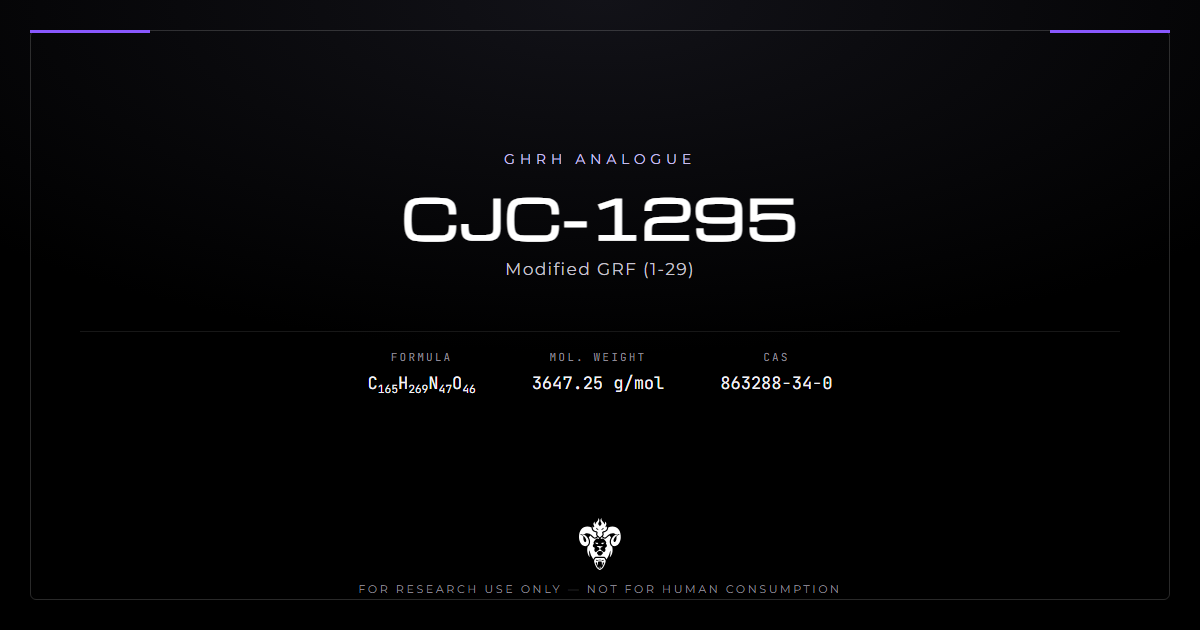
The full molecule is C165H269N47O46, molecular weight 3647.2 g/mol, CAS 863288-34-0, indexed as PubChem CID 91971820.
Reading the backbone
The 1-29 fragment is the receptor-binding region of native GHRH. Sermorelin is that fragment with an amide and no substitutions. CJC-1295 keeps the amide and then changes four residues plus the C-terminal handle.
Position 2 is D-alanine rather than L-alanine. That swap is invisible to intact mass. Glutamine sits at residue 8. Alanine sits at residue 15. Leucine sits at residue 27. Those three are ordinary L residues. A lot that missed only the D-alanine still looks like CJC-1295 on a low-resolution scan.
One methionine sits in the parent hormone family. Oxidation of that residue adds 16 Da. Watch the certificate for a +16 satellite. A sulfoxide is a different species with the same sequence claim.
Sermorelin sits near 3358 Da. Tesamorelin sits near 5136 Da. CJC-1295 sits at 3647 Da when the DAC group is present. Those three masses do not overlap. A methods section that names CJC-1295 and then quotes 3358 has named the wrong reagent.
| Property | Value |
|---|---|
| Class | GHRH (GRF) analog, tetrasubstituted hGRF(1-29) |
| Substitutions | D-Ala2, Gln8, Ala15, Leu27 |
| DAC group | N-epsilon-3-maleimidopropionamide on Lys30 |
| CAS | 863288-34-0 |
| Molecular formula | C165H269N47O46 |
| Molecular weight | 3647.2 g/mol |
| PubChem CID | 91971820 |
| Form | Lyophilised solid |
CJC-1295 with DAC and CJC-1295 no DAC are different molecules
This is the most consequential fact about the compound and the one most often lost.
The four substitutions at positions 2, 8, 15, and 27 give the peptide resistance to dipeptidyl peptidase-IV, the enzyme that clips native GRF at the N terminus. Those substitutions alone produce the 29-residue peptide sold as CJC-1295 no DAC. That material is more accurately called Modified GRF(1-29). It has no maleimide and cannot conjugate to albumin.
CJC-1295 with DAC carries the Lys30 maleimide and does conjugate. The published half-life of 5.8 to 8.1 days belongs to that conjugate, not to the peptide backbone [2].
Every primary paper cited below used the DAC form. Searching the literature for “CJC-1295” and applying the results to the no-DAC peptide attributes a pharmacokinetic profile to a molecule that lacks the group responsible for it. The two compounds share a backbone and differ by one residue and one reactive handle. That handle is what the entire pharmacology rests on.
A validated anti-doping method treats the two forms as separate analytes requiring separate reference materials [8]. The analytical literature therefore confirms what the naming convention obscures.
Mechanism of action
GRF binds the GHRH receptor on pituitary somatotropes and drives synthesis and release of growth hormone. Growth hormone in turn raises IGF-1. Native GRF is useless as a sustained stimulus because plasma enzymes destroy it quickly.
Why position 2 carries the protective load
The specific vulnerability is position 2. Kubiak and colleagues showed that DPP-IV hydrolyses Ala2-containing GRFs by cleaving between Ala2 and Asp3. Mouse GRF carries Val2 instead and resists that cleavage.
The same work incubated two bovine GRF analogs in plasma, including [Ala15,Leu27]bGRF(1-29)NH2. Both converted to their (3-29) fragments [5]. Two of those substitutions match CJC-1295 at positions 15 and 27. That is why the position-2 change carries the protective load.
Two problems, two features
CJC-1295 addresses both halves of the problem. The tetrasubstitution blocks enzymatic clipping. The maleimide anchors the peptide to albumin, a carrier with a plasma residence time measured in weeks.
Kubiak’s work also carries a caution. Blocking DPP-IV does not make a GRF peptide durable on its own, because trypsin-like and other proteolytic cleavages continue elsewhere in the chain [5]. Albumin conjugation, not the substitutions, is what produces the multi-day half-life.
Jette and colleagues synthesised three maleimido derivatives of hGRF(1-29) and conjugated them to human serum albumin. All three resisted DPP-IV and remained bioactive in a GH secretion assay in cultured rat anterior pituitary cells [1].
Albumin conjugation in rats
Subcutaneous administration to Sprague-Dawley rats produced acute GH secretion. CJC-1295 gave a fourfold increase in GH area under the curve over two hours compared with unmodified hGRF(1-29). Western blot of plasma from an injected rat showed CJC-1295 immunoreactivity on the band corresponding to serum albumin, appearing at 15 minutes and still present beyond 24 hours [1].
The knockout-mouse test of the receptor arm
Alba and colleagues treated GHRH-knockout mice from one week of age for five weeks, dosing 2 ug at intervals of 24, 48 or 72 hours [7]. Placebo-treated knockouts and heterozygous animals served as controls.
Daily dosing normalised body weight and length. Femur and tibia length stayed normal in animals treated every 24 and 48 hours. Relative lean mass and subcutaneous fat mass were normal across all treated groups [7]. Longer intervals produced partial rather than full normalisation [7].
Treatment increased total pituitary RNA and growth hormone messenger RNA. The authors attributed that to somatotroph proliferation and confirmed it immunohistochemically [7].
That result places the effect at the receptor. In an animal with no endogenous GHRH at all, the analogue alone restored normal growth.
Indexed papers and parked kinetics
Three papers define the human file [2][3] and [4]. Human PD endpoints from those papers sit outside this profile.
The half-life that belongs to the conjugate
Teichman and colleagues ran two randomised, placebo-controlled, double-blind ascending-dose papers in healthy adults aged 21 to 61 [2]. The estimated half-life was 5.8 to 8.1 days [2].
That number is the conjugate’s identity claim. It does not apply to Modified GRF(1-29). It does not license a human dose. Sample over days, not hours, if the DAC form is the reagent.
What the other two papers asked
Ionescu and Frohman asked whether continuous stimulation flattens a pulsatile axis [3]. Sackmann-Sala and colleagues hunted serum-protein markers of axis engagement [4]. Those human figures stay out. Cite the papers to find them.
What this profile will not do
It will not quote human fold-changes, human adverse-event rates, or human microgram-per-kilogram ladders. Those sentences turn a research article into a use document. The papers remain cited so a reader can find them [2][3] and [4].
Tesamorelin is a different GHRH analogue, a 1-44 chain with an N-terminal acyl cap. Indexed papers on that molecule exist [6]. They do not transfer to CJC-1295. Related write-ups sit at tesamorelin and sermorelin.
Physicochemical properties and handling
Supplied lyophilised, the peptide is stable at low temperature and away from light and moisture. Once in aqueous solution, two degradation routes matter.
The maleimide is a thiol-reactive electrophile. Any free thiol in the buffer competes with the intended target and consumes it. Reducing agents such as DTT or 2-mercaptoethanol are the usual culprits.
Maleimides also hydrolyse at elevated pH to the unreactive maleamic acid. That reaction destroys DAC function. It barely changes the peptide mass, so a mass check alone will not catch it.
Store the lyophilised powder cold, dry and dark, and reconstitute close to the point of use.
Storage guidance is a house recommendation. Analytical documentation is per-lot release testing.
Avoid repeated freeze-thaw cycles. Aliquot instead.
A no-DAC preparation is roughly 280 Da lighter and is a different product. Hydrolysed maleimide is a further small mass shift and is not visible at all in a purity number.
Trifluoroacetate from cleavage cocktails is common on research peptides. That counterion changes both the mass of the salt form and the peptide content of a weighed vial. Acetate exchange, if it was done, belongs on the certificate next to the free-base mass. Do not infer the salt from the sequence.
Maleimide hydrolysis is pH-dependent. Neutral or slightly acidic reconstitution slows it. Alkaline buffers accelerate it. A lot that sat in a basic stock is a different reagent even if the label still says DAC.
Surface adsorption is a third handling problem. Dilute solutions lose peptide to plastic. Aliquot on reconstitution rather than sampling one vial repeatedly.
Analytical characterization and quality
Peptide identity work rests on accurate mass and sequence confirmation. For a 30-mer at 3647 Da, high-resolution LC-MS gives the intact mass. MS/MS fragmentation confirms the sequence rather than merely the composition. That distinction matters here, because a deletion or a substitution elsewhere in the chain can leave the total mass close to correct.
Three checks specific to this molecule
Confirm the DAC group is present and intact. A no-DAC preparation is roughly 280 Da lighter and is a different product. Hydrolysed maleimide is a further small mass shift and is not visible at all in a purity number.
Confirm the D-alanine at position 2. Standard MS cannot distinguish D-Ala from L-Ala, and the L form is DPP-IV labile. This needs chiral amino acid analysis after hydrolysis.
Confirm net peptide content rather than chromatographic purity alone. Lyophilised material carries water and counter-ion mass, so HPLC area percent overstates how much peptide is in the vial.
Kimera publishes third-party certificates of analysis for every lot in its COA database. More peptide chemistry appears in the peptides category.
The conjugation chemistry in detail
The albumin bond is what makes this molecule work, and the chemistry is worth understanding rather than taking on trust.
Why Cys34
Human serum albumin carries 35 cysteine residues. Disulfide bridges lock 34 of them. Cysteine 34 is the exception, presenting the only free thiol on the protein.
That single reactive site makes albumin a viable conjugation partner in circulation. A maleimide group reacts with thiols selectively and rapidly under physiological conditions, forming a stable thioether bond.
Jette and colleagues exploited exactly that. They synthesised three maleimido derivatives of human growth hormone-releasing factor 1-29 and conjugated them to albumin. The best performer went forward [1]. Western blot analysis of plasma from injected rats showed the compound on the band corresponding to serum albumin within 15 minutes. It remained there beyond 24 hours [1].
Why the peptide needed protecting
The reason for going to this trouble is enzymatic. Dipeptidyl peptidase IV cleaves native growth hormone-releasing hormone rapidly, removing residues from the amino terminus.
The tetrasubstitution addresses this. All three albumin conjugates in the original work showed enhanced in vitro stability against that enzyme [1]. The substitutions serve that purpose rather than receptor affinity.
Two problems therefore get solved by two different features. Amino acid substitution blocks enzymatic degradation. The maleimide extends circulation time by attaching the peptide to a protein with a multi-week half-life.
Nothing published characterises what fraction of an administered dose actually conjugates to albumin under real conditions. The ratio of bound to free peptide in circulation is unmeasured [1][10].
Two routes to the same axis
Discussions frequently place CJC-1295 alongside compounds that raise growth hormone by a different route. The distinction is worth keeping clear.
| Feature | CJC-1295 | Ghrelin receptor agonists |
|---|---|---|
| Receptor | GHRH receptor | Growth hormone secretagogue receptor |
| Endogenous ligand mimicked | GHRH | Ghrelin |
| Molecule type | Peptide, 29 residues plus DAC | Small molecules or peptides |
| Half-life driver | Albumin thioether [1][2] | Compound-specific |
| Pulse question in the file | Indexed paper exists [3] | Separate literature [12] |
Both routes converge on pituitary somatotrophs. Smith reviews the secretagogue class as a separate receptor story [12].
They are not interchangeable experimentally. A GHRH analogue tests the GHRH receptor arm specifically. Any study attributing an effect to that receptor needs a compound acting there rather than at the ghrelin receptor.
Detection and the analytical problem
The doping-control literature contains the most rigorous analytical work on this compound, and it identifies a specific difficulty.
Timms and colleagues stated the problem plainly. Three features make conjugated CJC-1295 difficult to detect in blood by mass spectrometry: low abundance, high molecular weight once bound, and conjugation to a range of different protein substrates [10].
That last point is the awkward one. The compound does not exist as a single species in circulation. It exists as a family of conjugates, and that defeats methods expecting one analyte at one mass.
Their solution combined immunoaffinity capture with tryptic digestion before liquid chromatography tandem mass spectrometry. It reached detection down to 180 pg/mL in equine plasma [10]. Thomas and colleagues developed a comparable immunoaffinity approach covering twelve prohibited peptides including this one, at low picogram per millilitre limits [9].
The most directly relevant study for identity purposes is more recent. Memdouh and colleagues investigated in vitro metabolism and detection of four larger GHRH analogues. Their list runs sermorelin, tesamorelin, CJC-1295, and CJC-1295 with drug affinity complex [8].
Read that list carefully. A validated method treats the two forms as separate analytes requiring separate reference materials.
That study identified nineteen major in vitro metabolites. The authors synthesised and characterised them in house as reference materials, achieving detection limits generally at or below 1 ng/mL [8].
How the name circulates outside the laboratory
Van Hout and Hearne analysed discussion threads that used this name for more than one material [11]. Their relevant finding concerns information quality rather than effects. Two forms differ in half-life by orders of magnitude. A community discussing both under one name produces exactly the confusion this article opens with.
Common misclassifications
Four errors recur.
Suppliers treat the DAC and no-DAC forms as the same compound at different strengths. They differ by the maleimide group producing albumin binding, and therefore by their entire pharmacokinetic profile [1][8].
Summaries apply the conjugate half-life to the no-DAC form. Every indexed paper cited here used the albumin-binding compound [2][3] and [4].
Copy describes the compound as a growth hormone. It is a releasing-hormone analogue acting on pituitary somatotrophs [3][12].
Readers assume detection is straightforward. Conjugation to multiple protein substrates complicates direct mass spectrometric detection, and validated methods require immunoaffinity capture [9][10].
How to read a CJC-1295 result
State which form the study used, specifying the maleimide as present or absent. This is the single most important methodological detail for this compound.
Which structure was measured?
Intact mass near 3647 Da, CAS 863288-34-0, CID 91971820, Lys30 maleimide present. A lot missing that handle is Modified GRF(1-29).
Which receptor assay?
State the cell line or pituitary system, the species of the receptor, and whether GH release was the readout. Dual naming (DAC versus no DAC) does not change the assay. It changes the reagent.
Which analogue family?
Tetrasubstituted 1-29 with DAC is one reagent. Unmodified 1-29 is sermorelin. Full-length 1-44 with an acyl cap is tesamorelin. Ghrelin-receptor secretagogues are a fourth family [12]. Do not pool them.
Is the half-life being asked to do too much?
The 5.8 to 8.1 day estimate belongs to the conjugate [2]. Half-life cannot identify an unknown vial. A mapped digest still has to do that work. The no-DAC peptide does not inherit the number.
Frequently asked questions
What is CJC-1295? A tetrasubstituted analog of hGRF(1-29) bearing a maleimide group that conjugates covalently to serum albumin.
What does DAC mean? Drug affinity complex. The term refers to the N-epsilon-3-maleimidopropionamide on Lys30 that reacts with Cys34 of albumin [1].
Is CJC-1295 no DAC the same compound? No. That product is Modified GRF(1-29), the 29-residue peptide without the maleimide. Lacking the reactive handle, it cannot bind albumin, and none of the published CJC-1295 pharmacokinetics applies to it.
Does this page report human outcomes? No. Indexed papers are listed so they can be found [2][3] and [4]. This profile keeps the conjugate half-life and stops at chemistry, rat work and analytical identity.
Why do the four substitutions matter? Position 2 does the protective work. DPP-IV cleaves Ala2-containing GRFs between Ala2 and Asp3, and the D-alanine blocks it [5]. Other proteases still act elsewhere, so the substitutions alone do not confer a long half-life [5].
How much CJC-1295 literature exists compared with the class? Four primary papers on CJC-1295 against a GHRH-analog class that also includes tesamorelin [6]. Those tesamorelin papers do not transfer.
Can standard mass spectrometry confirm the D-alanine? No. D-Ala and L-Ala have identical mass. Chiral amino acid analysis after hydrolysis is required.
How much literature exists? Four primary papers, published between 2005 and 2009, all using the DAC form [1][2] and [3][4]. Later analytical papers treat the two commercial names as separate analytes [8][9] and [10].
Write the name, the mass and the handle on the first line of a notebook page. DAC present or absent decides which reagent is in the vial. A certificate that omits intact mass is not finished.
Status: supplied for laboratory research use only.
References
- Jetté L, Léger R, Thibaudeau K, et al. Human growth hormone-releasing factor (hGRF)1-29-albumin bioconjugates activate the GRF receptor on the anterior pituitary in rats: identification of CJC-1295 as a long-lasting GRF analog. Endocrinology. 2005;146(7):3052-3058. PMID 15817669. DOI
- Teichman SL, Neale A, Lawrence B, Gagnon C, Castaigne JP, Frohman LA. Prolonged stimulation of growth hormone (GH) and insulin-like growth factor I secretion by CJC-1295, a long-acting analog of GH-releasing hormone, in healthy adults. J Clin Endocrinol Metab. 2006;91(3):799-805. PMID 16352683. DOI
- Ionescu M, Frohman LA. Pulsatile secretion of growth hormone (GH) persists during continuous stimulation by CJC-1295, a long-acting GH-releasing hormone analog. J Clin Endocrinol Metab. 2006;91(12):4792-4797. PMID 17018654. DOI
- Sackmann-Sala L, Ding J, Frohman LA, Kopchick JJ. Activation of the GH/IGF-1 axis by CJC-1295, a long-acting GHRH analog, results in serum protein profile changes in normal adult subjects. Growth Horm IGF Res. 2009;19(6):471-477. PMID 19386527. DOI
- Kubiak TM, Martin RA, Leone JW, Cleary DL. Metabolism of mouse growth hormone-releasing factor, mGRF(1-42)OH, and selected analogs from the bovine GRF series in mouse and bovine plasma in vitro. Pept Res. 1994;7(3):153-161. PMID 7915920
-
Adrian S, Scherzinger A, Sanyal A, et al. The Growth Hormone Releasing Hormone Analogue, Tesamorelin, Decreases Muscle Fat and Increases Muscle Area in Adults with HIV. J Frailty Aging. 2019;8(3):154-159. PMID 31237318. DOI
-
Alba M, Fintini D, Sagazio A, et al. Once-daily administration of CJC-1295, a long-acting growth hormone-releasing hormone (GHRH) analog, normalizes growth in the GHRH knockout mouse. Am J Physiol Endocrinol Metab. 2006;291(6):E1290-E1294. PMID 16822960. DOI
- Memdouh S, Gavrilović I, Ng K, Cowan D, Abbate V. Advances in the detection of growth hormone releasing hormone synthetic analogs. Drug Test Anal. 2021;13(11-12):1871-1887. PMID 34665524. DOI
- Thomas A, Schänzer W, Delahaut P, Thevis M. Immunoaffinity purification of peptide hormones prior to liquid chromatography-mass spectrometry in doping controls. Methods. 2012;56(2):230-235. PMID 21871962. DOI
- Timms M, Ganio K, Steel R. A method for confirming CJC-1295 abuse in equine plasma samples by LC-MS/MS. Drug Test Anal. 2019;11(8):1248-1257. PMID 30938069. DOI
- Van Hout MC, Hearne E. Netnography of female use of the synthetic growth hormone CJC-1295: pulses and potions. Subst Use Misuse. 2016;51(1):73-84. PMID 26771670. DOI
- Smith RG. Development of growth hormone secretagogues. Endocr Rev. 2005;26(3):346-360. PMID 15814848. DOI
CJC-1295 is sold for laboratory research use only. Not for human consumption, nor medical, veterinary, or household uses.
Literature retrieved from PubMed.