
Everything below reports findings from cell cultures, isolated tissue and animals. This material is for research use only, not for human or veterinary use.
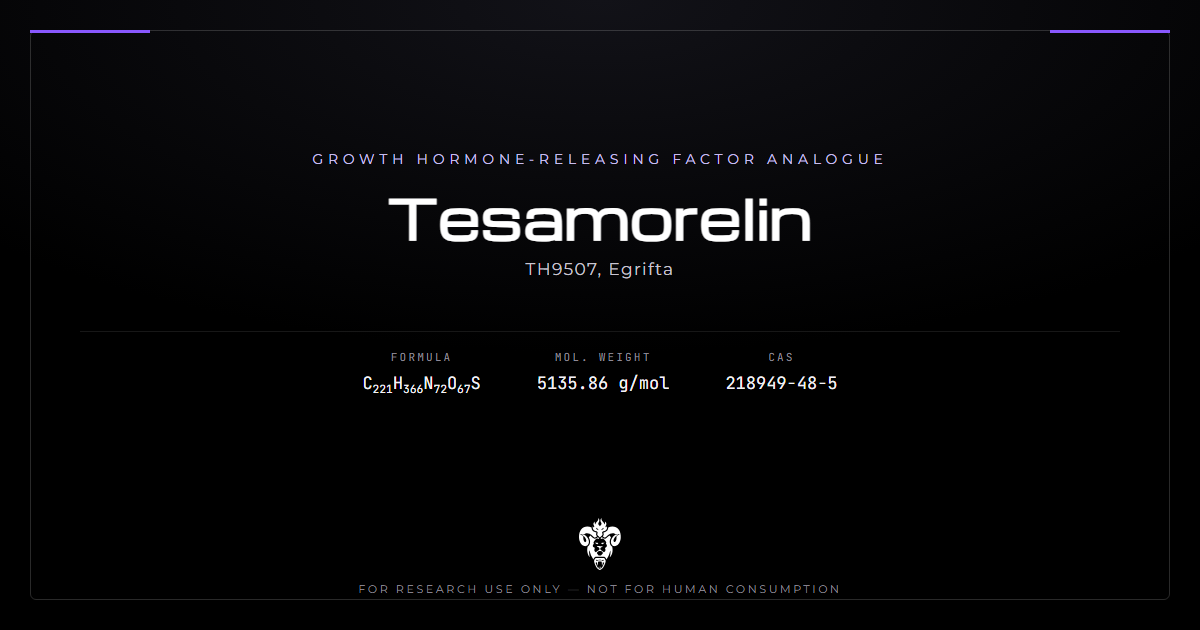
Tesamorelin carries two catalogue labels. One is TH9507, the development code assigned by the company that built it. The other is the generic name. Both describe one molecule: human growth hormone-releasing hormone, residues 1 to 44, amidated at the C-terminus, with a six-carbon acyl chain on the N-terminal tyrosine.
A long list of indexed clinical papers exists. Those human endpoints are outside the scope of this profile. The laboratory questions are identity, the GHRH receptor, and the enzymology that predicted the acyl group.
Chemical identity
The molecule is human growth hormone-releasing hormone, residues 1 to 44, amidated at the C-terminus. A six-carbon acyl chain sits on the N-terminal tyrosine.
| Property | Value |
|---|---|
| Systematic description | trans-3-hexenoyl-hGRF(1-44)-NH2 |
| Common names | Tesamorelin, TH9507 |
| Molecular formula | C221H366N72O67S |
| Average mass | 5135.9 g/mol |
| Monoisotopic mass | 5134.72 Da |
| CAS number | 218949-48-5 |
| PubChem CID | 16137828 |
| InChIKey | QBEPNUQJQWDYKU-BMGKTWPMSA-N |
| Residues | 44 |
| Stereocentres | 88 |
| Sulfur atoms | 1, from the single methionine |
| N-terminal modification | trans-3-hexenoyl, E configuration |
At 5,136 daltons Tesamorelin sits at the top of the peptide range. Solid-phase synthesis of 44 residues is demanding, and that difficulty drives the purity questions covered below.
The sequence
The chain reads YADAIFTNSYRKVLGQLSARKLLQDIMSRQQGESNQERGARARL, capped as the C-terminal amide. Three features matter in the laboratory.
One methionine sits at position 27, the only sulfur in the molecule. Methionine oxidises to the sulfoxide, adding 16 daltons.
Six arginines and two lysines outweigh two aspartates and two glutamates. Tesamorelin is therefore a basic peptide, and it behaves that way on ion exchange.
The C-terminal amide reproduces the native hormone. A lot ending in a free acid is a different molecule, one dalton heavier.
What the hexenoyl group does
Native GHRH(1-44) begins Tyr-Ala-Asp, and that opening pair is a liability.
Dipeptidyl peptidase IV strips N-terminal dipeptides from substrates carrying alanine in the second position. GHRH presents exactly that motif. Circulating hormone loses its first two residues, and its activity with them.
Acylating the tyrosine amine removes the free N-terminus the enzyme requires. Every residue past position 2 stays identical to the native hormone, so the receptor still sees a familiar ligand.
Baker and colleagues call tesamorelin a stabilised analogue of human GHRH [10]. One word covers the entire structural difference. The trans-3-hexenoyl group is that difference.
The 1992 enzymology that predicted it
Bongers and colleagues worked out the kinetics before this compound existed (PMID 1353684, DOI). They incubated synthetic human GRF and a series of analogues with purified placental DPP-IV, then followed the products by HPLC [1].
GRF(1-44)-NH2 lost its N-terminal dipeptide at roughly 5 umol/min/mg. The 1-29 and 1-20 fragments went at the same rate, so chain length beyond residue 20 contributed nothing.
Then came the result that mattered. Analogues lacking the alpha-amino group at Tyr1 resisted the enzyme outright, as did analogues carrying a methyl on that nitrogen. Blocking it stopped the reaction rather than slowing it.
Tesamorelin blocks the same nitrogen with an acyl chain. The design followed published enzymology by several years. DPP-IV resistance is the whole point of the hexenoyl group.
Where it sits among GHRH analogues
Two families of GHRH analogue circulate in research use, and they differ in chain length.
The 1-44 sequence is the full native hormone. A 1-29 fragment keeps the receptor-binding region and discards the rest, which is the scaffold behind sermorelin and the CJC-1295 series. Bongers and colleagues found both lengths equally vulnerable to DPP-IV [1].
Each family therefore needed its own stabilising modification. Tesamorelin took the acylation route on the full-length sequence. Other analogues substitute residue 2 or add albumin-binding chemistry instead. Trial evidence gathered on one scaffold transfers to none of the others.
| Analogue | Length | Stabilising change | Average mass |
|---|---|---|---|
| Native GHRH(1-44) amide | 44 | None | About 5,040 Da |
| Tesamorelin | 44 | trans-3-hexenoyl on Tyr1 | 5,136 Da |
| Sermorelin | 29 | None | About 3,358 Da |
| CJC-1295 without DAC | 29 | Residue substitutions | About 3,368 Da |
Mass and the acyl increment still decide the vial. A des-hexenoyl impurity sits 96 Da lighter and has none of the DPP-IV resistance the modification exists to provide [1].
Two names for one molecule
TH9507 runs through the early literature because that is what the sponsor called the compound in development.
Why the code persists
Falutz and colleagues used the code in the 2005 dose-ranging report [2]. Trials from 2007 onward use the generic name [3]. The pooled phase 3 paper hedges and prints both, titling itself a study of “tesamorelin (TH9507)” [6].
Reviews from the approval period searched both terms deliberately. Spooner and Olin list each among their search keys [8], which shows the split was causing retrieval problems by 2012. Human indication language in that review is outside this profile.
PubChem records TH9507, TH 9507 and TH-9507 as synonyms of CID 16137828. Search one string without the others and half the record stays hidden.
What it means for sourcing
The practical consequence for a laboratory is narrow and real.
Material labelled TH9507 and material labelled tesamorelin should meet one specification, because they are one compound. Neither name tells you which synthetic route produced the lot in front of you.
Catalogue codes also travel without their literature. Anyone who orders TH9507 and searches that string alone will find the 2005 paper and little else. They will miss the later indexed record [3][5] and [6]. Human endpoints in that record stay out of scope. The retrieval problem is still real.
A releasing factor, not the hormone itself
Recombinant growth hormone delivers the finished hormone into circulation. Tesamorelin acts one step earlier.
It binds the pituitary receptor for the releasing factor and lets the pituitary secrete. Gonzalez-Sales and colleagues state the sequence plainly: the analogue raises basal and pulsatile growth hormone secretion, and IGF-1 follows [14].
Where the feedback stays intact
Acting upstream leaves the regulatory machinery in place. Somatostatin tone and IGF-1 feedback both act on the pituitary, so both still shape output.
A stimulated axis is not a bypassed one. That distinction is the whole mechanistic claim. Tesamorelin is a releasing factor. It is not the hormone it releases.
IGF-1 confirms that the pituitary responded. It does not identify the lot. Stanley and colleagues treated IGF-1 as an engagement marker in indexed work [7][9]. Ellis and colleagues watched IGF-1 move while a cognitive score did not follow [23]. Human scores from those papers stay out of scope. The laboratory lesson is narrower: IGF-1 is a downstream marker, not an identity check.
Why the distinction shapes assay design
Tesamorelin acts through the pituitary, so it needs a functioning one. Any model system lacking an intact hypothalamic-pituitary axis cannot report on this mechanism.
Feedback also caps the achievable effect in a living system. A cell line that expresses the GHRH receptor can report cAMP. It cannot report a closed-loop axis. Name the system.
Ghrelin-mimetic secretagogues hit a different receptor. Ipamorelin and the GHRP series are not GHRH analogues. IGF-1 LR3 sits downstream of the whole axis. Keep those names on separate labels.
Pharmacokinetics of a peptide that clears fast
Gonzalez-Sales and colleagues modelled 38 subjects, patients and healthy volunteers together, on 1 or 2 mg daily for 14 days (PMID 25358450, DOI) [14].
Clearance and distribution
A one-compartment model with first- and zero-order absorption and linear elimination described the data.
Plasma clearance came out at 1,060 L/h, varying 33.6 percent between individuals. Volume of distribution was 200 L.
No covariate the authors tested predicted those parameters. Age failed, as did body size, race and HIV status. One thing did change with time: the fraction absorbed by the first-order process ran 13.1 percent higher on day 14 than on day 1.
Why a short pulse is the point
Set the clearance against the volume. Clearance exceeds the distribution volume five times over per hour, so plasma concentration collapses inside an hour of each injection.
That behaviour matches the pharmacology. A releasing factor provokes a secretory episode, and a sustained level would desensitise the receptor tesamorelin depends on.
Daily exposure therefore produces a spike, not a plateau. Any assay sampling tesamorelin itself hours after a dose will find nothing, and the informative endpoints sit downstream.
Interactions
Teng and colleagues ran crossover studies against simvastatin and ritonavir to probe CYP3A (PMID 27121785) [11]. Both drugs matter in the populations that entered the indexed record. This profile keeps the interaction result and leaves the use context out.
Simvastatin ratios sat inside the 80 to 125 percent window on every parameter. Ritonavir AUC ratios did too. Its lower bound on Cmax reached 74.8 percent, which the authors read as a small absorption change rather than an interaction.
A 44-residue peptide cleared by peptidases has little reason to touch cytochrome activity.
GHRH receptor logic in the laboratory
The useful receptor question is short. Does this lot activate the pituitary GHRH receptor, and does a des-hexenoyl impurity fail that test?
What the receptor sees
The GHRH receptor is a class B G protein-coupled receptor on somatotrophs. Ligand binding raises cAMP through Gs. Protein kinase A then drives growth-hormone release.
Tesamorelin presents the native 1-44 epitope plus an N-terminal acyl cap. The cap is on the amine the enzyme needs. The receptor-facing face of the chain stays native [1][10].
A lot that lost the acyl group is native-family GRF. Bongers showed that species is a DPP-IV substrate [1]. It is not this reagent.
What a cell assay can report
A GHRHR-expressing cell line can report cAMP. That is a potency pair against native GRF(1-44) amide, not a use claim.
Name the species of the receptor. Confirm the C-terminal amide on the map. Check hexenoyl geometry on the reverse-phase trace. A cAMP number on an uncharacterised vial is not a Tesamorelin result.
Pituitary explants and in-vivo animal axes add the closed loop. Those systems need an intact somatotroph population. A receptor-null background cannot save a bad lot, and it cannot indict a good one.
Related analogues and what does not transfer
Most confusion about this compound comes from treating every GHRH-family name as one reagent.
The 1-29 family
Sermorelin is unmodified GHRH(1-29) amide. It has no hexenoyl cap and no residue-2 substitution. Bongers found the 1-29 fragment just as vulnerable to DPP-IV as the 1-44 hormone [1].
CJC-1295 without DAC is a tetrasubstituted 1-29 analogue. CJC-1295 with DAC adds an albumin-binding maleimidopropionyl group. Neither is Tesamorelin. Related write-ups sit at sermorelin and CJC-1295.
Secretagogues that are not GHRH analogues
Ipamorelin, GHRP-2 and GHRP-6 hit the ghrelin receptor. That is a different protein with a different ligand pharmacophore. A laboratory that wants a GHRH-receptor agonist should not reach for a GHRP.
IGF-1 LR3 is a downstream ligand. It does not report on GHRHR engagement. Pairing it with Tesamorelin is an axis experiment, not an identity check.
Why read-across fails
Bongers showed that chain length past residue 20 does not change DPP-IV rate [1]. Stabilisation chemistry still differs. Acylation, residue-2 substitution and albumin ligation are three different solutions. A result that names “a GHRH analogue” without naming the lot is not usable.
Indexed papers on Tesamorelin do not transfer to sermorelin, and they do not transfer to CJC-1295 [2][3] and [6]. Keep the names on separate labels.
Indexed papers outside this profile
The reference list is longer than the animal and enzymology file. Most of those numbers point at human programmes.
Fat, liver and marker papers
Dose-ranging and confirmatory papers exist [2][3] and [5]. A pooled analysis exists [6]. Extension papers exist [4][5]. Human visceral-fat percentages from those papers are outside the scope of this profile.
Liver-focused papers exist. Inflammatory-marker and muscle-density papers exist [7][17] and [20]. Response-predictor and dorsocervical-fat papers exist [15][21]. An integrase-inhibitor subgroup paper exists [22]. Cite them as indexed records. Do not quote their human endpoints here.
Cognition, evaluation and approval-period reviews
Two controlled cognition papers exist and do not line up [10][23]. Human cognitive scores are out of scope. Baker’s paper still matters here for the structural description of tesamorelin as a stabilised GHRH analogue [10].
Spooner and Olin published an approval-period review [8]. Tomlinson published a 2006 development evaluation that listed several programmes [24]. Human indication language from both reviews stays out. Use them for chronology and synonyms.
Makimura and colleagues published a phosphocreatine-recovery paper in adults without HIV [12]. That population note is a limit on read-across, not a laboratory identity result.
What the record does not establish
The programmes that left the file
Tesamorelin entered development as a general growth-hormone-axis stimulant. Tomlinson catalogued a long list of programmes in 2006 [24]. One later review sits in the approval-period literature [8]. Human endpoints from those programmes are outside this profile. Their absence from later controlled files is still informative for anyone chasing a claim the list never supported.
The population problem
Indexed efficacy papers almost all ran in one clinical population [2][3], [5][6] and [13][18]. Read-across to other settings has no support in this list. Makimura and colleagues supply the nearest exception, and even that paper selected for reduced growth-hormone secretion [12].
Trial populations in the imaging re-analyses were also narrow by sex and ancestry [17][20]. A response predictor identified inside a sample that homogeneous deserves little weight until someone tests it elsewhere [15].
Missing comparisons
Stanley and colleagues measured four inflammatory and fibrinolytic markers [7]. Treatment then moved one of them in that paper. No cardiovascular outcome trial exists in this list. Those markers stand in for outcomes nobody measured here.
Nobody has run tesamorelin head to head against recombinant growth hormone in the papers listed. The selectivity argument rests on comparing separate literatures.
Controlled follow-up in the indexed file stops at finite windows [4][6] and [18]. Spooner and Olin flagged the absence of long-term data in 2012 [8], and that gap has not closed inside this list.
How to read a Tesamorelin result
Four questions separate usable papers from unusable ones.
Which structure was measured?
Average mass 5135.9, monoisotopic mass 5134.72, CAS 218949-48-5, CID 16137828. A lot that fails those checks is not Tesamorelin.
Name the acyl group. A des-hexenoyl impurity is native GRF(1-44) amide and is a DPP-IV substrate [1].
Name the double-bond geometry. The hexenoyl group is E configuration. The Z isomer has the same mass. Reversed-phase chromatography has to separate them.
Which receptor assay?
State the cell line or pituitary system, the species of the receptor, and whether cAMP or hormone release was the readout. Dual naming (tesamorelin versus TH9507) does not change the assay.
Which analogue family?
Full-length 1-44 with an acyl cap is one reagent. Unmodified 1-29 is another. Tetrasubstituted 1-29 is a third. Ghrelin-receptor secretagogues are a fourth. Do not pool them.
Is IGF-1 being asked to do too much?
IGF-1 can confirm axis engagement [14]. It cannot identify the vial. It cannot stand in for a mapped digest. Ellis and colleagues already showed a downstream marker that refused to track a human score [23]. Treat that as a warning about markers, not as a score to quote.
Verifying research material
Tesamorelin has 44 residues and 88 stereocentres, so optical rotation offers no useful identity check. Identity rests on mass and sequence.
Mass and sequence
Average mass is 5135.9 and the monoisotopic mass is 5134.72. Mass spectrometry resolves both at this size.
The informative check is the acyl group. A des-hexenoyl impurity, meaning unmodified GHRH(1-44) amide, sits 96 Da lighter. Such material carries none of the DPP-IV resistance the modification exists to provide [1], so it clears within minutes rather than acting as a weaker analogue.
Geometry is harder. The hexenoyl double bond is E configured, and its Z isomer has an identical mass. Reversed-phase chromatography has to separate them, so a certificate reporting mass alone has not established identity.
Peptide mapping confirms sequence. At 44 residues the tryptic map is longer than a 29-mer map, and arginine-rich stretches dominate it. Full coverage still decides whether the lot matches CID 16137828.
Degradation and storage
Two routes of decay dominate, and each shifts the mass in a recognisable direction.
Methionine 27 oxidises to the sulfoxide, adding 16 Da. Being the only sulfur, that single residue accounts for every oxidative impurity in the spectrum.
Deamidation takes the other direction, each asparagine or glutamine adding 1 Da as material ages in solution. Bongers and colleagues saw buffer-induced deamidation at Asn8 during their enzyme work, below 5 percent of total substrate loss [1].
Store lyophilised tesamorelin cold and dry. Reconstitute immediately before use. Peptides this long also aggregate, and aggregates cost potency without changing the mass a routine assay reports.
Storage guidance is a house recommendation. Analytical documentation is per-lot release testing.
What a certificate should report
Purity by reversed-phase HPLC with the gradient stated, mass by electrospray or MALDI against the 5135.9 average, and sequence confirmation.
Peptide content deserves as much attention as chromatographic purity. Lyophilised material carries counterions and water, so a lot at 95 percent purity may be 80 percent peptide by weight.
Intact mass without a map has not finished the job. The free-acid C-terminus, the Z hexenoyl isomer and a methionine sulfoxide are three different failures. One of them shares the exact mass of the intended lot.
Kimera publishes third-party certificates of analysis for every lot in its COA database. Laboratories source TH9507 as a GHRH receptor agonist, often against CJC-1295 without DAC as the 1-29 analogue. Others run it alongside ipamorelin or IGF-1 LR3, where a different point in the axis is under study. Related work appears in the peptides category.
Common questions about tesamorelin
Identity and mechanism
Is TH9507 a different compound? No. TH9507 is the development code for the same molecule, and PubChem lists it as a synonym of CID 16137828. The 2005 dose-ranging trial used the code [2], and everything from 2007 onward used the generic name [3].
How does it differ from injecting growth hormone? Tesamorelin acts on the pituitary receptor for the releasing factor, so the pituitary secretes and its feedback still applies [14].
How does it differ from sermorelin? Length and the acyl cap. Tesamorelin is the 1-44 hormone plus a trans-3-hexenoyl group. Sermorelin is unmodified 1-29 [1].
How long does it last in plasma? Not long. Clearance of 1,060 L/h against a 200 L distribution volume means concentrations fall away inside the hour [14].
Evidence and limits
Does this page report human fat or liver outcomes? No. Indexed papers exist. Human endpoints are outside the scope of this profile.
Does the indexed file include cognition papers? Yes, two of them, and they disagree [10][23]. This profile does not quote those scores.
Does it still appear in papers on modern antiretroviral regimens? One dedicated analysis exists [22]. Human endpoints from that paper stay out.
What should a certificate prove first? Intact mass 5135.9 average, the hexenoyl increment, E geometry on the double bond, and a mapped 44-residue sequence [1].
Summary of the evidence
Write the name, the mass and the acyl group on the first line of a notebook page. Everything else in this profile is a check on those three facts.
Identity: trans-3-hexenoyl-hGRF(1-44)-NH2, C221H366N72O67S, 5135.9 g/mol, CAS 218949-48-5. Catalogue code TH9507. PubChem CID 16137828 and InChIKey QBEPNUQJQWDYKU-BMGKTWPMSA-N close the record. A certificate that omits intact mass is not finished.
Tesamorelin is the long name for that lot. TH9507 is the same chain under a development code. Do not treat a code as a second compound.
If a methods section names Tesamorelin and then quotes a mass that belongs to sermorelin or to unmodified GRF(1-44) amide, stop. The rest of that paper is about a different reagent. The same rule applies in reverse. This is the cheapest way to keep two GHRH-family literatures from contaminating each other, and it costs one intact-mass line. Keep the certificate next to the notebook. A later reader should be able to match the Tesamorelin lot to the paper without asking you what was in the vial.
Design: the N-terminal acyl group blocks DPP-IV, which cleaves native GRF(1-44) amide at the Ala2-Asp3 bond and cannot touch analogues modified at the Tyr1 amine [1].
Pharmacokinetics: clearance 1,060 L/h, volume of distribution 200 L, no predictive covariates, minimal effect on CYP3A substrates [14][11].
Limits: human efficacy, human dose and human adverse-event figures are out of scope here. Those papers remain in the reference list [16][19].
Status: supplied for laboratory research use only.
References
- Bongers J, Lambros T, Ahmad M, Heimer EP. Kinetics of dipeptidyl peptidase IV proteolysis of growth hormone-releasing factor and analogs. Biochim Biophys Acta. 1992;1122(2):147-153. PMID 1353684. DOI
- Falutz J, Allas S, Kotler D, et al. A placebo-controlled, dose-ranging study of a growth hormone releasing factor in HIV-infected patients with abdominal fat accumulation. AIDS. 2005;19(12):1279-1287. PMID 16052083. DOI
- Falutz J, Allas S, Blot K, et al. Metabolic effects of a growth hormone-releasing factor in patients with HIV. N Engl J Med. 2007;357(23):2359-2370. PMID 18057338. DOI
- Falutz J, Allas S, Mamputu JC, et al. Long-term safety and effects of tesamorelin, a growth hormone-releasing factor analogue, in HIV patients with abdominal fat accumulation. AIDS. 2008;22(14):1719-1728. PMID 18690162. DOI
- Falutz J, Potvin D, Mamputu JC, et al. Effects of tesamorelin, a growth hormone-releasing factor, in HIV-infected patients with abdominal fat accumulation: a randomized placebo-controlled trial with a safety extension. J Acquir Immune Defic Syndr. 2010;53(3):311-322. PMID 20101189. DOI
- Falutz J, Mamputu JC, Potvin D, et al. Effects of tesamorelin (TH9507), a growth hormone-releasing factor analog, in human immunodeficiency virus-infected patients with excess abdominal fat: a pooled analysis of two multicenter, double-blind placebo-controlled phase 3 trials with safety extension data. J Clin Endocrinol Metab. 2010;95(9):4291-4304. PMID 20554713. DOI
- Stanley TL, Falutz J, Mamputu JC, et al. Effects of tesamorelin on inflammatory markers in HIV patients with excess abdominal fat: relationship with visceral adipose reduction. AIDS. 2011;25(10):1281-1288. PMID 21516030. DOI
- Spooner LM, Olin JL. Tesamorelin: a growth hormone-releasing factor analogue for HIV-associated lipodystrophy. Ann Pharmacother. 2012;46(2):240-247. PMID 22298602. DOI
- Stanley TL, Falutz J, Marsolais C, et al. Reduction in visceral adiposity is associated with an improved metabolic profile in HIV-infected patients receiving tesamorelin. Clin Infect Dis. 2012;54(11):1642-1651. PMID 22495074. DOI
- Baker LD, Barsness SM, Borson S, et al. Effects of growth hormone-releasing hormone on cognitive function in adults with mild cognitive impairment and healthy older adults: results of a controlled trial. Arch Neurol. 2012;69(11):1420-1429. PMID 22869065. DOI
- Teng S, Potvin D, Mamputu JC, et al. Impact of tesamorelin, a growth hormone-releasing factor (GRF) analogue, on the pharmacokinetics of simvastatin and ritonavir in healthy volunteers. Clin Pharmacol Drug Dev. 2013;2(3):237-245. PMID 27121785. DOI
- Makimura H, Murphy CA, Feldpausch MN, Grinspoon SK. The effects of tesamorelin on phosphocreatine recovery in obese subjects with reduced GH. J Clin Endocrinol Metab. 2014;99(1):338-343. PMID 24178787. DOI
- Stanley TL, Feldpausch MN, Oh J, et al. Effect of tesamorelin on visceral fat and liver fat in HIV-infected patients with abdominal fat accumulation: a randomized clinical trial. JAMA. 2014;312(4):380-389. PMID 25038357. DOI
- González-Sales M, Barrière O, Tremblay PO, et al. Population pharmacokinetic analysis of tesamorelin in HIV-infected patients and healthy subjects. Clin Pharmacokinet. 2015;54(3):285-294. PMID 25358450. DOI
- Mangili A, Falutz J, Mamputu JC, Stepanians M, Hayward B. Predictors of treatment response to tesamorelin, a growth hormone-releasing factor analog, in HIV-infected patients with excess abdominal fat. PLoS One. 2015;10(10):e0140358. PMID 26457580. DOI
- Fourman LT, Czerwonka N, Feldpausch MN, et al. Visceral fat reduction with tesamorelin is associated with improved liver enzymes in HIV. AIDS. 2017;31(16):2253-2259. PMID 28832410. DOI
- Adrian S, Scherzinger A, Sanyal A, et al. The growth hormone releasing hormone analogue, tesamorelin, decreases muscle fat and increases muscle area in adults with HIV. J Frailty Aging. 2019;8(3):154-159. PMID 31237318. DOI
- Stanley TL, Fourman LT, Feldpausch MN, et al. Effects of tesamorelin on non-alcoholic fatty liver disease in HIV: a randomised, double-blind, multicentre trial. Lancet HIV. 2019;6(12):e821-e830. PMID 31611038. DOI
- Fourman LT, Billingsley JM, Agyapong G, et al. Effects of tesamorelin on hepatic transcriptomic signatures in HIV-associated NAFLD. JCI Insight. 2020;5(16):e140134. PMID 32701508. DOI
- Lake JE, La K, Erlandson KM, et al. Tesamorelin improves fat quality independent of changes in fat quantity. AIDS. 2021;35(9):1395-1402. PMID 33756511. DOI
- Rahman F, McLaughlin T, Mesquita P, et al. Effect of tesamorelin in people with HIV with and without dorsocervical fat: post hoc analysis of phase III double-blind placebo-controlled trial. J Clin Transl Sci. 2022;7(1):e40. PMID 36845310. DOI
- Russo SC, Ockene MW, Arpante AK, et al. Efficacy and safety of tesamorelin in people with HIV on integrase inhibitors. AIDS. 2024;38(12):1758-1764. PMID 38905488. DOI
- Ellis RJ, Vaida F, Hu K, et al. Effects of tesamorelin on neurocognitive impairment in persons with HIV and abdominal obesity. J Infect Dis. 2025;231(5):1230-1238. PMID 39813152. DOI
- Tomlinson B. Drug evaluation: tesamorelin, a synthetic human growth hormone releasing factor. Curr Opin Investig Drugs. 2006;7(10):936-945. PMID 17086939.
Tesamorelin is sold for laboratory research use only. Not for human consumption, nor medical, veterinary, or household uses.
Literature retrieved from PubMed.