
Everything below reports findings from cell cultures, isolated tissue and animals. This material is for research use only, not for human or veterinary use.
Clomiphene citrate is not a single compound. It is a mixture of two geometric isomers. Manufacture never separated those two molecules. They do different things at the estrogen receptor that sets gonadotropin output.
That makes Enclomiphene vs Clomiphene a purity question rather than a potency question. One bottle holds a defined (E) substance. The other holds a ratio. The ratio does not stay where the label puts it.
Three measurements settle the comparison. A hypothalamic reporter moves in opposite directions for the two isomers. After weeks of mixture exposure, the serum ratio inverts. One isomer stays detectable in urine for many months.
Indexed papers on the isolated isomer exist. Those human endpoints sit outside this profile. Useful laboratory questions are identity, receptor direction, animal readouts, and how an assay tells the isomers apart.
What is actually in the bottle
| Property | Enclomiphene | Zuclomiphene |
|---|---|---|
| Geometry | (E) isomer, trans | (Z) isomer, cis |
| Share of clomiphene citrate | about 62% | about 38% |
| Molecular formula | C26H28ClNO | C26H28ClNO |
| Molecular weight | 406.0 g/mol | 406.0 g/mol |
| CAS | 15690-57-0 | 15690-58-1 |
| PubChem CID | 1548953 | 1548955 |
| InChIKey | GKIRPKYJQBWNGO-OCEACIFDSA-N | GKIRPKYJQBWNGO-QPLCGJKRSA-N |
| Action at hypothalamic ER | Antagonist | Agonist |
| Serum ratio after weeks | 1 | 20 |
| Urinary detection window | Days | 121 to over 261 days |
Kimera carries the separated (E) isomer as Enclomiphene. Older methods sections still print the mixture under the single word clomiphene. Reading Enclomiphene vs Clomiphene starts with that table, not with the abstract.
The two isomers
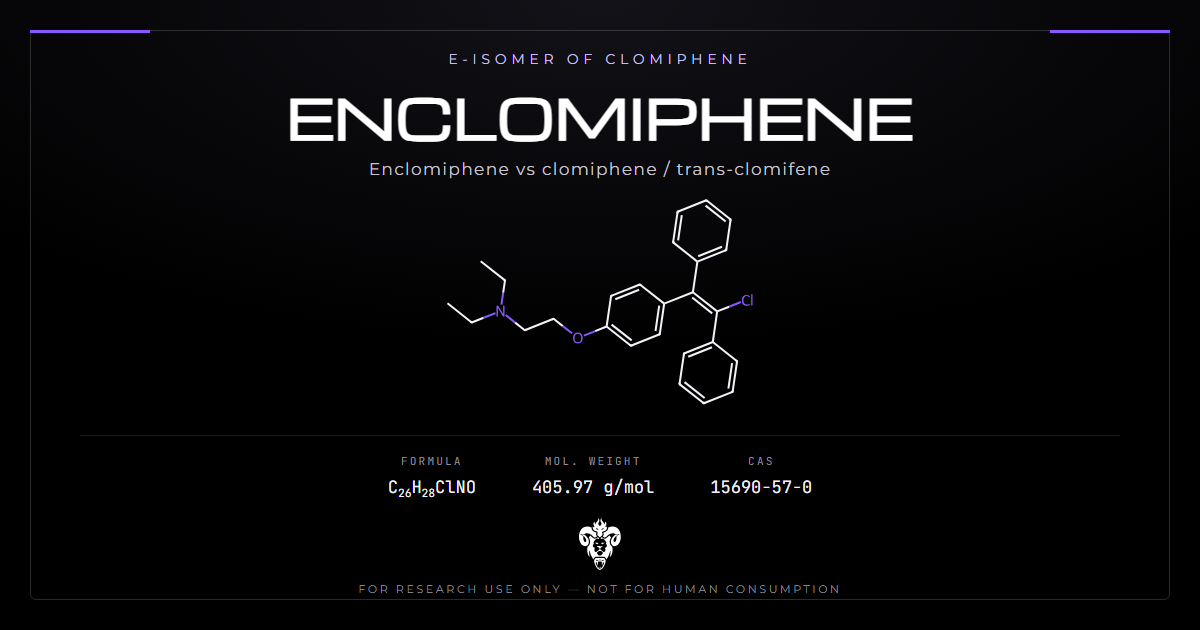
Both molecules share a formula, a mass and a connectivity. They differ in the arrangement around the central double bond of the triphenylethylene core. That geometry fixes the chlorine-bearing side chain either across from or alongside the rest of the structure.
That single geometric difference changes which face the molecule presents to an estrogen receptor. It is not a small potency step. It reverses the direction of the effect in at least one tissue.
Clomiphene reached the market in the 1960s. Separating geometric isomers at scale was harder then. Regulators did not require a single isomer. The Enclomiphene vs Clomiphene question is therefore a historical accident rather than a design decision. The accident has outlived the technical constraint that produced it.
Not a racemate, and the distinction matters
Published papers describe clomiphene as a mixture of “diastereoisomers” and, elsewhere, as a racemate. Both descriptions are wrong. Kaminetsky and colleagues use the diastereoisomer wording in an otherwise careful 2013 report (PMID 23530575) [5].
A racemate is a 50:50 pair of enantiomers. Those are non-superimposable mirror images. They share physical properties in an achiral environment. Clomiphene is neither 50:50 nor a mirror-image pair. Its components are geometric isomers. They are distinct compounds with different melting points, different chromatographic retention and different receptor behaviour. That determines which separation methods apply, so the terminology has practical consequences.
Enclomiphene vs Clomiphene at the receptor
Both isomers bind the estrogen receptor. The question is what happens after they bind. The answer is tissue dependent.
Opposite directions in the same assay
Fitzpatrick and colleagues characterised an immortalised rat hypothalamic cell line. They used it to sort estrogen mimetics by direction (PMID 10465261) [3]. Reading progesterone receptor induction, enclomiphene blocked estradiol with an IC50 of 77 nM. It stimulated nothing on its own.
Zuclomiphene, in the same cells, acted as an agonist with an EC50 of 100 nM. One isomer opposed estrogen. The other mimicked it. Concentrations sat in the same range. That tissue sets gonadotropin output. That is the cleanest single demonstration in the Enclomiphene vs Clomiphene literature.
Where the isomers behave the same
The separation is not universal. A fair reading has to say so. Olsson and colleagues cultured human granulosa cells. They tested both isomers from 1 nM to 10 uM on progestin synthesis (PMID 3117835) [1]. Both reduced basal and LH-stimulated progesterone accumulation in a dose-dependent way.
Their conclusion was that no qualitative difference separated the two isomers in that system. So “the isomers do opposite things” is a statement about the hypothalamus. It is not a statement about every cell that expresses an estrogen receptor.
The triphenylethylene core
Enclomiphene vs Clomiphene lives inside a well-known scaffold. Tamoxifen, clomiphene and several later SERMs share a 1,2-diphenylethylene with a third aryl ring. A basic side chain hangs off one phenol ether.
Geometry around the double bond
The IUPAC name for enclomiphene is 2-[4-[(E)-2-chloro-1,2-diphenylethenyl]phenoxy]-N,N-diethylethanamine. Zuclomiphene is the (Z) twin. PubChem splits them at CID 1548953 and CID 1548955. The connectivity block of the InChIKey is identical: GKIRPKYJQBWNGO. The stereodescriptor block is not. Enclomiphene ends OCEACIFDSA-N. Zuclomiphene ends QPLCGJKRSA-N.
Cis and trans language still appears in older papers. Trans maps to the (E) isomer. Cis maps to the (Z) isomer. Use the E/Z labels on a certificate. They survive a change of drawing convention.
The chlorine sits on the ethylene carbon. That halogen is part of the identity, not a salt. A lot missing chlorine is a different formula. A lot that swapped chlorine for hydrogen is a different mass.
Why mass cannot separate them
Both isomers are C26H28ClNO at 406.0 g/mol. Intact mass confirms the formula. It does not confirm geometry. A certificate that quotes mass and calls the work finished has answered the wrong question for this pair.
The diethylaminoethoxy chain is the SERM basic side chain. In this class that chain helps the receptor adopt an antagonist-like helix-12 pose in some tissues. Geometry still decides whether a given tissue reads antagonist or agonist. The chain alone does not.
Ultraviolet light can perturb geometry around a triphenylethylene double bond. Tamoxifen chemists already treat photoisomerisation as a real handling risk. The same risk applies here. A clear vial on a bench is an experiment on the ratio.
How the serum ratio shifts
The label ratio is roughly 62:38 in favour of enclomiphene. Nothing about that ratio survives contact with a repeated schedule.
What the serum ratio becomes
Helo and colleagues measured both isomers in serum after weeks of mixture exposure (PMID 27511863) [11]. Median enclomiphene came in at 2.2 ng/mL. Median zuclomiphene came in at 44.0 ng/mL.
That is a median serum ratio of 20 to 1 in favour of zuclomiphene. The preparation started at roughly 1.6 to 1 the other way. Enclomiphene vs Clomiphene is not a stable comparison once exposure begins. Age, body mass index and duration predicted none of the ratio on regression.
Those authors cite the different biochemical and toxicological properties of the two isomers. On that basis they argue for studying the pure antagonist rather than the mixture. That is a chemistry argument. It is not a use instruction.
Why persistence drives the invert
The invert is a clearance story. Enclomiphene leaves faster. Zuclomiphene accumulates. A bottle that starts enclomiphene-rich becomes zuclomiphene-rich in serum. Any paper that doses the mixture and then reports “clomiphene concentration” as one number has collapsed two exposures into one label.
Helo’s cohort is still the rare case that measured both [11]. Most methods sections never do. Read those papers as mixture papers. Do not read them as single-isomer papers.
How long each isomer stays
Miller and colleagues collected urine out to day 261 after a short mixture course (PMID 30295816) [13]. The work was built for anti-doping detection, not for a laboratory recipe.
Urinary windows
The zuclomiphene urinary detection window ran from 121 days to more than 261 days. A short course left the (Z) isomer measurable for four to nine months afterwards.
Enclomiphene clears in a different regime entirely. Persistence, rather than potency, converts a 62:38 starting mixture into a 20:1 steady state [11][13].
Serum concentrations and urinary excretion were non-uniform between individuals. Isomer concentrations varied. Two matched schedules do not produce two matched ratios.
What a washout must cover
A crossover with a four-week washout has not cleared zuclomiphene [13]. The second arm then starts from a (Z)-rich baseline. That design error is common in older mixture work. It is also invisible if the methods never measure the (Z) isomer.
What the animal work separates
Two studies dose the isomers separately in animals. They agree on direction. Animal work on Enclomiphene vs Clomiphene is where the tissues actually separate.
The immature rat
Weissenberg and colleagues treated intact and castrated immature male rats with clomiphene citrate or either isomer alone (PMID 1503253) [2]. Spermatogenesis arrested at the primary spermatocyte stage under the mixture and under zuclomiphene. Under enclomiphene it arrested later, at the young spermatid stage.
In castrated animals, zuclomiphene proved the most potent inhibitor of LH secretion of the three. Co-administered hCG abolished the effect on spermatogenesis. Co-administered testosterone abolished the effect on accessory gland growth. Both results place the action upstream rather than in the tissue itself.
Chronic dosing in mice
Fontenot and colleagues dosed male mice chronically by oral gavage (PMID 26220499) [8]. Each isomer ran at 4 and 40 mg/kg/day against placebo. Zuclomiphene produced what that group calls profound effects on Leydig cells, epididymis, seminal vesicles and kidneys. Testosterone, FSH and LH moved with them.
Enclomiphene raised testosterone and left testicular histology alone. Read the affiliations: all three authors worked for the company developing the single isomer, so the study is not independent. The direction agrees with Weissenberg’s independent rat work from 23 years earlier. That agreement is the reason to give it weight.
| Study | System | Animal dose | Direction |
|---|---|---|---|
| Weissenberg 1992 [2] | Immature male rat | isomers alone | spermatogenesis stage differs |
| Fontenot 2016 [8] | Male mouse, oral gavage | 4 and 40 mg/kg/day | (Z) hits accessory tissue; (E) leaves histology |
| Fitzpatrick 1999 [3] | Rat hypothalamic line | 77 nM IC50 / 100 nM EC50 | opposite directions |
| Olsson 1987 [1] | Human granulosa cells | 1 nM to 10 uM | same direction |
Indexed papers on the isolated isomer
A development programme and several indexed clinical papers exist. Those human endpoints sit outside the scope of this profile. The list remains so a reader can find the papers.
What those papers are
Hill and colleagues mapped the isolated isomer as an estrogen receptor antagonist in a 2009 review [4]. Kaminetsky, Wiehle and Kim later reported isolated-isomer programmes [5][6] and [7][9]. Rodriguez, Earl and Kim, Joseph, and Hohl then reviewed the same literature, including a 2025 meta-analysis [10][14] and [15][16].
Use those papers for chronology, synonyms and methods language. Do not use them as a use document. This profile will not quote human dose ladders, sperm counts, or comparisons against testosterone gel as therapy.
What this profile will not quote
It will not retell approval history as a reason to pick a bottle [14]. It will not treat hypogonadism or fertility as laboratory endpoints. Enclomiphene vs Clomiphene is a geometry and receptor-direction problem here. The clinical file is a pointer, not a protocol.
Wiehle 2013 sits in the list because it is one of the isolated-isomer reports [6]. Read the methods for which solid they weighed. Skip the human pharmacodynamic plots.
The detection problem
That elimination study was designed for anti-doping purposes. Its conclusion is that mixture use stays detectable in urine for at least four months after short-term exposure [13]. Serum concentrations and urinary excretion were non-uniform between individuals as the isomer concentrations varied.
Why one concentration is not an exposure
That non-uniformity is the analytical point. Two people on identical schedules do not carry identical isomer ratios. A single measured concentration therefore does not describe an exposure. Detection work makes Enclomiphene vs Clomiphene a two-window problem.
Laboratories that assay “clomiphene” with a method that does not resolve E from Z report a sum. The sum can be almost all zuclomiphene after a few weeks [11]. The label on the vial can still say 62:38.
Standards and the name on the vial
A calibration curve built on enclomiphene will mis-read a zuclomiphene-rich extract. A curve built on the mixture assumes the label ratio. Helo already showed that assumption fails in serum [11]. Match the standard to the isomer you claim to measure.
How to read an Enclomiphene vs Clomiphene study
Five questions separate papers that are about one isomer from papers that are about the mixture. They matter because the Enclomiphene vs Clomiphene comparison is usually implicit in a study rather than stated. A paper can look like a clean single-agent result while describing a shifting two-component exposure.
Which substance was actually dosed?
Older literature says “clomiphene” and means the mixture. Some of it says “clomiphene” and means an isolated isomer. Check the methods for a supplier and a purity statement, not the abstract.
Was the isomer ratio measured or assumed?
Almost no study measures both isomers in serum. Helo’s is the exception [11], and it found the ratio nothing like the label. A paper that dosed the mixture and reports a single concentration has not characterised the exposure.
Which tissue is the endpoint in?
The isomers oppose each other in a hypothalamic line [3] and behave alike in granulosa cells [1]. Read-across between tissues fails here. The direction of the failure is not predictable from the receptor name alone.
How long was the washout?
Zuclomiphene can persist past 261 days [13]. A crossover design with a four-week washout has not cleared the (Z) isomer. Its second arm is not a clean baseline.
Is the endpoint a receptor assay or a hormone panel?
Almost every result that circulates around Enclomiphene vs Clomiphene is a hormone concentration or a cell reporter. The hypothalamic reporter is the clean directional result [3]. Animal histology is the clean tissue result [2][8]. Symptom language belongs to the out-of-scope file [15].
Verifying research material
Both isomers are defined chemical entities with published identifiers, so verification is measurement rather than judgement. Verifying Enclomiphene vs Clomiphene means measuring geometry. Batch documentation sits on the certificates of analysis page.
Identity
Enclomiphene resolves to InChIKey GKIRPKYJQBWNGO-OCEACIFDSA-N, formula C26H28ClNO, molecular weight 406.0, CAS 15690-57-0. Mass spectrometry cannot distinguish the isomers, since they share a formula and an exact mass. Identity by mass alone is not identity here.
| Check | What it answers | What it cannot see |
|---|---|---|
| Intact mass | Formula C26H28ClNO | Which isomer |
| InChIKey stereoblock | E versus Z assignment | Purity of the lot |
| HPLC retention | Isomeric ratio | A new lot without standards |
| 1H NMR | Olefin geometry | Trace isomer below detection |
| beta-CD NMR | Preferential (Z) inclusion [12] | A purity figure by itself |
Isomeric purity
Chromatography separates the geometric isomers where mass spectrometry cannot. Retention difference is the assay that matters for this compound. A certificate that reports purity without reporting isomeric composition has answered a different question from the one worth asking.
An unusual analytical handle exists as well. Maheshwari and colleagues characterised inclusion complexes of clomiphene citrate with beta-cyclodextrin by NMR and molecular docking (PMID 28644553) [12]. The host cavity prefers the (Z) isomer. Differential binding to a cavity-bearing host is a route to separation. It is also a caution for anyone formulating with cyclodextrins.
Handling
The triphenylethylene core carries a double bond whose geometry defines the compound. Ultraviolet exposure can perturb geometry around a double bond. Store protected from light and confirm isomeric composition after prolonged storage rather than assuming it.
Storage guidance is a house recommendation. Analytical documentation is per-lot release testing.
A second handling question is the salt. Clomiphene in the older literature is usually the citrate. Enclomiphene lots may be citrate or free base. The free-base mass is 406.0. The citrate mass is higher by the acid. Weighing a salt as if it were free base silently changes the mole count.
A third question is residual solvent and water. Lyophilised or powdered lots carry both. Peptide-style content-versus-purity language applies to small molecules too. Chromatographic area percent is not the same as the weight of (E) isomer in the vial.
Related SERM-family reagents in this catalogue are not substitutes. Y134 is a benzothiophene with its own receptor numbers. 4-Hydroxytamoxifen is a different triphenylethylene. Gonadorelin sits one step upstream on the same axis. Keep the names on separate labels. More of the axis literature sits in the endocrine category.
Common questions about Enclomiphene vs Clomiphene
Is enclomiphene just the active half of clomiphene? Not quite. Reviews describe most of the intended receptor effect as belonging to the trans isomer, with zuclomiphene contributing little toward it [14]. Contributing little is not the same as contributing nothing. The animal work says the (Z) isomer contributes effects of its own [8].
Why does the ratio invert in serum? Persistence rather than potency. The (Z) isomer clears slowly enough to accumulate across repeated exposure, reaching a median 20:1 over the (E) isomer after weeks [11].
Do the isomers always act in opposite directions? No. That result comes from a hypothalamic cell line [3]. In human granulosa cells the two behaved alike [1].
Can mass spectrometry finish identity? No. Both isomers are C26H28ClNO. Run chromatography or NMR for geometry.
What do other SERM-family tools add? Comparators are how selectivity claims get tested. Y134 and 4-hydroxytamoxifen serve that purpose. Gonadorelin serves work one step upstream on the same axis.
Does this page report human outcomes? No. Indexed clinical papers are listed so they can be found. This profile stops at chemistry, receptor direction and animal systems.
Summary of the evidence
Write the two InChIKeys and the receptor directions on the first line of a notebook page. Everything else in this profile is a check on those facts.
Identity and what remains open
Identity: C26H28ClNO, 406.0 g/mol, CAS 15690-57-0 for the (E) isomer and 15690-58-1 for the (Z) isomer. PubChem CID 1548953 and CID 1548955 close the record. A certificate that omits isomeric purity is not finished.
Enclomiphene vs Clomiphene is the long name for that pair. The mixture is a ratio. The isolated isomer is a single geometric entity. Do not treat the word clomiphene as a second compound without reading the methods.
If a methods section names enclomiphene and then quotes a mixture CAS, stop. The rest of that paper may be about a different reagent. The same rule applies in reverse. Keep the certificate next to the notebook. A later reader should be able to match the lot to the paper without asking you what was in the vial.
Strongest evidence sits in four places. A hypothalamic cell line separates the isomers by direction with measured IC50 and EC50 values [3]. Direct serum measurement covers both isomers after mixture exposure [11]. A controlled elimination study gives the 121 to 261 day detection window [13]. Two animal programmes dose the isomers separately [2][8].
Weakest evidence: everything about the mixture’s isomer-specific behaviour in individual subjects, since almost no study measures both. The chronic mouse comparison comes from the developer of the single isomer [8]. Independent rat work corroborates its direction [2] rather than replicating it.
Read plainly, Enclomiphene vs Clomiphene is settled at the level of geometry and receptor direction. It is unsettled at the level of any single serum number on the mixture. The mixture is two compounds. The isomer is one.
Any claim about Enclomiphene vs Clomiphene that does not say which isomers were present, in what ratio, and for how long, has described a bottle rather than an exposure.
Status: supplied for laboratory research use only.
References
- Olsson JH, Nilsson L, Hillensjo T. Effect of clomiphene isomers on progestin synthesis in cultured human granulosa cells. Hum Reprod. 1987;2(6):463-468. PMID 3117835. DOI
- Weissenberg R, Dar Y, Lunenfeld B. The effect of clomiphene citrate and its Zu or En isomers on the reproductive system of the immature male rat. Andrologia. 1992;24(3):161-165. PMID 1503253. DOI
- Fitzpatrick SL, Berrodin TJ, Jenkins SF, Sindoni DM, Deecher DC, Frail DE. Effect of estrogen agonists and antagonists on induction of progesterone receptor in a rat hypothalamic cell line. Endocrinology. 1999;140(9):3928-3937. PMID 10465261. DOI
- Hill S, Arutchelvam V, Quinton R. Enclomiphene, an estrogen receptor antagonist for the treatment of testosterone deficiency in men. IDrugs. 2009;12(2):109-119. PMID 19204885.
- Kaminetsky J, Werner M, Fontenot G, Wiehle RD. Oral enclomiphene citrate stimulates the endogenous production of testosterone and sperm counts in men with low testosterone: comparison with testosterone gel. J Sex Med. 2013;10(6):1628-1635. PMID 23530575. DOI
- Wiehle R, Cunningham GR, Pitteloud N, Wike J, Hsu K, Fontenot GK, Rosner M, Dwyer A, Podolski J. Testosterone restoration by enclomiphene citrate in men with secondary hypogonadism: pharmacodynamics and pharmacokinetics. BJU Int. 2013;112(8):1188-1200. PMID 23875626. DOI
- Wiehle RD, Fontenot GK, Wike J, Hsu K, Nydell J, Lipshultz L. Enclomiphene citrate stimulates testosterone production while preventing oligospermia: a randomized phase II clinical trial comparing topical testosterone. Fertil Steril. 2014;102(3):720-727. PMID 25044085. DOI
- Fontenot GK, Wiehle RD, Podolski JS. Differential effects of isomers of clomiphene citrate on reproductive tissues in male mice. BJU Int. 2016;117(2):344-350. PMID 26220499. DOI
- Kim ED, McCullough A, Kaminetsky J. Oral enclomiphene citrate raises testosterone and preserves sperm counts in obese hypogonadal men, unlike topical testosterone: restoration instead of replacement. BJU Int. 2016;117(4):677-685. PMID 26496621. DOI
- Rodriguez KM, Pastuszak AW, Lipshultz LI. Enclomiphene citrate for the treatment of secondary male hypogonadism. Expert Opin Pharmacother. 2016;17(11):1561-1567. PMID 27337642. DOI
- Helo S, Mahon J, Ellen J, Wiehle R, Fontenot G, Hsu K, Feustel P, Welliver C, McCullough A. Serum levels of enclomiphene and zuclomiphene in men with hypogonadism on long-term clomiphene citrate treatment. BJU Int. 2017;119(1):171-176. PMID 27511863. DOI
- Maheshwari A, Saraswat H, Upadhyay SK. Structural insights into the inclusion complexes between clomiphene citrate and beta-cyclodextrin: the mechanism of preferential isomeric selection. Chirality. 2017;29(8):451-457. PMID 28644553. DOI
- Miller GD, Moore C, Nair V, Hill B, Willick SE, Rogol AD, Eichner D. Hypothalamic-pituitary-testicular axis effects and urinary detection following clomiphene administration in males. J Clin Endocrinol Metab. 2019;104(3):906-914. PMID 30295816. DOI
- Earl JA, Kim ED. Enclomiphene citrate: a treatment that maintains fertility in men with secondary hypogonadism. Expert Rev Endocrinol Metab. 2019;14(3):157-165. PMID 31063005. DOI
- Joseph T, Gibbs LM, Pham K. Are SERMs safe and effective for the treatment of hypogonadism in men? J Fam Pract. 2022;71(1):E18-E21. PMID 35259334. DOI
- Hohl A, Chavez MP, Pasqualotto E, Ferreira ROM, van de Sande-Lee S, Ronsoni MF. Clomiphene or enclomiphene citrate for the treatment of male hypogonadism: a systematic review and meta-analysis of randomized controlled trials. Arch Endocrinol Metab. 2025;69(5). PMID 41066380. DOI
Enclomiphene is sold for laboratory research use only. Not for human consumption, nor medical, veterinary, or household uses.
Literature retrieved from PubMed.