
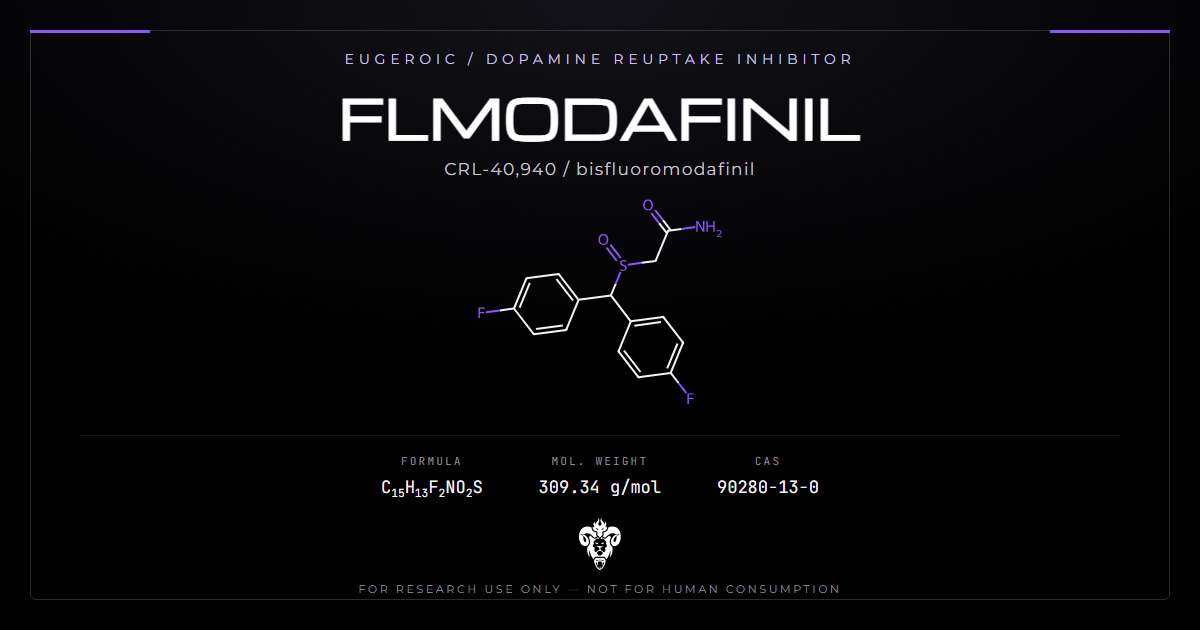
Flmodafinil is the bis(4-fluorophenyl) analog of modafinil, and it occupies an unusual position in the eugeroic literature. On one hand, it has a genuine peer-reviewed preclinical record and a named pharmaceutical sponsor. On the other, it has never entered a registered human trial, and much of what circulates about it online traces back to a single unpublished contract-lab screen. This reference separates the two. It covers chemical identity, the dopamine transporter mechanism, what the primary literature actually reported, the compliance picture as of 2026, and the specific analytical failure modes that make this scaffold harder to verify than it looks.
Everything below addresses laboratory and analytical contexts only.
Chemical Identity of Flmodafinil
Flmodafinil carries an unusually crowded synonym list, which is the first place errors creep in. The compound is a sulfinylacetamide with fluorine atoms at the para position of both phenyl rings.
| Property | Value |
|---|---|
| Systematic name | 2-{[bis(4-fluorophenyl)methyl]sulfinyl}acetamide |
| Molecular formula | C₁₅H₁₃F₂NO₂S |
| Molar mass | 309.34 g/mol |
| Monoisotopic mass | 309.0635 Da |
| CAS number | 90280-13-0 |
| PubChem CID | 13271852 |
| UNII | 174R2IG4T0 |
| InChIKey | YEAQNUMCWMRYMU-UHFFFAOYSA-N |
| Development codes | CRL-40,940; NLS-4; JBG01-41 |
| Other names | Bisfluoromodafinil; lauflumide |
The CRL-40,940 vs. CRL-40,941 Confusion
The two development codes differ by a single digit, and the compounds differ by a single oxygen atom. That combination has produced persistent mislabeling across vendor catalogs and even some reference databases.
- CRL-40,940 is Flmodafinil: the bisfluoro acetamide, C₁₅H₁₃F₂NO₂S, 309.34 g/mol.
- CRL-40,941 is Fladrafinil: the bisfluoro N-hydroxyacetamide, C₁₅H₁₃F₂NO₃S, 325.33 g/mol, CAS 90212-80-9.
Sixteen daltons separate them. Treat any material whose paperwork uses the codes interchangeably as unverified until orthogonal identity testing says otherwise.
Mechanism of Action
The literature describes Flmodafinil as a selective, atypical dopamine reuptake inhibitor. It binds the dopamine transporter (DAT) and slows dopamine clearance from the synaptic cleft, which raises extracellular dopamine in the relevant pathways.
The word atypical carries real meaning here rather than serving as a hedge. Modafinil-class inhibitors stabilize the transporter in a conformation distinct from the one cocaine and other classical stimulants favor, and that conformational difference tracks with a markedly different behavioral profile. Amy Hauck Newman’s group at NIDA mapped this systematically across a large modafinil analog series, and the bis(4-fluoro) substitution pattern appears throughout that work as a favored DAT-directed motif [4,5].
Two caveats matter for anyone designing around this mechanism. First, the parent scaffold binds DAT only weakly. Reported affinities for modafinil and its close acetamide analogs sit in the low-micromolar range, several orders of magnitude below reference DAT inhibitors. Second, modafinil’s own mechanism remains incompletely resolved after decades of study, and non-dopaminergic contributions have not been excluded [6].
About the “83% DAT Blockade” Figure
This number appears on nearly every commercial page describing Flmodafinil, usually stated as fact and usually paired with a claim that it beats methylphenidate. Its actual provenance is narrow. It comes from a single sentence in Luca et al. (2018), which attributes it to an unpublished contract-lab screen: CEREP study 100014859, dated 20/03/14 [1].
That is not a peer-reviewed result. No published methods, assay conditions, concentrations, or comparator data accompany it. Cite it as a preliminary, unpublished observation, or do not cite it at all.
What the Primary Preclinical Literature Shows
The definitive published study on this compound is Luca et al., Frontiers in Neuroscience, 2018 [1]. It is open access, and its data are worth stating precisely rather than in the vague terms most summaries use.
Design. Adult male C57BL/6J mice received intraperitoneal injections at light onset. Investigators recorded EEG and EMG continuously for 24 hours and scored vigilance states in 4-second epochs. A prior locomotor dose-finding run tested 32, 64, 128, and 256 mg/kg.
Dose selection. Wake induction rose up to 64 mg/kg and then plateaued, with no further increment at 128 or 256 mg/kg. The team therefore ran the main comparison at 64 mg/kg against modafinil at 150 mg/kg.
Primary result. Subtracting vehicle-induced wakefulness, NLS-4 produced 151.18 ± 15.33 minutes of added wake time versus 109.67 ± 16.59 minutes for modafinil (p < 0.05) — more wakefulness at roughly 43% of the comparator dose.
Sleep latency. 208.18 ± 12.99 minutes versus 55.92 minutes on vehicle. Modafinil gave 178.25 ± 12.59 minutes.
Recovery sleep. Neither compound produced rebound hypersomnia. However, the recovery profiles diverged. NLS-4 mice accumulated an 87.61-minute NREM deficit across the light period against modafinil’s 45.04 minutes, and EEG delta power was elevated for only the first 2 recovery intervals versus modafinil’s first 9. The authors read this as a lower homeostatic sleep debt despite longer induced wakefulness.
Behavior. Direct, infrared, and video observation detected no hyperlocomotion, stereotypy, or abnormal behavior under either compound.
One structural note from the same paper: the synthesis ran through a Grignard addition onto 4-fluorobenzaldehyde, thiourea displacement, alkylation with 2-chloroacetamide, and finally a Kagan asymmetric oxidation of the thioether — 23% overall yield across four steps. That last step matters more than it first appears.
The Stereochemistry Problem
Flmodafinil is chiral at sulfur. NLS-4, as synthesized and tested in the study above and as characterized by its sponsor, is the optically pure (R)-sulfoxide at greater than 95% enantiomeric excess [1,3].
Research-grade Flmodafinil sold as a bulk chemical is, in nearly all cases, racemic. These are not the same material, and the distinction has direct precedent in this exact chemical family: the two modafinil enantiomers clear at substantially different rates, which is why armodafinil exists as a separate product.
The practical consequences are concrete:
- Standard achiral reversed-phase HPLC cannot distinguish racemic Flmodafinil from (R)-lauflumide. Both elute as one peak.
- NMR in an achiral solvent will not resolve them either.
- A COA reporting “99.5% purity by HPLC” says nothing whatsoever about enantiomeric composition.
If a study design depends on the published NLS-4 findings, chiral chromatography or optical rotation is not optional. Absent that data, the honest description of the material is racemic Flmodafinil, and the published (R)-isomer results should be treated as a related but distinct dataset.
Development History and Clinical Status
Lafon Laboratories — the same French group behind Adrafinil and modafinil — conceptualized the compound but never developed it [1]. It resurfaced through a Paris-Sud patent estate, granted in 2017, and NLS Pharmaceutics subsequently carried it as NLS-4 for idiopathic hypersomnia, chronic fatigue syndrome, and long-COVID fatigue [3].
The sponsor has reported two findings that circulate widely and deserve accurate attribution. In human cell culture, NLS-4 did not induce cytochrome P450 enzymes including CYP3A4/5, in contrast to modafinil’s known enzyme induction on repeated dosing. The sponsor also described a “hypnolytic” effect — a reduced sleep need after sleep loss [3]. Both come from company disclosures rather than peer-reviewed publications, and neither has been independently replicated.
Company communications have also been internally inconsistent on mechanism. Materials presented at SLEEP 2023 described NLS-4 as an alpha-1 adrenergic receptor agonist, which does not sit comfortably alongside the selective dopamine reuptake inhibitor framing used elsewhere. A separate disclosure noted weak neuropeptide Y1 binding as a reverse agonist.
The bottom line on clinical status: trials were repeatedly announced as forthcoming and, as of this writing, no registered interventional human trial of lauflumide has been completed or published. Every efficacy statement about this compound rests on rodent data.
Analytical Verification of Flmodafinil
This scaffold is more analytically treacherous than its simple structure suggests. Three specific problems recur.
The 16-Dalton Problem
Modafinil-class chemistry generates a characteristic impurity set, formalized in the pharmacopoeial monographs for the parent drug: the acid (amide hydrolysis), the sulfone (over-oxidation), the ester, and the sulfide — the thioether precursor that simply failed to oxidize.
Applied to Flmodafinil, the bisfluoro versions of these sit at predictable mass offsets:
| Species | Relationship | Δ mass |
|---|---|---|
| Bisfluoro sulfide | Under-oxidation (unreacted precursor) | −16 Da |
| Flmodafinil (sulfoxide) | Target | — |
| Bisfluoro sulfone | Over-oxidation | +16 Da |
| Fladrafinil (N-hydroxy) | Different compound | +16 Da |
Two separate species land at +16 Da. A nominal-mass MS confirmation that reports “found 325” cannot tell you whether the material is over-oxidized Flmodafinil or mislabeled Fladrafinil. High-resolution accurate mass distinguishes them cleanly, because the elemental compositions differ. Nominal mass does not.
The sulfide precursor is the more common real-world finding, since incomplete oxidation is the obvious way this synthesis goes wrong. It also co-elutes poorly on unoptimized gradients.
GC-MS Thermal Degradation
This one is not widely known outside forensic chemistry and it disqualifies a whole method class.
Dowling et al. (2017) demonstrated that modafinil, modafinic acid, adrafinil, CRL-40,940, and CRL-40,941 all degrade thermally in the GC injector [2]. The benzhydryl core collapses, and the compounds converge on 1,1,2,2-tetraphenylethane and its fluorinated analogs. The team confirmed the degradants against independently synthesized authentic standards.
The consequence is direct: GC-MS is not a reliable primary identity method for Flmodafinil. An analyst running a standard injector program may see a degradation artifact rather than the analyte, and because the fluorinated compounds converge on shared degradants, GC-MS can blur exactly the distinctions that matter most here. LC-based methods avoid the problem entirely.
A Defensible Verification Panel
Given the above, a characterization package for this compound should include:
- HPLC-UV for chromatographic purity, with a gradient resolved for the sulfide and sulfone rather than a generic method.
- LC-MS with high-resolution accurate mass for identity — not GC-MS, and not nominal-mass confirmation.
- ¹H and ¹³C NMR for structural confirmation, which distinguishes the acetamide from the N-hydroxyacetamide unambiguously.
- Chiral analysis whenever enantiomeric composition is a study variable.
Every lot in the Kimera catalog carries third-party COA verification against this logic, and the full archive is public at the COA library. Related identity work across the eugeroic class is collected under Nootropics.
Regulatory and Compliance Status
FDA. Flmodafinil is not approved for human or veterinary use in the United States. It is not a medicine and is not intended to diagnose, treat, cure, or prevent any disease. It is handled strictly as a research-use-only material for qualified laboratory personnel.
WADA — updated for 2026. This is the single most consequential recent change, and most published material on the compound predates it. Effective with the 2026 Prohibited List, WADA added both Flmodafinil and Fladrafinil by name to S6.A, non-specified stimulants [7,8]. The listing cites their status as unapproved potent analogs of modafinil and adrafinil found in supplements and in products marketed as research chemicals.
Three points follow for anyone in a tested population:
- Non-specified stimulants carry the more severe sanction framework. This is not the lighter specified-substance pathway.
- S6 prohibition applies in-competition.
- The stimulant class explicitly covers all optical isomers, so the racemic-versus-(R) distinction offers no exemption.
Jurisdiction. Legal status varies by country. Researchers must confirm the position in their own jurisdiction before acquiring or handling the material.
Research Applications
With a defined transporter target and a published rodent EEG dataset, Flmodafinil functions primarily as a mechanistic tool compound. Reported laboratory contexts include:
- Sleep architecture and vigilance-state work, where polysomnographic endpoints benchmark eugeroic pharmacology.
- Sleep-homeostasis studies, where the divergent recovery-delta profile versus modafinil is itself the phenomenon of interest.
- DAT conformational and SAR studies, where the bisfluoro benzhydryl motif serves as a reference substitution pattern.
- Analytical method development and forensic reference work, particularly around the modafinil-analog degradation chemistry described above.
Frequently Asked Questions
What is Flmodafinil?
Flmodafinil is the bis(4-fluorophenyl) analog of modafinil, formally 2-{[bis(4-fluorophenyl)methyl]sulfinyl}acetamide. It carries the development codes CRL-40,940 and NLS-4, and also appears as bisfluoromodafinil and lauflumide.
How does Flmodafinil differ from modafinil?
Structurally, by two fluorine atoms at the para positions of both phenyl rings. Functionally, the published mouse comparison found more wake time at 64 mg/kg than modafinil produced at 150 mg/kg, along with less accumulated NREM debt during recovery.
Is Flmodafinil the same as Fladrafinil?
No. Fladrafinil is CRL-40,941, the N-hydroxyacetamide, at 325.33 g/mol. Flmodafinil is CRL-40,940, the acetamide, at 309.34 g/mol. One oxygen separates them, and the codes are frequently transposed.
Is Flmodafinil banned in sport?
Yes. WADA added Flmodafinil by name to the 2026 Prohibited List under S6.A as a non-specified stimulant, prohibited in-competition, covering all optical isomers.
Have there been human clinical trials of Flmodafinil?
No completed or published registered interventional trial exists. Clinical development was announced on several occasions but the compound’s evidence base remains preclinical.
Why is GC-MS a poor choice for verifying Flmodafinil?
Because it degrades in the GC injector. Published forensic work showed that CRL-40,940 and related eugeroics thermally decompose to tetraphenylethane derivatives during injection, producing artifacts rather than the intact analyte. LC-MS with high-resolution mass is the appropriate method.
References
- Luca G, Bandarabadi M, Konofal E, Lecendreux M, Ferrié L, Figadère B, Tafti M. Lauflumide (NLS-4) Is a New Potent Wake-Promoting Compound. Frontiers in Neuroscience. 2018;12:519. doi:10.3389/fnins.2018.00519
- Dowling G, Kavanagh PV, Talbot B, O’Brien J, Hessman G, McLaughlin G, Twamley B, Brandt SD. Outsmarted by nootropics? An investigation into the thermal degradation of modafinil, modafinic acid, adrafinil, CRL-40,940 and CRL-40,941 in the GC injector: formation of 1,1,2,2-tetraphenylethane and its tetra fluoro analog. Drug Testing and Analysis. 2017;9(3):518–528. doi:10.1002/dta.2142
- NLS Pharmaceutics Ltd. Preclinical data disclosures regarding NLS-4 (lauflumide). U.S. Securities and Exchange Commission filings, 2021. sec.gov
- Okunola-Bakare OM, Cao J, Kopajtic T, Katz JL, Loland CJ, Shi L, Newman AH. Elucidation of Structural Elements for Selectivity across Monoamine Transporters: Novel 2-[(Diphenylmethyl)sulfinyl]acetamide (Modafinil) Analogues. Journal of Medicinal Chemistry. 2014;57(3):1000–1013. doi:10.1021/jm401754x
- Cao J, Prisinzano TE, Okunola OM, Kopajtic T, Shook M, Katz JL, Newman AH. Structure-Activity Relationships at the Monoamine Transporters for a Novel Series of Modafinil Analogues. ACS Medicinal Chemistry Letters. 2011;2(1):48–52. doi:10.1021/ml1002025
- Minzenberg MJ, Carter CS. Modafinil: a review of neurochemical actions and effects on cognition. Neuropsychopharmacology. 2008;33(7):1477–1502. doi:10.1038/sj.npp.1301534
- World Anti-Doping Agency. The Prohibited List. wada-ama.org/en/prohibited-list
- U.S. Anti-Doping Agency. Athlete Advisory: What’s New on the 2026 WADA Prohibited List? usada.org
- National Center for Biotechnology Information. PubChem Compound Summary for CID 13271852, 2-{[bis(4-fluorophenyl)methyl]sulfinyl}acetamide. pubchem.ncbi.nlm.nih.gov
This article is provided for informational and research-reference purposes only. Flmodafinil is a research-use-only compound. No regulatory agency has approved it for human or veterinary use, and it is not intended to diagnose, treat, cure, or prevent any disease.