
Everything below reports findings from cell cultures, isolated tissue and animals. This material is for research use only, not for human or veterinary use.
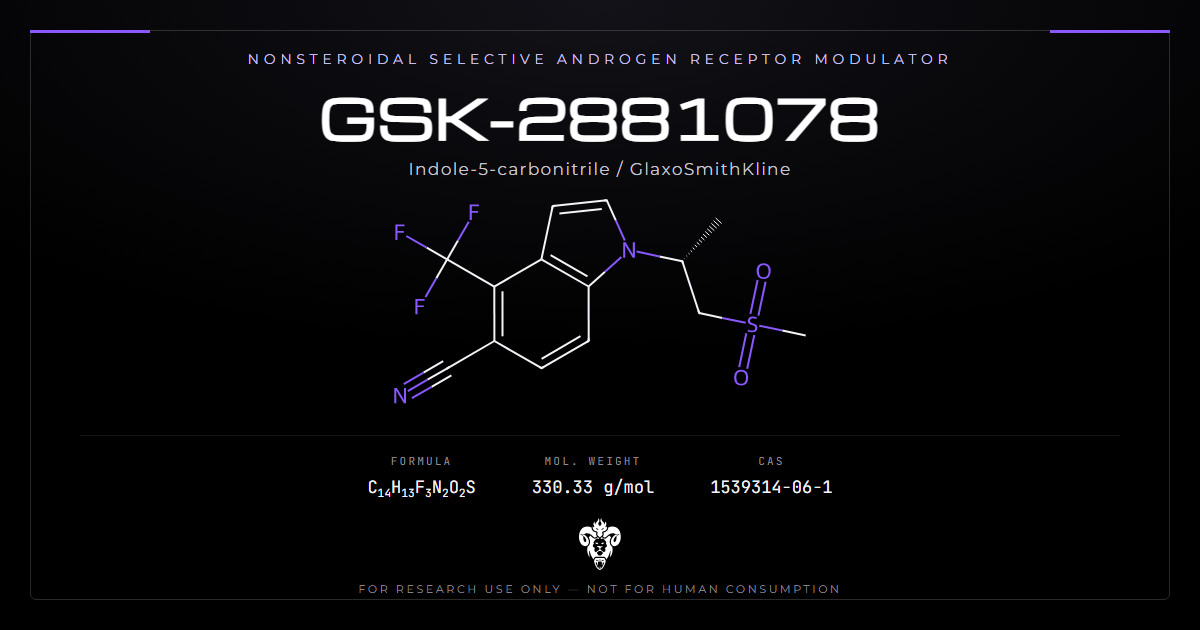
GSK-2881078 is a nonsteroidal indole-5-carbonitrile. It binds the androgen receptor. GlaxoSmithKline coded it. Catalogues list the same lot as GSK2881078.
The scaffold is not an arylpropionamide. Ostarine, andarine and S-23 share that older core. This lot does not. Anyone who copies arylpropionamide metabolism or arylpropionamide detection onto GSK-2881078 is crossing a real chemical gap.
Indexed clinical papers exist. Those human endpoints sit outside the scope of this profile. The laboratory questions are identity, receptor class, horse and in-vitro metabolism, and how anti-doping methods find the parent.
Three facts carry the file. PubChem records the (2R) indole as CID 86709174. Clark and colleagues reported a terminal half-life over 100 hours [1]. Rading and colleagues still found the parent in urine on day 42 after a single sub-milligram intake [8].
Chemical identity
| Property | Value |
|---|---|
| Common names | GSK-2881078, GSK2881078 |
| IUPAC name | 1-[(2R)-1-methylsulfonylpropan-2-yl]-4-(trifluoromethyl)indole-5-carbonitrile |
| Molecular formula | C14H13F3N2O2S |
| Molecular weight | 330.33 g/mol |
| Exact mass | 330.06498 Da |
| CAS | 1539314-06-1 |
| PubChem CID | 86709174 |
| InChIKey | SKDVMPZQJMZEAC-SECBINFHSA-N |
| Class | Nonsteroidal indole-5-carbonitrile |
| Configuration | (2R) |
| XLogP | 2.3 |
| H-bond donors / acceptors | 0 / 6 |
The catalogue carries it as GSK-2881078.
An indole, not an arylpropionamide
Most of this shelf shares one backbone. Ostarine, andarine and S-23 are arylpropionamides. GSK-2881078 is not related to them at all.
An indole carries a carbonitrile at position 5 and a trifluoromethyl at position 4. A methylsulfonyl propyl group sits on the indole nitrogen. The single stereocentre sits on that side chain in the (2R) configuration.
What defines the class is receptor behaviour, not a shared scaffold. GSK-2881078 is a useful reminder of that. Metabolism maps and fragment ions travel with the core. They do not travel across cores.
PubChem CID 86709174 records the isomeric SMILES. The at-sign in that string is the (2R) carbon. Flip that centre and the lot is a different reagent at the receptor.
Why the trifluoromethyl and the nitrile matter
Those two groups do electronic work. The nitrile is a hydrogen-bond acceptor on the six-membered ring. The three fluorines pull electron density and give the molecule a distinctive mass defect.
GSK-2881078 carries no chlorine or bromine. There is no convenient halogen isotope pattern to check. The trifluoromethyl and the methylsulfonyl both give characteristic losses. Published mass spectrometric characterisation exists for the class [12].
Fluorine NMR then gives a fast orthogonal identity check. Most laboratories can run that experiment. A certificate that never mentions fluorine has skipped an easy test.
Mass and formula
Formula C14H13F3N2O2S and mass 330.33 g/mol close the first check. Exact mass 330.06498 Da separates this lot from nearby catalogue SARMs if the instrument can resolve it.
A racemic preparation would still match formula, mass and every achiral spectrum. That is why mass alone never finishes the job. The next section returns to the stereocentre.
Receptor logic for GSK-2881078
Selective androgen receptor modulator is a class nickname. It is not a measured pair of potencies on a certificate.
What selective means here
The design story is simple. Reach the androgen receptor without a steroid ring. Tissue readouts in animals then score anabolic organs against androgenic organs. Dalton set that field problem out in a 2017 commentary that sat beside the first indexed GSK-2881078 paper (PMID 28621446) [2].
Dalton’s point was about the class, not about this lot. Lean-mass assays are easy to run. Function assays are not. This profile does not import those human scores. It keeps the receptor claim where it belongs: a ligand, a binding assay, and a stated cell or animal system.
GSK-2881078 is a nonsteroidal ligand. It does not aromatise to an estrogen in the design story. Those negatives are claims about the ligand. They are not claims about a vial on a bench. Run the receptor panel if the experiment needs them.
What the scaffold does not predict
An indole-carbonitrile does not inherit arylpropionamide clearance. It does not inherit arylpropionamide glucuronides. Horse work later showed how far that gap runs [9].
Binding affinity is also not on this page as a single Ki. The indexed GSK-2881078 papers do not publish a clean displacement number that this profile can quote. A laboratory that needs one runs the assay against a stated construct and a stated radioligand.
Tissue selectivity is a ratio in a stated model. It is not a property of the powder. Castrated-rat organ weights are the usual class assay. This file does not substitute a human endpoint for that missing animal table.
Indexed clinical papers
A development programme and several indexed papers exist. Later reviews still name the lot. Human endpoints sit outside the scope of this profile. The papers stay in the reference list so a reader can find them.
What those files are
Clark and colleagues published the opening healthy-volunteer package in 2017 (PMID 28449232) [1]. Neil and colleagues later took the same molecule into older adults [4]. Mohan and colleagues published a randomised disease-population paper in Thorax (PMID 36283827) [3]. Tabberer and colleagues interviewed people from that same protocol [5].
Vignali and colleagues reviewed safety across the class [6]. Wen and colleagues pooled randomised SARM trials [7]. Borecki and colleagues and Jeyaraman and colleagues still name GSK-2881078 in 2025 reviews (PMID 40586402) [14][15].
Cite those papers for the fact that a file exists. Do not import their human endpoints into a laboratory protocol.
What this profile will not quote
It will not quote lean-mass deltas, leg-strength scores, patient-reported outcomes, human milligram ladders, or adverse-event rates. Those sentences turn a research article into a use document.
Sponsor programmes are not laboratory identity results. Disease-population protocols are not handling instructions. A 2025 review that still names the lot is not a certificate [14][15].
Company authors sit on several of the indexed papers [1][3] and [4]. That does not void the chemistry. It does mean independent replications carry weight, and most of those sit in anti-doping laboratories.
Pharmacokinetic facts already on the record
One published human-PK sentence stays because the original file already bound it to a paper.
Terminal half-life
Clark and colleagues reported that exposure rose in proportion to dose. The terminal half-life exceeded 100 hours [1]. That is long for a small molecule. It shapes everything downstream.
A half-life that long means accumulation on a repeated daily schedule. Steady state arrives slowly. Washout is slow. Later protocol papers show the developers knew it: dosing started twice daily for three days, then dropped to once daily [4]. That schedule is a PK design choice. It is not a use instruction.
Accumulation as chemistry
Long residence also explains the detection window in the next section. Six weeks of urinary detectability after a sub-milligram intake follows directly from that half-life [8].
Neil and colleagues also tested CYP3A4 inhibition [4]. Human interaction endpoints sit outside this profile. The useful laboratory point is simpler. A 100-hour half-life and a strong enzyme interaction would compound each other. Anyone modelling clearance should say which paper they used for the half-life and which system they used for the enzyme.
Horse and in-vitro metabolism
The metabolite map is where this indole parts company with the arylpropionamides.
Thoroughbred metabolites
Karatt and colleagues mapped GSK-2881078 in the horse (PMID 36922727) [9]. They found five in-vivo metabolites and six in-vitro metabolites. Most were hydroxylated.
They observed no glucuronide and no sulfate conjugates. That is unusual in this class. The usual hydrolysis step before chromatography adds nothing here. A method written for ostarine glucuronide will miss this parent.
Horse liver is not a human hepatocyte. Treat the map as a species-bound result. It still tells a laboratory which transitions to watch first.
Equine microsomes and a second laboratory
Cutler and colleagues identified equine in-vitro metabolites of seven non-steroidal SARMs, including this one (PMID 34714606) [13]. Their purpose was doping control. Their value at the bench is a second independent fragment list.
Two laboratories seeing the same hydroxylated series is stronger than one. A lot that produces a different series is either a different scaffold or a degraded vial.
Human in-vitro maps
Kowalczyk and colleagues ran in-vitro metabolic studies on novel SARMs and used the products for doping-control methods (PMID 34414676) [10]. GSK-2881078 sits in that set.
Stacchini and colleagues then published a multi-class urine method that covers different SARM chemical families in one assay (PMID 33383501) [11]. That paper is the practical reason a laboratory can screen an indole and an arylpropionamide on the same plate.
Detection windows
Anti-doping laboratories have characterised GSK-2881078 more thoroughly than most catalogue SARMs. Two findings still set practice.
Urine after a single intake
Rading and colleagues gave a single oral intake and followed it out (PMID 33037775) [8]. Urine peaked near 920 pg/mL at eight hours after 760 micrograms. The parent stayed above the 2 pg/mL detection limit until day 42.
Six weeks of detectability from a sub-milligram intake follows from the 100-hour half-life [1][8]. It also puts this compound alongside ostarine and roxadustat in the group where trace exposure produces month-scale windows.
That sentence is a sensitivity result. It is not a dosing instruction. A detected picogram does not convert into an intended intake.
Hair segments
Rading’s group also shaved scalp hair at weeks 0, 1, 3, 5 and 9 after a single 1.5 mg intake. Intact GSK-2881078 peaked at 1.7 pg/mg in the week 3 segment. It then fell to 0.7 at week 5 and 0.2 at week 9 [8].
Their conclusion is the practical one. Hair analysis is feasible. It works only if the segment analysed covers the period of intake. At those concentrations a mis-segmented sample returns nothing.
Multi-class methods and class reviews
Human in-vitro work and multi-class urine methods cover GSK-2881078 as well [10][11] and [13]. Class detection reviews name it among the compounds those methods watch [16]. A 2017 ionisation study characterised its behaviour under both electron ionisation and electrospray ionisation (PMID 29232975) [12].
| Matrix | What was measured | Window or note | Paper |
|---|---|---|---|
| Urine | Parent | Above 2 pg/mL to day 42 after 760 ug | [8] |
| Hair | Parent | Peak 1.7 pg/mg in week 3 segment | [8] |
| Horse urine / plasma | Five in-vivo metabolites | Hydroxylated; no conjugates | [9] |
| Horse liver microsomes | Six in-vitro metabolites | Hydroxylated series | [9] |
| Equine in vitro | Metabolite IDs among seven SARMs | Doping-control panel | [13] |
| Human in vitro | Metabolic products | Method development | [10] |
| Human urine | Multi-class SARM screen | Indole plus other cores | [11] |
| Instrument | EI and ESI-CID behaviour | Class characterisation | [12] |
Mass spectrometric behaviour
Electron ionisation and electrospray collision-induced dissociation both appear in the 2017 class study [12]. GSK-2881078 belongs on that list because the indole core fragments differently from an arylpropionamide.
What to watch on the instrument
The trifluoromethyl and the methylsulfonyl both give characteristic losses. Those losses are the cheap identity check once the parent mass is in hand. A spectrum that shows the mass and none of those losses is not this lot.
GSK-2881078 carries no chlorine or bromine. Do not hunt a halogen isotope pair. Hunt the fluorine mass defect and the sulfone losses instead.
Shared benches
The same caution applies in the laboratory. Trace-level SARM detections are a known contamination problem in shared facilities [8][16]. Anyone quantifying GSK-2881078 should treat a low-level hit as a question about the workspace before treating it as a result. Blank runs between samples cost little and settle the question quickly.
Where GSK-2881078 sits among catalogue SARMs
Every SARM shares the same premise: reach the androgen receptor without a steroid ring. What separates the lots is substitution, clearance, and how far each file went before the indexed record thinned out.
Same class, different cores
Ostarine puts nitriles on both rings of an arylpropionamide. Andarine puts a nitro and an acetamide on that same core. S-23 puts chlorine and fluorine on the B-ring. LGD-2226 and LGD-4033 leave the indole class entirely. GSK-2881078 is the indole-carbonitrile on this shelf.
Comparing GSK-2881078 to an arylpropionamide on marketing copy is not an experiment. Run both on the same receptor assay and the same intact-mass method.
Depth of characterisation
GSK-2881078 has a published human half-life [1], a controlled excretion file [8], a horse metabolite map [9], two equine in-vitro lists [9][13], and multi-class urine methods [10][11]. Most catalogue SARMs have a fraction of that detection depth.
Indexed clinical papers exist as well. This profile leaves their endpoints unread. Comparative bench work is still the only place a laboratory can put two lots on the same assay. Related write-ups sit at Ostarine, S-23 and LGD-2226.
Wen and colleagues pooled nine randomised trials across six SARMs [7]. Those pooled human scores sit outside this profile. The paper remains cited so a reader can find the class file.
A compound can stay in the review literature long after a development programme has gone quiet [14][15]. A reader who meets GSK-2881078 in a 2025 review would not learn that from a catalogue label. Identity still starts with mass and the (2R) centre.
How to read a GSK-2881078 result
Five questions keep this literature from collapsing into a single slogan.
Which structure was measured?
Intact mass 330.33 Da average, 330.06498 monoisotopic, CAS 1539314-06-1, CID 86709174, InChIKey SKDVMPZQJMZEAC-SECBINFHSA-N. A lot that fails those checks is not GSK-2881078. An arylpropionamide with a nearby mass is a different reagent.
Which stereoisomer?
The SECBINFHSA block encodes the (2R) configuration. Mass spectrometry cannot tell the enantiomers apart. Chiral chromatography answers it.
Which matrix and which species?
Horse metabolites, human in-vitro products, urine, and hair are different maps [8][9] and [10]. Read-across between them is a claim that needs its own experiment.
Is a detected concentration a dose?
No. A picogram in urine or hair is a sensitivity result [8]. It does not convert into an intended intake.
Did the paper measure a human endpoint?
If it did, this profile stops before that table [1][3] and [4][5]. Chemistry, receptor class, animal metabolism and detection still stand.
Verifying research material
Batch documentation sits on the certificates of analysis page.
Identity
Formula C14H13F3N2O2S, molecular weight 330.33, CAS 1539314-06-1, InChIKey SKDVMPZQJMZEAC-SECBINFHSA-N.
GSK-2881078 carries no chlorine or bromine, so there is no convenient halogen isotope pattern to check. Its trifluoromethyl and methylsulfonyl groups both give characteristic losses. Published mass spectrometric characterisation exists for the class [12].
Stereochemistry
The SECBINFHSA block encodes the (2R) configuration at the side-chain carbon. There is one stereocentre, so a racemic preparation would contain 50% of the wrong enantiomer while matching formula, mass and every achiral spectrum.
Chiral chromatography against a characterised standard is the check. A certificate reporting purity by area percentage on an achiral column has not addressed configuration.
Handling
Store the solid cold, dry and dark. Keep the jar sealed between weighings.
Storage guidance is a house recommendation. Analytical documentation is per-lot release testing.
This is the compound in the catalogue where a decimal place on a stock solution matters. Detection work started from hundreds of micrograms [8]. Anyone reproducing a published exposure should convert on a molar basis and check the units twice.
Related SARM write-ups sit in the SARMs category.
Common questions about GSK-2881078
What is GSK-2881078? A (2R) indole-5-carbonitrile selective androgen receptor modulator. Formula C14H13F3N2O2S, mass 330.33 g/mol, CAS 1539314-06-1.
How does it differ from ostarine? Different core. Ostarine is an arylpropionamide. GSK-2881078 is an indole. Metabolite maps and fragment ions do not transfer [9][12].
Do indexed clinical papers exist? Yes. Opening, dose-ranging and disease-population papers are in the file [1][3] and [4]. Their human endpoints sit outside this profile.
What half-life is already on the record? Over 100 hours in the opening package [1].
How long is it detectable? Up to 42 days in urine after a single 760 microgram intake [8]. Hair works if the segment covers the intake [8].
Does it form glucuronides in the horse? Karatt and colleagues observed none [9]. Hydroxylated metabolites dominate that map.
What is the main identity risk? The wrong enantiomer at the single stereocentre. Achiral HPLC will not catch it.
Summary of the evidence
Write the name, the mass and the (2R) centre on the first line of a notebook page. Everything else in this profile is a check on those three facts.
Identity: C14H13F3N2O2S, 330.33 g/mol, CAS 1539314-06-1, CID 86709174, InChIKey SKDVMPZQJMZEAC-SECBINFHSA-N. GSK-2881078 is the long name for that lot. GSK2881078 is the same chain without the hyphen.
Receptor: a nonsteroidal androgen-receptor ligand on an indole-carbonitrile, not an arylpropionamide [2]. Run the binding assay if the experiment needs a number. This page does not invent one.
Clearance chemistry: terminal half-life over 100 hours [1]. Urinary parent still above 2 pg/mL on day 42 after 760 micrograms [8]. Horse metabolites are hydroxylated and unconjugated [9].
Limits: human efficacy, human dose ladders and human adverse-event figures are out of scope here. Those papers remain in the reference list.
Status: supplied for laboratory research use only.
References
- Clark RV, Walker AC, Andrews S, Turnbull P, Wald JA, Magee MH. Safety, pharmacokinetics and pharmacological effects of the selective androgen receptor modulator, GSK2881078, in healthy men and postmenopausal women. Br J Clin Pharmacol. 2017;83(10):2179-2194. PMID 28449232. DOI
- Dalton JT. The long and winding road for selective androgen receptor modulators. Br J Clin Pharmacol. 2017;83(10):2131-2133. PMID 28621446. DOI
- Mohan D, Rossiter H, Watz H, Fogarty C, Evans RA, Man W, et al. Selective androgen receptor modulation for muscle weakness in chronic obstructive pulmonary disease: a randomised control trial. Thorax. 2022;78(3):258-266. PMID 36283827. DOI
- Neil D, Clark RV, Magee M, Billiard J, Chan A, Xue Z, et al. GSK2881078, a SARM, produces dose-dependent increases in lean mass in healthy older men and women. J Clin Endocrinol Metab. 2018;103(9):3215-3224. PMID 29982690. DOI
- Tabberer M, Williamson N, Tatlock S, Gater A, Grimes R, Akinseye C, et al. Qualitative interviews of patients with COPD and muscle weakness enrolled in a clinical trial evaluating a new anabolic treatment. J Patient Rep Outcomes. 2024;8(1):45. PMID 38641716. DOI
- Vignali JD, Pak KC, Beverley HR, DeLuca JP, Downs JW, Kress AT, et al. Systematic review of safety of selective androgen receptor modulators in healthy adults: implications for recreational users. J Xenobiot. 2023;13(2):218-236. PMID 37218811. DOI
- Wen J, Syed B, Leapart J, Shehabat M, Ansari U, Akhtar M, et al. Selective androgen receptor modulators (SARMs) effects on physical performance: a systematic review of randomized control trials. Clin Endocrinol (Oxf). 2024;102(1):3-27. PMID 39285652. DOI
- Rading A, Anielski P, Thieme D, Keiler AM. Detection of the selective androgen receptor modulator GSK2881078 and metabolites in urine and hair after single oral administration. Drug Test Anal. 2020;13(1):217-222. PMID 33037775. DOI
- Karatt TK, Sathiq MA, Laya S, Kal AKK, Subhahar MB, Muhammed Ajeebsanu MP, et al. In-depth metabolic study of nonsteroidal selective androgen receptor modulator GSK2881078 in thoroughbred horses and horse liver microsomes for doping control. Drug Test Anal. 2023;15(7):757-768. PMID 36922727. DOI
- Kowalczyk K, Torres-Elguera JC, Jarek A, Konopka A, Kwiatkowska D, Bulska E. In vitro metabolic studies of novel selective androgen receptor modulators and their use for doping control analysis. Drug Test Anal. 2021;14(1):122-136. PMID 34414676. DOI
- Stacchini C, Botrè F, Comunità F, de la Torre X, Dima AP, Ricci M, et al. Simultaneous detection of different chemical classes of selective androgen receptor modulators in urine by liquid chromatography-mass spectrometry-based techniques. J Pharm Biomed Anal. 2020;195:113849. PMID 33383501. DOI
- Thevis M, Volmer DA. Mass spectrometric studies on selective androgen receptor modulators (SARMs) using electron ionization and electrospray ionization/collision-induced dissociation. Eur J Mass Spectrom (Chichester). 2017;24(1):145-156. PMID 29232975. DOI
- Cutler C, Viljanto M, Taylor P, Hincks P, Biddle S, Van Eenoo P. Identification of equine in vitro metabolites of seven non-steroidal selective androgen receptor modulators for doping control purposes. Drug Test Anal. 2022;14(2):349-370. PMID 34714606. DOI
- Borecki R, Byczkiewicz P, Słowikowska-Hilczer J. Selective androgen receptor modulators (SARMs): potential anabolic drugs for the treatment of cachexia and frailty syndrome. Endokrynol Pol. 2025;76(3):248-256. PMID 40586402. DOI
- Jeyaraman M, Jeyaraman N, Nallakumarasamy A, Ramasubramanian S, Muthu S, Murugan S, et al. Sarcopenia in aging: pathogenesis, diagnosis, and emerging therapeutic frontiers. Mol Imaging Biol. 2025;28(1):1-22. PMID 41296190. DOI
- Thevis M, Schänzer W. Detection of SARMs in doping control analysis. Mol Cell Endocrinol. 2017;464:34-45. PMID 28137616. DOI
GSK-2881078 is sold for laboratory research use only. Not for human consumption, nor medical, veterinary, or household uses.
Literature retrieved from PubMed.