
Everything below reports findings from cell cultures, isolated tissue and animals. This material is for research use only, not for human or veterinary use.
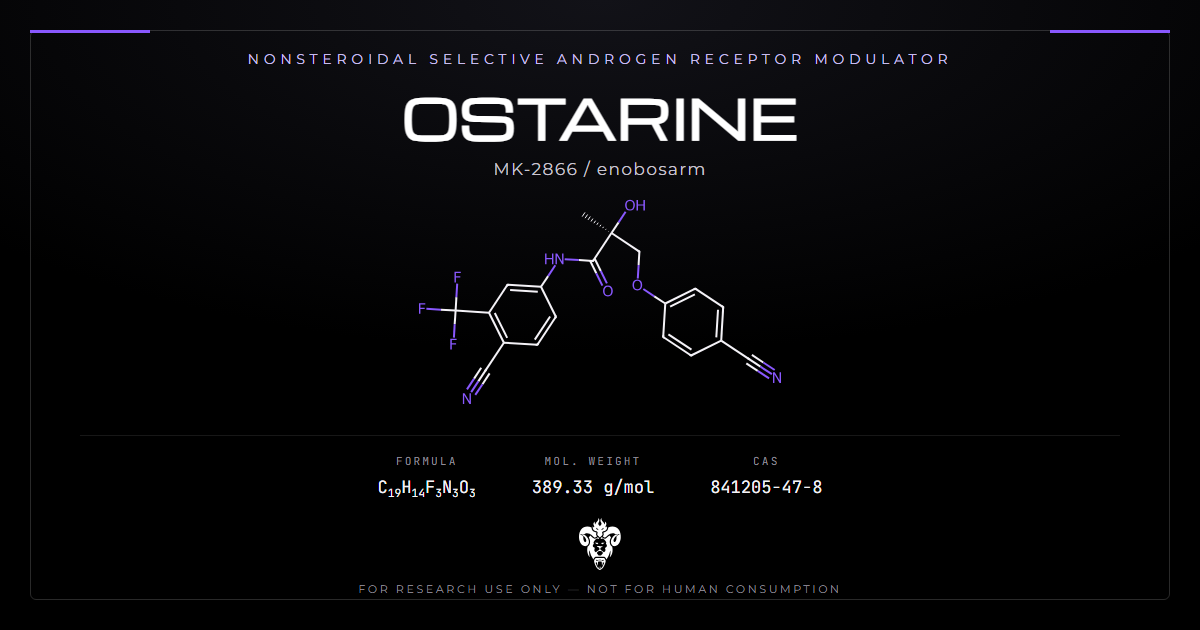
Ostarine is a nonsteroidal arylpropionamide that binds the androgen receptor. GTx coded it GTx-024 and S-22. Catalogues list it as MK-2866. Enobosarm is the same molecule under a USAN name.
A development programme and several indexed clinical papers exist. Those human endpoints sit outside the scope of this profile. The laboratory questions are identity, receptor binding, rodent tissue readouts, and how anti-doping methods find the parent and its glucuronide.
Three facts carry the file. The (2S) arylpropionamide is a defined small molecule, not a steroid. Castrated-rat work put anabolic-tissue activity at dose rates as low as 0.03 mg/day [13]. A single one-microgram oral intake stayed detectable in urine for nine days [8].
Chemical identity
| Property | Value |
|---|---|
| Common names | Ostarine, MK-2866, enobosarm, GTx-024, S-22 |
| IUPAC name | (2S)-3-(4-cyanophenoxy)-N-[4-cyano-3-(trifluoromethyl)phenyl]-2-hydroxy-2-methylpropanamide |
| Molecular formula | C19H14F3N3O3 |
| Molecular weight | 389.33 g/mol |
| Exact mass | 389.0987 Da |
| CAS | 841205-47-8 |
| PubChem CID | 11326715 |
| InChIKey | JNGVJMBLXIUVRD-SFHVURJKSA-N |
| Class | Nonsteroidal arylpropionamide |
| Configuration | (2S) |
| AR binding | Ki 2.0 to 3.8 nM in the S-19 to S-22 series [13] |
| XLogP | 2.7 |
| H-bond donors / acceptors | 2 / 8 |
The catalogue carries it as MK-2866.
Reading the structure
An arylpropionamide core carries two aromatic rings. One ring bears a nitrile. The other bears a nitrile and a trifluoromethyl group. An ether and an amide join them around a tertiary alcohol at the (2S) centre.
Nothing about that skeleton resembles testosterone. No steroid ring system appears anywhere in it. That absence is the point of the class. The molecule reaches the same receptor by a different chemical route, so it distributes and metabolises differently.
PubChem CID 11326715 records the isomeric SMILES. The at-sign in that string is the (2S) alcohol. Flip that centre and the lot is a different reagent at the receptor.
Why the trifluoromethyl group matters
That group does electronic work rather than filling space. Medicinal chemists have tested the claim directly. Shao and colleagues synthesised 21 derivatives replacing it with a pentafluorosulfanyl group (PMID 31757115) [7]. That substituent is a more electronegative bioisostere.
Several retained androgen receptor agonist activity in vitro. The scaffold tolerates substitution at that position. The trifluoromethyl is tuned rather than essential.
Three fluorines also give the molecule a distinctive mass defect. Fluorine NMR then gives a fast orthogonal identity check that most laboratories can run.
How S-22 was selected
Kim, Dalton and colleagues compared four para-substitution analogues on the same arylpropionamide core (PMID 15987833) [13]. Ostarine in that series is S-22: cyano on both aromatic rings.
Four analogues, one clearance rank
S-19 and S-20 keep a nitro on the A-ring. S-21 and S-22 put a cyano there instead. All four bound the androgen receptor tightly. Ki values ran from 2.0 to 3.8 nM [13]. Binding alone did not pick a winner.
In vivo clearance did. S-22 cleared the slowest, then S-20, then S-21, then S-19 [13]. The cyano/cyano pair slowed removal. That is why the catalogue molecule is S-22 and not its nitro cousins.
Andarine (S-4) sits on the same core with a nitro and an acetamide. Change those rings and you change both clearance and the impurity map. A certificate that quotes an ostarine mass on an andarine label has already failed.
What the castrated-rat assay actually scored
The same paper scored S-22 in castrated male rats on prostate, seminal vesicle and levator ani weights [13]. Anabolic-tissue activity appeared at dose rates as low as 0.03 mg/day. The authors report a relative potency of 4.41 on that muscle readout.
Those organ weights are the class assay, not a human endpoint. Levator ani is a perineal muscle that responds fast to androgen receptor ligands. Prostate weight is the androgenic counterweight. A ratio of those two weights is how this literature defines tissue selectivity. It is not a proof about people.
Receptor binding and cell work
The binding number that circulates with this compound is a Ki near 3.8 nM against recombinant androgen-receptor ligand-binding domain, by displacement of tritiated mibolerone [13]. Treat that figure as assay-bound. A different construct or radioligand will move it.
The (2S) centre is the ligand
The InChIKey block SFHVURJKSA encodes the (2S) configuration. Mass spectrometry cannot tell the enantiomers apart. The (2R) form is a different compound at the receptor. Chiral chromatography answers it. A certificate that reports only area-percent purity has not addressed enantiomeric excess.
Ostarine does not aromatise to an estrogen. It does not bind other steroid receptors in the design story that GTx published [3]. Those two negatives are claims about the ligand, not about a lot on a bench. Run the receptor panel if the experiment needs them.
Satellite-cell knockout mice
Dubois and colleagues asked whether GTx-024 needs androgen receptor in the satellite-cell lineage (PMID 26393303) [14]. They used mice that lack the receptor in satellite cells, myoblasts and myocytes (satARKO). Orchidectomy still dropped levator ani weight in those animals. GTx-024 at 3 mg/kg/d subcutaneous for two weeks restored levator ani weight as well as dihydrotestosterone at 7 mg/kg/d.
Muscle-specific androgen-responsive genes (S-adenosylmethionine decarboxylase and myostatin) moved with androgen status in control muscle and stayed low in satARKO. IGF-IEa fell after castration and came back under both ligands in both genotypes [14]. Residual androgen-receptor-positive cells remained in satARKO muscle and co-stained for the fibroblast marker vimentin.
Read that as a cell-type map, not as a use claim. Ostarine still needs androgen receptor. It does not need that receptor only in the satellite-cell lineage.
Isolated adipocytes
Leciejewska and colleagues incubated isolated Wistar-rat adipocytes with ostarine and with testosterone (PMID 31642815) [18]. Ostarine raised lipolysis and cut lipogenesis. It also cut leptin and adiponectin mRNA and their release. Androgen-receptor inhibitors blocked the genomic part of that response.
Cayman-style summaries quote 0.001 and 0.01 µM on lipogenesis. The paper is an in-vitro adipocyte assay. It is not a body-composition result. Keep the two apart.
Rodent bone and muscle readouts
A Göttingen group has run ostarine through several rat osteoporosis designs. The same laboratory, the same oral milligram-per-kilogram band, and different surgical models. That is useful. It is also easy to over-read.
| Study | Model | Route and dose | What moved |
|---|---|---|---|
| Kim 2005 [13] | Castrated male rats | Oral, down to 0.03 mg/day | Levator ani; slower clearance than S-19 to S-21 |
| Dubois 2015 [14] | satARKO and control mice | 3 mg/kg/d SC, 2 weeks | Levator ani restored; fibroblast AR remains |
| Hoffmann 2019 [17] | OVX female rats | 0.04, 0.4, 4 mg/kg oral, 5 weeks | BMD and bone volume at 0.4 and 4 mg/kg |
| Komrakova 2020 [15] | Orx males plus tibial osteotomy | 0.35 mg/kg in diet | Callus up on prophylaxis; callus down on delayed start |
| Boker 2023 [16] | Orx males, no osteotomy | 0.4 mg/kg oral | Cortical and trabecular indices on prophylaxis |
| Leciejewska 2019 [18] | Isolated rat adipocytes | In vitro | Lipolysis up; lipogenesis down |
Ovariectomised females
Hoffmann and colleagues ovariectomised three-month female Sprague-Dawley rats, waited eight weeks, then gave ostarine orally for five weeks at 0.04, 0.4 or 4 mg/kg (PMID 29785666) [17]. The low dose did nothing measurable. The two higher doses improved bone mineral density and bone volume density. Femur moved more than vertebra. Five weeks did not move biomechanical strength. RANKL mRNA fell. Uterine weight rose.
Structure moved. Load-bearing did not. That split shows up again in this class.
Orchiectomised males, with and without a cut bone
Komrakova and colleagues ran 8-month male Sprague-Dawley rats through orchiectomy, then a bilateral tibial osteotomy at week 12 (PMID 32876707) [15]. Ostarine in the diet ran at about 0.35 mg/kg. Prophylaxis started at orchiectomy and ran 18 weeks. Therapy started at the osteotomy and ran six weeks.
Prophylaxis raised callus area and callus density and dropped cortical density. It also raised prostate weight. Therapy cut callus density and area and delayed osteotomy bridging. Levator ani weight rose in both ostarine groups [15].
Boker and colleagues used the same orchiectomy model without the osteotomy (PMID 37378829) [16]. Oral ostarine at 0.4 mg/kg as prophylaxis limited osteoporotic change in cortical and trabecular bone. Biomechanical parameters did not move. Therapy starting at week 12 raised femoral cortical density and little else. Prostate weight rose on prophylaxis.
The timing of the first dose changes the bone story. A lot added after the defect is a different experiment from a lot started at castration.
What the rodent file does not settle
None of these designs is a healthy intact adult. None is a human. Prostate weight still moved in the male prophylaxis arms [15][16]. Uterine weight moved in the female study [17]. Tissue selectivity is a ratio in a stated model, not a property of the powder.
Limits of the published record
Indexed clinical papers exist for this molecule. Human endpoints sit outside the scope of this profile. The papers stay in the reference list so a reader can find them.
What those papers are
Zilbermint and Dobs reviewed the early file when only phase 1 and 2 reports existed [1]. Srinath and Dobs later mapped the same development codes [3]. Crawford and colleagues published the POWER design paper [5]. Kinsey and colleagues analysed the POWER control arm [6]. Dobs and colleagues, Yuan and colleagues, and Palmieri and colleagues published later clinical reports [2][9] and [11]. Koller and colleagues published a case series [10].
This profile will not quote human dose ladders, lean-mass deltas, stair-climb scores, tumour response rates, or adverse-event rates from those papers. Those sentences turn a research article into a use document.
What this profile will not do
Sponsor programmes are not laboratory identity results. Cachexia or breast-cancer protocols are not handling instructions. Detected urinary concentrations do not convert into an intended intake [8][12].
Company authors sit on several of the indexed papers [2][5] and [11]. That does not void the chemistry. It does mean independent replications carry weight, and few exist outside anti-doping laboratories.
Pharmacokinetics and interactions
Two published packages sit here. One is rat ADME with carbon-14. The other is a human probe-drug set that the original draft already cites. Both stay, because both are clearance chemistry.
Rat ADME
Kim, Dalton and colleagues gave [14C]GTx-024 to rats (PMID 24074268) [19]. Oral absorption was rapid and complete. Tissue distribution of radioactivity was wide. Plasma clearance ran at 117.7 mL/h/kg in males and 74.5 mL/h/kg in females. Mean elimination half-life was 0.6 h in males and 16.4 h in females.
Faeces carried about 70% of the dose within 48 h. Urine carried 21 to 25%. Intact-rat faeces held mostly unchanged parent (49.3 to 64.6%). Identified metabolites included oxidation of the cyanophenol ring (M8, 17.6%), amide hydrolysis (M3, 8 to 12%), and glucuronidation at the tertiary alcohol (M6, 3.5 to 3.7%). Plasma held no quantifiable metabolite [19].
That last line matters at the bench. The circulating species in the rat is the parent. The urinary species that anti-doping methods watch is often the glucuronide [8]. Do not treat those two matrices as the same map.
Probe-drug interactions
Coss and colleagues ran a series of open-label phase 1 interaction studies against five probes (PMID 27105861) [4]. The results locate the human clearance route.
Itraconazole, a CYP3A4 inhibitor, had no effect. Rifampin, an inducer, produced the largest change of any agent tested. Maximum concentration fell 23% and total exposure 43%. Probenecid, a pan-UGT inhibitor, raised parent exposure by 50% and glucuronide exposure by 112%.
Read together, those results put glucuronidation ahead of oxidation. Ostarine did not meaningfully change celecoxib or rosuvastatin pharmacokinetics either. It is neither a strong CYP2C9 nor a strong BCRP perpetrator.
The detection problem
Anti-doping laboratories have characterised this compound more thoroughly than most. Two of their findings still set laboratory practice.
One microgram, nine days
Walpurgis and colleagues ran single and multiple oral intakes at 1, 10 and 50 µg (PMID 32959982) [8]. The design mimicked supplement contamination rather than a use protocol. A single oral dose of 1 µg remained detectable for up to nine days by monitoring the parent compound, and five days by its glucuronide.
Hydroxylated metabolites gave shorter windows. Inter-individual variation in peak concentration and detection window ran high. That variation limits how precisely a measured concentration back-calculates to an intake.
Oral fluid after a controlled intake
Kintz and colleagues measured ostarine in oral fluid after a single NMR-verified oral intake of 17.3 mg (PMID 38499138) [12]. Collection ran over eight hours. Concentration peaked at 468 ng/mL at 15 minutes and stayed at 1 to 2 ng/mL beyond four hours. The authors treat transfer during close oral contact as an analytically plausible contamination route.
That sentence is a sensitivity result. When a nanogram in oral fluid matters, exposure routes that were previously irrelevant become adjudicable.
Shared benches
The same caution applies in the laboratory. Ostarine turns up as a contaminant in products that never listed it, which is why the microdose work was commissioned [8]. Anyone quantifying this compound in a shared facility should treat a low-level detection as a question about the workspace before treating it as a result. Blank runs between samples cost little and settle the question quickly.
What separates ostarine from the rest of the class
Every SARM shares the same premise: reach the androgen receptor without a steroid ring. What separates the lots is substitution, clearance, and how far each file went before the indexed record thinned out.
Same scaffold, different rings
Ostarine puts nitriles on both rings and a trifluoromethyl on the A-ring. Andarine puts a nitro and an acetamide on the same core. S-23 puts chlorine and fluorine on the B-ring. LGD-4033 leaves the arylpropionamide class entirely and uses a phenylpyrrolidine [13].
Binding affinities in the arylpropionamide set sit in the low nanomolar band. Clearance and metabolite maps do not. Kim’s four-analogue paper is the reason S-22 became the development lot [13]. Comparing ostarine to a quinolinone or a pyrrolidine on marketing copy is not an experiment.
Depth of characterisation
Ostarine has a published rat ADME map [19], a human probe-drug package [4], a controlled microdose excretion file [8], an oral-fluid method [12], and several independent rodent bone designs [15][16] and [17]. Most catalogue SARMs have a fraction of that.
Indexed clinical papers exist as well. This profile leaves their endpoints unread. Comparative bench work is still the only place a laboratory can put two lots on the same assay. The catalogue carries LGD-4033, andarine and RAD-140 for that reason. Related write-ups sit at LGD-4033, andarine and RAD-140.
How to read an ostarine study
Five questions keep this literature from collapsing into a single slogan.
Which structure was measured?
Intact mass 389.33 Da average, 389.0987 monoisotopic, CAS 841205-47-8, CID 11326715, InChIKey JNGVJMBLXIUVRD-SFHVURJKSA-N. A lot that fails those checks is not ostarine. A nitro analogue with a nearby mass is andarine or an S-19/S-21 relative [13].
Which animal model?
Castrated rats, satARKO mice, ovariectomised females, and orchiectomised aged males with or without osteotomy are different systems [13][14], [15][16] and [17]. Read-across between them is a claim that needs its own experiment.
Is a detected concentration a dose?
At these sensitivities, no. One microgram is detectable for nine days [8], and oral fluid transfer is documented [12]. A positive result establishes exposure, not intent and not quantity.
Who funded it?
GTx authors sit on the early reviews, the interaction package, and several clinical reports [1][3] and [4][5]. Anti-doping and the Göttingen bone papers are a different funding stream [8][15] and [16][17]. State the sponsor before stacking the figures.
Which matrix?
Rat plasma in the ADME paper is mostly parent [19]. Human urine in the microdose paper is parent plus glucuronide [8]. Oral fluid is a third map [12]. Quoting a concentration without the matrix is not usable.
Verifying research material
The compound is a defined small molecule with a specified stereocentre, so verification is measurement. Batch documentation sits on the certificates of analysis page.
Identity
Formula C19H14F3N3O3, molecular weight 389.33, CAS 841205-47-8, InChIKey JNGVJMBLXIUVRD-SFHVURJKSA-N. Three fluorines give a distinctive mass defect. Fluorine NMR then provides a fast orthogonal identity check that most laboratories can run. Two nitrile stretches on infrared sit where a nitro-bearing analogue would not.
Peptide-style mapping does not apply. This is a 389 Da small molecule. Intact mass, a 19F spectrum, and a reversed-phase trace against a characterised reference close identity. High-resolution mass should also show the trifluoromethyl isotope pattern.
Stereochemistry
That InChIKey carries the SFHVURJKSA block, encoding the (2S) configuration. Mass spectrometry cannot distinguish the enantiomers, and the (2R) form is a different compound at the receptor. Chiral chromatography answers it. A certificate reporting only purity has not addressed enantiomeric excess.
Handling
Store the solid cold, dry and dark. Weigh on a dedicated balance. Keep dedicated spatulas and glassware. A single microgram produces a nine-day urinary window [8]. Shared benches transfer analytically meaningful quantities.
Storage guidance is a house recommendation. Analytical documentation is per-lot release testing.
Dilute solutions lose material to plastic. Aliquot on dissolution rather than sampling one vial repeatedly. Freeze-thaw cycling is less of a peptide-aggregation problem here, but it still concentrates impurities at the meniscus. Do not infer salt form from the free-base formula. Acetate or residual solvent belongs on the certificate next to the free-base mass.
Kimera publishes third-party certificates of analysis for every lot. Laboratories source Ostarine as an arylpropionamide androgen-receptor ligand. It sits alongside LGD-4033, andarine and RAD-140 for comparative receptor work. Related work appears in the SARMs category.
Common questions about ostarine
What is ostarine? A (2S) arylpropionamide androgen-receptor ligand, also called MK-2866, enobosarm, GTx-024 and S-22 [13].
How does it differ from andarine? Both share the arylpropionamide core. Ostarine carries nitriles on both rings. Andarine carries a nitro and an acetamide. Mass, clearance and the impurity map all change [13].
What did the castrated-rat assay show? Anabolic-tissue activity at dose rates as low as 0.03 mg/day, with slower clearance than the nitro analogues in the same set [13].
Does this page report human outcomes? No. Indexed clinical papers are listed so they can be found. This profile stops at chemistry, binding, rodent systems and detection.
How does it clear? In rats, faeces carry most of a labelled dose and plasma holds parent [19]. In the human probe-drug set, a UGT inhibitor raised exposure 50%, while a CYP3A4 inhibitor did nothing [4].
How long does a trace stay findable? A 1 µg oral intake stayed detectable in urine up to nine days as parent [8]. Oral fluid still held 1 to 2 ng/mL beyond four hours after a larger controlled intake [12].
Summary of the evidence
Write the name, the mass and the (2S) centre on the first line of a notebook page. Everything else in this profile is a check on those three facts.
Identity: C19H14F3N3O3, 389.33 Da, CAS 841205-47-8, PubChem CID 11326715, InChIKey JNGVJMBLXIUVRD-SFHVURJKSA-N. A certificate that omits intact mass and stereochemistry is not finished.
Ostarine is the long name for that lot. MK-2866, enobosarm, GTx-024 and S-22 are the same chain. Do not treat a code as a second compound.
If a methods section names ostarine and then quotes a mass that belongs to andarine, stop. The rest of that paper is about a different reagent. The same rule applies in reverse. This is the cheapest way to keep two arylpropionamide literatures from contaminating each other, and it costs one intact-mass line.
Design: a nonsteroidal androgen-receptor ligand selected from a four-analogue para-substitution set because S-22 cleared slowest [13].
Rodent evidence: levator ani restoration in satARKO and control mice [14], bone-index changes in ovariectomised and orchiectomised rats that did not always move biomechanics [15][16] and [17], and an adipocyte assay that moved lipolysis and adipokines [18].
Limits: human efficacy, human dose and human adverse-event figures are out of scope here. Those papers remain in the reference list.
Status: supplied for laboratory research use only.
References
- Zilbermint MF, Dobs AS. Nonsteroidal selective androgen receptor modulator Ostarine in cancer cachexia. Future Oncol. 2009;5(8):1211-1220. PMID 19852734. DOI
- Dobs AS, Boccia RV, Croot CC, Gabrail NY, Dalton JT, Hancock ML, Johnston MA, Steiner MS. Effects of enobosarm on muscle wasting and physical function in patients with cancer: a double-blind, randomised controlled phase 2 trial. Lancet Oncol. 2013;14(4):335-345. PMID 23499390. DOI
- Srinath R, Dobs A. Enobosarm (GTx-024, S-22): a potential treatment for cachexia. Future Oncol. 2014;10(2):187-194. PMID 24490605. DOI
- Coss CC, Jones A, Dalton JT. Pharmacokinetic drug interactions of the selective androgen receptor modulator GTx-024 (enobosarm) with itraconazole, rifampin, probenecid, celecoxib and rosuvastatin. Invest New Drugs. 2016;34(4):458-467. PMID 27105861. DOI
- Crawford J, Prado CMM, Johnston MA, Gralla RJ, Taylor RP, Hancock ML, Dalton JT. Study design and rationale for the phase 3 clinical development program of enobosarm, a selective androgen receptor modulator, for the prevention and treatment of muscle wasting in cancer patients (POWER trials). Curr Oncol Rep. 2016;18(6):37. PMID 27138015. DOI
- Kinsey E, Ajazi E, Wang X, Johnston MAM, Crawford J. Predictors of physical and functional loss in advanced-stage lung cancer patients receiving platinum chemotherapy. J Thorac Oncol. 2018;13(9):1294-1301. PMID 29981438. DOI
- Shao P, Zhou Y, Yang D, Wang MW, Lu W, Jin J. Synthesis of aryl propionamide scaffold containing a pentafluorosulfanyl moiety as SARMs. Molecules. 2019;24(23):4227. PMID 31757115. DOI
- Walpurgis K, Rubio A, Wagener F, Krug O, Knoop A, Görgens C, Guddat S, Thevis M. Elimination profiles of microdosed ostarine mimicking contaminated products ingestion. Drug Test Anal. 2020;12(11-12):1570-1580. PMID 32959982. DOI
- Yuan Y, Lee JS, Yost SE, Frankel PH, Ruel C, Egelston CA, Guo W, Gillece JD, Folkerts M, Reining L, Highlander SK, Robinson K, Padam S, Martinez N, Tang A, Schmolze D, Waisman J, Sedrak M, Lee PP, Mortimer J. A phase II clinical trial of pembrolizumab and enobosarm in patients with androgen receptor-positive metastatic triple-negative breast cancer. Oncologist. 2021;26(2):99-e217. PMID 33141975. DOI
- Koller T, Vrbova P, Meciarova I, Molcan P, Smitka M, Adamcova Selcanova S, Skladany L. Liver injury associated with the use of selective androgen receptor modulators and post-cycle therapy: two case reports and literature review. World J Clin Cases. 2021;9(16):4062-4071. PMID 34141767. DOI
- Palmieri C, Linden H, Birrell SN, Wheelwright S, Lim E, Schwartzberg LS, Dwyer AR, Hickey TE, Rugo HS, Cobb P, O’Shaughnessy JA, Johnston S, Brufsky A, Tilley WD, Overmoyer B. Activity and safety of enobosarm, a novel, oral, selective androgen receptor modulator, in androgen receptor-positive, oestrogen receptor-positive, and HER2-negative advanced breast cancer (Study G200802): a randomised, open-label, multicentre, multinational, parallel design, phase 2 trial. Lancet Oncol. 2024;25(3):317-325. PMID 38342115. DOI
- Kintz P, Gheddar L, Garnier D. Evidence of ostarine excretion in oral fluid after a single controlled oral administration. Clin Chim Acta. 2024;557:117879. PMID 38499138. DOI
- Kim J, Wu D, Hwang DJ, Miller DD, Dalton JT. The para substituent of S-3-(phenoxy)-2-hydroxy-2-methyl-N-(4-nitro-3-trifluoromethyl-phenyl)-propionamides is a major structural determinant of in vivo disposition and activity of selective androgen receptor modulators. J Pharmacol Exp Ther. 2005;315(1):230-239. PMID 15987833. DOI
- Dubois V, Simitsidellis I, Laurent MR, Jardi F, Saunders PTK, Vanderschueren D, Claessens F. Enobosarm (GTx-024) modulates adult skeletal muscle mass independently of the androgen receptor in the satellite cell lineage. Endocrinology. 2015. PMID 26393303. DOI
- Komrakova M, Nagel J, Hoffmann DB, Lehmann W, Schilling AF, Sehmisch S. Effect of selective androgen receptor modulator enobosarm on bone healing in a rat model for aged male osteoporosis. Calcif Tissue Int. 2020;107(6):593-602. PMID 32876707. DOI
- Boker KO, Komrakova M, Fahrendorff L, Spelsberg BR, Hoffmann DB, Schilling AF, Lehmann W, Taudien S, Sehmisch S. Treatment of osteoporosis using a selective androgen receptor modulator ostarine in an orchiectomized rat model. Endocrine. 2023. PMID 37378829. DOI
- Hoffmann DB, Komrakova M, Pflug S, von Oertzen M, Saul D, Weiser L, Walde TA, Wassmann M, Schilling AF, Lehmann W, Sehmisch S. Evaluation of ostarine as a selective androgen receptor modulator in a rat model of postmenopausal osteoporosis. J Bone Miner Metab. 2019;37(2):243-255. PMID 29785666. DOI
- Leciejewska N, Pruszynska-Oszmalek E, Bien J, Nogowski L. Effect of ostarine (enobosarm/GTX024), a selective androgen receptor modulator, on adipocyte metabolism in Wistar rats. J Physiol Pharmacol. 2019;70(4):525-533. PMID 31642815. DOI
- Kim J, Wang R, Veverka KA, Dalton JT. Absorption, distribution, metabolism and excretion of the novel SARM GTx-024 [(S)-N-(4-cyano-3-(trifluoromethyl)phenyl)-3-(4-cyanophenoxy)-2-hydroxy-2-methylpropanamide] in rats. Xenobiotica. 2013. PMID 24074268. DOI
Ostarine is sold for laboratory research use only. Not for human consumption, nor medical, veterinary, or household uses.
Literature retrieved from PubMed.