
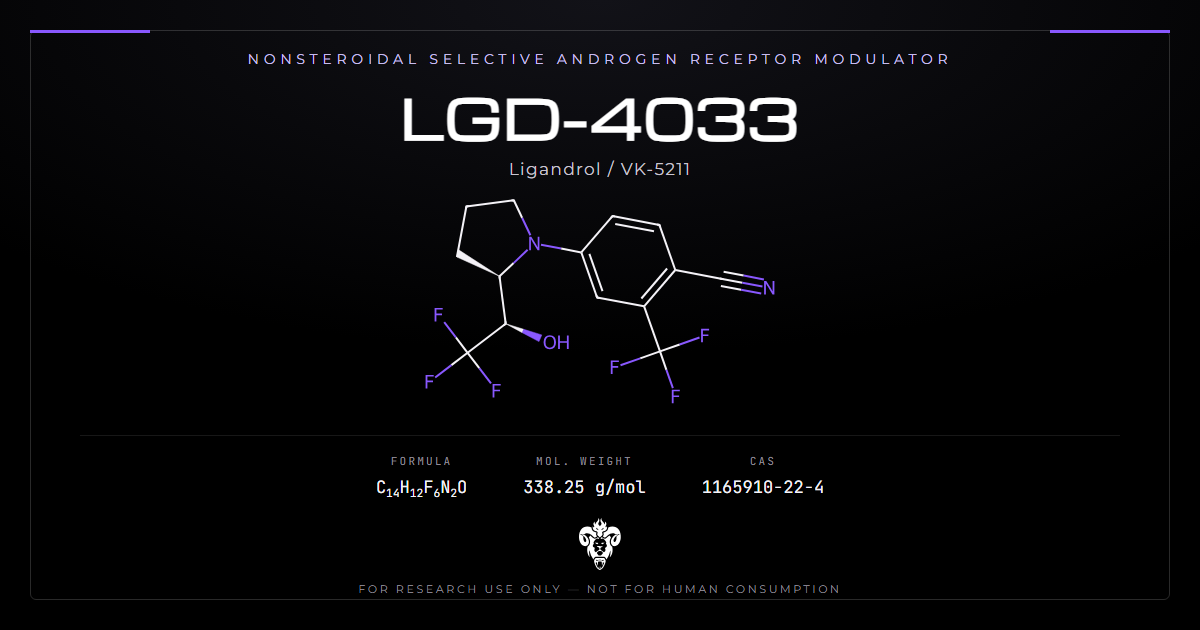
Everything below reports findings from cell cultures, isolated tissue and animals. This material is for research use only, not for human or veterinary use.
LGD-4033 is a nonsteroidal phenylpyrrolidine that binds the androgen receptor. Ligandrol and VK-5211 are the same molecule under a trade name and a development code [4]. Catalogues list it as LGD-4033.
A development programme and several indexed clinical papers exist. Those human endpoints sit outside the scope of this profile. The laboratory questions are identity, the two defined stereocentres, rodent bone readouts, and the long-term urinary markers that anti-doping methods use.
Three facts carry the file. Six fluorines sit on a 338 Da frame. Both stereocentres are specified, so mass alone does not identify the lot. The published structure of the main bishydroxylated marker was wrong for fourteen years [9].
Chemical identity
| Property | Value |
|---|---|
| Common names | LGD-4033, ligandrol, VK-5211 |
| IUPAC name | 4-[(2R)-2-[(1R)-2,2,2-trifluoro-1-hydroxyethyl]pyrrolidin-1-yl]-2-(trifluoromethyl)benzonitrile |
| Molecular formula | C14H12F6N2O |
| Molecular weight | 338.25 g/mol |
| Exact mass | 338.0854 Da |
| CAS | 1165910-22-4 |
| PubChem CID | 44137686 |
| InChIKey | OPSIVAKKLQRWKC-VXGBXAGGSA-N |
| Class | Phenylpyrrolidine, nonsteroidal |
| Stereocentres | Two, (2R) and (1R) |
| XLogP | 3.7 |
| H-bond donors / acceptors | 1 / 9 |
The catalogue carries it as LGD-4033.
Reading the structure
A benzonitrile ring carries a trifluoromethyl group and connects through nitrogen to a pyrrolidine. That pyrrolidine bears a second trifluoromethyl group on a hydroxyl-bearing carbon.
Six fluorines on a 338 Da molecule is a high proportion. Both trifluoromethyl groups sit adjacent to the atoms doing the binding. Carbon-fluorine bonds resist the oxidation that would otherwise clear the molecule quickly.
This is not an arylpropionamide. Ostarine and andarine share that older core. LGD-4033 left it. A method tuned to propionamide fragments will not automatically find a pyrrolidinyl-benzonitrile [4].
Two stereocentres, both specified
The InChIKey ends in VXGBXAGGSA-N. The systematic name resolves both centres as (2R) on the pyrrolidine and (1R) on the hydroxyethyl carbon. Neither is a formality.
Mass spectrometry cannot distinguish stereoisomers. A preparation containing the wrong diastereomer has the same formula, the same exact mass and a different pharmacology. Identity by mass alone therefore does not establish what is in a vial.
Six fluorines as an analytical handle
Two CF3 environments, one formula
Fluorine-19 NMR is the fastest orthogonal check on this lot. Two distinct trifluoromethyl environments should appear as two signals rather than one. A mono-defluorinated impurity, or a lot missing one CF3, changes that spectrum in a way an achiral area-percent will not.
High-resolution mass should also show the six-fluorine isotope envelope. Exact mass 338.0854 Da separates this formula from nearby arylpropionamides. Ostarine sits at 389.10. Andarine sits at 441.11. A certificate that quotes one of those other masses is not LGD-4033.
Infrared is a third cheap check. The nitrile stretch sits where a nitro-bearing analogue would not. LGD-4033 has one nitrile on the benzonitrile ring. Andarine has a nitro. Ostarine has two nitriles. One sharp nitrile and two CF3 signals is this lot. Two nitriles and one CF3 is ostarine. Get those two spectra before arguing about a receptor result.
Rotatable-bond count is two. Compact frames leave little room for large cleaved pieces. Long-term metabolites are therefore hydroxylations and a carboxylate on the same core [5][9] and [12].
PubChem lists XLogP 3.7 and a topological polar surface area of 47.3 square angstroms. One hydrogen-bond donor sits on the hydroxyethyl carbon. Nine acceptors come mostly from fluorine and the nitrile. That polarity profile is why hair incorporation sits above andarine and in the same band as ostarine [7].
A second practical consequence is solubility. The free base is a compact, fluorinated solid. Dimethyl sulfoxide is the usual stock solvent. Aqueous buffers will not hold a useful concentration without a cosolvent. State the vehicle in the notebook. A methods section that names LGD-4033 and then omits the vehicle has not described the exposure.
Compare the three catalogue cores on paper before treating them as equivalents.
| Lot | Core | Formula | Exact mass | Fluorines |
|---|---|---|---|---|
| LGD-4033 | Phenylpyrrolidine | C14H12F6N2O | 338.0854 | 6 |
| Ostarine | Arylpropionamide | C19H14F3N3O3 | 389.0987 | 3 |
| Andarine | Arylpropionamide | C19H18F3N3O6 | 441.11 | 3 |
| RAD-140 | Phenyl-oxadiazole | C20H16ClN5O2 | 393.10 | 0 |
A chlorine isotope envelope belongs to RAD-140, not to this lot. Three fluorines belong to the arylpropionamides. Six fluorines and no chlorine belong here.
Animal bone work
Hoffmann and colleagues tested LGD-4033 in an ovariectomised rat model of osteoporosis (PMID 37407738) [10]. Doses ran at 0.03, 0.3 and 3 mg/kg for five weeks. Bone was assessed by micro-computed tomography, biomechanics, ashing and gene expression.
What moved, and what did not
Only the top dose changed anything. Trabecular number improved in femur, lumbar vertebra and tibia. Serum phosphorus rose. Biomechanical parameters were not changed.
That distinction is the same one the class keeps producing. Structure improved and function did not. Uterus and heart weights also rose at that dose, which is not tissue selectivity. The authors conclude that further investigation for postmenopausal osteoporosis should be reevaluated [10].
Low and medium doses affected bone not at all. A compound whose only effective rodent dose also moved uterus and heart has a narrow window in that model.
How to read the rat file
Trabecular number is a structural count. Biomechanical testing measures whether the bone resists load. Improving the first without the second is a dissociation, not a success. Five weeks in ovariectomised females is not a healthy intact adult and is not a human.
The same laboratory has run ostarine through related rat designs. Do not stack those figures. Different lots, different papers, different clocks.
Ovariectomy removes ovarian oestrogen and accelerates bone loss. That is a different deficiency from orchidectomy, which removes testicular androgen. Hoffmann used the female model [10]. Read a levator-ani result from a castrated male paper as a different assay. LGD-4033 does not have a published Gao-style organ-weight percentage set in castrated males. Do not borrow andarine’s 16% prostate figure and paste it onto this lot.
Gene-expression panels in the Hoffmann paper are part of the same five-week clock. They do not convert a structural count into a strength result. Ashing and micro-CT describe mineral and architecture. Three-point bending describes load. Name which one a sentence is using.
Limits of the published record
Indexed clinical papers exist for this molecule. Human endpoints sit outside the scope of this profile. The papers stay in the reference list so a reader can find them.
What those papers are
Basaria and colleagues published a short randomised study in healthy men [1]. Dalton and colleagues reviewed the class from a competing-SARM company [2]. Barbara, Cardaci and Labban published case reports [6][8] and [11].
This profile will not quote human dose ladders, lean-mass deltas, hormone or lipid changes, transaminase values, or adverse-event rates from those papers. Those sentences turn a research article into a use document.
What this profile will not do
Sponsor programmes are not laboratory identity results. Case reports after unsupervised intake are not handling instructions. A detected urinary concentration does not convert into an intended intake [12].
The published record names a second code, VK-5211, as the same chain [4]. It does not explain why a larger programme never appeared in the indexed literature. This article does not guess.
Class rationale, without a use story
Dalton and colleagues set out the rationale that carried the field (PMID 24189892) [2]. SARMs modulate the same anabolic pathways as steroidal androgens. Within the dose range where muscle effects appear in the models they cite, androgenic effects on prostate, skin and hair have not been observed.
They name LGD-4033 among compounds with clinical-efficacy data at that point. Read now, the review records what the class expected to deliver. It also shows that the expectation came largely from the companies developing it.
The prostate half of that claim is a receptor-selectivity argument. It is not a certificate claim. Run the tissue panel if the experiment needs it.
One cited pharmacokinetic sentence from the Basaria paper stays, because it is bound to that paper. The compound showed a long elimination half-life with dose-proportional accumulation on repeated dosing [1]. This profile does not add a numeric half-life or a human milligram figure.
The detection problem
Anti-doping laboratories have characterised LGD-4033 more thoroughly than the pharmacology file has.
On seized products before most labels named it
Krug and colleagues analysed 337 black-market products seized in Germany between 2010 and 2013 (PMID 25168622) [3]. They identified 67 active ingredients and flag LGD-4033 as one of three outstanding findings.
That is an identity result in a forensic set. It is not a use protocol.
Where it sits in the testing regime
Thevis and Schanzer review detection across the class (PMID 28137616) [4]. SARMs joined the prohibited list in 2008. Their review names LGD-4033 and VK-5211 as the same compound, which is worth knowing when older sources treat the codes separately.
Hair extends the window
Kintz and colleagues applied hair analysis to three SARMs including ligandrol (PMID 33337588) [7]. Measured concentrations were 14 to 42 pg/mg for ligandrol, against 3 to 21 for ostarine and 0.1 to 0.7 for andarine.
Segmental hair analysis distinguishes repeated exposure from a single contact, which urine cannot do. Duration is the variable the rest of this file cannot settle from one short indexed study [1]. Hair is the matrix that at least records time.
The equine metabolite map
Cutler and colleagues dosed two thoroughbred horses orally and tracked urine, plasma and hair (PMID 31655494) [5]. Eight metabolites appeared in urine, five of them only as phase II conjugates. The parent compound appeared in urine only in the conjugated fraction.
Di- and tri-hydroxylated metabolites gave the longest urinary detection. In plasma, mono-hydroxylated metabolites lasted longest. All eleven phase I metabolites seen in equine liver microsomes also appeared in vivo. That is better model-to-animal agreement than most such comparisons achieve.
Hydrolysis before analysis is not optional on this map. Parent in urine sat only in the conjugated fraction [5]. A method that skips beta-glucuronidase will under-report exposure and will miss the longer-lived di- and tri-hydroxy species. Plasma is a different map. There the mono-hydroxy species outlast the parent. Quote the matrix with the ion.
Hair in the equine study is a third map again. Cutler tracked it alongside urine and plasma [5]. Kintz later put human hair concentrations in the 14 to 42 pg/mg band [7]. Those two papers do not share a calibration. They share the point that hair records a longer clock than a single urine void.
Shared benches matter here for the same reason they matter for ostarine. Microgram-scale intakes still write a multi-day urinary record [12]. Blank runs between samples cost little. They settle whether a low-level ion is the workspace or the vial.
The marker that had the wrong structure
Pitsinos and colleagues revisited the main bishydroxylated long-term metabolic marker for ligandrol (PMID 36354052) [9]. They proposed a chemically more stable structure than the one previously established. Synthesis followed, and NMR plus comparison against a real metabolic sample confirmed the revision.
The compound was prohibited in 2008 and routinely detected for years. Correction of the published structure for its key long-term marker arrived in 2022. Detection worked throughout, because the analytical signal was real. The structural assignment attached to that signal was wrong.
Sakellariou and colleagues have since developed quantification for a different long-term metabolite, the carboxylated M5-b, using newly synthesised certified reference material (PMID 42547066) [12]. Applied to microdose excretion work at 1, 10 and 50 µg, it shows rapid formation and dose-dependent urinary concentrations. Detectability runs several days after a single intake and substantially longer after repeated intake.
That work exists to distinguish contamination from a deliberate intake. It is also the first quantitative excretion data for the marker. The interpretation framework therefore postdates the enforcement by nearly two decades.
How to read an LGD-4033 study
Five questions keep this literature from collapsing into a slogan.
Which structure was measured?
Intact mass 338.25 Da average, 338.0854 monoisotopic, CAS 1165910-22-4, CID 44137686, InChIKey OPSIVAKKLQRWKC-VXGBXAGGSA-N. A lot that fails those checks is not LGD-4033. A six-fluorine count on fluorine NMR is the fast screen.
Human, rodent or horse?
The bone data are rat [10]. The fullest metabolite map is equine [5]. Indexed clinical papers exist and stay unread here. Both animal files are informative. Neither is a human result.
Is the endpoint structure or function?
The rat bone study improved trabecular number and left biomechanics unchanged [10]. Lean mass and physical function are likewise separate endpoints. This profile does not quote the human half of that pair.
Was the material assayed?
LGD-4033 appeared in seized products more than a decade ago [3]. A stated concentration on a label is not an exposure. Intact mass and chiral chromatography are.
Which marker, and which published structure?
The bishydroxylated long-term marker had the wrong published connectivity until 2022 [9]. M5-b is a later, quantified carboxylate [12]. Name the ion and the paper before stacking detection windows.
Verifying research material
The compound has two defined stereocentres and a distinctive fluorine count, so verification is straightforward when done properly. Batch documentation sits on the certificates of analysis page.
Identity
Formula C14H12F6N2O, molecular weight 338.25, CAS 1165910-22-4, InChIKey OPSIVAKKLQRWKC-VXGBXAGGSA-N. Six fluorines produce an unmistakable fluorine NMR signature. Two distinct trifluoromethyl environments should appear as two signals rather than one.
Stereochemistry
Both centres carry defined configuration, encoded in the VXGBXAGGSA block of the InChIKey. Chiral chromatography against a characterised reference is the assay that confirms it. Mass spectrometry alone cannot, and a certificate reporting only chemical purity has not addressed diastereomeric composition.
Handling
Store the solid cold, dry and dark. Weigh on a dedicated balance. Keep dedicated spatulas and glassware. Single microgram-scale intakes produce detectable urinary metabolites for days [12]. Shared benches transfer analytically meaningful quantities.
Storage guidance is a house recommendation. Analytical documentation is per-lot release testing.
Dilute solutions lose material to plastic. Aliquot on dissolution rather than sampling one vial repeatedly. Do not infer salt form from the free-base formula. Residual solvent belongs on the certificate next to the free-base mass.
A second handling question is the hydroxyethyl alcohol. That is the site that later metabolites oxidise and carboxylate [9][12]. It is also a site that a sloppy esterification could occupy. OTR-AC is the acetate of ostarine, not of this lot, but the lesson travels. If a certificate quotes 338 Da and an extra 42 Da is sitting in the same vial, something has been acylated. Run intact mass first.
A third question is diastereomeric excess after a poor reduction or a racemic starting pyrrolidine. Both centres are defined. A 1:1 mix at either centre is not LGD-4033 as catalogued. Chiral HPLC against a characterised reference is the assay. Optical rotation alone does not assign both centres.
Kimera publishes third-party certificates of analysis for every lot. Laboratories source LGD-4033 as a phenylpyrrolidine androgen-receptor ligand. It sits alongside ostarine, andarine and RAD-140 for comparative receptor work. Related write-ups sit at ostarine, andarine and RAD-140. Related work appears in the SARMs category.
Common questions about LGD-4033
What is LGD-4033? A phenylpyrrolidine androgen-receptor ligand, also called ligandrol and VK-5211 [4].
Is LGD-4033 the same as VK-5211? Yes. The two codes describe one compound [4].
Does this page report human outcomes? No. Indexed clinical papers are listed so they can be found. This profile stops at chemistry, rodent bone and detection.
Does it build bone in rats? In ovariectomised rats the top dose improved trabecular structure without improving biomechanical strength [10].
What was wrong with the long-term marker? Synthesis and NMR revised the published structure of the main bishydroxylated marker in 2022 [9]. Detection had been real. Assignment had not.
What else is in this class? Ostarine, andarine and RAD-140 sit alongside it for comparative work.
Summary of the evidence
Write the name, the mass and both stereocentres on the first line of a notebook page. Everything else in this profile is a check on those three facts.
Identity: C14H12F6N2O, 338.25 Da, CAS 1165910-22-4, PubChem CID 44137686, InChIKey OPSIVAKKLQRWKC-VXGBXAGGSA-N. A certificate that omits intact mass and chiral chromatography is not finished.
LGD-4033 is the long name for that lot. Ligandrol and VK-5211 are the same chain. Do not treat a code as a second compound.
If a methods section names LGD-4033 and then quotes a mass that belongs to ostarine, stop. The rest of that paper is about a different reagent.
Design: a nonsteroidal phenylpyrrolidine selected outside the arylpropionamide series [2][4].
Rodent evidence: trabecular number up and biomechanics unchanged at 3 mg/kg in ovariectomised rats [10].
Analytical evidence: an equine metabolite map [5], a revised bishydroxylated marker [9], and quantified M5-b excretion after microgram-scale intakes [12].
Limits: human efficacy, human dose and human adverse-event figures are out of scope here. Those papers remain in the reference list.
Status: supplied for laboratory research use only.
References
- Basaria S, Collins L, Dillon EL, Orwoll K, Storer TW, Miciek R, Ulloor J, Zhang A, Eder R, Zientek H, Gordon G, Kazmi S, Sheffield-Moore M, Bhasin S. The safety, pharmacokinetics, and effects of LGD-4033, a novel nonsteroidal oral, selective androgen receptor modulator, in healthy young men. J Gerontol A Biol Sci Med Sci. 2013;68(1):87-95. PMID 22459616. DOI
- Dalton JT, Taylor RP, Mohler ML, Steiner MS. Selective androgen receptor modulators for the prevention and treatment of muscle wasting associated with cancer. Curr Opin Support Palliat Care. 2013;7(4):345-351. PMID 24189892. DOI
- Krug O, Thomas A, Walpurgis K, Piper T, Sigmund G, Schänzer W, Laussmann T, Thevis M. Identification of black market products and potential doping agents in Germany 2010-2013. Eur J Clin Pharmacol. 2014;70(11):1303-1311. PMID 25168622. DOI
- Thevis M, Schänzer W. Detection of SARMs in doping control analysis. Mol Cell Endocrinol. 2017;464:34-45. PMID 28137616. DOI
- Cutler C, Viljanto M, Hincks P, Habershon-Butcher J, Muir T, Biddle S. Investigation of the metabolism of the selective androgen receptor modulator LGD-4033 in equine urine, plasma and hair following oral administration. Drug Test Anal. 2020;12(2):247-260. PMID 31655494. DOI
- Barbara M, Dhingra S, Mindikoglu AL. Ligandrol (LGD-4033)-induced liver injury. ACG Case Rep J. 2020;7(6):e00370. PMID 32637435. DOI
- Kintz P, Gheddar L, Ameline A, Raul JS. Perspectives in evaluating selective androgen receptor modulators in human hair: a short communication. Ther Drug Monit. 2021;43(2):298-300. PMID 33337588. DOI
- Cardaci TD, Machek SB, Wilburn DT, Heileson JL, Harris DR, Cintineo HP, Willoughby DS. LGD-4033 and MK-677 use impacts body composition, circulating biomarkers, and skeletal muscle androgenic hormone and receptor content: a case report. Exp Physiol. 2022;107(12):1467-1476. PMID 36303408. DOI
- Pitsinos EN, Angelis YS, Petrou M. Structure revision and chemical synthesis of ligandrol’s main bishydroxylated long-term metabolic marker. Org Biomol Chem. 2022;20(46):9112-9116. PMID 36354052. DOI
- Hoffmann DB, Derout C, Müller-Reiter M, Böker KO, Schilling AF, Roch PJ, Lehmann W, Saul D, Hawellek T, Taudien S, Sehmisch S, Komrakova M. Effects of ligandrol as a selective androgen receptor modulator in a rat model for osteoporosis. J Bone Miner Metab. 2023;41(6):741-751. PMID 37407738. DOI
- Labban H, Kwait B, Paracha A, Islam M, Kim DO. LGD-4033 and a case of drug-induced liver injury: exploring the clinical implications of off-label selective androgen receptor modulator use in healthy adults. Cureus. 2024;16(9):e69601. PMID 39421081. DOI
- Sakellariou P, Schröder SM, Thelen J, Korsmeier L, Guddat S, Görgens C, Thomas A, Thevis M. Quantification of the carboxylated LGD-4033 long-term metabolite in human micro-dose excretion study urine samples. Drug Test Anal. 2026. PMID 42547066. DOI
LGD-4033 is sold for laboratory research use only. Not for human consumption, nor medical, veterinary, or household uses.
Literature retrieved from PubMed.