
Everything below reports findings from cell cultures, isolated tissue and animals. This material is for research use only, not for human or veterinary use.
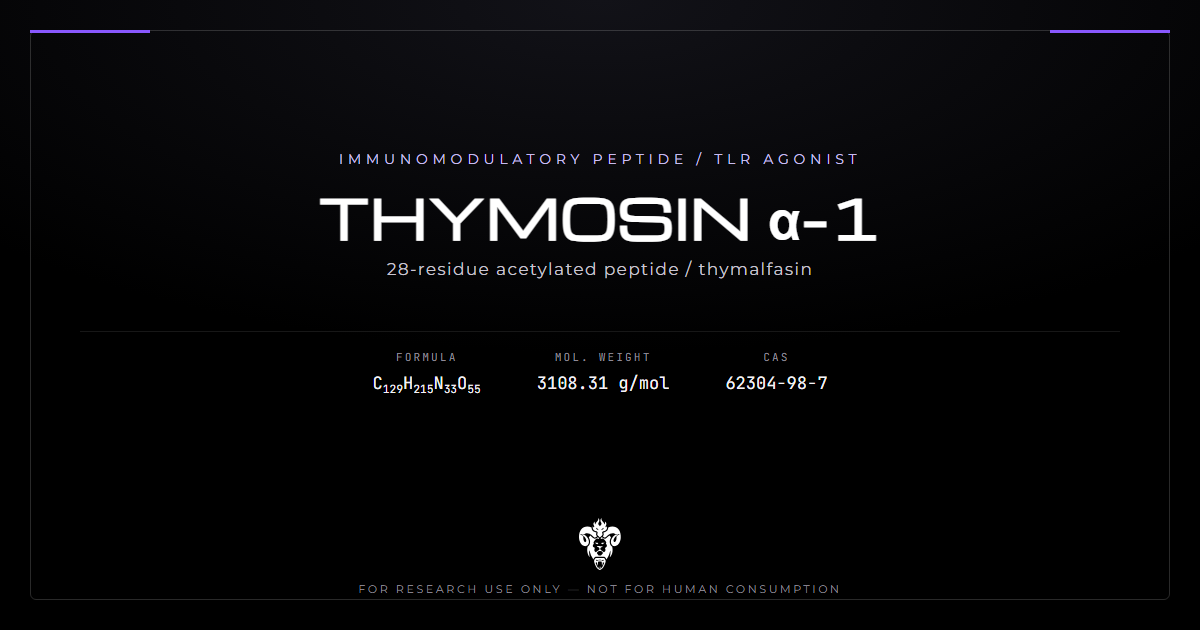
Thymosin Alpha-1 is a 28-residue peptide, N-terminally acetylated. It matches the first 28 residues of prothymosin alpha. Investigators first isolated it from thymic tissue as the fraction that restored immune function in thymectomised mice [3].
The published mechanism does not look like a classical hormone. It acts through Toll-like receptors on myeloid and plasmacytoid dendritic cells. That step activates signalling pathways and starts cytokine production [3][12]. That is innate immune stimulation. It sits closer to an adjuvant than to a hormone.
Indexed immune-trial papers exist and run unusually large. Those human endpoints sit outside this profile. The useful laboratory questions are identity, the acetyl, and what the Toll-like receptor account actually predicts.
Chemical identity
A 28-residue peptide, N-terminally acetylated, corresponding to the first 28 residues of prothymosin alpha.
| Property | Value |
|---|---|
| Common names | Thymosin Alpha-1, thymalfasin, Ta1, Zadaxin |
| Sequence | Ac-SDAAVDTSSEITTKDLKEKKEVVEEAEN |
| Molecular formula | C129H215N33O55 |
| Molecular weight | 3108.3 |
| CAS | 62304-98-7 |
| PubChem CID | 16130571 |
| InChIKey | NZVYCXVTEHPMHE-ZSUJOUNUSA-N |
| Residues | 28 |
| N-terminus | Acetylated |
| Cysteines | None |
| Parent | Prothymosin alpha, first 28 residues |
Kimera supplies the material as Thymosin Alpha-1.
Size changes what verification means
At 3108 daltons and 28 residues Thymosin Alpha-1 is a large peptide by catalogue standards. It carries roughly three times the mass of the melanocortin peptides. It carries four times that of the LL-37 fragments in common use.
Size matters for practical reasons. Synthesis at 28 residues accumulates deletion sequences. A peptide missing one internal residue differs from the target by that residue mass alone, on a molecule already above 3000. Proportionally that is a small shift on a large number.
The N-terminal acetyl is part of the molecule
Acetylation at the N-terminus is not a protecting group left over from synthesis. It is present in the native peptide. A deacetylated preparation is a different compound 42 daltons lighter.
A certificate that does not name the acetylation state is answering a narrower question than it appears to.
PubChem records the condensed sequence as Ac-Ser-Asp-Ala-Ala-Val-Asp-Thr-Ser-Ser-Glu-Ile-Thr-Thr-Lys-Asp-Leu-Lys-Glu-Lys-Lys-Glu-Val-Val-Glu-Glu-Ala-Glu-Asn-OH. That string is the identity. A lot that drops the acetyl or clips a residue is not Thymosin Alpha-1.
Residue chemistry of Thymosin Alpha-1
Twenty-eight residues is a short protein and a long synthetic peptide. The composition is not generic.
What the sequence is made of
| Residue class | Residues | Count in Thymosin Alpha-1 |
|---|---|---|
| Acidic | Asp, Glu | 9 |
| Basic | Lys | 4 |
| Hydroxyl | Ser, Thr | 6 |
| Small aliphatic | Ala, Val, Leu, Ile | 8 |
| Amide | Asn | 1 |
| Missing | Cys, Met, Trp, Tyr, Phe, His, Arg, Pro, Gly, Gln | 0 |
Nine acidic residues on a 28-residue chain is a lot. The usual aqueous instability of acidic peptides applies. There is no cysteine, so disulfide scrambling is not a concern. That distinguishes Thymosin Alpha-1 from many peptides of comparable size.
Compare with ARA-290, a much shorter immunomodulatory peptide with a different stability profile. Related write-ups sit at ARA-290 and Thymogen.
Why the missing residues help the analyst
No cysteine means no scrambled disulfides. No methionine and no tryptophan means oxidation is not the first impurity to hunt. Deletion sequences and partial deacetylation still are.
Lysine appears four times. Those amines are the sites a chemist would worry about during acetylation or during a careless capping step. An extra acetyl on a lysine is a different +42 shift from the N-terminal acetyl. Intact mass alone cannot tell those two +42 species apart without a mapped digest.
Charge envelope at this mass
Singly charged ions above 3000 sit outside the comfortable range of many instruments. Practical analysis uses multiply charged species. The charge envelope itself carries information.
A clean Thymosin Alpha-1 preparation gives a tidy series. A ragged envelope, or peaks that deconvolute to several nearby masses, points at deletion sequences or partial deacetylation rather than at instrument noise.
The acetyl check is a 42-dalton shift. That is a 1.35 percent change at this mass. A modern instrument can resolve it.
The name is accurate about origin and misleading about class
Investigators first isolated Thymosin Alpha-1 from thymic tissue. It was the fraction that restored immune function in thymectomised mice [3].
It is not a thymic hormone in the usual sense
The name invites reading it as a hormone with a receptor and a feedback loop. The published mechanism does not look like that.
It acts through Toll-like receptors on myeloid and plasmacytoid dendritic cells. That step activates signalling pathways and starts cytokine production [3]. That is innate immune stimulation. It sits closer to an adjuvant than to a hormone.
Garaci and colleagues set the same peptide in a bench-to-bedside frame (PMID 17600290) [12]. Use that paper for the cell work and the historical isolation. Do not use it as a use document.
Pleiotropic is the operative word
Reviews describe the mechanism as pleiotropic. It touches multiple immune cell subsets [3]. A compound that touches many subsets does not produce a single clean readout.
This matters when reading any later paper. Any single cell-population outcome shows one facet of a broad effect. It does not predict what a different population will do.
What the sequence implies for handling
Aspartate and glutamate content is high. The usual aqueous instability of acidic peptides applies. There is no cysteine, so disulfide scrambling is not a concern.
Aliquot on reconstitution. Repeated freeze-thaw of a 28-residue acidic peptide is how a clean envelope becomes a ragged one.
What the mechanism predicts, and what it does not
The Toll-like receptor account [3] does useful work here. It tells a laboratory which cells to put in the well.
An adjuvant needs something to adjuvant
Thymosin Alpha-1 amplifies an immune response already being mounted, through Toll-like receptor stimulation on dendritic cells. It does not create one from nothing.
In a system with a functioning immune set-point and a controlled insult, there may be little to amplify. In models where immune paralysis is part of the pathology, there is a great deal.
That framing comes from the mechanistic literature rather than from any one outcome table [3].
What it does not predict
The size of any effect, or its durability. Pleiotropic immune stimulation is not quantitatively predictable from a receptor mechanism.
It also says nothing about whether stimulation is desirable in a given setting. Amplifying an immune response is not automatically beneficial. In models where inflammation drives the pathology it could run the other way.
Cell-level readouts that match the claim
Dendritic-cell cytokine production and Toll-like receptor signalling are the proximal measurements [3][12]. Distant clinical scores do not report receptor occupancy. A single cell-subset count does not report the pleiotropic claim.
Myeloid dendritic cells and plasmacytoid dendritic cells are different wells. Mix them and the cytokine mix changes. State the subset if the paper is going to be usable.
Immune-cell assays in animals and cells
The isolation experiment is still the cleanest animal fact in the file. Thymectomised mice lost a function. The thymic fraction that is now Thymosin Alpha-1 put it back [3].
What a dendritic-cell well can show
King and Tuthill review Toll-like receptor engagement on myeloid and plasmacytoid dendritic cells (PMID 27450734) [3]. Cytokine output is the proximal readout. Downstream subset shifts are secondary.
A well that never saw a Toll-like receptor ligand is a different experiment from a well that already did. The adjuvant claim predicts a larger move in the second well. Test that prediction. Do not assume it.
Garaci and colleagues collected earlier cell and animal work under one heading [12]. Treat that paper as a map of which cell types people have already put in a dish. It is not a certificate for a new lot.
What a mouse experiment can show
Thymectomy removes the organ that originally yielded the peptide. Restoring a function in that model is how the fraction was identified [3]. Later mouse designs that never remove the thymus are asking a different question.
State the strain, the insult, and whether the animal was immune-suppressed. The mechanism predicts that last variable matters [3]. A paper that skips it is hard to read.
What those assays do not license
Those assays do not license a human endpoint or a milligram ladder. Nothing in the cell file supports a claim that every immune cell will move the same way.
A pleiotropic adjuvant in one subset can look silent in another. That is a feature of the mechanism, not a failed lot [3].
Indexed immune papers
A database search for Thymosin Alpha-1 returns well over a hundred trials, reviews and protocols. They span several disease names.
Volume of evidence is not the same as weight of evidence. Liu and colleagues opened their 2016 sepsis review by calling its own constituent studies small and poorly designed [1]. Gu and colleagues later used trial sequential analysis and individual patient data [4]. Wu and colleagues ran a large cirrhosis paper [2]. Chen and colleagues ran an acute-on-chronic liver-failure paper [5].
Those human endpoints sit outside this profile.
| Study | What the file is | What this profile uses |
|---|---|---|
| 2016 sepsis review [1] | Pooled RCTs | Indexed file exists |
| 2025 sepsis review [4] | Pooled RCTs | Indexed file exists |
| ACLF RCT [5] | HBV liver-failure paper | Indexed file exists |
| Cirrhosis RCT [2] | HBV compensated-cirrhosis paper | Indexed file exists |
| Oncology combinations [6][7] and [8] | Combination regimens | Cannot isolate the peptide |
| Critical-care protocols [9][10] and [11] | Surgery, pneumonitis, pancreatitis | Protocols and post hoc papers |
Cite those papers for the fact that a file exists. Do not import their human endpoints into a laboratory protocol.
Combination work cannot isolate the peptide
Published work pairs the peptide with checkpoint inhibitors, radiotherapy and colony-stimulating factors [6][7]. Neoadjuvant use alongside immunochemotherapy has a prospective paper [8].
These are combination studies. Attributing an outcome to any single component of a multi-part regimen is not possible from them. The papers do not claim otherwise.
The rationale behind the pairing is coherent. Checkpoint inhibitors work better when antigen presentation is intact. Dendritic cell stimulation is exactly what Thymosin Alpha-1 does [3]. Combining them is a reasonable hypothesis rather than an arbitrary stack.
Reasonable hypotheses still need isolating experiments.
Protocols and post hoc papers
A protocol exists for a trial in acute aortic dissection surgery [9]. A randomised paper addressed radiation pneumonitis in locally advanced non-small cell lung cancer [7]. Pancreatitis has both a trial protocol and a post hoc analysis [10][11].
The breadth reflects the mechanism. A pleiotropic immune stimulant is testable anywhere immune suppression contributes to an outcome. That is a long list. It is not a reason to treat those human scores as laboratory identity.
How to read a Thymosin Alpha-1 assay
Five questions, and the first two do most of the work.
Which structure was in the well?
Intact mass 3108.3, formula C129H215N33O55, InChIKey NZVYCXVTEHPMHE-ZSUJOUNUSA-N, acetyl present. A lot that fails those checks is not Thymosin Alpha-1.
Was the system immune-suppressed?
The mechanism predicts that it matters [3]. Indexed papers in different populations exist [2][5]. Their human endpoints sit outside this profile. In a dish, state whether the cells already had an insult.
Monotherapy or combination?
Much of the recent oncology literature is combination work [6][7] and [8]. Those studies cannot isolate this compound’s contribution.
Which endpoint?
Cell subset counts and cytokine levels are not interchangeable with distant clinical scores. The immunological endpoints move more readily. They are also closer to the Toll-like receptor claim [3].
Was it a review of reviews?
This literature has accumulated enough secondary sources that some publications summarise other summaries. Those inherit every weakness of the papers underneath without re-examining them.
The two sepsis reviews here went back to primary studies [1][4]. The 2025 one went further by using individual patient data. That distinction is worth checking before treating any review as evidence. Neither review supplies a laboratory identity result.
Sequence chemistry at the bench
Twenty-eight residues means 27 coupling steps. Incomplete coupling at any one produces a peptide short by one residue. These are chemically similar to the target and can co-elute.
At 99 percent purity per coupling step across 27 steps, the theoretical yield of full-length peptide is around 76 percent. Real syntheses do better than that through capping and purification. The pressure is still real and it scales with length.
This is why a 28-residue peptide and a 7-residue peptide at the same stated purity are not comparable products. The shorter one has six coupling steps to go wrong. Thymosin Alpha-1 has 27.
Reading a mass spectrum at this size
Singly charged ions above 3000 sit outside the comfortable range of many instruments. Practical analysis uses multiply charged species. The charge envelope itself carries information.
A clean preparation gives a tidy series. A ragged envelope points at deletion sequences or partial deacetylation.
The acetyl check is a 42-dalton shift. Confirm it on every Thymosin Alpha-1 batch.
Counterions and peptide content
Lyophilised material carries counterions and water. A vial labelled by weight holds less peptide than that mass. Acetate or trifluoroacetate content belongs on the certificate next to the free-base mass.
High aspartate and glutamate content makes trifluoroacetate a likely leftover from cleavage. Residual TFA carries its own activity in some cell assays. Ask for it, or exchange it, before a low-concentration experiment.
Verifying research material
Thymosin Alpha-1 is a defined chemical entity with published identifiers, so verification is arithmetic rather than judgement. Batch documentation sits on the certificates of analysis page.
Identity
Formula C129H215N33O55, molecular weight 3108.3, InChIKey NZVYCXVTEHPMHE-ZSUJOUNUSA-N. At this mass the practical mass spectrometry approach uses multiply charged ions rather than the singly charged species.
The acetylation check
Confirm the N-terminal acetyl on any Thymosin Alpha-1 batch. Its absence costs 42 daltons.
The check matters because a deacetylated peptide is a plausible synthesis outcome and is not the native molecule.
Deletion sequences are the main purity risk
Ask for a chromatographic trace rather than a single purity number. Deletion sequences show as shoulders. A bare percentage hides them.
An approved thymalfasin specification exists in some jurisdictions. That has a practical benefit for a laboratory. A supplier’s certificate can be compared against a named specification rather than against nothing. Ask which specification a batch was assayed against. “Meets specification” without naming the specification says nothing.
Handling
Store the lyophilised solid at minus 20 degrees Celsius, dark. Treat reconstituted material as short-lived.
Storage guidance is a house recommendation. Analytical documentation is per-lot release testing.
The sequence carries no cysteine, so disulfide scrambling is not a concern. Aspartate and glutamate content is high, and the usual aqueous instability applies. Aliquot on reconstitution.
The rest of the peptide literature sits in the peptides category.
Common questions about Thymosin Alpha-1
Identity and class
What is thymalfasin? The same compound. Thymalfasin is the international nonproprietary name. Zadaxin is a brand name.
Is it a hormone? Not in the usual sense. Investigators isolated it from thymus. It acts through Toll-like receptors on dendritic cells rather than a classical hormone receptor [3].
How large is it? 28 residues, 3108.3 daltons, N-terminally acetylated. It corresponds to the first 28 residues of prothymosin alpha.
Evidence
Do indexed immune-trial papers exist? Yes. Sepsis reviews, a large cirrhosis paper, and an acute liver-failure paper are in the file. Their human endpoints sit outside this profile.
Can the oncology results be attributed to it? Not from combination trials [6][7] and [8], which is most of that literature.
Is the mechanism actually settled? Better than the distant endpoints are. Toll-like receptor action on myeloid and plasmacytoid dendritic cells is the published account [3][12].
Why would an adjuvant look different in different models? Because it amplifies a response rather than creating one. A system that is not immune-paralysed is a different test [3].
Handling and verification
What is the main identity risk? Loss of the N-terminal acetyl, which costs 42 daltons.
What is the main purity risk? Deletion sequences. 28 residues means 27 coupling steps, and each is an opportunity to drop a residue.
Does it contain cysteine? No, so disulfide scrambling is not a concern, unlike many peptides of similar size.
Why ask which specification a batch met? Because a named pharmacopoeial specification exists for thymalfasin in some markets. That is unusual for a catalogue peptide.
Summary of the evidence
Identity: 28 residues, C129H215N33O55, 3108.3 g/mol, N-terminally acetylated, CAS 62304-98-7. First 28 residues of prothymosin alpha. Sequence Ac-SDAAVDTSSEITTKDLKEKKEVVEEAEN.
Mechanism: Toll-like receptor stimulation on myeloid and plasmacytoid dendritic cells, with a pleiotropic cytokine and subset profile [3][12]. Isolated as the active fraction from thymic extract in thymectomised mice [3].
Indexed immune-trial papers exist. Their human endpoints sit outside this profile.
Analytical risk: deletion sequences at 27 coupling steps, and loss of the 42-dalton acetyl.
Status: supplied for laboratory research use only.
References
- Liu F, Wang HM, Wang T, Zhang YM, Zhu X. The efficacy of thymosin α1 as immunomodulatory treatment for sepsis: a systematic review of randomized controlled trials. BMC Infect Dis. 2016;16:488. PMID 27633969. DOI
- Wu X, Shi Y, Zhou J, Sun Y, Piao H, Jiang W, Ma A, Chen Y, et al.. Combination of entecavir with thymosin alpha-1 in HBV-related compensated cirrhosis: a prospective multicenter randomized open-label study. Expert Opin Biol Ther. 2018;18(sup1):61-69. PMID 30063860. DOI
- King R, Tuthill C. Immune Modulation with Thymosin Alpha 1 Treatment. Vitam Horm. 2016;102:151-78. PMID 27450734. DOI
- Gu B, Zhou Y, Nie Y, Wang L, Liang L, Liao Z, Wen J, Guan X, et al.. Efficacy of thymosin α1 for sepsis: a systematic review and meta-analysis of randomized controlled trials. Front Cell Infect Microbiol. 2025;15:1673959. PMID 40969554. DOI
- Chen JF, Chen SR, Lei ZY, Cao HJ, Zhang SQ, Weng WZ, Xiong J, Lin DN, et al.. Safety and efficacy of Thymosin α1 in the treatment of hepatitis B virus-related acute-on-chronic liver failure: a randomized controlled trial. Hepatol Int. 2022;16(4):775-788. PMID 35616850. DOI
- Yu J, Yin L, Guo W, Wang Q, Liu J, Zhang L, Ye H, Xia J, et al.. Hypofractionated radiotherapy combined with a PD-1 inhibitor, granulocyte macrophage-colony stimulating factor, and thymosin-α1 in advanced metastatic solid tumors: a multicenter Phase II clinical trial. Cancer Immunol Immunother. 2025;74(3):98. PMID 39904914. DOI
- Liu F, Qiu B, Xi Y, Luo Y, Luo Q, Wu Y, Chen N, Zhou R, et al.. Efficacy of Thymosin α1 in Management of Radiation Pneumonitis in Patients With Locally Advanced Non-Small Cell Lung Cancer Treated With Concurrent Chemoradiotherapy: A Phase 2 Clinical Trial (GASTO-1043). Int J Radiat Oncol Biol Phys. 2022;114(3):433-443. PMID 35870709. DOI
- Xu H, Li F, Li B, Yang D, Liu T, Xia Y, Hua H, Li Q, et al.. Neoadjuvant immunochemotherapy plus thymalfasin in locally advanced gastric cancer: a prospective clinical trial. BMC Med. 2026;24(1). PMID 41749205. DOI
- Liu H, Qian SC, Zhang YY, Tang CB, Yue HH, Fan GL, Zhao X, Jiang YY, et al.. Effect of thymosin α1 on Immune response and organ function in acute aortic dissection surgery: PANDA II trial protocol. Future Cardiol. 2025;21(7):447-454. PMID 40367062. DOI
- Zhou J, Mao W, Ke L, Chen T, He W, Pan X, Chen M, He C, et al.. Thymosin alpha 1 in the prevention of infected pancreatic necrosis following acute necrotising pancreatitis (TRACE trial): protocol of a multicentre, randomised, double-blind, placebo-controlled, parallel-group trial. BMJ Open. 2020;10(9):e037231. PMID 32994239. DOI
- Huang X, Mao W, Hu X, Qin F, Zhao H, Zhang A, Wang X, Stoppe C, et al.. Immune-Enhancing Treatment among Acute Necrotizing Pancreatitis Patients with Metabolic Abnormalities: A Post Hoc Analysis of a Randomized Clinical Trial. Gut Liver. 2024;18(5):906-914. PMID 38356344. DOI
- Garaci E, Favalli C, Pica F, Sinibaldi Vallebona P, Palamara AT, Matteucci C, Pierimarchi P, Serafino A, et al.. Thymosin alpha 1: from bench to bedside. Ann N Y Acad Sci. 2007;1112:225-34. PMID 17600290. DOI
Thymosin Alpha-1 is sold for laboratory research use only. Not for human consumption, nor medical, veterinary, or household uses.