
Kimera Chems
0

9-ME-BC

Don’t see your product’s COA?

Search our full archive of third-party verified Certificates of Analysis to pull the exact batch you received.

Browse the COA Database

9-ME-BC

9-ME-BC is sold for laboratory research use only. Terms of sale apply. Not for human consumption, nor medical, veterinary, or household uses. Please familiarize yourself with our Terms and Conditions prior to ordering.

Trust badges: SSL secure checkout with 256-bit encryption, and third-party verification by HPLC and mass spectrometry

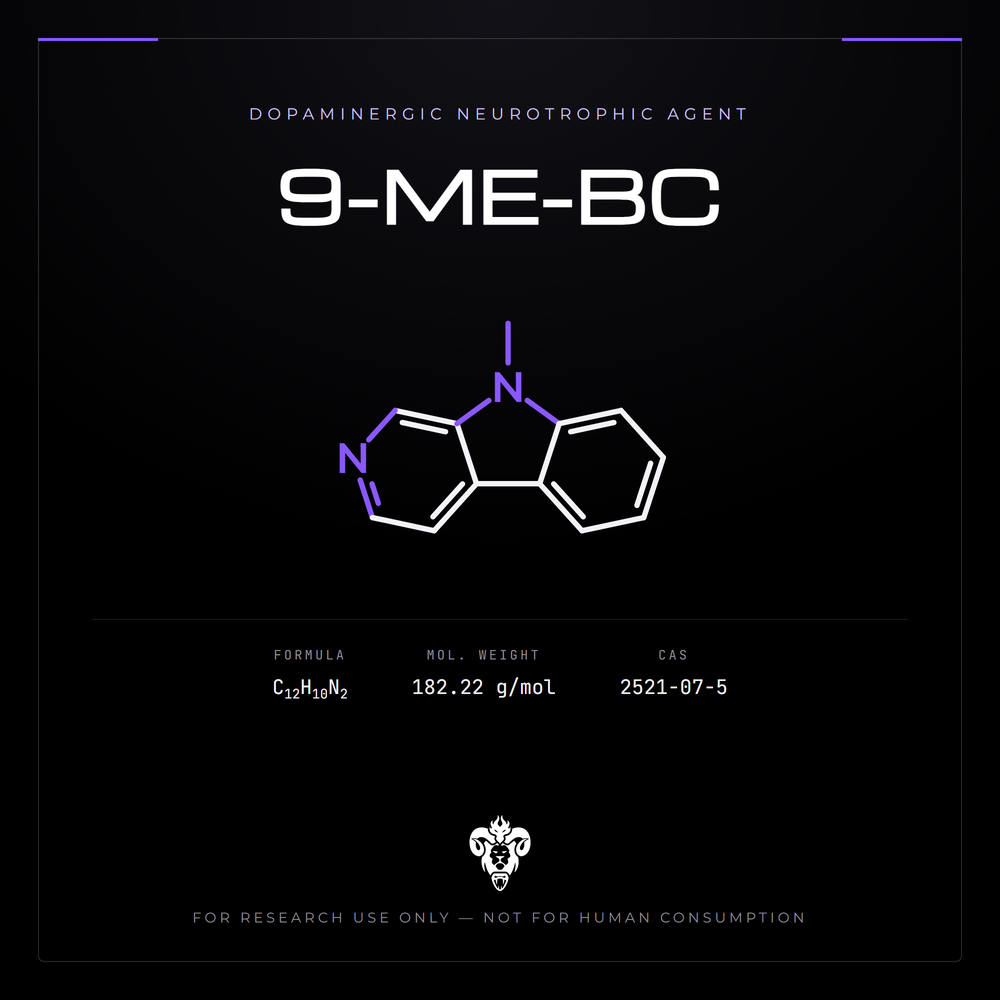
9-ME-BC (9-Methyl-beta-carboline) Research Standard

9-ME-BC (9-Methyl-beta-carboline) is a heterocyclic amine derivative belonging to the beta-carboline family. Within the field of neuropharmacology, it is an investigative compound characterized by its potential dopaminergic and neurotrophic properties. Researchers utilize 9-ME-BC as a pharmacological probe to study pathways involved in neuroprotection, the stimulation of neurite outgrowth, and the enhancement of dopaminergic signaling in controlled in vitro and animal models.

Technical Specifications

Property Specification
Product Name 9-ME-BC (9-Methyl-beta-carboline)
CAS Number 2521-07-5
Chemical Formula C12H10N2
Molecular Weight 182.22 g/mol
Chemical Class Beta-carboline derivative
Physical Appearance White to off-white/pale brown powder
Assay Purity Refer to the batch-specific Certificate of Analysis (COA) supplied for the lot received

Mechanism of Action & Research Context

9-ME-BC is primarily investigated for its effects on the dopaminergic system and its potential neuro-regenerative influence, as detailed in established scientific literature.

  • Neurite Outgrowth and TH Expression: 9-ME-BC is notably researched for its neurotrophic properties. Foundational studies by Gille et al. (2011) demonstrated that the compound stimulates neurite outgrowth and increases the expression of tyrosine hydroxylase (TH)—the rate-limiting enzyme in dopamine synthesis—in cultured mesencephalic dopaminergic neurons.

  • Neuroprotective Mechanisms: Research into the compound’s neuroprotective capacity indicates it may mitigate dopaminergic degeneration. Studies by Polanski et al. (2010) evaluated the compound’s ability to provide protection against neurotoxic insults in cellular models, suggesting a role in maintaining dopaminergic neuronal integrity under stress.

  • Cognitive and Behavioral Research: Investigations into the compound’s potential effects on higher-order function have utilized animal models. Research by Gille et al. (2013) observed improvements in spatial learning and memory following administration, hypothesizing that 9-ME-BC may modulate synaptic connectivity pathways.

Research Applications

9-ME-BC is a specialized reagent essential for modern neuroscience and neuro-degenerative research.

Primary fields of in vitro and laboratory investigation include:

  • Neuroprotection Studies: Assessing the ability of the compound to rescue dopaminergic neurons from neurotoxin-induced damage in cellular models.

  • Neurite Outgrowth Analysis: Quantifying the effect of 9-ME-BC on axonal and dendritic extension in cultured primary neurons.

  • Dopaminergic Signaling: Benchmarking the compound’s efficacy in modulating dopamine synthesis and turnover rates.

  • Cognitive Enhancement Models: Utilizing animal models to observe the impact of 9-ME-BC on memory, learning, and synaptic connectivity pathways.

Storage & Handling Guidelines

To maintain the chemical stability and experimental reliability of the compound:

  • Storage Environment: Store in a cool, dry place. Maintain at -20°C for long-term stability.

  • Environmental Control: Protect strictly from light, moisture, and high temperatures to prevent oxidation and degradation of the beta-carboline scaffold.

  • Handling: Utilize standard laboratory safety practices. Allow the container to equilibrate to room temperature before opening to minimize condensation.

  • Aseptic Technique: Ensure the use of sterile laboratory tools to prevent cross-contamination during preparation of solutions for in vitro experiments.

Related Research Compounds

Research Use Disclaimer

Research Use Only Disclaimer: This product is developed and distributed strictly as a Research Use Only (RUO) laboratory reference chemical intended exclusively for non-clinical analytical and scientific investigation. It is not an FDA-approved drug, medical treatment, dietary supplement, or food ingredient, and is strictly prohibited for human or animal consumption. Kimera Chems supplies this research material solely to qualified institutions and professional investigators for authorized laboratory research.
Weight 25 g
Form

Dry-Fill Capsule 60ct/20mg/1.2g, Powder 1g

Description

9-ME-BC Article

9-ME-BC (9-Methyl-beta-carboline) Research Standard

9-ME-BC (9-Methyl-beta-carboline) is a heterocyclic amine derivative belonging to the beta-carboline family. Within the field of neuropharmacology, it is an investigative compound characterized by its potential dopaminergic and neurotrophic properties. Researchers utilize 9-ME-BC as a pharmacological probe to study pathways involved in neuroprotection, the stimulation of neurite outgrowth, and the enhancement of dopaminergic signaling in controlled in vitro and animal models.

Technical Specifications

Property Specification
Product Name 9-ME-BC (9-Methyl-beta-carboline)
CAS Number 2521-07-5
Chemical Formula C12H10N2
Molecular Weight 182.22 g/mol
Chemical Class Beta-carboline derivative
Physical Appearance White to off-white/pale brown powder
Assay Purity Refer to the batch-specific Certificate of Analysis (COA) supplied for the lot received

Mechanism of Action & Research Context

9-ME-BC is primarily investigated for its effects on the dopaminergic system and its potential neuro-regenerative influence, as detailed in established scientific literature.

  • Neurite Outgrowth and TH Expression: 9-ME-BC is notably researched for its neurotrophic properties. Foundational studies by Gille et al. (2011) demonstrated that the compound stimulates neurite outgrowth and increases the expression of tyrosine hydroxylase (TH)—the rate-limiting enzyme in dopamine synthesis—in cultured mesencephalic dopaminergic neurons.

  • Neuroprotective Mechanisms: Research into the compound’s neuroprotective capacity indicates it may mitigate dopaminergic degeneration. Studies by Polanski et al. (2010) evaluated the compound’s ability to provide protection against neurotoxic insults in cellular models, suggesting a role in maintaining dopaminergic neuronal integrity under stress.

  • Cognitive and Behavioral Research: Investigations into the compound’s potential effects on higher-order function have utilized animal models. Research by Gille et al. (2013) observed improvements in spatial learning and memory following administration, hypothesizing that 9-ME-BC may modulate synaptic connectivity pathways.

Research Applications

9-ME-BC is a specialized reagent essential for modern neuroscience and neuro-degenerative research.

Primary fields of in vitro and laboratory investigation include:

  • Neuroprotection Studies: Assessing the ability of the compound to rescue dopaminergic neurons from neurotoxin-induced damage in cellular models.

  • Neurite Outgrowth Analysis: Quantifying the effect of 9-ME-BC on axonal and dendritic extension in cultured primary neurons.

  • Dopaminergic Signaling: Benchmarking the compound’s efficacy in modulating dopamine synthesis and turnover rates.

  • Cognitive Enhancement Models: Utilizing animal models to observe the impact of 9-ME-BC on memory, learning, and synaptic connectivity pathways.

Storage & Handling Guidelines

To maintain the chemical stability and experimental reliability of the compound:

  • Storage Environment: Store in a cool, dry place. Maintain at -20°C for long-term stability.

  • Environmental Control: Protect strictly from light, moisture, and high temperatures to prevent oxidation and degradation of the beta-carboline scaffold.

  • Handling: Utilize standard laboratory safety practices. Allow the container to equilibrate to room temperature before opening to minimize condensation.

  • Aseptic Technique: Ensure the use of sterile laboratory tools to prevent cross-contamination during preparation of solutions for in vitro experiments.

Related Research Compounds

Research Use Disclaimer

Research Use Only Disclaimer: This product is developed and distributed strictly as a Research Use Only (RUO) laboratory reference chemical intended exclusively for non-clinical analytical and scientific investigation. It is not an FDA-approved drug, medical treatment, dietary supplement, or food ingredient, and is strictly prohibited for human or animal consumption. Kimera Chems supplies this research material solely to qualified institutions and professional investigators for authorized laboratory research.
Compound Class Beta-carboline derivative
CAS Number 2521-07-5
Other Names 9-MBC, 9-Methylnorharman, N-Methyl-β-carboline
IUPAC Name 5-Methyl-5H-pyrido[3,4-b]indole
Molecular Formula C₁₂H₁₀N₂
Molecular Weight 182.226 g/mol
Capsule Concentration 20mg x 60ct
Bulk Powder Quantity 1g
Kimera Chems


Kimerachems
By starting a chat with our artificial intelligence-powered assistant, you agree to the automated processing of your personal data.
Kimera Chems assistant
...