Skip to content
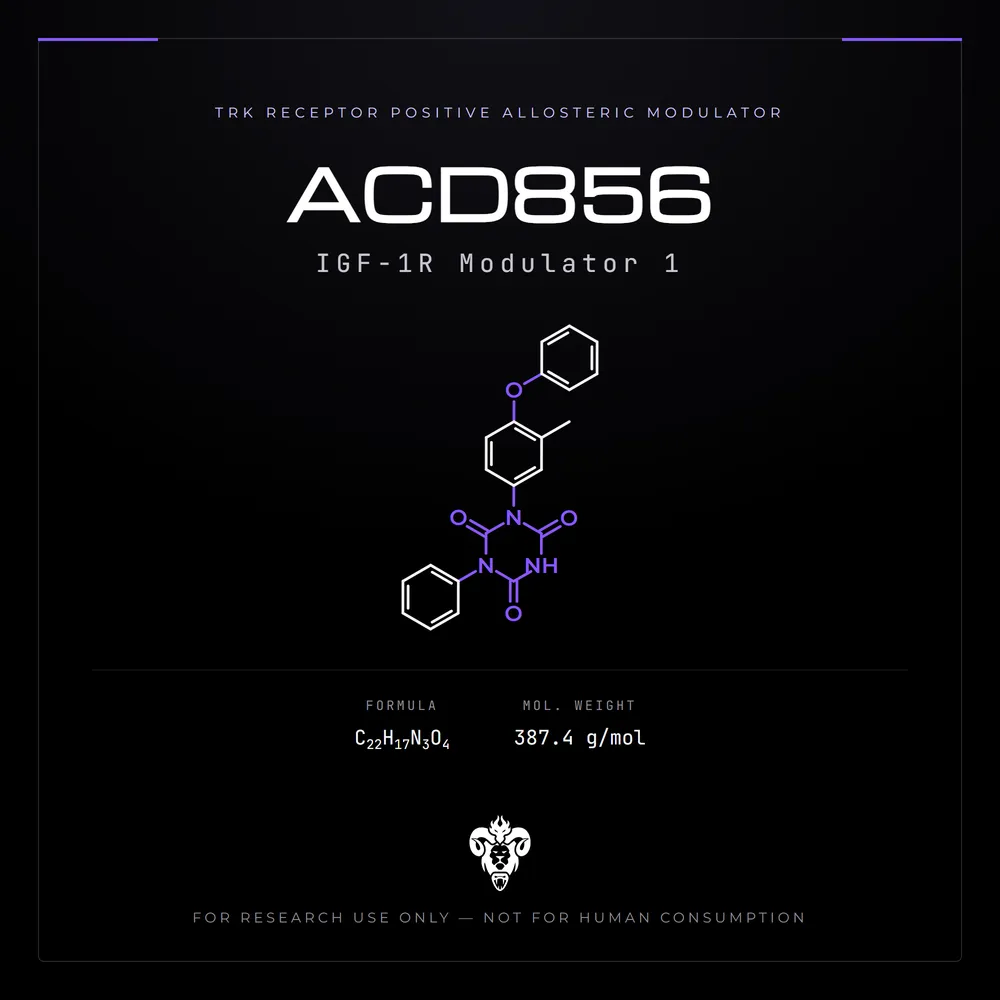

ACD856 (IGF-1R Modulator 1) Research Standard
ACD856 (IGF-1R Modulator 1), chemically identified as 1-(3-methyl-4-phenoxyphenyl)-3-phenyl-1,3,5-triazinane-2,4,6-trione (CAS 2375424-89-6), is a triazinetrione-class research compound characterized in the scientific literature as a pan-Trk positive allosteric modulator. It serves as a pharmacological tool for investigating neurotrophin receptor signaling — the TrkA, TrkB, and TrkC receptors activated by NGF and BDNF — and for comparative receptor profiling against the structurally related IGF-1R and FGFR1 receptor tyrosine kinases. In controlled laboratory environments, ACD856 allows researchers to observe how allosteric modulation shapes receptor kinase activity, downstream ERK1/2 signaling, and synaptic protein expression in cellular and neural models.
Physical & Handling Properties
| Property | Specification |
|---|---|
| Physical Appearance | White to off-white powder |
| Solution Base | PEG400 |
Mechanism of Action & Research Context
ACD856 is investigated for its capacity to positively modulate the activity of neurotrophin receptors rather than activate them directly.
-
Pan-Trk Positive Allosteric Modulation: Cell-based reporter assays on this compound register EC50 values of approximately 0.38 µM at TrkA, 0.29 µM at TrkB, and 0.33 µM at TrkC, with maximum effects of 185%, 176%, and 328% of the activation reached by the natural ligand alone. Published characterization of the same molecule reports an increase in the apparent Vmax of TrkA kinase activity, consistent with enhanced NGF- and BDNF-stimulated receptor signaling rather than direct receptor activation.
-
Receptor Selectivity Profiling: In the same assay series the compound registers EC50 values of approximately 0.19 µM at FGFR1 and 0.25 µM at IGF-1R, the two most potent values in the set, while their maximum effects reach only 117% and 104% against 176–328% at the neurotrophin receptors. Published work describes this as a selectivity toward neurotrophin receptors with respect to efficacy rather than potency. This separation of potency from efficacy makes it a useful probe for dissecting selectivity between Trk receptors and related receptor tyrosine kinases.
-
Downstream Signaling: Researchers employ ACD856 to examine potentiation of ERK1/2 phosphorylation, neurite outgrowth, and pre-synaptic protein expression (such as SNAP25) in in vitro neuronal models.
Research Applications
ACD856 is a specialized reagent for modern neurotrophin signaling and receptor pharmacology research.
Primary fields of in vitro laboratory investigation include:
-
Neurotrophin Receptor Assays: Quantifying TrkA/TrkB/TrkC phosphorylation and kinase kinetics under allosteric modulation.
-
BDNF/NGF Potentiation Studies: Measuring how sub-threshold neurotrophin concentrations are amplified in primary neuronal cultures.
-
Comparative RTK Pharmacology: Benchmarking potency and efficacy across Trk receptors, IGF-1R, and FGFR1 to map allosteric selectivity.
-
Structure–Activity Relationship (SAR) Studies: Comparing substituted 1,3,5-triazinane-2,4,6-trione analogs to characterize how aryl substitution shapes modulator potency.
-
Analytical Reference Work: Serving as a reference material for chromatographic and mass-spectrometric identification and method development.
Storage & Handling Guidelines
Store at controlled room temperature. Keep tightly closed. Liquid formats: do not refrigerate or freeze. Cold storage may cause the solution to cloud or precipitate. If this occurs, return to room temperature and mix until clear.
Storage guidance is a house recommendation. Analytical documentation is per-lot release testing.
Related Research Compounds
Research Use Disclaimer
Research Use Only Disclaimer: This product is labeled and sold “For Research Use Only — NOT FOR HUMAN CONSUMPTION.” It is not a drug, dietary supplement, food, cosmetic, or medical device, and it is not approved by the FDA or any other regulator for human or veterinary use. It is supplied to approved account holders as a research chemical for laboratory use and must be handled in accordance with applicable law.
![Chemical structure representation of 522-054, a triazolopyridazine ([1,2,4]triazolo[4,3-b]pyridazine) derivative.](https://kimerachems.co/wp-content/uploads/2026/08/522-054-kimera-cover.png)