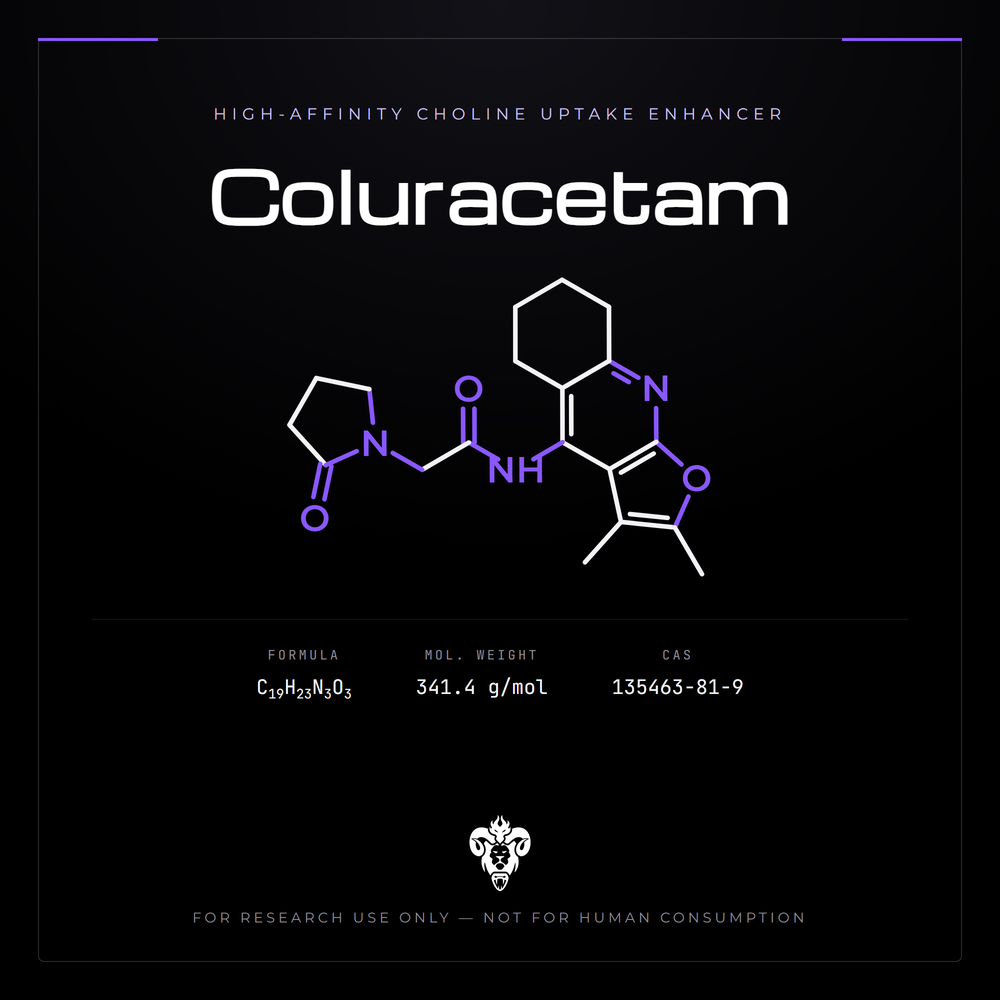

Coluracetam
Coluracetam (investigational code BCI-540, formerly MKC-231) is a synthetic tetrahydrofuroquinoline derivative belonging to the racetam family of nootropic research compounds. While structurally related to classical pyrrolidone-based agents, Coluracetam is distinguished in the literature by its unique interaction with high-affinity choline uptake (HACU) systems. By serving as a potent enhancer of the rate-limiting step in acetylcholine synthesis, Coluracetam offers researchers a highly specialized chemical tool for studying cholinergic neurotransmission, synaptic plasticity, and neuroprotective pathways in targeted in vitro models.
Physical & Handling Properties
| Property | Specification |
|---|---|
| Solubility Profile | Soluble in DMSO, DMF, and Ethanol; limited solubility in aqueous buffers |
Research Applications & Mechanism of Interest
The primary value of Coluracetam in neurochemical models is its capacity to alter the regulatory dynamics of the choline transporter system.
Primary fields of preclinical and in vitro laboratory investigation include:
-
HACU Enhancement Kinetics: Measuring how the compound interacts with hippocampal synaptosomes to upregulate high-affinity choline uptake. This uptake is the critical, rate-limiting pathway for synthesizing acetylcholine (ACh).
-
Reversal of Cholinergic Deficits: Investigating the compound’s protective parameters in cellular models exposed to cholinergic neurotoxins (such as ethylcholine aziridinium/AF64A).
-
AMPA Receptor Signaling Cross-talk: Studying how long-term choline transporter modulation indirectly influences AMPA-mediated neurotransmission and downstream synaptic plasticity cascades.
-
Glutamate Cytotoxicity Mitigation: Evaluating primary cortical culture lines to track how Coluracetam protects delicate neuronal networks from high-dose glutamate toxicity.
Comparison of Racetam Reference Standards
Because different racetam scaffolds target entirely distinct cellular mechanisms, selecting the correct reference standard is vital to experimental design:
| Compound | Primary Research Target | Core Molecular Mechanism |
|---|---|---|
| Piracetam | Membrane Fluidity | Enhances phospholipid membrane dynamics and general neurotransmission. |
| Aniracetam | AMPA Modulator | Allosterically modulates AMPA receptors; applied in anxiolytic pathways. |
| Oxiracetam | Synaptic Plasticity | Upregulates NDMA-receptor signaling and hippocampal learning pathways. |
| Coluracetam | Choline Transporter | Selectively enhances high-affinity choline uptake (HACU) systems. |
Storage & Handling Guidelines
Store at controlled room temperature. Keep tightly closed.
Storage guidance is a house recommendation. Analytical documentation is per-lot release testing.
Related Research Compounds
Frequently Asked Research Questions
Is Coluracetam structurally identical to classic racetams like Piracetam?
No. While it features the classic pyrrolidone ring common to the racetam family, Coluracetam is fused to a much larger, tri-cyclic tetrahydrofuroquinoline core. This unique molecular geometry completely shifts its binding profile away from general membrane modulation and toward the choline transporter system.
Does Coluracetam directly stimulate acetylcholine receptors?
No. Coluracetam does not act as a direct agonist at nicotinic or muscarinic acetylcholine receptors. Instead, it acts upstream by enhancing the high-affinity uptake of choline, which provides the essential intracellular substrate needed for endogenous acetylcholine synthesis.
What is the recommended vehicle for dissolving Coluracetam for assays?
Due to its bulky, lipophilic polycyclic core, Coluracetam shows very poor solubility in water. For biological testing or HPLC mobile phase preparations, the compound should first be dissolved in anhydrous organic solvents such as DMSO or Ethanol before diluting into working buffers.
Research Use Only Disclaimer: This product is labeled and sold “For Research Use Only — NOT FOR HUMAN CONSUMPTION.” It is not a drug, dietary supplement, food, cosmetic, or medical device, and it is not approved by the FDA or any other regulator for human or veterinary use. It is supplied to approved account holders as a research chemical for laboratory use and must be handled in accordance with applicable law.