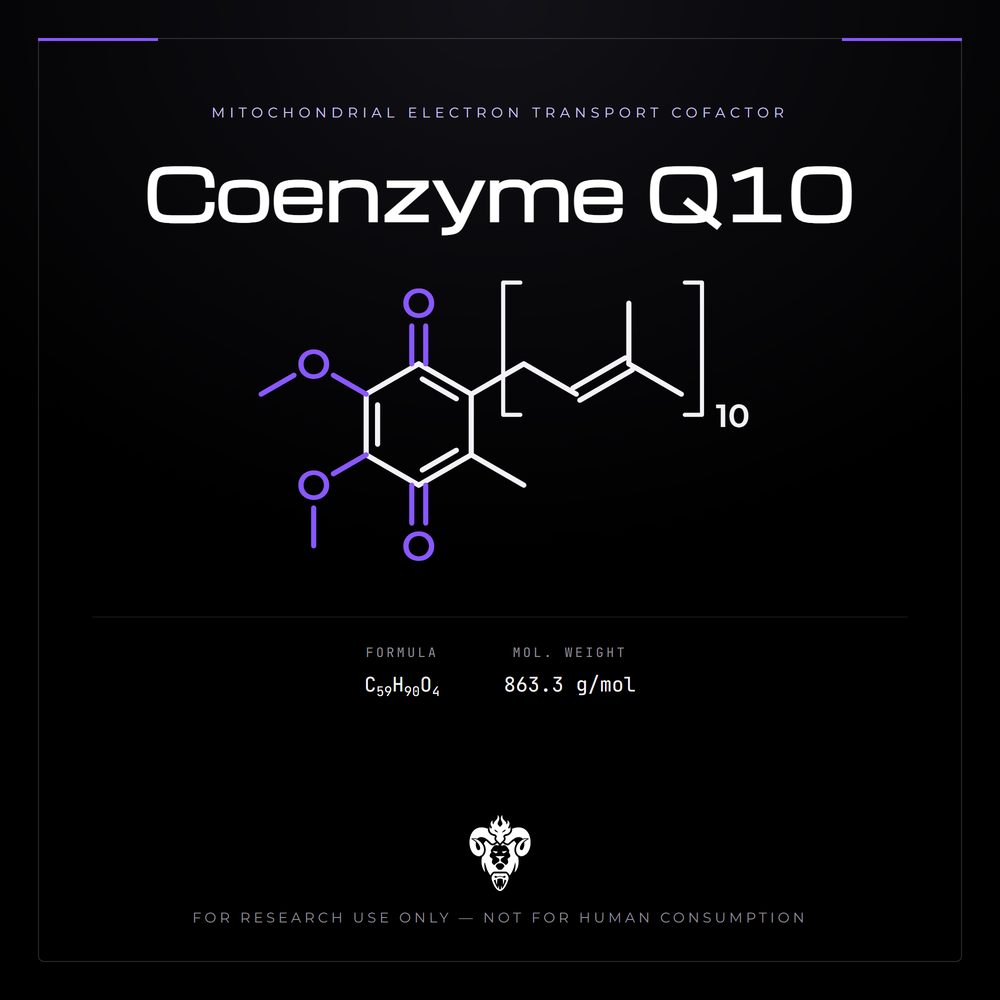

Coenzyme Q10
Coenzyme Q10 (CoQ10), functionally categorized as ubiquinone in its oxidized state or ubiquinol in its reduced state, is an endogenous, lipophilic benzoquinone localized predominantly within the inner mitochondrial membrane. Central to cellular bioenergetics, CoQ10 acts as an obligatory mobile electron carrier within the mitochondrial electron transport chain (ETC). Beyond its core role in adenosine triphosphate (ATP) transduction, this compound serves as a powerful lipid-soluble antioxidant, maintaining cellular redox balance, stabilizing lipid bilayers, and protecting biological membranes from oxidative degradation. It remains a foundational tool compound for investigating mitochondrial dysfunction, metabolic expenditure, and the kinetic profiles of oxidative stress.
Technical Specifications
| Property | Specification |
|---|---|
| Product Name | Coenzyme Q10 (Ubiquinone) |
| CAS Number | 303-98-0 |
| IUPAC Name | 2-[(2E,6E,10E,14E,18E,22E,26E,30E,34E)-3,7,11,15,19,23,27,31,35,39-decamethyltetraconta-2,6,10,14,18,22,26,30,34,38-decaenyl]-5,6-dimethoxy-3-methylcyclohexa-2,5-diene-1,4-dione |
| Molecular Formula | C₅₉H₉₀O₄ |
| Molecular Weight | 863.36 g/mol |
| Chemical Class | Benzoquinone Derivative / Isoprenoid Coenzyme |
| Solubility | Soluble in organic solvents (DMSO, Ethanol, PEG-400) and lipids; insoluble in water |
| Solution Base | MCT Oil, 1% Benzyl Alcohol |
Mechanism of Action & Research Context
The chemical interest in Coenzyme Q10 centers on its capacity to undergo reversible, two-electron redox cycles, fluctuating between an oxidized quinone configuration and a reduced hydroquinone layout.
Primary metabolic pathways under active investigation include:
-
Electron Transport Chain Interception: Shuttling electron equivalents from NADH dehydrogenase (Complex I) and succinate dehydrogenase (Complex II) directly to coenzyme Q:cytochrome c oxidoreductase (Complex III). Researchers utilize this pathway to examine rates of mitochondrial proton-motive force generation and oxygen consumption.
-
Endogenous Antioxidant Regeneration: In its reduced state (ubiquinol), the molecule directly scavenges reactive oxygen species (ROS) and lipid peroxyl radicals. It is frequently applied in membrane models to observe the secondary recycling pathways of alpha-tocopherol (Vitamin E) and ascorbate.
-
Structural Membrane Stabilization: Because it features a long, lipophilic polyisoprenoid tail, CoQ10 integrates deeply into the interior hydrophobic core of cellular lipid bilayers. Laboratories study this positioning to monitor alterations in membrane fluidity, phospholipid packaging, and structural resilience against mechanical or chemical stress.
Ubiquinone vs. Ubiquinol (Research Distinction)
When configuring experimental protocols, investigators must select between the two principal states of the compound based on target structural stability and assay dynamics:
| Form | Redox State | Experimental & Analytical Notes |
|---|---|---|
| Ubiquinone | Oxidized | Possesses high thermodynamic stability; optimal for long-term baseline storage, structural profiling, and standard metabolic reference applications. |
| Ubiquinol | Reduced | Exhibits superior radical-scavenging activity; highly sensitive to spontaneous atmospheric oxidation, requiring modified, anaerobic handling environments. |
Common Preclinical Applications
-
Mitochondrial Dysfunction Signaling: Deployed as a metabolic rescue agent in cellular models of aging, cellular senescence, and neurodegenerative pathways where endogenous respiration is compromised.
-
Oxidative Degradation Assays: Applied across white and brown fat cell assays to study how lipophilic anti-radical agents block downstream lipid peroxidation cascades and preserve structural cell signaling.
-
Drug-Induced Myopathy Modeling: Utilized as a target control in cellular matrices treated with HMG-CoA reductase inhibitors (statins) to analyze the mechanisms of secondary mitochondrial inhibition and transient muscle tissue breakdown.
-
Cardiometabolic Bioenergetics: Investigated in specialized isolated tissue configurations to track cellular energy expenditure boundaries, metabolic efficiency profiles, and structural cell-repair kinetics under high energy demand.
Storage & Handling Guidelines
To maintain standard chemical uniformity and protect the compound from premature photolytic oxidation or environmental degradation:
-
Thermal Settings: Store bulk powder consistently in a cool, dry location. Long-term reference stocks should ideally be maintained under deep freeze conditions (-20°C).
-
Atmospheric Boundaries: CoQ10 is prone to gradual oxidation. Keep containers hermetically sealed under dry conditions, and consider purging with nitrogen for reduced ubiquinol preparations.
-
Photolytic Protections: Protect from direct sunlight and ultraviolet (UV) radiation by storing the compound inside opaque or high-grade amber laboratory containment vessels.
-
Reconstitution Management: Reconstitute using fully anhydrous organic carriers such as pure ethanol, DMSO, or polyethylene glycol matrices. Pair with specialized lipid vectors or cyclodextrins when configuring aqueous dispersion tests.
-
Analytical Quality Standards: To secure complete reproducibility across research cohorts, every lot is subjected to a strict verification protocol combining High-Performance Liquid Chromatography (HPLC) and CHN elemental analysis to independently confirm structural identity, mass distribution, and target purity.
Related Research Compounds
Analytical Documentation
Purity, identity, and composition vary by manufacturing lot. Kimera Chems does not publish a single fixed purity figure for this item; refer to the batch-specific Certificate of Analysis (COA) issued for the lot received, which reflects third-party analytical testing for that lot. Contact us if a COA for your lot is required.
Research Use Only Disclaimer: This compound is developed, manufactured, and distributed strictly as a Research Use Only (RUO) laboratory reference chemical. It is not an FDA-approved drug, licensed medication, therapeutic compound, medical device, or dietary supplement, and is strictly prohibited for human or veterinary use. Kimera Chems supplies these reference standards exclusively to accredited institutional laboratories, anti-doping verification units, and professional investigators for controlled in vitro and analytical research.