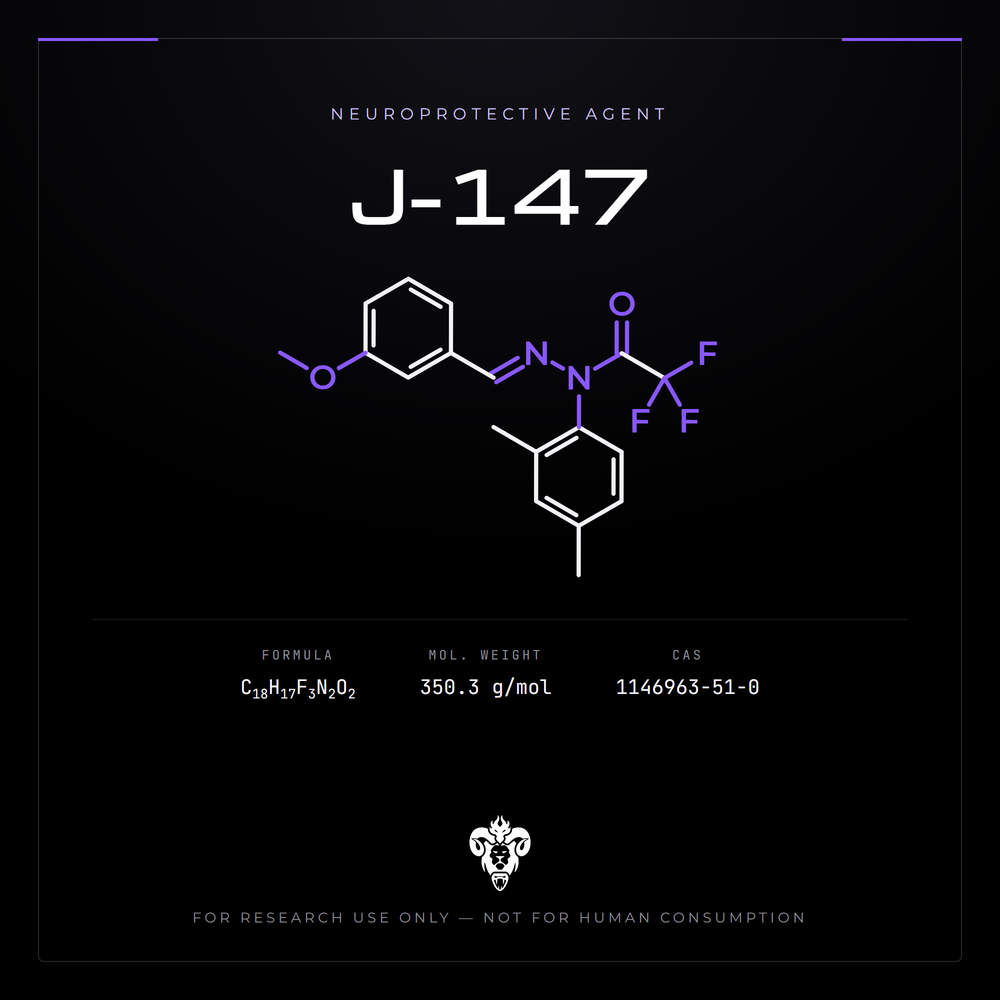

J-147 (Trifluoroacetamide Hydrazone)
J-147 is a synthetic trifluoroacetamide hydrazone originally developed at the Salk Institute (Schubert Laboratory). Derived from a curcumin-based screening series, J-147 was specifically engineered to address the inherent metabolic instability and poor bioavailability of the curcumin scaffold. By integrating a trifluoromethyl group, researchers successfully created a compound that retains the pharmacophore while significantly improving metabolic profile.
Technical Specifications
| Property | Specification |
|---|---|
| Product Name | J-147 |
| CAS Number | 1146963-51-0 |
| Molecular Formula | C18H17F3N2O2 |
| Molecular Weight | 350.12 g/mol |
| Chemical Class | Synthetic Trifluoroacetamide Hydrazone |
| Appearance | White to off-white crystalline solid |
| Assay Purity | Refer to the batch-specific Certificate of Analysis (COA) supplied for the lot received |
Mechanism of Action & Scientific Context
J-147 was identified through phenotypic screening in cell-based assays of neuronal survival rather than target-directed design. Subsequent drug-affinity chromatography identified the α-subunit of mitochondrial ATP synthase (ATP5A) as a primary binding partner.
Mechanism Clarification:
J-147 is not a mitochondrial enhancer. Research indicates it acts as a partial inhibitor of ATP synthase activity. The observed biological effects are not a result of increased energy production, but rather an adaptive, AMPK-dependent stress response triggered by the cell in response to the mild reduction in mitochondrial respiration.
Primary fields of in vitro laboratory investigation include:
-
ATP Synthase Binding: Mapping target-engagement and binding kinetics with the ATP5A subunit.
-
Mitochondrial Respirometry: Measuring oxygen consumption rates and membrane potential under controlled conditions.
-
AMPK Signaling: Analyzing cellular stress-response pathways.
-
Neuronal Cytoprotection: Utilizing cell culture models to assess protective mechanisms.
-
Comparative SAR: Assessing the structure-activity relationship across curcumin-derivative series.
Storage & Handling Guidelines
Store at controlled room temperature. Keep tightly closed.
Storage guidance is a house recommendation. Analytical documentation is per-lot release testing.
Related Research Compounds
Research Use Only Disclaimer: This product is developed and distributed strictly as a Research Use Only (RUO) laboratory reference chemical intended exclusively for non-clinical analytical and scientific investigation. It is not an FDA-approved drug, food, cosmetic, or dietary supplement, and is strictly prohibited for human or animal consumption. Kimera Chems supplies these chemical batches solely to accredited institutional laboratories and qualified scientific investigators.