MID-35 (Myostatin Inhibitory D-Peptide)
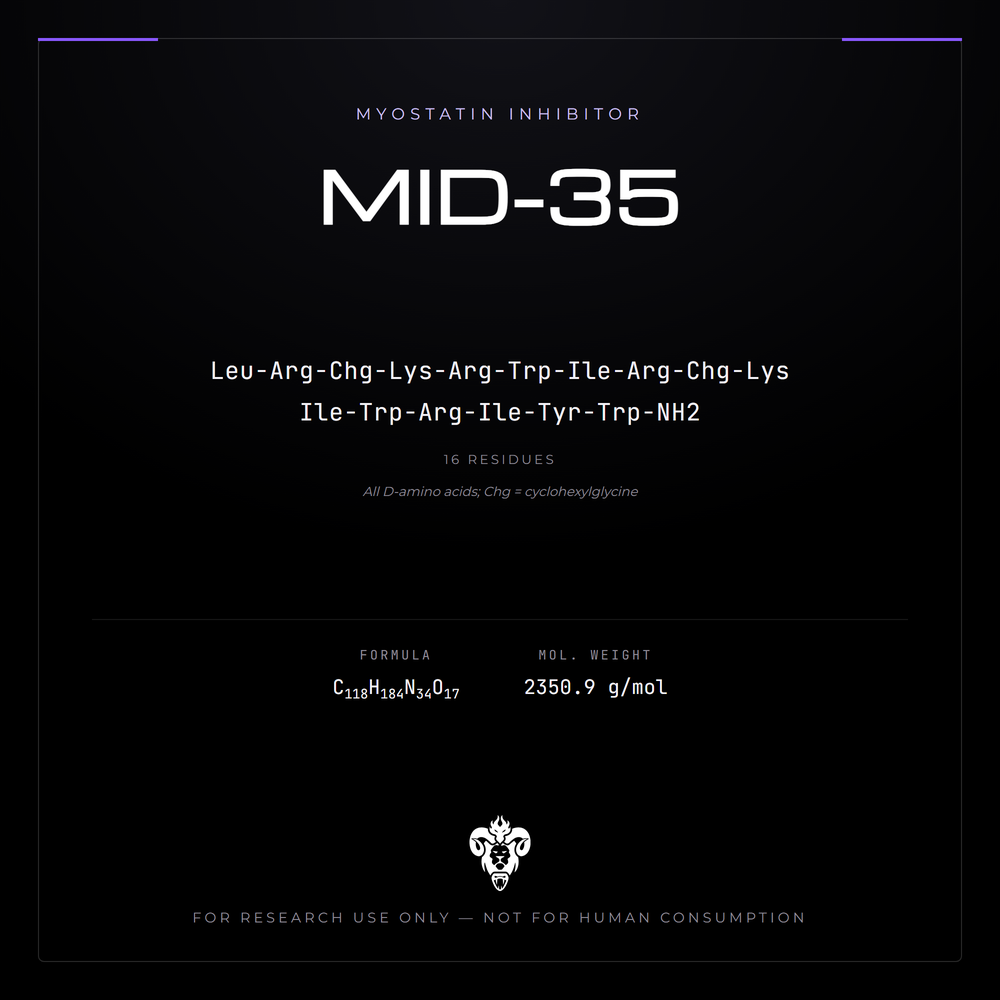
MID-35 is a synthetic, 16-amino-acid retro-inverso D-peptide designed as an inhibitor of myostatin (Growth Differentiation Factor 8, GDF-8). By utilizing a retro-inverso configuration—reversing the amino acid sequence and employing D-form residues—MID-35 maintains the precise spatial orientation required for myostatin binding while achieving significant resistance to proteolytic degradation. This structural design makes it a specialized tool for studying myostatin-mediated signaling and muscle growth regulation in controlled in vitro and in vivo laboratory models.
Technical Specifications
| Property | Specification |
|---|---|
| Product Name | MID-35 |
| Peptide Class | 16-amino-acid retro-inverso D-peptide |
| Molecular Weight | ~2350 Da |
| Mechanism | Myostatin/ActRIIB signaling inhibition |
| Physical Appearance | White to off-white lyophilized powder |
| Assay Purity | Refer to the batch-specific Certificate of Analysis (COA) supplied for the lot received |
Mechanism of Action & Research Context
Myostatin acts as a negative regulator of skeletal muscle growth by signaling through the activin receptor type IIB (ActRIIB). This process recruits type I receptors (ALK4/ALK5) and triggers downstream Smad2/3 phosphorylation, which inhibits myogenic gene transcription.
-
Mechanism of Inhibition: MID-35 binds directly to the myostatin/activin type I receptor interface, effectively blocking Smad2/3 signaling activation.
-
Selectivity Profile: Published dose-response data report IC50 values of 0.19 µM for myostatin, 0.63 µM for GDF-11, 0.89 µM for activin A and 1.6 µM for TGF-β1, spanning roughly eightfold. MID-35 is a broad TGF-β family inhibitor with a preference for myostatin rather than a selective one. Because it binds the ligand rather than the type II receptor, it does not engage ActRIIB, so the BMP9/BMP10 cross-inhibition associated with decoy receptor strategies should not apply.
-
Enzymatic Stability: The D-amino acid configuration provides superior resistance to standard proteolytic enzymes compared to conventional L-peptide inhibitors, enhancing stability in research applications.
Research Applications
MID-35 serves as a high-potency probe for investigating muscle atrophy, sarcopenia, and myostatin-mediated signaling pathways.
Primary fields of laboratory investigation include:
-
Myogenic Signaling Research: Evaluating the modulation of muscle growth and atrophy gene expression (e.g., MyoD, Atrogin-1, MuRF-1).
-
Cachexia Models: Studying the alleviation of skeletal muscle atrophy in disease-state models (e.g., cancer cachexia) and synergy with other metabolic modulators.
-
Non-Invasive Delivery Systems: Investigating transdermal delivery technologies, such as iontophoresis, for peptide transport into skeletal muscle.
-
Structure-Activity Relationship (SAR): Comparative analysis of retro-inverso vs. L-peptide configurations in myostatin binding potency.
Storage & Handling Guidelines
Store at controlled room temperature, sealed and protected from light.
Storage guidance is a house recommendation. Analytical documentation is per-lot release testing.
Related Research Compounds
Further reading: MID-35 research overview
Key Preclinical Literature
-
Takayama K, et al. (2022) Development of Myostatin Inhibitory d-Peptides to Enhance the Potency, Increasing Skeletal Muscle Mass in Mice. ACS Med. Chem. Lett. 13(3):492–498.
-
Hanada K, et al. (2022) Combination therapy with anamorelin and a myostatin inhibitor is advantageous for cancer cachexia in a mouse model. Cancer Sci. 113(10):3547–3557.
-
Michiue K, et al. (2023) Increasing Skeletal Muscle Mass in Mice by Non-Invasive Intramuscular Delivery of Myostatin Inhibitory Peptide by Iontophoresis. Pharmaceuticals. 16(3):397.
Research Use Disclaimer
Research Use Only Disclaimer: This product is developed and distributed strictly as a Research Use Only (RUO) laboratory reference chemical intended exclusively for non-clinical analytical and scientific investigation. It is not an FDA-approved drug, medical treatment, dietary supplement, or food ingredient, and is strictly prohibited for human or animal consumption. Kimera Chems supplies this research material solely to qualified institutions and professional investigators for authorized laboratory research purposes.