Skip to content
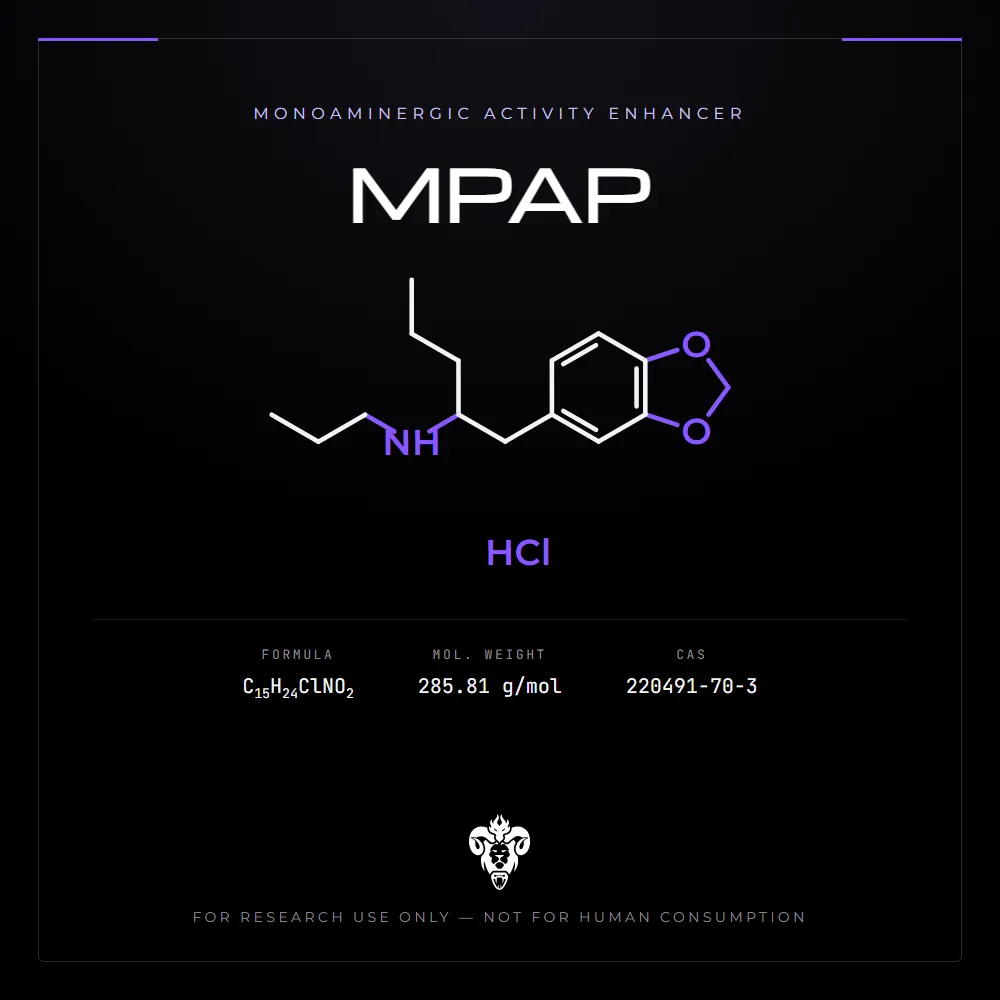

MPAP (Methylenedioxyphenylpropylaminopentane) Research Standard
MPAP (Methylenedioxyphenylpropylaminopentane) is a synthetic research compound classified as a Monoaminergic Activity Enhancer (MAE). Structurally related to phenylpropylaminopentane (PPAP), MPAP belongs to the phenethylamine and alpha-propylphenethylamine families. As a specialized pharmacological tool, it is studied for its ability to modulate synaptic monoamine activity, serving as a critical reference standard for investigating neurotransmitter dynamics and the comparative pharmacology of the MAE class.
Additional Properties
| Property | Specification |
|---|---|
| Structural Family | Phenethylamine / alpha-propylphenethylamine |
| Physical Appearance | White to off-white powder |
| Solution Base | PEG400, DMSO |
Mechanism of Action (Pharmacological Context)
MPAP functions as a Monoaminergic Activity Enhancer, characterized by its capacity to modulate synaptic monoamine levels (dopamine, serotonin, and norepinephrine). Unlike traditional monoamine releasing agents that trigger non-selective neurotransmitter efflux, MPAP facilitates monoamine release in a feedback-dependent manner, responding to neuronal impulse flow.
-
Feedback-Dependent Modulation: By synchronizing neurotransmitter release with neuronal firing, MPAP provides researchers with a model for studying the fine-tuning of synaptic transmission.
-
Structural Homology with PPAP: Its structural relationship to PPAP allows for precise comparative research into how the addition of the methylenedioxyphenyl ring influences binding affinity, transporter selectivity, and the duration of MAE activity.
-
Transporter Interaction: Investigation centers on its interactions with the dopamine transporter (DAT), serotonin transporter (SERT), and norepinephrine transporter (NET) to determine how specific structural modifications alter the kinetics of neurotransmitter reuptake inhibition versus activity enhancement.
Research Applications
MPAP is utilized as a focused reagent for neuropharmacological mapping and comparative signaling studies in controlled laboratory environments.
Primary fields of investigation include:
-
MAE Pharmacology: Mapping the comparative efficacy of MPAP against established reference standards like PPAP within the MAE class.
-
Neurotransmitter Modulation: Investigating the feedback-dependent release mechanisms of dopamine, serotonin, and norepinephrine in controlled neuronal cultures.
-
SAR Analysis: Evaluating how the phenethylamine / alpha-propylphenethylamine scaffold influences pharmacological potency and transporter selectivity.
-
Comparative Behavioral Research: Utilizing MPAP to study neurotransmitter system involvement in cognitive or alertness-based research models.
Storage & Handling Guidelines
Store at controlled room temperature. Keep tightly closed. Liquid formats: do not refrigerate or freeze. Cold storage may cause the solution to cloud or precipitate. If this occurs, return to room temperature and mix until clear.
Storage guidance is a house recommendation. Analytical documentation is per-lot release testing.
Related Research Compounds
Research Use Disclaimer
Research Use Only Disclaimer: This product is labeled and sold “For Research Use Only — NOT FOR HUMAN CONSUMPTION.” It is not a drug, dietary supplement, food, cosmetic, or medical device, and it is not approved by the FDA or any other regulator for human or veterinary use. It is supplied to approved account holders as a research chemical for laboratory use and must be handled in accordance with applicable law.
![Chemical structure representation of 522-054, a triazolopyridazine ([1,2,4]triazolo[4,3-b]pyridazine) derivative.](https://kimerachems.co/wp-content/uploads/2026/08/522-054-kimera-cover.png)