Skip to content

N-methyl Cyclazodone Research Standard
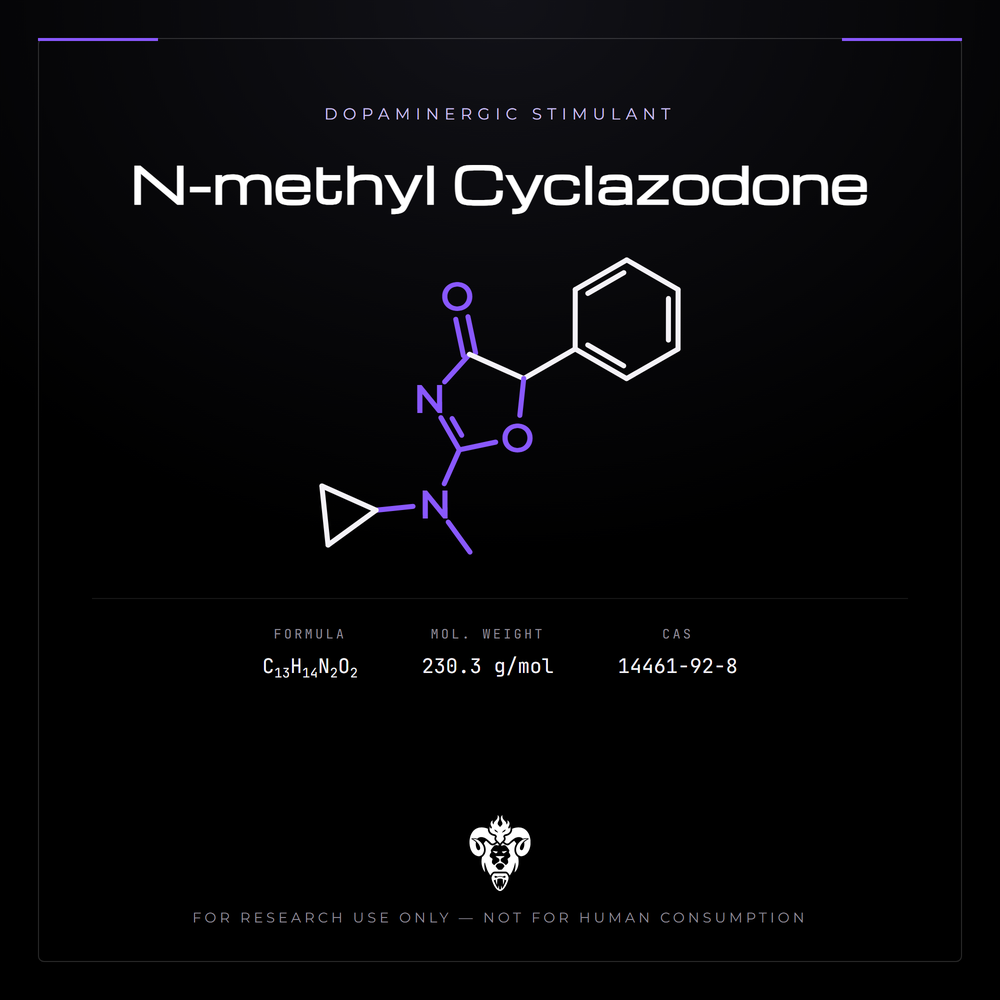
N-methyl Cyclazodone (LD 4202), chemically identified as 2-[cyclopropyl(methyl)amino]-5-phenyl-1,3-oxazol-4-one, is the N-methylated derivative of cyclazodone and a member of the pemoline family of 2-oxazolinone research compounds. It is utilized as a reference material for analytical method development across the oxazolinone scaffold, and as a substrate for in vitro biotransformation work. In controlled laboratory environments, N-methyl Cyclazodone allows researchers to observe how N-substitution on the 2-amino position of the oxazolinone core influences metabolic handling and analytical behaviour relative to pemoline, cyclazodone and thozalinone.
Physical & Handling Properties
| Property | Specification |
|---|---|
| Physical Appearance | White to off-white crystalline powder |
| Solution Base | PEG400, DMSO |
Mechanism of Action & Research Context
N-methyl Cyclazodone is investigated for its metabolic handling and for the structure–activity relationships of the pemoline scaffold.
-
Metabolic Conversion: Published biotransformation work reports a single phase I transformation — N-demethylation to cyclazodone — in pooled human liver S9 fraction and in rodent urine, with no phase II metabolites detected. Enzyme kinetics attribute this conversion primarily to CYP2A6, with CYP1A2 and CYP2C19 contributing. Plasma protein binding is reported as low-to-moderate at approximately 36%.
-
Scaffold Structure–Activity Mapping: As the N-methyl analog of cyclazodone, the molecule lets researchers isolate the effect of N-substitution on the 2-amino position of the oxazolinone core, benchmarked against pemoline, cyclazodone, and thozalinone.
-
Scaffold Pharmacology, by Analogy: The oxazolone scaffold this compound shares with pemoline is characterized in the literature as acting on presynaptic dopamine release and reuptake. Direct pharmacological characterization of N-methyl Cyclazodone itself has not been published, so it is best used as a scaffold-matched comparator rather than as a characterized pharmacological probe.
Research Applications
N-methyl Cyclazodone is a specialized reagent for analytical and biotransformation research.
Primary fields of in vitro laboratory investigation include:
-
Analytical Reference Work: Serving as a reference material for chromatographic and mass-spectrometric identification and method development. Published HPLC-HRMS/MS characterization records a protonated molecule at m/z 231.1128 with a base-peak fragment at m/z 146.0964.
-
Metabolite Identification Studies: Mapping phase I and phase II biotransformation in liver S9 and microsomal preparations, using the N-demethyl product as the marker analyte.
-
Cytochrome P450 Phenotyping: Determining isoform contribution and Michaelis–Menten kinetics for N-dealkylation across recombinant CYP panels.
-
Structure–Activity Relationship (SAR) Studies: Comparing N-substituted oxazolinone analogs to characterize how amine modification shapes metabolic stability and analytical signature across the pemoline family.
Storage & Handling Guidelines
Store at controlled room temperature. Keep tightly closed. Liquid formats: do not refrigerate or freeze. Cold storage may cause the solution to cloud or precipitate. If this occurs, return to room temperature and mix until clear.
Storage guidance is a house recommendation. Analytical documentation is per-lot release testing.
Related Research Compounds
Research Use Disclaimer
Research Use Only Disclaimer: This product is labeled and sold “For Research Use Only — NOT FOR HUMAN CONSUMPTION.” It is not a drug, dietary supplement, food, cosmetic, or medical device, and it is not approved by the FDA or any other regulator for human or veterinary use. It is supplied to approved account holders as a research chemical for laboratory use and must be handled in accordance with applicable law.