Skip to content

Nefiracetam Research Standard
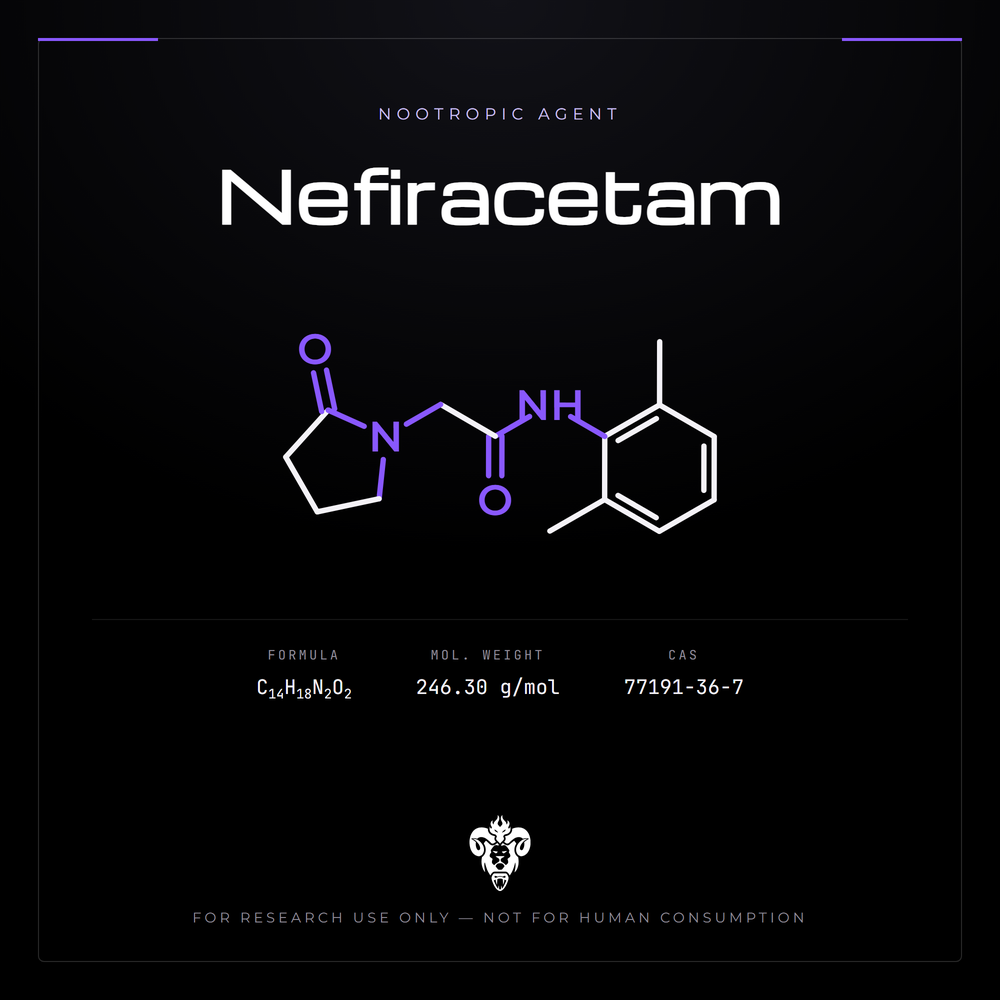
Nefiracetam is an N-phenyl-substituted pyrrolidone derivative belonging to the racetam family of compounds. Its unique chemical structure—characterized by high lipophilicity—facilitates distinct pharmacological interactions within neural tissues. In laboratory research, it is primarily utilized to investigate mechanisms of neuroplasticity, cholinergic neurotransmission, and calcium channel modulation. Unlike foundational racetams, Nefiracetam acts as a potent tool for studying the fine-tuning of synaptic signaling and the mitigation of cellular stress responses in neuronal models.
Physical & Handling Properties
| Property | Specification |
|---|---|
| Physical Appearance | White to off-white / light yellow crystalline powder |
Mechanism of Action & Research Context
Nefiracetam is researched for its multi-target interactions within the central nervous system, particularly its influence on excitatory and inhibitory signaling pathways.
-
Calcium Channel Modulation: Research highlights its ability to facilitate the activity of voltage-dependent calcium channels (specifically N-type and L-type), which is central to its role in enhancing neurotransmitter release.
-
Cholinergic Enhancement: The compound is widely used to study the sustained enhancement of acetylcholine (ACh) release in the hippocampus, a pathway critical for studying memory formation and synaptic plasticity.
-
GABAergic & Glutamatergic Signaling: Investigations utilize Nefiracetam to observe its modulatory effects on GABA receptors and its potential to counteract excitotoxicity via glutamate pathway regulation.
-
Neuroplasticity: Through these mechanisms, the compound serves as a probe for observing structural changes in neuronal connections and the molecular basis of long-term potentiation (LTP).
Research Applications
Nefiracetam is a specialized reference compound for studying cognitive pharmacology and neuroprotection.
Primary fields of in vitro laboratory investigation include:
-
Synaptic Plasticity Studies: Exploring cellular models of learning and information processing by measuring changes in synaptic efficiency.
-
Calcium Channel Dynamics: Quantifying ion flux through nerve cell membranes in the presence of N-phenyl-substituted pyrrolidones.
-
Neuroprotective Research: Observing cellular responses to oxidative or metabolic stress to evaluate the potential of racetam-class molecules to mitigate nerve cell damage.
-
Receptor Signaling: Examining the interaction between the pyrrolidone nucleus and various neurotransmitter sites (GABA, ACh).
Storage & Handling Guidelines
Store at controlled room temperature. Keep tightly closed.
Storage guidance is a house recommendation. Analytical documentation is per-lot release testing.
References
-
Nishizaki T, et al. (1999) “Nefiracetam facilitates neurotransmission by stimulating the activity of N-type Ca2+ channels.” Journal of Biological Chemistry. 274(2): 895–902.
-
Moriguchi S, et al. (2003) “Nefiracetam enhances long-term potentiation and synaptic transmission in the hippocampus.” Neuropharmacology. 45(4): 509–518.
-
Karasawa J, et al. (1997) “Nefiracetam: a novel cognitive enhancer.” CNS Drug Reviews. 3(2): 179–191.
Related Research Compounds
Research Use Disclaimer
Research Use Only Disclaimer: This product is labeled and sold “For Research Use Only — NOT FOR HUMAN CONSUMPTION.” It is not a drug, dietary supplement, food, cosmetic, or medical device, and it is not approved by the FDA or any other regulator for human or veterinary use. It is supplied to approved account holders as a research chemical for laboratory use and must be handled in accordance with applicable law.