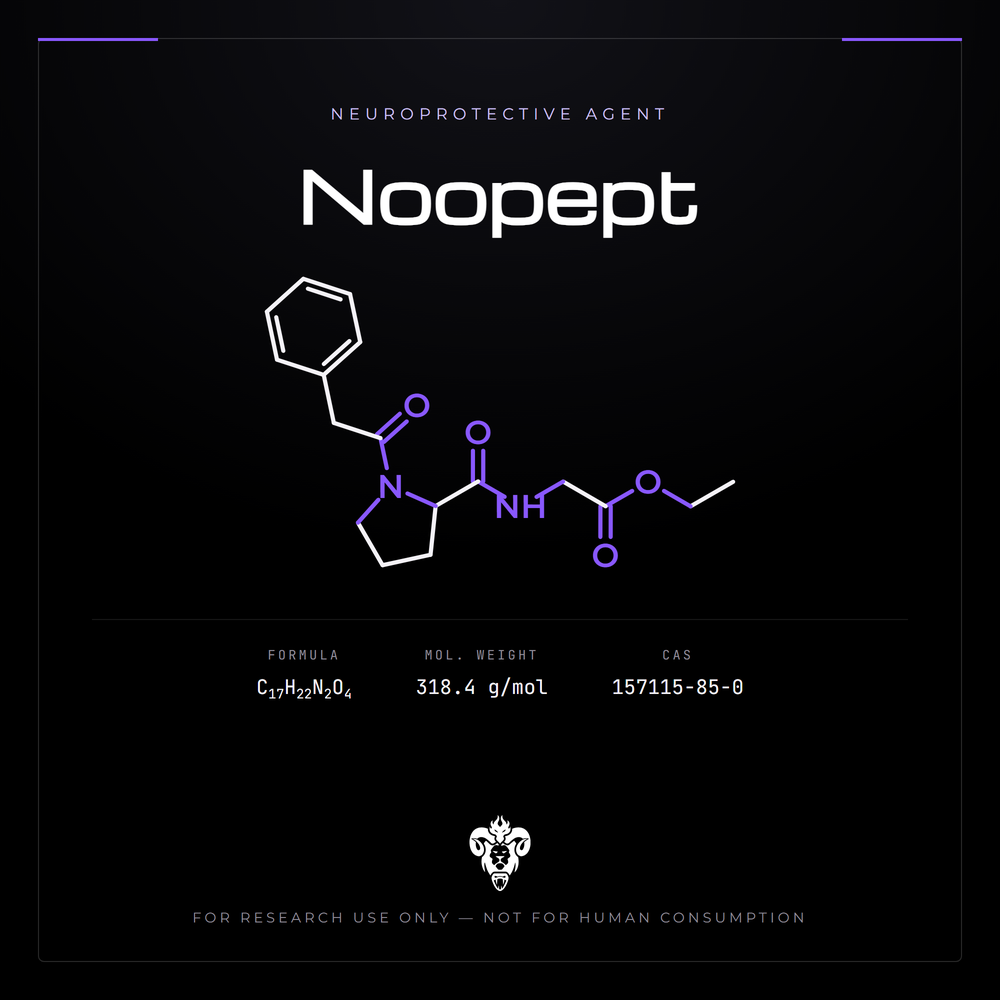

Noopept (Omberacetam, GVS-111)
Noopept is a synthetic proline-containing dipeptide, the ethyl ester of N-phenylacetyl-L-prolylglycine. It was designed at the Zakusov Institute of Pharmacology as a conformationally constrained dipeptide analogue of the pyrrolidone nootropics, which is why it is frequently described alongside the racetam family despite not sharing their 2-oxopyrrolidine core. In laboratory work it is used chiefly as a reference ligand for Pro-Gly dipeptide pharmacology and as a comparator against piracetam in neurochemical assays, where it is active at concentrations roughly three orders of magnitude lower.
Its pharmacology is complicated by biotransformation: Noopept is cleaved in tissue to cycloprolylglycine (cyclo-L-prolylglycine, CPG), an endogenous cyclic dipeptide that is itself neuroactive. Experiments intended to characterise the parent compound therefore have to account for a metabolite with overlapping activity, and analytical protocols commonly track both species.
Technical Specifications
| Property | Specification |
|---|---|
| Product Name | Noopept |
| Synonyms | Omberacetam, GVS-111, N-phenylacetyl-L-prolylglycine ethyl ester |
| CAS Number | 157115-85-0 |
| Molecular Formula | C₁₇H₂₂N₂O₄ |
| Molecular Weight | 318.37 g/mol |
| Chemical Class | Substituted Pro-Gly dipeptide ester |
| Known Metabolite | Cycloprolylglycine (CPG) |
| Appearance | White to off-white crystalline solid |
| Solubility Profile | Soluble in ethanol and DMSO; limited aqueous solubility |
| Storage | Store at controlled room temperature. Keep tightly closed. Liquid formats: do not refrigerate or freeze. Cold storage may cause the solution to cloud or precipitate. If this occurs, return to room temperature and mix until clear. |
| Solution Base | PEG400, DMSO |
Storage guidance is a house recommendation. Analytical documentation is per-lot release testing.
Research Applications & Mechanism of Action
No single receptor accounts for the reported activity of this dipeptide, and the mechanistic literature converges on several distinct lines of investigation rather than one target. Primary fields of in vitro and preclinical laboratory investigation include:
-
Neurotrophin Expression: Measuring NGF and BDNF mRNA in hippocampal and cortical tissue models, where the compound is used as a positive comparator in transcript-level assays.
-
Hypoxia-Response Signalling: Probing HIF-1 DNA-binding activity and HIF-1α stabilisation in neuronal cell lines. Docking work implicates HIF prolyl hydroxylase 2 as a binding partner, which offers a plausible common root for otherwise unrelated observations.
-
Glutamatergic Mediation: Using NMDA and quisqualate/AMPA antagonists to dissect which receptor populations mediate electrophysiological responses, and to characterise how those responses change on repeated exposure.
-
Metabolite Pharmacology: Separating the activity of the parent ester from cycloprolylglycine in cell-free and tissue preparations.
-
Analytical Reference Work: Serving as a characterised standard for chromatographic and mass-spectrometric method development across the Pro-Gly dipeptide class.
Selected Research Literature
Peer-reviewed preclinical literature indexed on PubMed, provided for scientific context only. These are animal and in-vitro studies; nothing here describes or implies a use for this material.
- Ostrovskaya RU, Gudasheva TA, Zaplina AP, et al. Noopept stimulates the expression of NGF and BDNF in rat hippocampus. Bull Exp Biol Med. 2008;146(3):334-337. doi:10.1007/s10517-008-0297-x
- Zainullina LF, Ivanova TV, Sadovnikov SV, Vakhitova YV, Seredenin SB. Cognitive enhancer noopept activates transcription factor HIF-1. Dokl Biochem Biophys. 2020;494(1):256-260. doi:10.1134/S1607672920050129
- Vorobyov V, Kaptsov V, Kovalev G, Sengpiel F. Effects of nootropics on the EEG in conscious rats and their modification by glutamatergic inhibitors. Brain Res Bull. 2011;85(3-4):123-132. doi:10.1016/j.brainresbull.2011.02.011
Assay note. Vorobyov et al. report that the electrophysiological response changes across repeated administrations in rats, and that an AMPA/quisqualate antagonist restores it. Exposure history is therefore a variable worth recording rather than an experimental detail to standardise away.
Analytical Documentation
Purity, identity, and composition vary by manufacturing lot. Kimera Chems does not publish a single fixed purity figure for this item; refer to the batch-specific Certificate of Analysis (COA) issued for the lot received, which reflects third-party analytical testing for that lot. Contact us if a COA for your lot is required.
Related Research Compounds
Research Use Disclaimer
Research Use Only Disclaimer: This product is developed and distributed strictly as a Research Use Only (RUO) laboratory reference chemical intended exclusively for non-clinical analytical and scientific investigation. It is not an FDA-approved drug, medical treatment, dietary supplement, or food ingredient, and is strictly prohibited for human or animal consumption. Kimera Chems supplies this research material solely to qualified institutions and professional investigators for authorized laboratory research.