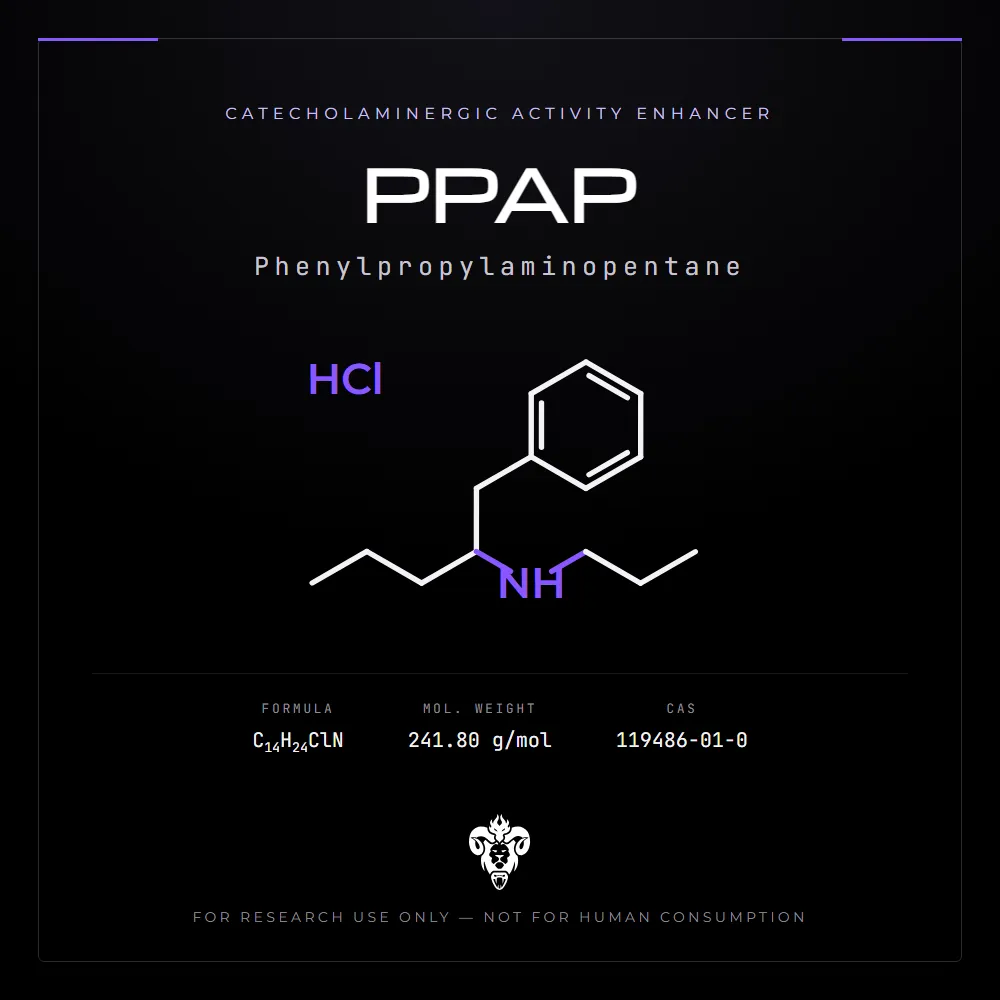

PPAP (Phenylpropylaminopentane) Hydrochloride Research Standard
PPAP (Phenylpropylaminopentane) Hydrochloride is a synthetic derivative belonging to the phenethylamine class, functioning as a monoamine releasing agent. Unlike traditional stimulants that primarily act as reuptake inhibitors, PPAP is researched for its capacity to stimulate the selective release of dopamine and norepinephrine, making it a critical tool for mapping neurochemical transport dynamics. In laboratory settings, PPAP HCl is utilized to study the precise movement of neurotransmitters across synaptic membranes and serves as a vital benchmark for Structure-Activity Relationship (SAR) modeling within the phenethylamine family.
Physical & Handling Properties
| Property | Specification |
|---|---|
| Physical Appearance | Fine white to off-white crystalline powder |
| Solution Base | PEG400, DMSO |
Mechanism of Action & Research Context
PPAP HCl is characterized as a “releasing agent,” which distinguishes its pharmacological activity from traditional monoamine reuptake inhibitors.
-
Monoamine Release Dynamics: The compound is studied for its ability to interact with monoamine transporters (dopamine and norepinephrine) to facilitate the release of neurotransmitters into the synaptic cleft, rather than simply blocking their reuptake.
-
Transporter Binding: Investigations often center on the binding affinity of the molecule to these transporters, helping to elucidate the specific mechanisms by which it triggers release versus uptake inhibition.
-
Salt Form: The hydrochloride is used in preference to the freebase in most laboratory settings. Salt forms of basic amines are generally more water-soluble than the corresponding free base.
-
SAR Modeling: Because of its unique structure within the phenethylamine scaffold, PPAP serves as a baseline for comparing the activity of various analogs, allowing researchers to refine models regarding how specific side-chain modifications impact neurotransmitter interaction.
Research Applications
PPAP HCl is a specialized reagent used to explore the nuances of brain chemistry and monoamine system regulation.
Primary fields of in vitro laboratory investigation include:
-
Neurotransmitter Release Mapping: Tracking the movement and synaptic release of dopamine and norepinephrine in controlled cell-based models.
-
Transporter Interaction Studies: Analyzing how the compound binds to and modulates specific monoamine transporters.
-
Structure-Activity Relationship (SAR) Modeling: Using PPAP as a comparative baseline to test and categorize other phenethylamine analogs.
-
Analytical Benchmarking: Utilizing powder to calibrate laboratory equipment and develop reliable test solutions for complex neurochemical assays.
Storage & Handling Guidelines
Store at controlled room temperature. Keep tightly closed. Liquid formats: do not refrigerate or freeze. Cold storage may cause the solution to cloud or precipitate. If this occurs, return to room temperature and mix until clear.
Storage guidance is a house recommendation. Analytical documentation is per-lot release testing.
Related Research Compounds
Research Use Disclaimer
Research Use Only Disclaimer: This product is labeled and sold “For Research Use Only – NOT FOR HUMAN CONSUMPTION.” It is not a drug, dietary supplement, food, cosmetic, or medical device, and it is not approved by the FDA or any other regulator for human or veterinary use. It is supplied to approved account holders as a research chemical for laboratory use and must be handled in accordance with applicable law.