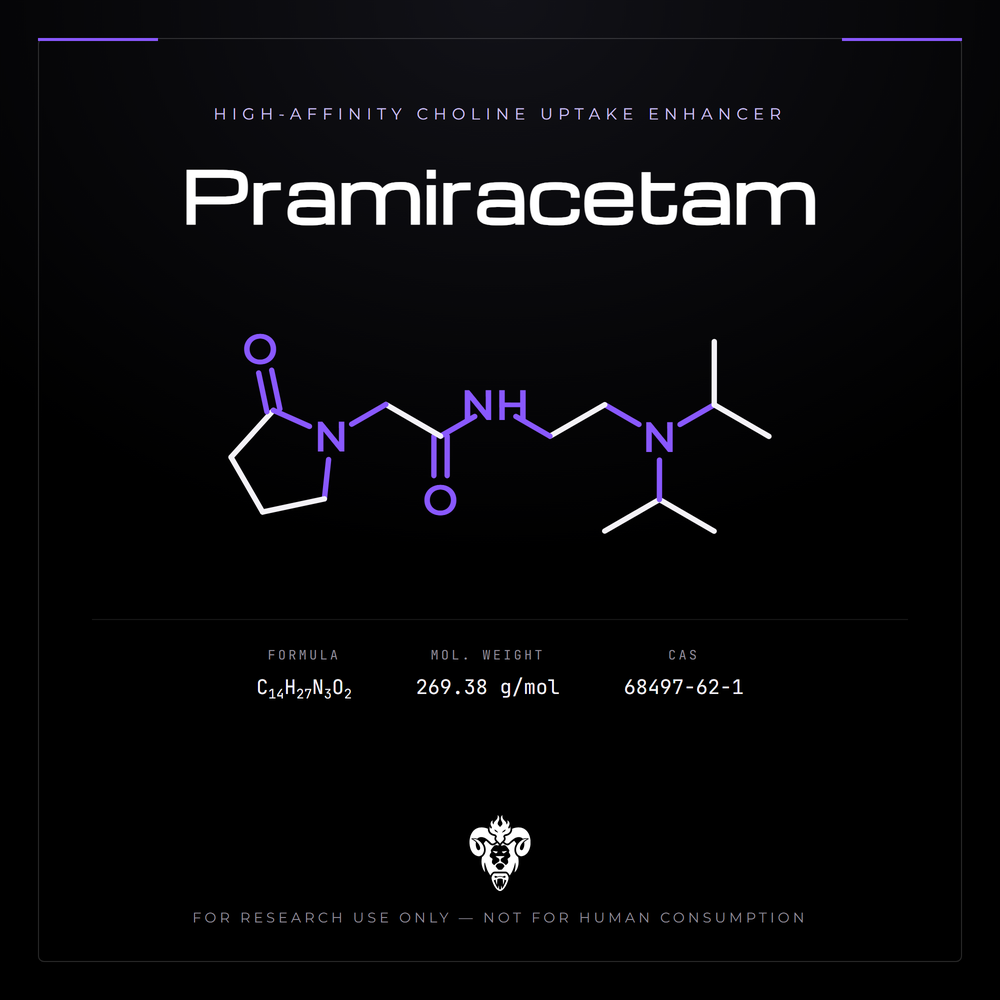

Pramiracetam Research Standard
Pramiracetam is a potent, lipid-soluble derivative of the piracetam scaffold, distinguished by its unique pharmacokinetic profile compared to its water-soluble racetam counterparts. By featuring a lipophilic structure, pramiracetam exhibits increased membrane permeability, facilitating investigations into high-affinity choline uptake (HACU) and intracellular signaling dynamics. In laboratory research, it serves as an advanced cognitive model tool for studying membrane transport mechanisms, synaptic plasticity, and the optimization of neurotransmitter signaling pathways in controlled in vitro environments.
Physical & Handling Properties
| Property | Specification |
|---|---|
| Physical Appearance | White to off-white crystalline powder |
Mechanism of Action & Research Context
Pramiracetam’s research utility is primarily driven by its enhanced lipid solubility, which allows for distinct interaction patterns with cellular components compared to typical hydrophilic racetams.
-
Choline Uptake Modulation: One of the most studied mechanisms is its ability to facilitate high-affinity choline uptake (HACU) in the hippocampus, which is critical for the synthesis of acetylcholine and the maintenance of cholinergic signaling pathways.
-
Membrane Interactions: Its lipophilicity allows it to interact more readily with lipid bilayers. Researchers utilize this to study membrane fluidity and the potential for the molecule to alter the behavior of membrane-bound proteins and ion channels.
-
Signaling Efficacy: In attention-related experimental models, pramiracetam is used to map signal patterns between nerve cells, providing a model for how structural modification of the pyrrolidone nucleus influences cognitive-related signaling networks.
Research Applications
Pramiracetam is a specialized benchmark for high-fidelity studies in cellular biology and neuropharmacology.
Primary fields of in vitro laboratory investigation include:
-
Cholinergic System Modeling: Investigating the kinetics of choline uptake and neurotransmitter synthesis in cultured neuronal tissue.
-
Membrane Biophysics: Studying the transport mechanisms of fat-soluble molecules across cellular barriers in controlled settings.
-
Attention-Pathway Mapping: Researching signal connectivity and synaptic firing patterns associated with cognitive-related signaling.
-
Metabolic Profiling: Testing the influence of the molecule on enzymatic processing and cellular energy utilization pathways.
Storage & Handling Guidelines
Store at controlled room temperature. Keep tightly closed.
Storage guidance is a house recommendation. Analytical documentation is per-lot release testing.
References
-
Pentalieri G, et al. (1982) “Pramiracetam: a new nootropic.” Current Therapeutic Research. 31: 712–723.
-
Gualtieri F, et al. (2002) “Design and study of piracetam-like nootropics, controversial members of the problematic class of cognition-enhancing drugs.” Current Pharmaceutical Design. 8(2): 125–138.
Related Research Compounds
Research Use Disclaimer
Research Use Only Disclaimer: This product is labeled and sold “For Research Use Only – NOT FOR HUMAN CONSUMPTION.” It is not a drug, dietary supplement, food, cosmetic, or medical device, and it is not approved by the FDA or any other regulator for human or veterinary use. It is supplied to approved account holders as a research chemical for laboratory use and must be handled in accordance with applicable law.