
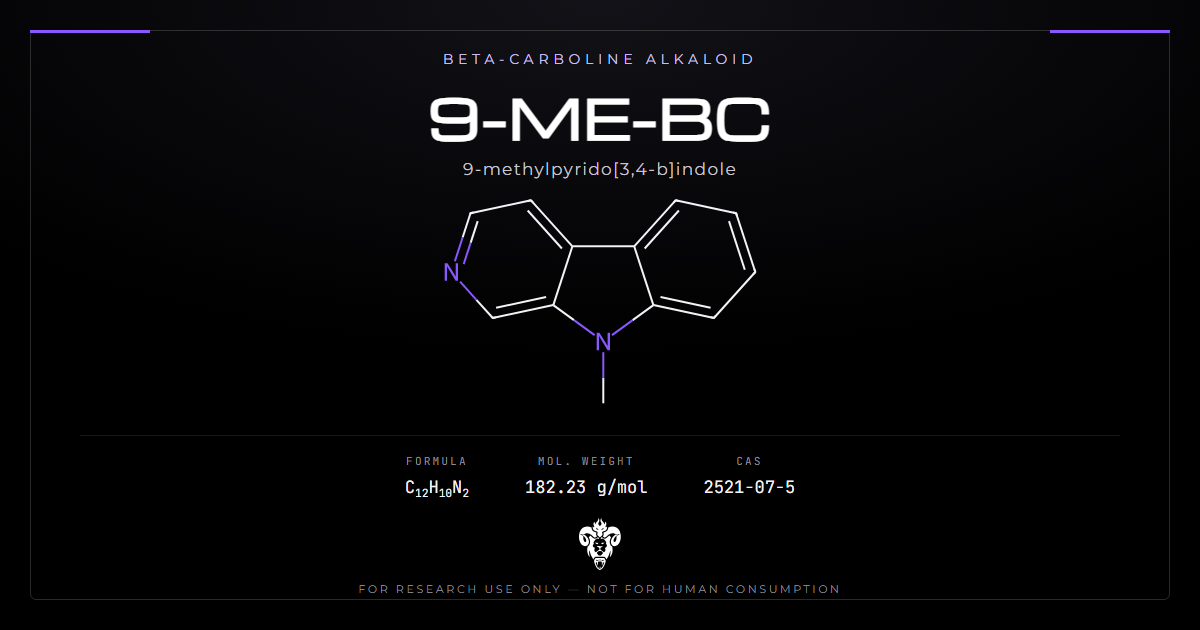
Most compounds enter the literature as promising, then disappoint. 9-ME-BC did the opposite. Researchers were studying β-carbolines because some members of the family looked like neurotoxins implicated in Parkinson’s disease. Then a Dresden group tested one particular methylated variant and found the reverse: it increased dopaminergic cell counts instead of killing them. That single result opened a fifteen-year research thread. This profile reviews what 9-ME-BC is, how it works in the published models, and what the data still cannot answer — useful context for anyone working in the wider nootropics research space.
What Is 9-ME-BC?
9-ME-BC is short for 9-methyl-β-carboline. Structurally, it is a pyridoindole: a tricyclic scaffold formally named 9-methyl-9H-pyrido[3,4-b]indole. Its molecular formula is C₁₂H₁₀N₂, its molar mass is 182.22 g/mol, and it carries CAS number 2521-07-5 (PubChem CID 164979).
The parent compound, β-carboline, is not exotic. Mammals form β-carbolines endogenously from tryptophan and tryptophan-derived indoleamines. Meanwhile, exogenous sources are everywhere: high-temperature cooking of protein, coffee, alcohol, and tobacco smoke all generate them. Consequently, β-carbolines appear in human blood, brain tissue, and cerebrospinal fluid as a matter of course.
The single methyl group at the N9 position is what separates 9-ME-BC from the rest of the family. As the sections below show, that one substitution changes everything. Kimera supplies research-grade 9-ME-BC in powder and capsule formats for laboratory investigation.
Why the β-Carboline Family Cuts Both Ways
Understanding 9-ME-BC requires understanding what it is not. The β-carboline that worried neuroscientists is 2,9-dimethyl-β-carbolinium ion — a doubly methylated, permanently charged species detected in human brain. In primary dopaminergic culture, that cation damages neurons through mechanisms broadly comparable to the classic parkinsonian toxin MPP+ [1].
The structural difference is small but decisive. Methylation at N9 leaves a neutral, lipophilic molecule. Methylation at the pyridine nitrogen (N2) creates a quaternary cation that mitochondria handle very differently. In other words, position determines outcome. Therefore, papers on “β-carboline neurotoxicity” and papers on “9-ME-BC neuroprotection” can both be correct — they are describing different molecules.
This distinction also matters analytically, a point returned to below.
9-ME-BC Mechanism of Action in the Published Literature
The mechanistic picture assembled between 2008 and 2020 is unusually multimodal. Rather than acting at one target, 9-ME-BC appears to touch several systems at once.
Tyrosine Hydroxylase and Transcriptional Effects
In primary mesencephalic culture, 9-ME-BC increased the number of tyrosine hydroxylase-immunoreactive (TH+) neurons in a concentration-dependent manner, with reported effects across roughly the 10–100 µM range [2]. Importantly, the effect was not simply proliferation. TH expression rose in pre-existing dopa decarboxylase-immunoreactive neurons, and TH-relevant transcription factors including Gata2, Gata3, Creb1, and Crebbp were upregulated [3].
Neurite outgrowth increased alongside it. Inhibitor experiments implicated protein kinases A and C, the EGF and FGF receptors, and the neural cell adhesion molecule NCAM in those effects [3].
Neurotrophic Factor Induction
Both in vitro and in vivo work reports induction of growth factors relevant to dopaminergic survival. The developmental signals SHH, WNT1, and WNT5A feature in the culture data [4]. In the rat model discussed below, microarray and RT-PCR analysis showed induction of brain-derived neurotrophic factor (BDNF), conserved dopamine neurotrophic factor (CDNF), cerebellin 1 precursor protein, and ciliary neurotrophic factor (CNTF), with western blots consistent [5].
MAO-A and MAO-B Inhibition
9-ME-BC also inhibits monoamine oxidase, with reported IC₅₀ values of 1 µM for MAO-A and 15.5 µM for MAO-B — meaning it is substantially MAO-A preferring [6]. That activity plausibly contributes to the elevated dopamine content observed in treated cultures. For experimental design, however, it is also a confound worth controlling: any model involving monoamine substrates or co-administered agents needs to account for it.
Transport, Astrocytes, and Mitochondrial Function
Uptake appears to be transporter-mediated. The dopamine transporter carries 9-ME-BC into dopaminergic neurons, whereas the organic cation transporter — not DAT — mediates at least part of the astrocyte effect [4][6]. In astrocyte cultures, 9-ME-BC was anti-proliferative without being cytotoxic, and it stimulated neurotrophic factor expression through the PI3K pathway [6].
The mitochondrial data are among the most striking. In lesioned rats, complex I activity rose roughly 80% relative to lesioned controls, and ATP levels increased, without changes to the overall composition of the respiratory complexes [5]. Researchers studying mitochondrial redox tool compounds such as TND1128 will recognize the design logic behind those measurements.
Key Preclinical Findings
Primary Culture: The Original Observation
Hamann and colleagues reported in 2008 that 48-hour treatment of primary mesencephalic dopaminergic cultures with 9-ME-BC inhibited basal lactate dehydrogenase release and increased the appearance of differentiated dopaminergic neurons [2]. Notably, the authors were explicit that they could not determine the source of the additional TH+ cells — precursor differentiation, previously TH-negative neurons, or transdifferentiation all remained open.
The MPP+ Rat Model
Wernicke et al. tested restoration rather than prevention. Rats received the neurotoxin MPP+ for 28 days, at a dose that lowered striatal dopamine by roughly 50%. Only afterward did 9-ME-BC begin — infused into the left cerebral ventricle for 14 days. The compound reversed the dopamine-lowering effect in the left striatum, alongside the mitochondrial and neurotrophin changes noted above [5].
Protection and Anti-Inflammatory Activity
Polanski and colleagues described a “tetrad” of effects in 2010: stimulation, protection, regeneration, and anti-inflammatory activity. In acute toxicity models, 9-ME-BC protected TH+ neurons against both lipopolysaccharide and 2,9-dimethyl-β-carbolinium challenge [3]. A follow-up review framed the combination of protective and regenerative properties as unusual for a single small molecule [4].
Spatial Learning in the Radial Maze
Gruss et al. extended the work to behavior. After 10 days of treatment — but not after 5 — rats showed improved spatial learning in the radial maze. The behavioral change coincided with elevated dopamine in the hippocampal formation and with longer, more branched dendritic trees and higher spine counts on dentate gyrus granule neurons [7]. The authors described the compound as acting as a cognitive enhancer in a hippocampus-dependent task, while noting the association was correlative.
For comparison, researchers often read this alongside compounds that raise dopaminergic tone by other routes — enzyme upregulation in the case of bromantane, or the enhancer-regulation concept explored in the BPAP literature.
What the 9-ME-BC Research Does Not Show
Honest sourcing means naming the gaps, and here they are substantial.
No human clinical data exist. 9-ME-BC has no regulatory approval anywhere and has not been evaluated in controlled human trials. Every finding above comes from cell culture or rodent work.
Route of administration limits interpretation. The pivotal restorative study delivered the compound intracerebroventricularly, bypassing absorption and first-pass metabolism entirely [5]. The literature notes that the unsubstituted parent β-carboline crosses the blood-brain barrier readily, but 9-ME-BC’s own systemic pharmacokinetics remain poorly characterized.
Concentrations were high. Culture effects appeared in the micromolar range. Whether comparable exposures are achievable in an intact organism is unresolved.
Photosensitization is a documented liability. This is the finding most often omitted from summaries. 9-Methyl-β-carbolines are efficient photosensitizers. Under UVA excitation at physiological pH, they generate DNA damage through a type-I mechanism — predominantly oxidized purines, plus single-strand breaks, sites of base loss, and cyclobutane pyrimidine dimers [8]. Related work in mammalian cells linked β-carboline photosensitization to micronucleus formation and reduced proliferation [9]. This is established photochemistry, not speculation, and it has direct consequences for how the material is stored and handled.
Handling, Storage, and Analytical Verification
Because of the photochemistry above, light protection is not optional for this compound. Amber glass or foil-wrapped containers, minimal bench light exposure, and light-shielded stock solutions are all reasonable precautions for laboratory work. Standard practice for a small aromatic solid otherwise applies: desiccated storage at controlled room temperature, protection from heat, and stock solutions prepared fresh rather than held. Storage guidance is a house recommendation. Analytical documentation is per-lot release testing.
Identity and purity verification deserve particular attention with 9-ME-BC, because its likely impurities are pharmacologically meaningful rather than inert. Incomplete N-methylation leaves residual norharman, the unsubstituted parent. Over-alkylation can generate the N2-quaternized species — precisely the cation associated with dopaminergic toxicity [1]. A purity number alone does not distinguish these; identity confirmation and impurity profiling do.
Every Kimera lot ships with third-party COA verification, and the results are published openly in our public COA archive. Reviewers can check identity and purity data for the current lot before ordering 9-ME-BC.
Frequently Asked Questions
What is 9-ME-BC? 9-ME-BC is 9-methyl-β-carboline, a pyridoindole small molecule studied in dopaminergic neuroscience. Its formula is C₁₂H₁₀N₂ and its molar mass is 182.22 g/mol.
How does 9-ME-BC differ from 2,9-dimethyl-β-carbolinium? Methyl position. 9-ME-BC carries a single methyl at the indole nitrogen and remains neutral. The 2,9-dimethyl species is a permanently charged cation associated with dopaminergic toxicity in culture models.
Is 9-ME-BC a monoamine oxidase inhibitor? Yes, in the published assays. Reported IC₅₀ values are 1 µM for MAO-A and 15.5 µM for MAO-B, making it MAO-A preferring.
Has 9-ME-BC been tested in humans? No. The literature consists of cell culture and rodent studies. There are no controlled human trials and no approvals in any jurisdiction.
Why does light exposure matter for 9-ME-BC? 9-Methyl-β-carbolines act as photosensitizers. UVA excitation drives DNA photodamage in cell-free and cellular systems, so light-protected storage and handling are appropriate for laboratory material.
What was the most-cited in vivo finding? A 14-day intracerebroventricular infusion reversed MPP+-induced striatal dopamine depletion in rats, with an associated increase in mitochondrial complex I activity and induction of BDNF, CDNF, and CNTF.
Kimera sells 9-ME-BC for laboratory and research use only. Not for human consumption, nor for medical, veterinary, or household use.
References
- Hamann J, Rommelspacher H, Storch A, Reichmann H, Gille G. Neurotoxic mechanisms of 2,9-dimethyl-β-carbolinium ion in primary dopaminergic culture. J Neurochem. 2006;98(4):1185–1199. https://doi.org/10.1111/j.1471-4159.2006.03940.x
- Hamann J, Wernicke C, Lehmann J, Reichmann H, Rommelspacher H, Gille G. 9-Methyl-β-carboline up-regulates the appearance of differentiated dopaminergic neurones in primary mesencephalic culture. Neurochem Int. 2008;52:688–700. https://pubmed.ncbi.nlm.nih.gov/17913302/
- Polanski W, Enzensperger C, Reichmann H, Gille G. The exceptional properties of 9-methyl-β-carboline: stimulation, protection and regeneration of dopaminergic neurons coupled with anti-inflammatory effects. J Neurochem. 2010;113(6):1659–1675. https://doi.org/10.1111/j.1471-4159.2010.06725.x
- Polanski W, Reichmann H, Gille G. Stimulation, protection and regeneration of dopaminergic neurons by 9-methyl-β-carboline: a new anti-Parkinson drug? Expert Rev Neurother. 2011;11(6):845–860. https://doi.org/10.1586/ern.11.1
- Wernicke C, Hellmann J, Zięba B, et al. 9-Methyl-β-carboline has restorative effects in an animal model of Parkinson’s disease. Pharmacol Rep. 2010;62(1):35–53. https://pubmed.ncbi.nlm.nih.gov/20360614/
- Keller S, Polanski WH, Enzensperger C, Reichmann H, Hermann A, Gille G. 9-Methyl-β-carboline inhibits monoamine oxidase activity and stimulates the expression of neurotrophic factors by astrocytes. J Neural Transm. 2020;127(7):999–1012. https://doi.org/10.1007/s00702-020-02189-9
- Gruss M, Appenroth D, Flubacher A, et al. 9-Methyl-β-carboline-induced cognitive enhancement is associated with elevated hippocampal dopamine levels and dendritic and synaptic proliferation. J Neurochem. 2012;121(6):924–931. https://doi.org/10.1111/j.1471-4159.2012.07713.x
- Vignoni M, Rasse-Suriani FAO, Butzbach K, Erra-Balsells R, Epe B, Cabrerizo FM. Mechanisms of DNA damage by photoexcited 9-methyl-β-carbolines. Org Biomol Chem. 2013;11(32):5300–5309. https://doi.org/10.1039/C3OB40344K
- Vignoni M, Erra-Balsells R, Epe B, Cabrerizo FM. Intra- and extra-cellular DNA damage by harmine and 9-methyl-harmine. J Photochem Photobiol B. 2014;132:66–71. https://doi.org/10.1016/j.jphotobiol.2014.01.020
- 9-Methyl-β-carboline, PubChem CID 164979. https://pubchem.ncbi.nlm.nih.gov/compound/164979