
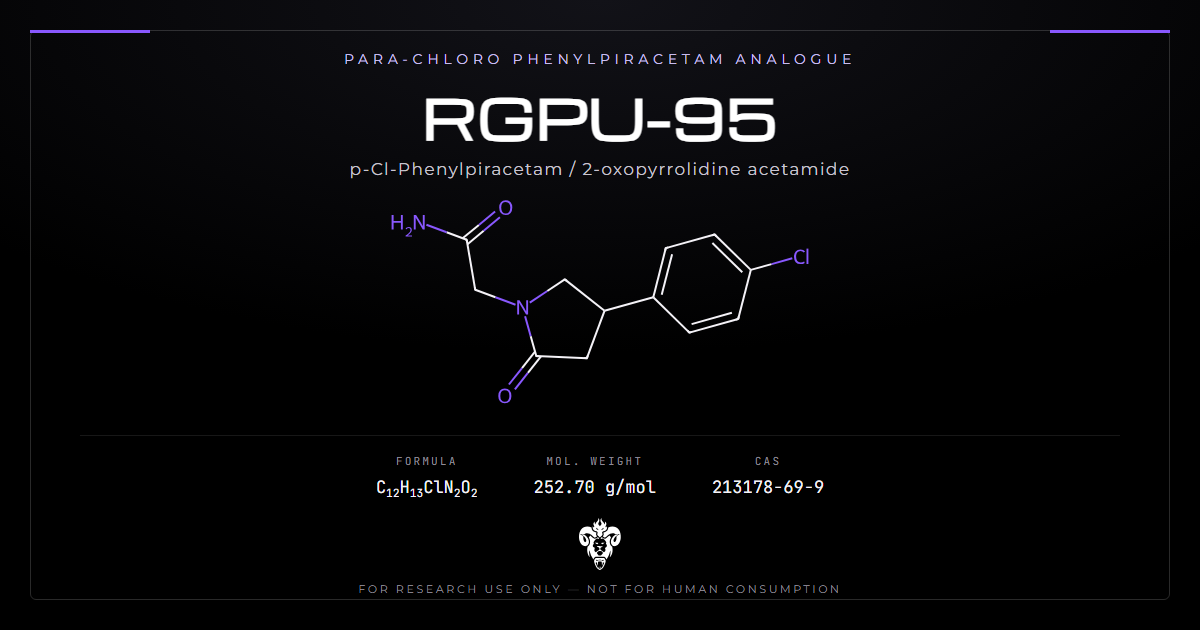
Search PubMed for RGPU-95 and exactly one paper comes back. A Volgograd group compared Fenotropil against what the abstract calls its structural analogue, compound RGPU-95, measuring anxiety and depression-related behaviour in rats [1].
That abstract never states the structure. It says structural analogue and stops there.
The catalogue sells this compound as p-chloro-phenylpiracetam, which is a specific molecule with its own registry entry. Whether that molecule is the one in the paper is a question the paper does not answer. Kimera supplies RGPU-95 as research material. This article sets out what is documented, what is inferred, and how to tell the two apart at the bench.
Everything below reports findings from animal and analytical studies. This material is for research use only, not for human or veterinary use.
What the catalogue supplies
The product name identifies a para-chloro derivative of phenylpiracetam. That structure has a PubChem record and a registry number.
Identity and physical data
| Property | Value, para-chloro structure |
|---|---|
| Product name | RGPU-95 (p-Cl-Phenylpiracetam) |
| PubChem CID | 10824736 |
| CAS number | 213178-69-9 |
| Molecular formula | C12H13ClN2O2 |
| Molecular weight | 252.69 g/mol |
| InChIKey | NEEZTPLBDJRDCV-UHFFFAOYSA-N |
| IUPAC name | 2-[4-(4-chlorophenyl)-2-oxopyrrolidin-1-yl]acetamide |
| Parent compound | Phenylpiracetam, C12H14N2O2, 218.25 g/mol |
| Chemical class | 2-oxopyrrolidine acetamide, a racetam |
Two names doing different jobs
One half of the product title is a laboratory series code. The other half is a structural description. A code identifies a compound inside one group’s numbering system, and it carries no chemistry on its own. A structural name carries chemistry and nothing else.
Reading the title as if both halves came from the same source is the error worth avoiding. They did not, and the rest of this article is about the gap between them.
The stereocentre
Position 4 of the pyrrolidine ring carries the aryl group, and that carbon is a stereocentre. The registry record specifies no configuration, so material described by it is racemic. That matters more here than it usually would, and the section on the parent compound explains why.
The one paper that names RGPU-95
The 2010 study compared Fenotropil, the Russian trade name for phenylpiracetam, against compound RGPU-95 in rats [1]. Both reduced anxiety-related and depression-related behaviour, and both did so more in males than in females.
The reported comparisons
On anxiolytic measures the analogue exceeded Fenotropil while remaining below diazepam. On antidepressant-type measures it was comparable to imipramine and exceeded Fenotropil [1]. Those are the results, and they belong to the rat models that produced them.
What the abstract omits
No structure. No formula, no registry number, no synthesis reference. A reader cannot confirm from that paper which analogue was tested (PubMed). Chemist co-authors appear on the paper, and their compound still goes undrawn.
Why the omission matters
Every downstream claim about RGPU-95 traces to this one paper. If the designation refers to a different analogue than the product name implies, the behavioural results describe a molecule nobody is selling. The evidence chain has one link, and that link is missing a structure.
RGPU is a series code, not a molecule class
The designation is not unique to phenylpiracetam derivatives. Other RGPU numbers appear in indexed pharmacology, and they are different chemistry.
What the other numbers are
RGPU-135 is beta-phenylglutamic acid hydrochloride, published under the names neuroglutam and glutarone, and studied for behavioural effects in animals [2][3]. RGPU-207 is a cyclic GABA derivative examined for effects on cardiac and cerebral mitochondria in stressed animals [4]. RGPU-260 is another GABA derivative, tested on functional reserves of rat heart after chronic alcohol intoxication [5].
The pattern that follows
Three published RGPU compounds are amino acid derivatives, not racetams. The numbering spans a laboratory’s output rather than a chemical family, which is exactly why a code cannot substitute for a structure. A reader who assumes RGPU-95 must be a racetam because RGPU-95 sounds like a racetam is reasoning from the product name, not from the series.
What a single-step edit usually does
Adding a halogen to an aryl ring is one of the most common moves in medicinal chemistry. It raises lipophilicity, it blocks metabolism at that position, and it changes electron density across the ring. Any of those can shift potency in either direction.
None of them is predictable without measurement. A chlorine can improve a compound, kill its activity, or leave it unchanged, and which of the three happened is an empirical question that nobody has answered here.
The parent compound, and the limits of read-across
Phenylpiracetam is well studied by the standards of this corner of the literature, and what that work shows argues against casual extrapolation.
Its enantiomers behave differently
A 2011 study investigated stereoselective pharmacological activity and found the effects were not shared equally between enantiomers [6]. In 2017 a second group identified S-phenylpiracetam as a selective dopamine transporter inhibitor, reducing body weight gain in animals without changing locomotor activity [7]. A 2020 study reported neuroprotective and anti-inflammatory activity for R-phenylpiracetam in inflammation models in male mice [8].
What that does to an analogue argument
The parent’s pharmacology splits by enantiomer. A racemic analogue therefore inherits two questions at once: whether the chlorine changes activity, and which enantiomer carries whatever activity remains. No published work addresses either for the para-chloro compound.
The rest of the parent literature
Reviews of fonturacetam, another name for the same molecule, cover its pharmacological profile and its clinical use in the countries where it is approved [9]. A 2025 systematic review and meta-analysis examined its use in asthenia [10]. A 2011 study reported immune-related effects in animals under stress [11]. None of it transfers to a chlorinated analogue without evidence, and none of that evidence exists.
Where the compound sits in the racetam family
The 2-oxopyrrolidine acetamide core defines the class. This programme has published on nine members of it, which makes the family unusually well covered.
| Compound | Modification from piracetam | Article |
|---|---|---|
| Piracetam | none, the parent | Piracetam research |
| Phenylpiracetam | phenyl at ring position 4 | via the hydrazide article below |
| Phenylpiracetam Hydrazide | phenyl plus hydrazide for amide | Hydrazide research |
| RGPU-95 as sold | phenyl plus para-chlorine | this article |
| Pramiracetam | diisopropylaminoethyl amide | Pramiracetam research |
| Noopept | dipeptide ester, related core | Noopept research |
Three modifications, one parent
Phenylpiracetam sits at the centre of this group. The hydrazide changes its amide. The para-chloro compound changes its ring. Two different vendors’ compounds are therefore two different single-step edits of the same molecule, and the two articles should be read together.
Why the family matters analytically
Members of this class share a chromophore, a core mass fragment and similar chromatographic behaviour. That similarity is the reason identity confirmation on any one of them needs more than a retention time.
Confirming the identity analytically
The good news is that the para-chloro claim is easy to test. Chlorine leaves fingerprints that nothing else in this family produces.
The isotope pattern settles it in one spectrum
Chlorine has two stable isotopes in a roughly three to one ratio. Any chlorinated fragment therefore shows a companion peak two mass units higher at about a third the height. A phenylpiracetam analogue without chlorine cannot produce that pattern, so a single mass spectrum separates the para-chloro structure from the unsubstituted parent and from the hydrazide.
Mass differences to expect
The para-chloro structure runs 252.69 against 218.25 for phenylpiracetam and 233.27 for the hydrazide. Nominal mass differences of 34 and 19 units are large, and no mass analyser in routine use struggles with them.
The NMR check
Para substitution on a benzene ring gives a symmetric four-proton pattern, two doublets facing each other, rather than the five-proton multiplet of an unsubstituted phenyl. That distinction is visible at a glance in a proton spectrum and it confirms the substitution position, which mass alone cannot do.
Running the three siblings together
The cleanest identity experiment uses the family. Inject phenylpiracetam, the hydrazide and this material in one sequence under identical conditions.
Three distinct masses come out: 218.25, 233.27 and 252.69. Only one of the three carries the chlorine isotope signature. Retention order follows polarity, and the chlorinated compound is the most lipophilic of the set, so it elutes last under reversed-phase conditions. One sequence answers identity, purity and family membership at once, and the two siblings are already in the catalogue.
What a certificate should carry
Identity by NMR or by comparison against a qualified standard, purity by HPLC with the wavelength stated, and explicit confirmation of the chlorinated formula. Batch documentation for catalogue material sits in the certificate of analysis database.
The surveillance literature, and why standards exist
Analytical laboratories test consumer products for undeclared pharmaceutical ingredients, and racetams turn up in that work.
What the surveys found
A 2021 study reported five unapproved drugs in products sold as cognitive enhancers [12]. Two years later, a review covered unauthorised ingredients in nootropic supplements across their history, pharmacology, prevalence and regulation [13]. A 2025 market surveillance study run by twelve official medicines control laboratories examined illicit smart drugs in Europe and Australia [14].
The connection to reference material
Those laboratories need characterised standards to identify what they find. A compound with an ambiguous designation and a specific structure is exactly the kind of material that ends up in such a survey. It is also the kind that needs its identity settled before anybody reports a result against it.
Reading the Russian-language literature
Most primary work on this family sits in Russian journals with English abstracts and no English full text. That shapes what any reader outside those journals can actually verify.
What the abstract-only ceiling costs
An English abstract carries the result and drops the methods. Structures, doses, strains and statistics stay behind the language barrier. The RGPU-95 paper is the extreme case: the abstract omits the one detail that would make the result usable [1], and no English full text exists to recover it.
Search terms that surface the record
Try the transliterations as well as the English names. Fenotropil, phenotropil, fonturacetam and carphedon all appear as separate strings for the same parent compound, and PubMed indexes them separately (PubMed). The designation itself is worth searching bare, since RGPU numbering appears across unrelated chemistry [2][4] and [5].
Where the class literature is broader
Work on pyrrolidone derivatives as a group extends further than any single compound. A 2014 study examined antiaggregant mechanisms of pyrrolidone derivatives in rats with chronic hyperglycaemia [15], and a 1985 study looked at effects of piracetam derivatives on antibody formation [16]. Both describe the class rather than this compound, which is the correct level of generality when a specific molecule has no literature of its own. Further reading sits in the nootropics research library.
How to write the compound up
Naming decides whether a future reader can follow the work, and this compound makes that harder than most.
Name the structure, keep the code
Give the structure first and the designation second. A methods line reading “2-[4-(4-chlorophenyl)-2-oxopyrrolidin-1-yl]acetamide (CAS 213178-69-9), supplied as RGPU-95” survives translation, indexing and a decade of citation drift.
The reverse order does not. A paper that names only RGPU-95 reproduces the gap this article exists to describe, and the 2010 study shows exactly how expensive that gap becomes [1].
Cite the paper for what it says
The 2010 result belongs to an unspecified analogue [1]. Citing it as evidence about a named structure overstates it, and citing it as evidence about the class understates it. Say what it reports and what it omits, in one sentence, then move on.
Record the batch
Batch documentation ties a result to a specific material. For a compound whose identity rests on vendor assignment rather than published chemistry, that link carries more weight than usual. Keep the certificate with the data rather than in a drawer.
Physicochemical properties and handling
| Property | Detail |
|---|---|
| Appearance | White to off-white crystalline solid |
| Solubility | Soluble in DMSO; limited aqueous solubility |
| Recommended stock | DMSO, split into single-use aliquots |
| Storage, solid | Minus 20 degrees Celsius, desiccated |
| Storage, solution | Minus 20 degrees Celsius, avoid repeated freeze-thaw |
| Stability note | Lactam and primary amide; avoid strong acid or base |
| Handling | Standard laboratory controls for a fine powder |
The chlorine changes the physical behaviour
Adding chlorine to the ring raises lipophilicity and molecular weight against the parent. Expect lower aqueous solubility than phenylpiracetam and a greater tendency to come out of solution when a DMSO stock meets buffer. Add stock to well-mixed medium rather than the reverse.
Weighing a small batch
Racetam powders are light and static-prone. A milligram-scale weighing on an unearthed balance can drift by several percent, which matters when the whole experiment hangs off one stock concentration.
Weigh into a tared vial rather than onto paper, let the reading settle, and record the actual mass rather than the target. Back-calculate the concentration from what you weighed. That habit costs nothing and removes a whole class of quiet error.
Hydrolysis is the degradation route
The molecule carries a lactam ring and a primary amide. Both hydrolyse under strong acid or base, giving the corresponding acids. Keep aqueous work near neutral pH, and prepare working dilutions fresh rather than storing them.
Designing an experiment with this material
Confirm identity before anything else
Run the isotope pattern check on the material in hand. It costs one injection. Every result generated with an unconfirmed compound inherits that uncertainty, and no statistical treatment removes it afterwards.
Choose comparators from the same family
The published siblings make good controls. Phenylpiracetam is the direct parent, and the hydrazide is a second single-step edit of it. Running two of the three together tests whether an effect belongs to the core or to a specific substituent.
Report the enantiomeric state
Say that the material is racemic. The parent’s activity splits by enantiomer [6][7] and [8]. A racemate result and a single-enantiomer result are not comparable unless the write-up says which is which.
What a first characterisation should measure
Treat this as characterisation rather than replication. Measure what nobody has published: solubility in the vehicle you intend to use, stability in that vehicle over the experiment’s duration, and a full concentration-response curve rather than one point.
Add a parent-compound arm at matched concentrations. That single addition converts an uninterpretable result into a comparison, and the parent has enough published pharmacology to anchor it [6][7] and [8].
Expect a thin comparison literature
One indexed paper names this designation [1]. Nothing else does. A study using this compound is closer to primary characterisation than to replication, and the write-up should say so plainly.
What this literature does not establish
The structure behind the designation
The single paper naming RGPU-95 does not state a structure [1]. Until somebody publishes the chemistry that assigns the code, treat behavioural results reported under it as belonging to an unspecified analogue.
Any pharmacology for the para-chloro molecule
No indexed study reports pharmacology for 2-[4-(4-chlorophenyl)-2-oxopyrrolidin-1-yl]acetamide by name, formula or registry number. The compound with the confirmed structure has no published pharmacology, and the compound with published behaviour has no confirmed structure.
Which enantiomer, if either, was tested
The 2010 paper does not say whether its compound was racemic or resolved [1]. Given the parent’s enantiomer split, that omission compounds the structural one. Two unknowns sit on the same result.
Human data
None exists for this compound in any form. Approved uses of the parent in other countries say nothing about a chlorinated analogue.
Enantiomer behaviour
Unknown, as for most of this family. The parent is the exception, and its enantiomer split is the reason the question deserves an answer here.
Frequently asked questions
What does RGPU-95 refer to?
A compound designation used in one indexed paper, which describes it only as a structural analogue of Fenotropil [1]. The catalogue attaches the designation to the para-chloro derivative of phenylpiracetam.
Is the identity confirmed?
Partly. Its structure has a registry entry and a CAS number, while the link between that structure and the published designation is not confirmed in the literature.
How does it differ from phenylpiracetam?
By one chlorine on the phenyl ring, in the para position, giving 252.69 g/mol against 218.25.
How do I check that the chlorine is there?
Mass spectrometry. The chlorine isotope pattern gives a companion peak two units up at roughly a third the height, which an unchlorinated analogue cannot produce.
Are other RGPU compounds racetams?
No. RGPU-135, RGPU-207 and RGPU-260 are amino acid and GABA derivatives [2][3] and [4][5]. The series numbering spans a laboratory’s output, not a chemical family.
Why is the compound sold under a code at all?
Because that is how it entered the literature. The single indexed paper uses the designation, so a vendor matching a product to that paper inherits the designation with it.
Can the parent’s clinical data support any claim here?
No. Approvals and clinical reviews describe phenylpiracetam in the countries where it is registered [9][10]. A chlorinated analogue with no clinical record inherits none of that.
Does the para-chloro structure have its own registry entry?
Yes. PubChem CID 10824736 and CAS 213178-69-9 describe 2-[4-(4-chlorophenyl)-2-oxopyrrolidin-1-yl]acetamide, which is the structure the product name specifies.
Which sibling article should I read next?
The phenylpiracetam hydrazide piece. It covers the other single-step edit of the same parent and reaches the same conclusion about the designation from the other side.
References
- Tiurenkov IN, Bagmetova VV, Shishkina AV, et al. [Gender differences in action of Fenotropil and its structural analog, compound RGPU-95, on anxiety-depressive behavior of animals]. Eksp Klin Farmakol. 2010;73(11):10-4. PubMed
- Tyurenkov IN, Bagmetova VV, Chernysheva YV, et al. Comparison of neurotropic effects of L-glutamic acid and its new derivative beta-phenylglutamic acid hydrochloride (RGPU-135, glutarone). Bull Exp Biol Med. 2014;156(6):781-4. PubMed DOI
- Tyurenkov IN, Bagmetova VV, Chernyshova YV, et al. Dose-dependent effects of beta-phenylglutamic acid hydrochloride (RGPU-135, neuroglutam) on animal behavior. Bull Exp Biol Med. 2014;158(2):229-33. PubMed DOI
- Mokrousov IS, Perfilova VN, Prokofiev II, et al. Effect of a new cyclic derivative of GABA, RGPU-207, on the functions of cardiac and cerebral mitochondria of stressed animals. J Pharm Pharmacol. 2019;71(7):1055-1064. PubMed DOI
- Kustova MV, Perfilova VN, Prokofiev II, et al. Effect of RGPU-260, a novel GABA derivative, on functional reserves of rat heart after chronic alcohol intoxication. Bull Exp Biol Med. 2021;170(5):631-635. PubMed DOI
- Zvejniece L, Svalbe B, Veinberg G, et al. Investigation into stereoselective pharmacological activity of phenotropil. Basic Clin Pharmacol Toxicol. 2011;109(5):407-12. PubMed DOI
- Zvejniece L, Svalbe B, Vavers E, et al. S-phenylpiracetam, a selective DAT inhibitor, reduces body weight gain without influencing locomotor activity. Pharmacol Biochem Behav. 2017;160:21-29. PubMed DOI
- Zvejniece L, Zvejniece B, Videja M, et al. Neuroprotective and anti-inflammatory activity of DAT inhibitor R-phenylpiracetam in experimental models of inflammation in male mice. Inflammopharmacology. 2020;28(5):1283-1292. PubMed DOI
- Gromova OA, Torshin IY. [Pharmacological effects of fonturacetam and prospects for its clinical use]. Zh Nevrol Psikhiatr Im S S Korsakova. 2024;124(8):21-31. PubMed DOI
- Devlikamova FI, Safina DR. [Efficacy and safety of fonturacetam in asthenia: a systematic review and meta-analysis]. Zh Nevrol Psikhiatr Im S S Korsakova. 2025;125(2):69-79. PubMed DOI
- Samotrueva MA, Tyurenkov IN, Teplyi DL, et al. Psychoimmunomodulatory effect of phenotropil in animals with immune stress. Bull Exp Biol Med. 2011;151(1):51-4. PubMed DOI
- Cohen PA, Avula B, Wang YH, et al. Five unapproved drugs found in cognitive enhancement supplements. Neurol Clin Pract. 2021;11(3):e303-e307. PubMed DOI
- Jedrejko K, Catlin O, Stewart T, et al. Unauthorized ingredients in nootropic dietary supplements: a review of the history, pharmacology, prevalence, international regulations, and potential as doping agents. Drug Test Anal. 2023;15(8):803-839. PubMed DOI
- Vanhee C, Deconinck E, George M, et al. The occurrence of illicit smart drugs or nootropics in Europe and Australia and their associated dangers: results from a market surveillance study by 12 official medicines control laboratories. J Xenobiot. 2025;15(3):88. PubMed DOI
- Zhilyuk VI, Levykh AE, Mamchur VI. A study of the mechanisms for antiaggregant activity of pyrrolidone derivatives in rats with chronic hyperglycemia. Bull Exp Biol Med. 2014;156(6):799-802. PubMed DOI
- Ratnikov VI, Ostrovskaia RU, Vazhenina ZP, et al. [Effect of piracetam derivatives on antibody formation]. Biull Eksp Biol Med. 1985;100(11):578-81. PubMed