
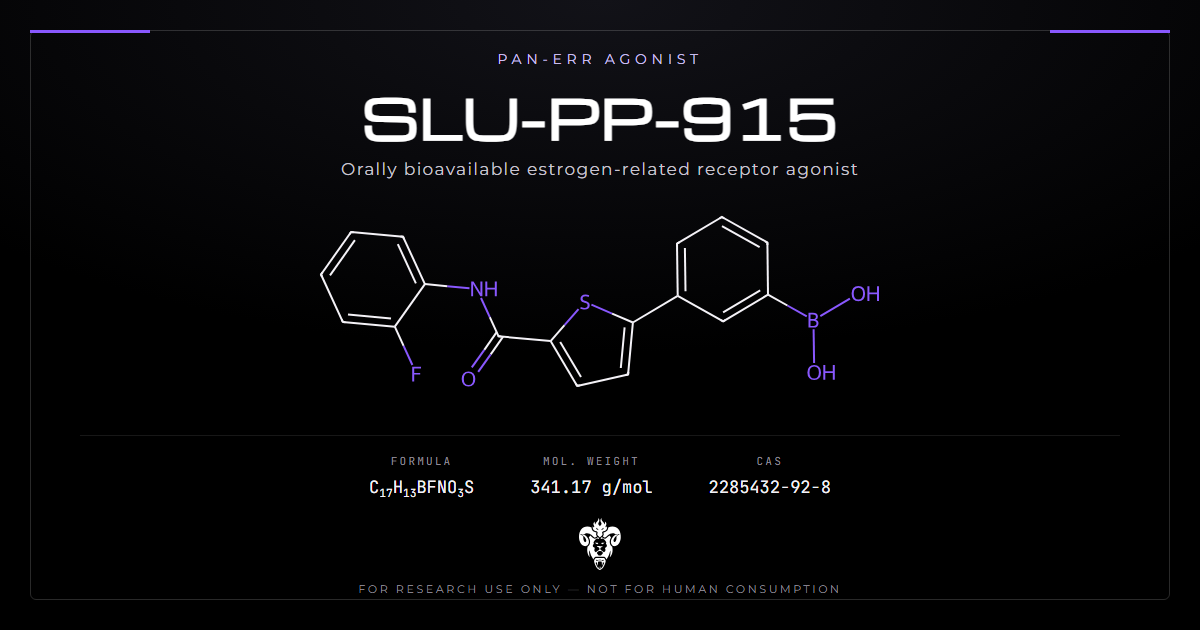
SLU-PP-915 is a synthetic small molecule reported to activate all three estrogen-related receptor isoforms, ERRα, ERRβ, and ERRγ, with EC50 values near 400 nM in the cited assays. It emerged from a structure-based optimization campaign as a successor to SLU-PP-332, and researchers study it as a chemical probe for mitochondrial biogenesis, oxidative metabolism, and exercise-responsive transcription. This reference covers its chemistry, mechanism, published preclinical findings, and analytical verification.
SLU-PP-915 is supplied strictly for laboratory research use. It is not approved for human or veterinary use anywhere, and nothing below should be read as guidance for administration.
Chemical Profile and Identifiers
| Property | Value |
|---|---|
| Compound name | SLU-PP-915 (compound 10s) |
| Chemical name | [3-[5-[(2-Fluorophenyl)carbamoyl]thiophen-2-yl]phenyl]boronic acid |
| CAS number | 2285432-92-8 |
| Molecular formula | C₁₇H₁₃BFNO₃S |
| Molecular weight | 341.16 g/mol |
| InChIKey | CKROIKQTGRZRKF-UHFFFAOYSA-N |
| PubChem CID | 142532359 |
| Compound class | 2,5-Disubstituted thiophene carboxamide; arylboronic acid |
| Receptor target | Pan-ERR agonist (ERRα / ERRβ / ERRγ) |
| Reported EC50 | 414 nM (ERRα), 435 nM (ERRβ), 378 nM (ERRγ) ¹ |
The molecule carries four features worth noting for anyone characterizing it: a phenylboronic acid, a secondary carboxamide, a central thiophene heterocycle, and an ortho-fluorinated aniline ring. Each of these shapes both its receptor pharmacology and its behaviour on analytical instruments.
What SLU-PP-915 Actually Targets
The estrogen-related receptors are orphan nuclear receptors. Despite close structural and sequence homology to the classical estrogen receptors, estrogens do not activate them, and no endogenous ligand has been definitively established. Instead, ERRs sit at the centre of cellular energy control, driving transcription of genes that govern mitochondrial biogenesis, oxidative phosphorylation, fatty acid oxidation, and tricarboxylic acid cycle flux.
That biology explains the research interest. ERR expression and activity rise in response to aerobic exercise, and the receptors mediate several downstream adaptations — increased mitochondrial density, a shift toward oxidative fibre types, and altered fuel selection in skeletal muscle. Consequently, ERR agonists became one of the more heavily studied classes in “exercise mimetic” research.
Binding and Transcriptional Activation
SLU-PP-915 binds the ERR ligand-binding domain directly. Investigators confirmed this biophysically using ¹H NMR protein–ligand titration experiments against the ERRγ LBD, rather than inferring engagement from cell-based readouts alone.¹ The boronic acid hydroxyls act as hydrogen-bond donors, occupying the same interaction space that a phenol occupies in earlier agonist scaffolds. Ligand binding then stabilises a conformation that favours coactivator recruitment — notably PGC-1α — which in turn drives transcription at ERR response elements in target gene promoters.
Downstream Gene Targets
In C2C12 myoblasts treated at 5 µM, SLU-PP-915 significantly upregulated a consistent panel of canonical ERR targets:¹
- PPARGC1A (PGC-1α) — the master coactivator of mitochondrial biogenesis
- PDK4 — shifts fuel selection away from glucose toward fatty acids
- LDHA — lactate dehydrogenase A
- DDIT4 — DNA damage-inducible transcript 4, robustly induced by acute aerobic exercise
Hampton et al. (2023) reported induction of these genes in mouse quadriceps muscle. The observation is preclinical and does not establish an effect in people.¹
Medicinal Chemistry: Why the Boronic Acid Matters
The design lineage here is unusually clean, and it explains why SLU-PP-915 exists at all.
Researchers started from the crystal structure of ERRγ bound to GSK-4716, a known acyl hydrazide agonist (PDB 2GPP). Acyl hydrazides carry well-documented liabilities, so the team applied a cyclisation strategy: replace the central hydrazide with a five-membered heterocyclic ring. Docking results and synthetic accessibility both favoured thiophene, which yielded a series of 2,5-disubstituted thiophenes accessible in two steps from 5-bromo-2-thiophenecarboxylic acid.¹
The decisive move came later in the series. Substituting the phenolic or aniline hydrogen-bond donor with a phenylboronic acid preserved pan-ERR potency while substantially improving stability in human and mouse liver microsomes.¹ The reported change in microsomal stability distinguishes this compound from its predecessor in the cited preclinical work.
Boronic acids remain comparatively uncommon in nuclear receptor chemistry, and the substitution is the single most interesting design decision in the molecule. It is also the feature that most affects handling, as covered below.
Preclinical Research Findings
All published work on SLU-PP-915 is preclinical — cell assays, ex vivo tissue, and rodent models. No human clinical trials have been registered or reported. The summaries below describe what investigators observed in those models and are not claims about effects in people.
Skeletal Muscle and Aerobic Capacity
The defining study appeared in the Journal of Pharmacology and Experimental Therapeutics.² Billon and colleagues reported changes in running distance and duration in mice, with SLU-PP-915 and SLU-PP-332 producing similar results after adjustment for systemic exposure. These are preclinical findings and do not establish an effect in people.
Billon and colleagues also reported changes in Ddit4, mitochondrial gene expression, and mitochondrial DNA measures in mouse quadriceps when compound exposure was examined alongside exercise training. The study describes a preclinical interaction in that model and does not establish a human performance outcome.
That synergy detail is frequently lost in secondary coverage, which tends to frame ERR agonists as replacements for training. The primary data does not support that framing.
Cardiac Function in Heart Failure Models
A large multi-omics study in Circulation evaluated both SLU-PP-332 and SLU-PP-915 in a pressure overload–induced heart failure model.³ Using RNA sequencing, metabolomics, and genetic dependency experiments, the investigators reported improved cardiac function driven by enhanced fatty acid metabolism and mitochondrial function. Isoform-dependency work traced the effect mainly through ERRγ, and the benefit occurred without a corresponding change in cardiac hypertrophy.
Autophagy and Lysosomal Regulation
Related work from the same research network established that ERRs induce the autophagy–lysosome pathway in cardiomyocytes through TFEB, the master transcriptional regulator of lysosomal biogenesis.⁴ This adds a mechanistic layer beyond straightforward mitochondrial gene induction and is relevant to anyone designing experiments around proteostasis or cardiac remodelling.
SLU-PP-915 vs. SLU-PP-332
Both compounds are pan-ERR agonists from the same programme, yet they are chemically distinct molecules. Substituting one for the other changes experimental design in ways that matter.
| SLU-PP-915 | SLU-PP-332 | |
|---|---|---|
| Core scaffold | 2,5-Disubstituted thiophene carboxamide | Acyl hydrazide (benzohydrazide class) |
| Key H-bond donor | Phenylboronic acid | Phenol |
| CAS | 2285432-92-8 | 303760-60-3 |
| Isoform coverage | ERRα / ERRβ / ERRγ | ERRα / ERRβ / ERRγ |
| Microsomal stability | Improved in cited study | Lower in cited study |
| Evidence scope | Preclinical cell and rodent models | Preclinical cell and rodent models |
The two compounds differ in metabolic stability and in the evidence available for each scaffold, while both engage all three isoforms. Researchers comparing them should treat SLU-PP-332 as the first-generation reference tool and SLU-PP-915 as the later analog, and should keep results from different experimental designs separate.
In Vitro Metabolism and Detection
The most detailed analytical characterisation comes from sports drug testing research. Möller, Krug, and Thevis at the German Sport University Cologne profiled both compounds by liquid chromatography–high resolution tandem mass spectrometry (LC-HRMS/MS), then generated metabolites using human liver S9 fraction and human liver microsomes.⁵
Their findings diverge sharply between the two molecules:
- SLU-PP-915 yielded seven metabolites, all Phase I — no Phase II conjugates were detected.
- SLU-PP-332 yielded nine metabolites: six Phase I products plus three Phase II conjugates.
The team synthesised selected SLU-PP-915 metabolites and confirmed their structures by NMR, which gives laboratories genuine reference standards rather than inferred assignments. For anyone building detection methods or investigating metabolic fate, this paper is the primary resource.
Handling, Solubility, and Storage
Standard practice for this scaffold class applies, with one caveat specific to boronic acids.
- Storage: Store the powder sealed at controlled room temperature, protected from light and moisture.
- Solubility: DMSO is reported as a vehicle in in vitro work. The cited literature is summarized without a delivery protocol.
- Moisture sensitivity: Arylboronic acids can undergo reversible dehydration to cyclic boroxine anhydrides on standing, particularly when stored warm or improperly sealed. This matters analytically, because boroxine formation can shift apparent mass balance and complicate assay results without indicating any genuine chemical impurity. Rigorous drying protocols and sealed, desiccated storage are therefore worth the effort.
Follow standard practice for fine research powders. Storage guidance is a house recommendation. Analytical documentation is per-lot release testing.
Analytical Verification
Boron gives this compound an unusually convenient identity handle. The element has two stable isotopes — ¹¹B at roughly 80% natural abundance and ¹⁰B at roughly 20% — so mass spectra of any boron-containing molecular ion display a characteristic M−1 satellite peak at approximately one quarter the intensity of the main peak. That isotope signature is difficult to fake and provides fast orthogonal confirmation that boron is genuinely present in the sample.
Beyond MS, meaningful verification for this compound should draw on orthogonal methods rather than a single chromatographic trace:
- HPLC for purity and impurity profiling
- Mass spectrometry for molecular ion confirmation, including the boron isotope pattern
- NMR for structural confirmation — particularly useful here given that published metabolite structures were elucidated by NMR
- Elemental analysis where mass balance needs an independent anchor
Every lot is released only after third-party COA verification. Batch documentation is published in the Kimera COA archive, and additional compounds in this space are catalogued under metabolic compounds. Researchers working adjacent questions in mitochondrial redox biology often pair ERR work with reference materials such as TND1128.
Regulatory and Anti-Doping Status
SLU-PP-915 is investigational. No regulatory authority has approved it for human or veterinary use, and it is supplied for laboratory research only.
Anti-doping status deserves specific attention. SLU-PP-915 is not individually named on the WADA Prohibited List. However, the List explicitly states that substances need not be named individually to be prohibited: category S0 (Non-Approved Substances) covers any pharmacological substance not currently approved by any governmental regulatory health authority for human therapeutic use, and substances with similar chemical structure or biological effect to listed entries are captured as well. Given that ERR agonists are explicitly investigated as exercise mimetics, and that anti-doping laboratories have already published LC-HRMS/MS detection methods and metabolite reference data for this exact compound,⁵ any research programme touching sport or human performance testing should treat it accordingly.
Frequently Asked Questions
What is SLU-PP-915? A synthetic pan-agonist of the estrogen-related receptors (ERRα, ERRβ, ERRγ), used as a research tool for studying ERR signalling, mitochondrial function, and exercise physiology.
What makes SLU-PP-915 different from SLU-PP-332? Chemistry and pharmacokinetics. SLU-PP-915 is built on a boronic acid–bearing thiophene scaffold with improved microsomal stability, while SLU-PP-332 is an acyl hydrazide from the earlier series. Both engage all three ERR isoforms.
What is the EC50 of SLU-PP-915? Reported values are approximately 414 nM (ERRα), 435 nM (ERRβ), and 378 nM (ERRγ) — a balanced pan-agonist profile rather than an isoform-selective one.¹
Has SLU-PP-915 been tested in humans? No. All published data are preclinical: in vitro assays, ex vivo tissue, and rodent models. No human clinical trials have been registered or reported.
Why does the boronic acid group matter? It replaces the phenol or aniline hydrogen-bond donor of earlier scaffolds while substantially improving liver microsomal stability. That change is what enabled oral activity.
Is SLU-PP-915 approved for human use? No. It is an investigational research compound supplied strictly for laboratory use, not for human or veterinary application.
References
- Hampton CS, Sitaula S, Billon C, Haynes K, Avdagic A, Wanninayake U, Adeyemi CM, Chatterjee A, Griffett K, Banerjee S, Burris SL, Schoepke E, Boehm T, Bess A, de Vera IMS, Burris TP, Walker JK. Development and pharmacological evaluation of a new chemical series of potent pan-ERR agonists, identification of SLU-PP-915. European Journal of Medicinal Chemistry. 2023;258:115582. doi:10.1016/j.ejmech.2023.115582
- Billon C, Appourchaux K, Côté I, Burris TP, et al. An orally active estrogen receptor–related receptor agonist, SLU-PP-915, enhances aerobic exercise capacity. Journal of Pharmacology and Experimental Therapeutics. 2025. PMID: 41421047
- Xu W, Billon C, Li H, Wilderman A, Qi L, Graves A, Dela Cruz Rideb JR, Zhao Y, Hayes M, Yu K, Losby M, Hampton CS, Adeyemi CM, Hong SJ, Nasiotis E, Fu C, Oh TG, Fan W, Downes M, Welch RD, Evans RM, Milosavljevic A, Walker JK, Jensen BC, Pei L, Burris T, Zhang L. Novel pan-ERR agonists ameliorate heart failure through enhancing cardiac fatty acid metabolism and mitochondrial function. Circulation. 2024;149(3):227–250. doi:10.1161/CIRCULATIONAHA.123.066542
- Losby M, Hayes M, Valfort A, Sopariwala DH, Sanders R, Walker JK, Xu W, Narkar VA, Zhang L, Billon C, Burris TP. The estrogen receptor-related orphan receptors regulate autophagy through TFEB. Molecular Pharmacology. 2024;106(4):164–172. doi:10.1124/molpharm.124.000889
- Möller T, Krug O, Thevis M. In vitro metabolism and analytical characterization of SLU-PP-332 and SLU-PP-915: novel pan-ERR agonists with doping potential. Rapid Communications in Mass Spectrometry. 2026;40(8):e70039. doi:10.1002/rcm.70039
- Billon C, Sitaula S, Banerjee S, et al. Synthetic ERRα/β/γ agonist induces an ERRα-dependent acute aerobic exercise response and enhances exercise capacity. ACS Chemical Biology. 2023;18(4):756–771. doi:10.1021/acschembio.2c00720
- Shahien M, Elagawany M, Sitaula S, et al. Modulation of estrogen-related receptors subtype selectivity: conversion of an ERRβ/γ selective agonist to ERRα/β/γ pan agonists. Bioorganic Chemistry. 2020;102:104079. doi:10.1016/j.bioorg.2020.104079
- Avliyakulov NK, Sobolevsky T, Ahrens E. Analysis and identification of in vitro metabolites of exercise mimetic SLU-PP-332 ERRα/β/γ agonist for doping-control purposes. Drug Testing and Analysis. 2026. doi:10.1002/dta.70035
- National Center for Biotechnology Information. PubChem Compound Summary for CID 142532359, SLU-PP-915. https://pubchem.ncbi.nlm.nih.gov/compound/142532359
SLU-PP-915 is sold for laboratory research use only. It is not a drug, supplement, food, or cosmetic, and is not intended for human or veterinary use, ingestion, injection, or topical application. Access full specifications and batch COA data by logging in or creating a research account.