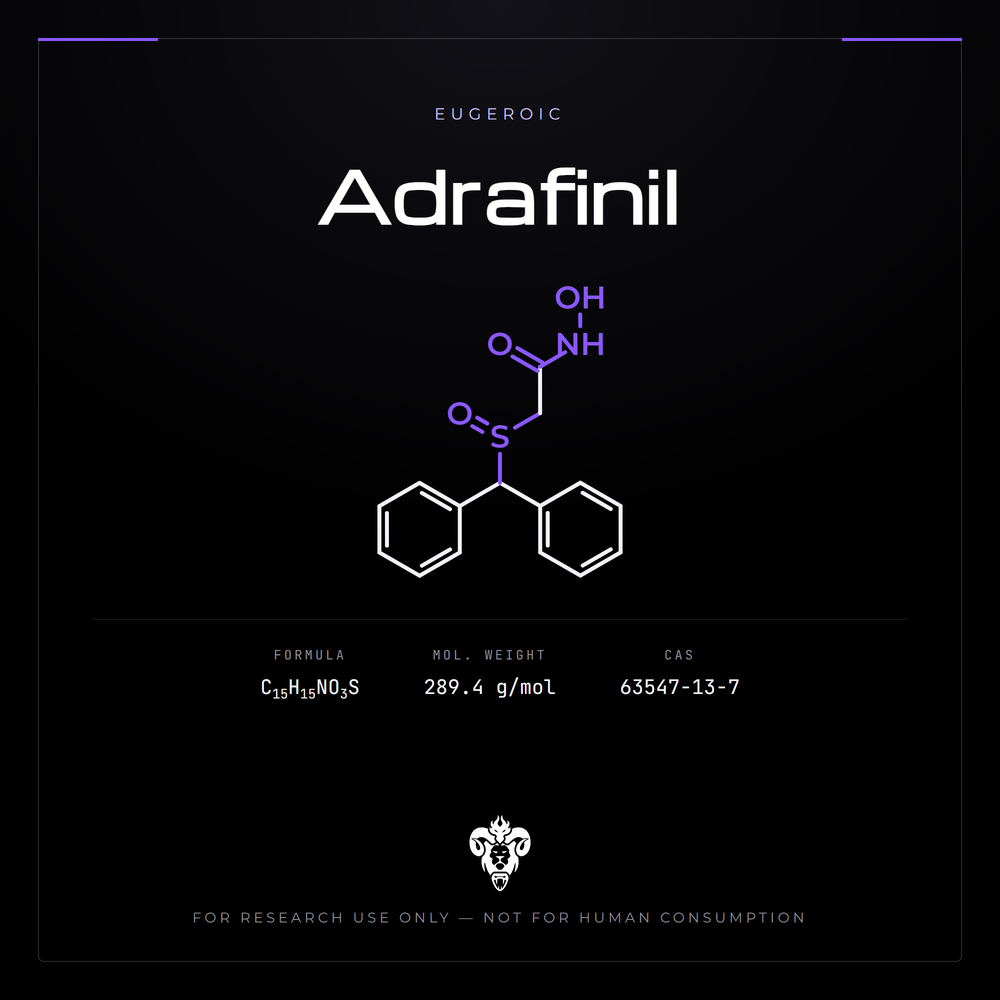

Adrafinil Research Standard
Adrafinil (2-(diphenylmethylsulfinyl)-N-hydroxyacetamide) is a synthetic, wakefulness-promoting agent characterized primarily as a prodrug to modafinil. In research environments, it serves as a specialized investigative tool for studying the pharmacokinetics of prodrug metabolism and the resultant neuropharmacological effects of its active metabolite. Unlike direct-acting stimulants, adrafinil requires hepatic metabolism to be converted into modafinil, which subsequently modulates central nervous system activity. It is widely utilized in neuroscience research to investigate vigilance, attention, and the neurochemical pathways underlying wakefulness.
Physical & Handling Properties
| Property | Specification |
|---|---|
| Physical Appearance | White to off-white crystalline powder |
| Solution Base | PEG400, DMSO |
Mechanism of Action & Research Context
Adrafinil’s research utility is defined by its role as a precursor to the active moiety, modafinil.
-
Prodrug Metabolism: Following administration, adrafinil undergoes extensive hepatic metabolism, where it is converted into modafinil, the primary active pharmacological agent. This conversion process is the subject of pharmacokinetic and pharmacodynamic research, as it alters the onset and duration of the resultant physiological effects.
-
Pharmacological Activity (via Modafinil): Once converted, the active metabolite interacts with multiple neurotransmitter systems. Research indicates it acts as an atypical dopamine reuptake inhibitor (DRI) at the dopamine transporter (DAT). It also influences the release and transmission of histamine, orexin, glutamate, and GABA, contributing to its wakefulness-promoting profile.
-
Receptor Modulation: While historical literature sometimes categorized it as an alpha-1 adrenergic agonist, contemporary research suggests this effect is weak or negligible, pointing toward a more complex modulation of the arousal system rather than direct receptor agonism.
Research Applications
Adrafinil is a specialized reagent essential for comparative pharmacological and pharmacokinetic research.
Primary fields of in vitro and laboratory investigation include:
-
Pharmacokinetic Profiling: Analyzing the metabolic clearance and conversion rates of prodrugs into active metabolites in in vivo or microsomal models.
-
Vigilance & Wakefulness Models: Investigating the neural mechanisms of alertness and focus in laboratory models of fatigue or sleep-wake cycle disruption.
-
Comparative Pharmacodynamics: Benchmarking the efficacy and behavioral effects of adrafinil against direct-acting modafinil to determine the impact of the metabolic conversion process on physiological outcomes.
-
Cognitive Research: Studying the compound’s impact on executive function, memory, and psychomotor speed in preclinical models.
Storage & Handling Guidelines
Store at controlled room temperature. Keep tightly closed. Liquid formats: do not refrigerate or freeze. Cold storage may cause the solution to cloud or precipitate. If this occurs, return to room temperature and mix until clear.
Storage guidance is a house recommendation. Analytical documentation is per-lot release testing.
Related Research Compounds
Research Use Disclaimer
Research Use Only Disclaimer: This product is labeled and sold “For Research Use Only — NOT FOR HUMAN CONSUMPTION.” It is not a drug, dietary supplement, food, cosmetic, or medical device, and it is not approved by the FDA or any other regulator for human or veterinary use. It is supplied to approved account holders as a research chemical for laboratory use and must be handled in accordance with applicable law.