
O-304 (ATX-304) AMPK Activator Research Standard
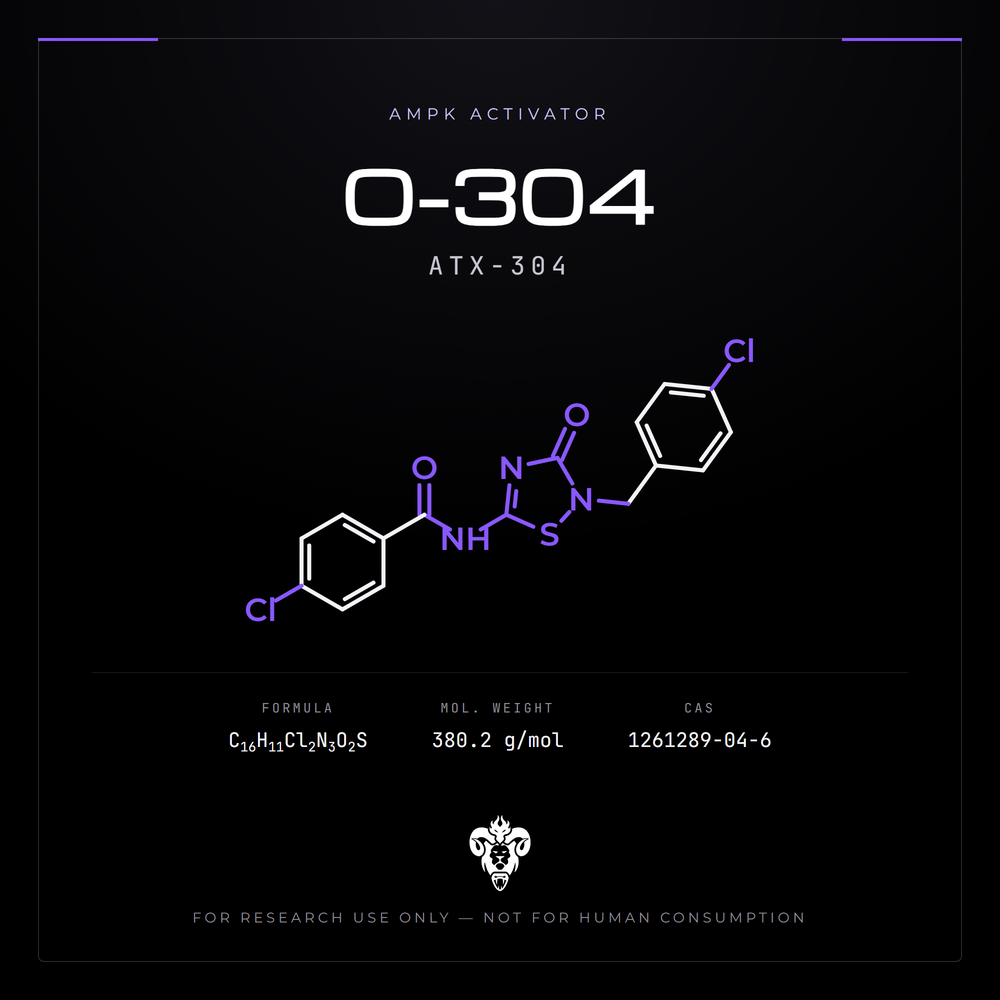
ATX-304 (also called O-304) is a synthetic research compound studied as a pan-AMPK activator. Its reported identity is CAS 1261289-04-6 with a 1,2,4-thiadiazol-3(2H)-one scaffold, not a benzothiazole. Published work describes protection of AMPK phosphorylation from PP2C-mediated dephosphorylation, with activity dependent on existing upstream kinase tone. This page is for laboratory research use only.
Technical Specifications
| Property | Specification |
|---|---|
| Product Name | O-304 (ATX-304) |
| Chemical Formula | C₁₆H₁₁Cl₂N₃O₂S |
| Molecular Weight | 380.2 g/mol |
| Chemical Class | AMPK activator, 1,2,4-thiadiazol-3(2H)-one scaffold |
| Physical Appearance | White powder |
| Assay Purity | Refer to the batch-specific Certificate of Analysis (COA) supplied for the lot received |
Mechanism of Action & Research Context
Published work describes ATX-304 as protecting p-T172 AMPK from PP2C-mediated dephosphorylation rather than acting as an AdAM-site allosteric ligand. The reported effect depends on upstream kinase activity, so the experimental model determines whether activation can be observed.
-
Enzyme Interaction: Published work describes O-304 as protecting AMPK phosphorylation from PP2C-mediated dephosphorylation. In in vitro models, the observed effect depends on existing upstream kinase activity.
-
AMPK Activation: By modulating this pathway, the compound allows researchers to study the downstream phosphorylation of metabolic targets and the regulation of lipid and glucose oxidation in isolated cellular environments.
-
Binding Kinetics: The chlorine-substituted 1,2,4-thiadiazol-3(2H)-one scaffold provides structural context for comparing O-304 with other AMPK activators in assay and mechanism studies.
Research Applications
O-304 is utilized as a specialized benchmark for high-fidelity studies in metabolic signaling and enzyme kinetics.
Primary fields of in vitro laboratory investigation include:
-
Enzyme Binding Assays: Measuring the binding strength between O-304 and AMPK in cell-free enzyme preparations, often utilizing competitive displacement techniques.
-
Kinase Assays: Utilizing fluorescence-based probes to observe how O-304 influences the catalytic efficiency of the AMPK complex.
-
Competitive Displacement Studies: Using labeled probes to compete for the same binding pocket, helping to delineate the specificity of the benzothiazole core.
-
Structural Biology: Investigating the interaction patterns of chlorine-substituted heterocycles within kinase catalytic sites.
Storage & Handling Guidelines
Store at controlled room temperature. Keep tightly closed.
Storage guidance is a house recommendation. Analytical documentation is per-lot release testing.
References
-
Sidarala V, et al. (2020) “AMPK Activation by O-304 Improves Metabolic Health and Enhances Insulin Sensitivity.” Molecular Metabolism. 31: 1–13.
-
Cokorinos EC, et al. (2017) “Activation of AMPK by O-304 in non-human primates.” Cell Chemical Biology. 24(7): 879–889.
-
Kim, J., et al. (2016) “Direct AMPK Activation by Small-Molecule Activators.” Cell Metabolism. 23(1): 11–12.
Related Research Compounds
Research Use Disclaimer
Research Use Only Disclaimer: This product is developed and distributed strictly as a Research Use Only (RUO) laboratory reference chemical intended exclusively for non-clinical analytical and scientific investigation. It is not an FDA-approved drug, medical treatment, dietary supplement, or food ingredient, and is strictly prohibited for human or animal consumption. Kimera Chems supplies this research material solely to qualified institutions and professional investigators for authorized laboratory research.