Skip to content
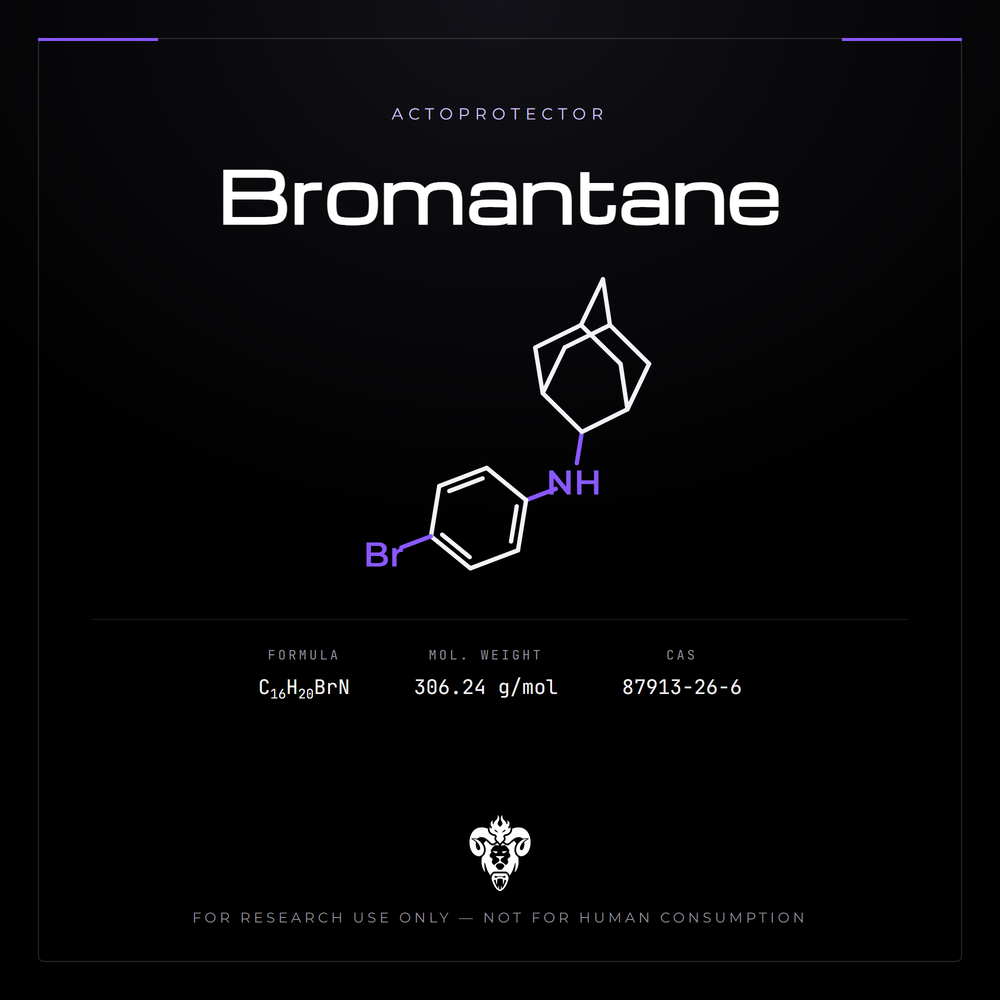

Bromantane
Bromantane (also researched as Ladasten or ADK-709) is a synthetic adamantane derivative. Bromantane is valued in neurochemical research due to its non-receptor-mediated, transcriptional mechanism of action. Rather than forcing the rapid release of existing neurotransmitter pools or blocking reuptake channels, it acts on gene expression pathways to upregulate the cellular machinery responsible for dopamine biosynthesis. This unique profile makes it an essential tool for investigators studying the metabolic and transcriptional regulation of dopaminergic pathways.
Technical Specifications
| Property | Specification |
|---|---|
| Product Name | Bromantane (Ladasten) |
| CAS Number | 87913-26-6 |
| IUPAC Name | N-(4-bromophenyl)adamantan-2-amine |
| Molecular Formula | C₁₆H₂₀BrN |
| Molecular Weight | 306.24 g/mol |
| Chemical Class | Adamantane derivative |
| Assay Purity | Refer to the batch-specific Certificate of Analysis (COA) supplied for the lot received |
| Solution Base | MCT Oil |
Research Applications & Mechanism of Interest
The primary academic interest in Bromantane lies in its novel transcriptional influence on catecholamine biosynthesis. Research published in Neuroscience and Behavioral Physiology demonstrates that the compound’s effects are mediated through the genomic upregulation of critical dopaminergic enzymes rather than direct receptor interaction.
Primary fields of investigative research include:
-
Upregulation of Biosynthetic Enzymes: Evaluating how the compound stimulates the expression of tyrosine hydroxylase (TH) and aromatic L-amino acid decarboxylase (AADC)—the rate-limiting and terminal enzymes, respectively, in the synthesis of dopamine.
-
Transporter Pharmacology Comparison: Serving as a negative control in transporter assays. Because Bromantane lacks functional affinity for the dopamine transporter (DAT), researchers utilize it to isolate transcriptional synthesis changes from synaptic reuptake inhibition.
-
Transcriptional Kinetics: Mapping the prolonged molecular timescale of gene-expression-mediated monoamine regulation (occurring over hours) compared to the millisecond-range synaptic transmission changes triggered by traditional stimulants.
-
Anti-Doping & Forensic Assays: Due to its classification by the World Anti-Doping Agency (WADA) under class S6.A (Non-Specified Stimulants), Bromantane is highly relevant to sports science. Investigators deploy it as a primary reference standard for developing, validating, and calibrating doping-control detection methodologies.
Storage & Handling Guidelines
Store at controlled room temperature. Keep tightly closed. Liquid formats: do not refrigerate or freeze. Cold storage may cause the solution to cloud or precipitate. If this occurs, return to room temperature and mix until clear.
Storage guidance is a house recommendation. Analytical documentation is per-lot release testing.
Related Research Compounds
Further reading: Bromantane research overview
Frequently Asked Research Questions
How does Bromantane’s dopamine-related mechanism differ from classical stimulants?
Traditional stimulants (such as amphetamine or methylphenidate) act directly on transport proteins to inhibit reuptake or force immediate neurotransmitter release. Bromantane operates via genomic pathways, upregulating the actual synthesis capacity of dopamine by increasing the expression of the rate-limiting enzymes tyrosine hydroxylase and AADC.
Is Bromantane soluble in aqueous laboratory assays?
No. Bromantane is poorly soluble in water and soluble in organic solvents such as DMSO.
Scientific References
-
Salimov, R. M., et al. (2001). “The effects of ladasten on the levels of monoamines and their metabolites in the rat brain.” Neuroscience and Behavioral Physiology, 31(6), 613–619. doi:10.1023/A:1012351214352.
-
Grekhova, T. V., et al. (1995). “Effect of bromantane on the dopaminergic system of the rat brain.” Bulletin of Experimental Biology and Medicine, 119(3), 262–264. doi:10.1007/BF02445831.
Research Use Only Disclaimer: This product is labeled and sold “For Research Use Only — NOT FOR HUMAN CONSUMPTION.” It is not a drug, dietary supplement, food, cosmetic, or medical device, and it is not approved by the FDA or any other regulator for human or veterinary use. It is supplied to approved account holders as a research chemical for laboratory use and must be handled in accordance with applicable law.