Skip to content

CJC-1295 No DAC / Ipamorelin Research Blend
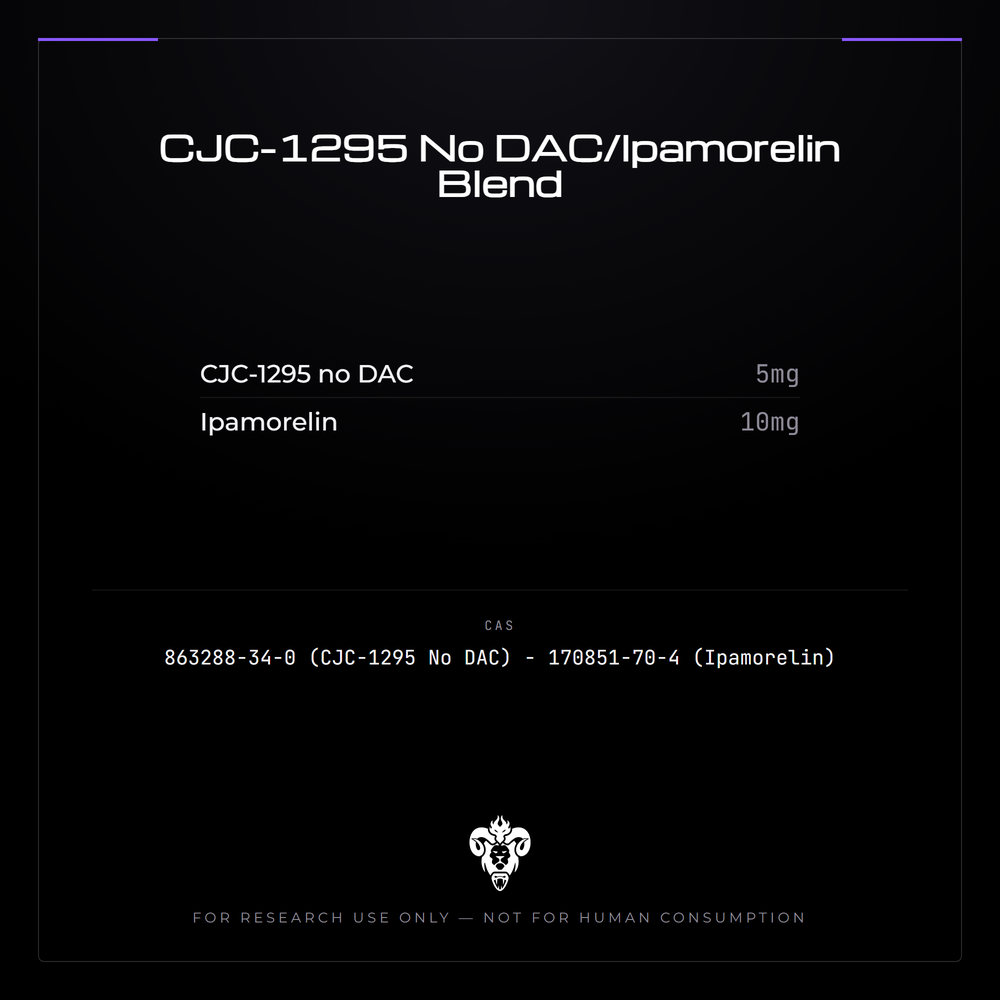
A co-formulated research material supplying 5 mg CJC-1295 No DAC and 10 mg ipamorelin as a lyophilized powder in a 3 mL vial. What makes this blend interesting as a research tool is that its two components act at different receptors — not two ligands competing at one site.
Two receptors, not one
-
CJC-1295 No DAC targets GHRH-R, a class II GPCR on pituitary somatotrophs. It is a substituted GRF(1-29) analogue engineered to resist dipeptidyl peptidase IV, the protease that inactivates unmodified GRF(1-29) by clipping it to GRF(3-29). It lacks the albumin-binding maleimide of the DAC version.[1,2]
-
Ipamorelin targets GHS-R1a, the ghrelin receptor. It is a pentapeptide, Aib-His-D-2-Nal-D-Phe-Lys-NH2, with EC50 1.3 ± 0.4 nmol/L in primary rat pituitary cells, and it is distinguished within its own class by releasing GH without raising ACTH or cortisol even above 200× its ED50.[3]
-
Antagonist profiling separates them. The two arms can be dissected in a single preparation using GHRP and GHRH antagonists, which is how ipamorelin’s response was assigned to the GHRP-like receptor rather than GHRH-R in the first place.[3]
What is not established
No published study tests these two compounds together. The rationale for pairing a GHRH analogue with a ghrelin-receptor agonist is mechanistic — two distinct receptor systems converging on the same secretory cell — but mechanistic plausibility is not evidence. There is no combination pharmacology here, no interaction data, and no demonstration of additive or synergistic behaviour. Any combined effect is the open question, and it is the reason to run single-compound arms alongside the blend rather than the blend alone.
Research Applications
-
Dual-receptor GH secretion assays in cultured anterior pituitary cells, with single-compound controls.[1,3]
-
Antagonist dissection using GHRP and GHRH antagonists to apportion the response.[3]
-
Combination pharmacology — genuinely uncharacterised for this pair.
-
Analytical method development resolving a 29-residue peptide from a pentapeptide in one sample.[2]
Analytical Documentation
Purity and identity vary by manufacturing lot. Kimera Chems does not publish a single fixed purity figure for this item; refer to the batch-specific Certificate of Analysis (COA) issued for the lot received, which reflects third-party analytical testing for that lot.
References
- Jetté L, Léger R, Thibaudeau K, et al. Human growth hormone-releasing factor (hGRF)1-29-albumin bioconjugates activate the GRF receptor on the anterior pituitary in rats: identification of CJC-1295 as a long-lasting GRF analog. Endocrinology. 2005;146(7):3052–3058. doi:10.1210/en.2004-1286
- Bai JP, Chang LL. The involvement of dipeptidyl peptidase IV in brush-border degradation of GRF(1-29)NH2 by intestinal mucosal cells. J Pharm Pharmacol. 1995;47(8):698–701. doi:10.1111/j.2042-7158.1995.tb05863.x
- Raun K, Hansen BS, Johansen NL, et al. Ipamorelin, the first selective growth hormone secretagogue. Eur J Endocrinol. 1998;139(5):552–561. doi:10.1530/eje.0.1390552
Storage & Handling
Store at controlled room temperature, sealed and protected from light.
Storage guidance is a house recommendation. Analytical documentation is per-lot release testing.
Related Research Compounds
Research Use Only Disclaimer: This product is labeled and sold “For Research Use Only – NOT FOR HUMAN CONSUMPTION.” It is not a drug, dietary supplement, food, cosmetic, or medical device, and it is not approved by the FDA or any other regulator for human or veterinary use. It is supplied to approved account holders as a research chemical for laboratory use and must be handled in accordance with applicable law.