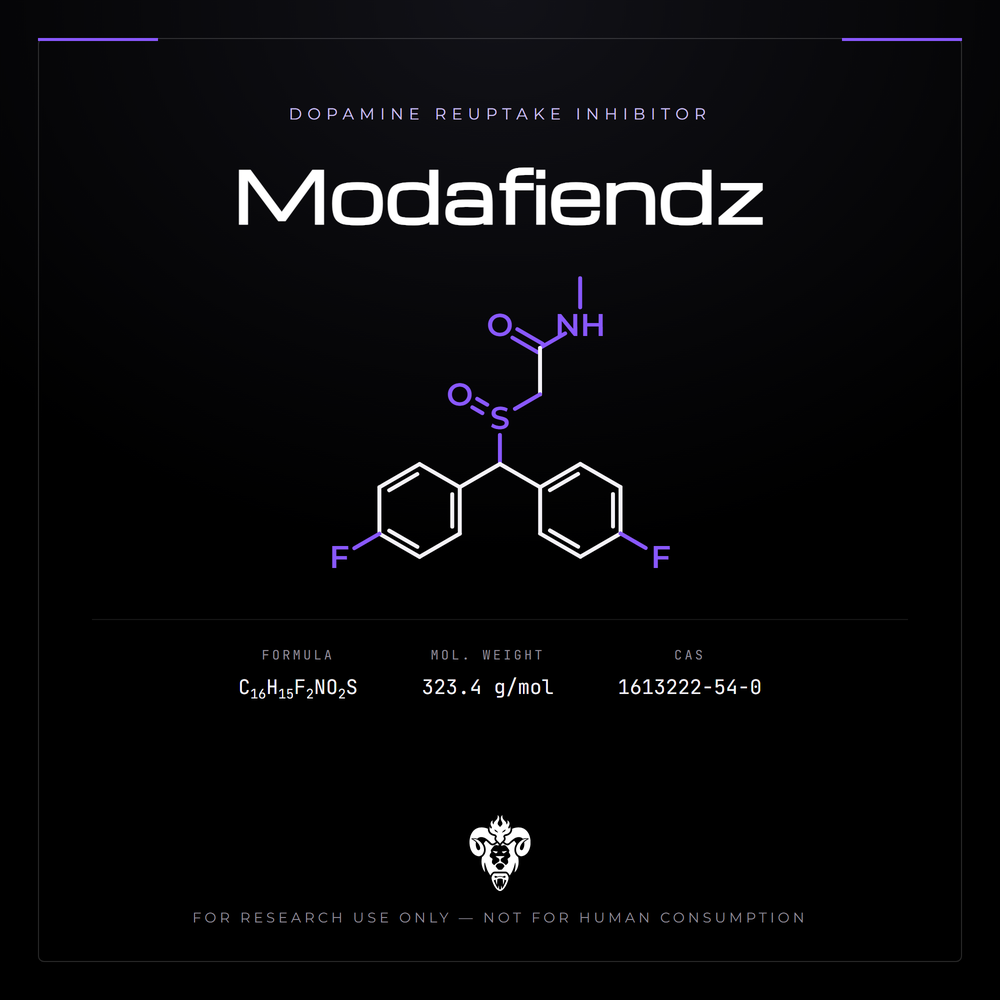

Modafiendz (N-methyl-4,4-difluoro Modafinil) Research Standard
Modafiendz (N-methyl-4,4-difluoro Modafinil) is a synthetic, diphenylmethyl-sulfinyl acetamide derivative used in neuroscience research. As a fluorinated analog of the parent compound modafinil, it is studied for its potent interactions with monoamine transporters. It serves as a specialized tool for investigators examining wakefulness-promoting mechanisms, neurotransmitter dynamics, and the structural determinants of Dopamine Transporter (DAT) inhibition in in vitro models.
Physical & Handling Properties
| Property | Specification |
|---|---|
| Physical Appearance | White to off-white crystalline powder |
| Solution Base | PEG400, DMSO |
Mechanism of Action & Research Context
Modafiendz is primarily researched for its role as a ligand at the Dopamine Transporter (DAT).
-
DAT Inhibition: The primary mechanism investigated in laboratory models is the inhibition of the dopamine transporter (DAT). By binding to the transporter, the compound limits the reuptake of dopamine into the presynaptic neuron, thereby increasing extracellular dopamine concentrations in the synapse.
-
Signaling Modulation: Comparative studies utilize Modafiendz to assess how fluorination at the 4,4′ positions and N-methylation affects binding affinity and selectivity for DAT compared to modafinil.
-
Neurotransmitter Dynamics: Its investigation often focuses on the resulting modulation of orexin and dopamine signaling cascades, which are key to understanding fatigue-related signaling pathways and alertness.
Research Applications
Modafiendz acts as a focused reference compound for neuropharmacological mapping.
Primary fields of in vitro laboratory investigation include:
-
Transporter Binding Assays: Utilizing radioligand binding or fluorescence-based assays to quantify DAT inhibition constants.
-
Comparative SAR Analysis: Evaluating how structural modifications (fluorination/N-methylation) influence the pharmacological potency of diphenylmethyl-sulfinyl acetamides.
-
Neurotransmitter Pathway Mapping: Investigating the downstream effects of DAT inhibition on orexinergic signaling and catecholamine pathways.
-
Fatigue Models: Employing the compound to measure cellular responses to simulated extended stimulation in controlled laboratory environments.
Storage & Handling Guidelines
Store at controlled room temperature. Keep tightly closed. Liquid formats: do not refrigerate or freeze. Cold storage may cause the solution to cloud or precipitate. If this occurs, return to room temperature and mix until clear.
Storage guidance is a house recommendation. Analytical documentation is per-lot release testing.
Related Research Compounds
Research Use Disclaimer
Research Use Only Disclaimer: This product is labeled and sold “For Research Use Only — NOT FOR HUMAN CONSUMPTION.” It is not a drug, dietary supplement, food, cosmetic, or medical device, and it is not approved by the FDA or any other regulator for human or veterinary use. It is supplied to approved account holders as a research chemical for laboratory use and must be handled in accordance with applicable law.