Skip to content

PE-22-28 Research Standard
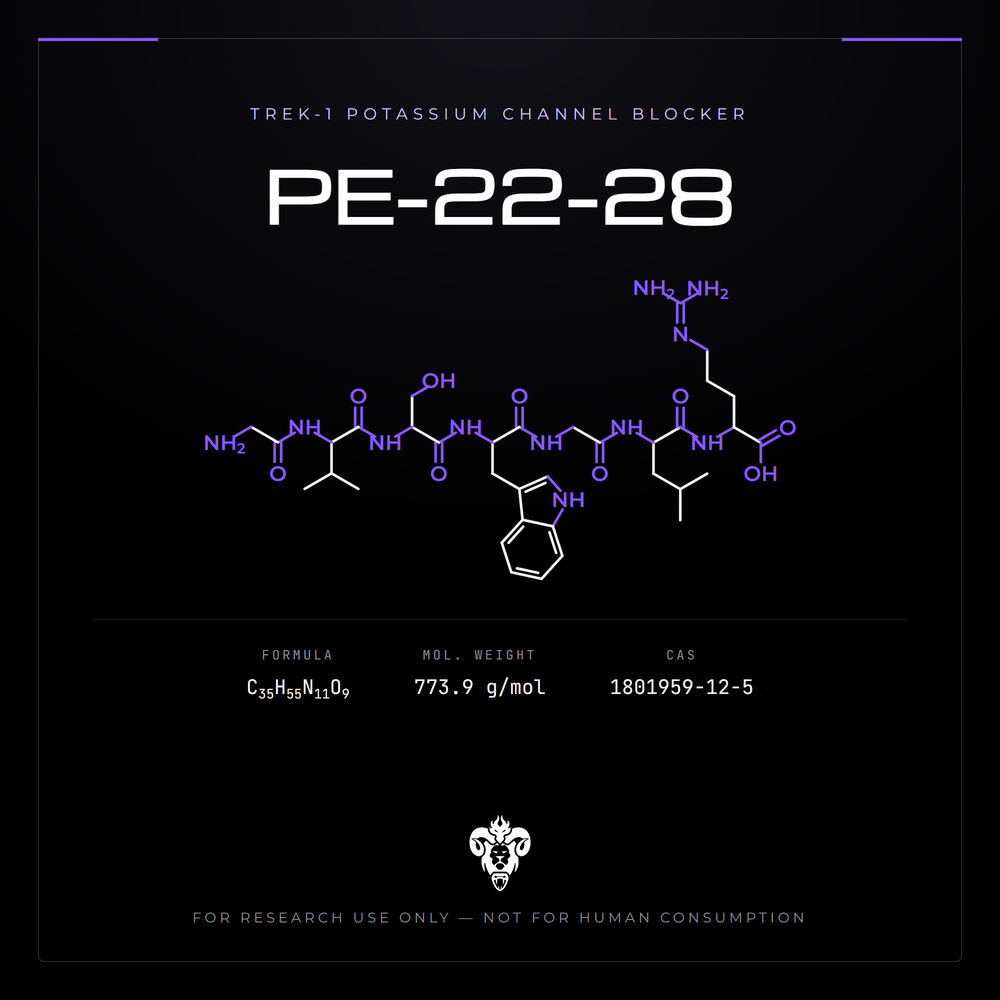
PE-22-28 (CAS 1801959-12-5) is a seven-amino-acid peptide corresponding to residues 22–28 of the sortilin propeptide, supplied as a 10 mg lyophilized powder in a 3 mL vial. Understanding what it is requires following where it comes from, because the well-characterised molecule in this lineage is not this fragment but its longer relative, spadin.
Where this peptide comes from
Sortilin is cleaved to release a propeptide. Sortilin, also called neurotensin receptor-3 (NTSR3), is synthesised as a precursor and converted to the mature protein by the convertase furin in late Golgi compartments. That maturation releases a 44-amino-acid propeptide, referred to as PE — which is where this product’s name originates.[2]
The propeptide and its analogue block TREK-1. Sortilin physically interacts with the two-pore-domain potassium channel TREK-1, and both the propeptide and its synthetic analogue spadin block TREK-1 activation.[2]
What is established is established for spadin. Spadin binds TREK-1 specifically with an affinity around 10 nM and blocks channel activity in COS-7 cells, cultured hippocampal pyramidal neurons and CA3 neurons in brain slices. In vivo it increased 5-HT neuron firing rate in the dorsal raphe nucleus, and a four-day intravenous course enhanced hippocampal CREB phosphorylation and neurogenesis.[1] Those numbers describe spadin. PE-22-28 is a shorter fragment from the same propeptide, and data on one should not be quoted as data on the other.
The target itself is well defined. TREK-1 is a two-pore-domain potassium channel; mice lacking the TREK-1 gene show a depression-resistant phenotype resembling antidepressant treatment, which is what made channel antagonists interesting in the first place.[1]
Research Applications
Primary fields of in vitro and preclinical laboratory investigation include:
TREK-1 electrophysiology by patch clamp in transfected cells, cultured neurons and brain slices.[1]
Comparative potency work against spadin and the full 44-residue propeptide — the obvious gap, since the fragment’s own affinity is not established here.[1,2]
Sortilin/TREK-1 interaction studies, including co-immunoprecipitation and colocalisation.[2]
Serotonergic firing rate measurement in the dorsal raphe.[1]
Analytical Documentation
Purity and identity vary by manufacturing lot. Kimera Chems does not publish a single fixed purity figure for this item; refer to the batch-specific Certificate of Analysis (COA) issued for the lot received, which reflects third-party analytical testing for that lot.
References
- Mazella J, Pétrault O, Lucas G, et al. Spadin, a sortilin-derived peptide, targeting rodent TREK-1 channels: a new concept in the antidepressant drug design. PLoS Biol. 2010;8(4):e1000355. doi:10.1371/journal.pbio.1000355
- Mazella J, Borsotto M, Heurteaux C. The involvement of sortilin/NTSR3 in depression as the progenitor of spadin and its role in the membrane expression of TREK-1. Front Pharmacol. 2019;9:1541. doi:10.3389/fphar.2018.01541
Storage & Handling
Store at controlled room temperature, sealed and protected from light.
Storage guidance is a house recommendation. Analytical documentation is per-lot release testing.