Skip to content
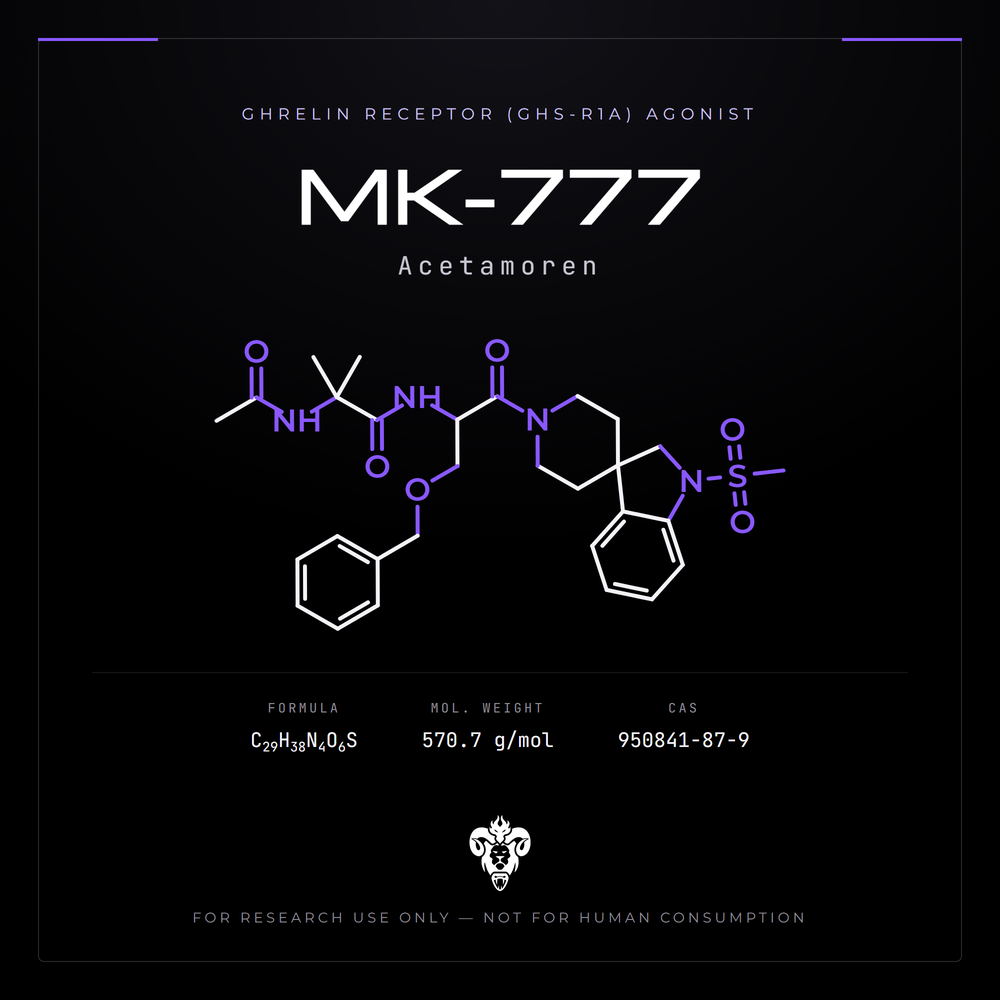

MK-777 (Acetamoren) Research Material
MK-777, also called Acetamoren (CAS 950841-87-9), is supplied as a research material related to ibutamoren (MK-677), a non-peptide growth hormone secretagogue acting at GHS-R1a. Its molecular formula C29H38N4O6S is ibutamoren’s C27H36N4O5S plus C2H2O, consistent with the addition of an acetyl group and with the “Acetamoren” name.
What is and is not known about this material
There is no published pharmacology for this derivative. A PubMed search for MK-777 returns no records: no binding affinity, no functional data, no pharmacokinetics, no hydrolysis or deacetylation kinetics, no metabolite identification. Everything below the parent-compound heading describes ibutamoren, not the material on this page.
An acetylated analogue would be expected to deacetylate back toward the parent, but rate, extent and whether the intact molecule has activity of its own are all unmeasured here. Treat the intact derivative and the parent as separate analytes in any method, and establish those parameters rather than assuming them.
The parent compound: ibutamoren (MK-677)
Ibutamoren is a non-peptide agonist at the growth hormone secretagogue receptor GHS-R1a, whose endogenous ligand is ghrelin.
-
A defined binding site. MK-0677 binds membranes from GHS-R-expressing cells with Bmax 2.0 ± 0.3 × 10⁻¹⁰ mol/mg protein, with no detectable binding to non-transfected membranes.[1]
-
Its pocket is not the only one. Adenosine acts as a partial agonist at the same receptor but binds a site distinct from the characterised MK-0677 and GHRP-6 pocket, shown by ligand binding and site-directed mutagenesis, with cross-desensitisation between the two.[2] So GHS-R1a has more than one route to activation, which matters when interpreting a competition assay.
-
High constitutive receptor activity. GHS-R1a signals substantially without ligand, and that basal activity has genetic support for physiological relevance.[3]
Research Applications
Given the absence of characterisation data, the honest applications are the ones that would generate it:
-
Deacetylation and stability studies establishing whether and how fast the derivative converts to ibutamoren.
-
Comparative receptor binding of derivative against parent at GHS-R1a.[1,2]
-
Analytical method development resolving intact derivative from parent.
Analytical Documentation
Purity and identity vary by manufacturing lot. Kimera Chems does not publish a single fixed purity figure for this item; refer to the batch-specific Certificate of Analysis (COA) issued for the lot received, which reflects third-party analytical testing for that lot.
References
These references describe the parent compound. None of them studied the material on this page.
- Tullin S, Hansen BS, Ankersen M, Møller J, Von Cappelen KA, Thim L. Adenosine is an agonist of the growth hormone secretagogue receptor. Endocrinology. 2000;141(9):3397–3402. doi:10.1210/endo.141.9.7631
- Smith RG, Griffin PR, Xu Y, et al. Adenosine: a partial agonist of the growth hormone secretagogue receptor. Biochem Biophys Res Commun. 2000;276(3):1306–1313. doi:10.1006/bbrc.2000.3610
- Mear Y, Enjalbert A, Thirion S. GHS-R1a constitutive activity and its physiological relevance. Front Neurosci. 2013;7:87. doi:10.3389/fnins.2013.00087
Storage & Handling
Store at controlled room temperature. Keep tightly closed. Liquid formats: do not refrigerate or freeze. Cold storage may cause the solution to cloud or precipitate. If this occurs, return to room temperature and mix until clear.
Storage guidance is a house recommendation. Analytical documentation is per-lot release testing.
Related Research Compounds
Research Use Only Disclaimer: This product is labeled and sold “For Research Use Only – NOT FOR HUMAN CONSUMPTION.” It is not a drug, dietary supplement, food, cosmetic, or medical device, and it is not approved by the FDA or any other regulator for human or veterinary use. It is supplied to approved account holders as a research chemical for laboratory use and must be handled in accordance with applicable law.