Skip to content

TH9507 (Tesamorelin) Research Standard
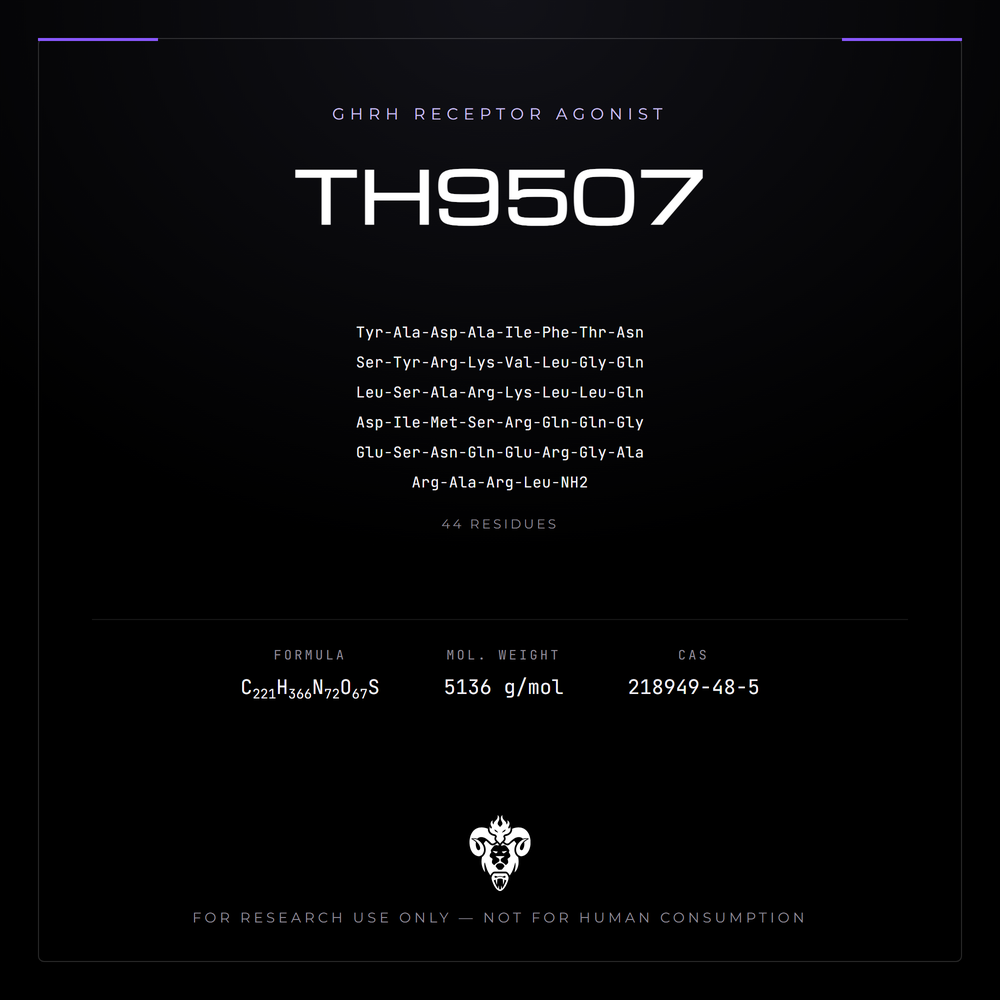
TH9507, also indexed as tesamorelin (CAS 218949-48-5), is a 44-amino-acid peptide analogue of natural human growth hormone releasing factor. Unlike the GRF(1-29) analogues it retains the full-length 44-residue sequence rather than the shortened active fragment, which makes it the natural comparator when a study needs to ask whether the truncation matters.[1]
Mechanism of Action & Research Context
The molecular target is the growth hormone-releasing hormone receptor (GHRH-R), a class II GPCR on pituitary somatotrophs — a different receptor from the GHS-R1a targeted by the ghrelin-mimetic secretagogues.
-
The receptor. GHRH-R is a class II G-protein-coupled receptor required for normal growth hormone synthesis and release, and for normal growth and proliferation of pituitary somatotrophs. Mutations in mouse and human are associated with GH deficiency, short stature and pituitary hypoplasia. Alternative mRNA splicing produces variants proposed to act as dominant-negative inhibitors of the wild-type receptor.[3]
-
Full-length rather than truncated. Sermorelin and the CJC analogues are built on GRF(1-29). TH9507 keeps all 44 residues, so a panel containing both lets the contribution of residues 30–44 be tested directly rather than assumed irrelevant.
-
DPP-IV is the limiting factor. GRF(1-29)NH2 is degraded mainly by dipeptidyl peptidase IV, which clips the N-terminal dipeptide to leave inactive GRF(3-29)NH2. Analogues designed to resist plasma DPP-IV are markedly more stable, and that resistance carries across compartments — a DPP-IV-resistant analogue was far more stable than the parent in intestinal enterocytes as well as plasma.[2]
-
Characterised canine pharmacokinetics. In beagle dogs, terminal half-life was 39 minutes after intratracheal dry-powder insufflation and 26 minutes after subcutaneous injection, with no significant difference between routes. Mean residence time was longer intratracheally (74 against 52 minutes). Bioavailability by the inhaled route was 41% relative to subcutaneous, with absolute bioavailability estimated at 13%.[1]
-
A route-comparison dataset. Few peptides in this catalogue have published side-by-side intravenous, subcutaneous and pulmonary data in the same species. That makes TH9507 useful for delivery and formulation work well beyond its own pharmacology.[1]
Research Applications
Primary fields of in vitro and preclinical laboratory investigation include:
-
Delivery-route and formulation studies, including dry-powder insufflation against subcutaneous and intravenous dosing.[1]
-
Pharmacokinetic modelling using published half-life, MRT and bioavailability values.[1]
-
Structure-activity comparison of full-length GRF against GRF(1-29) analogues.
-
Receptor pharmacology at GHRH-R.[3]
Analytical Documentation
Purity and identity vary by manufacturing lot. Kimera Chems does not publish a single fixed purity figure for this item; refer to the batch-specific Certificate of Analysis (COA) issued for the lot received, which reflects third-party analytical testing for that lot.
References
- Jansen M, Darby I, Abribat T, Dubreuil P, Ferdinandi ES, Hardy JG. Pulmonary delivery of TH9507, a growth hormone releasing factor analogue, in the dog. Int J Pharm. 2004;276(1–2):75–81. doi:10.1016/j.ijpharm.2004.02.012
- Bai JP, Chang LL. The involvement of dipeptidyl peptidase IV in brush-border degradation of GRF(1-29)NH2 by intestinal mucosal cells. J Pharm Pharmacol. 1995;47(8):698–701. doi:10.1111/j.2042-7158.1995.tb05863.x
- Gaylinn BD. Growth hormone releasing hormone receptor. Recept Channels. 2002;8(3–4):155–162. PMID: 12529933.
Storage & Handling
Store at controlled room temperature, sealed and protected from light.
Storage guidance is a house recommendation. Analytical documentation is per-lot release testing.
Related Research Compounds
Research Use Only Disclaimer: This product is labeled and sold “For Research Use Only – NOT FOR HUMAN CONSUMPTION.” It is not a drug, dietary supplement, food, cosmetic, or medical device, and it is not approved by the FDA or any other regulator for human or veterinary use. It is supplied to approved account holders as a research chemical for laboratory use and must be handled in accordance with applicable law.