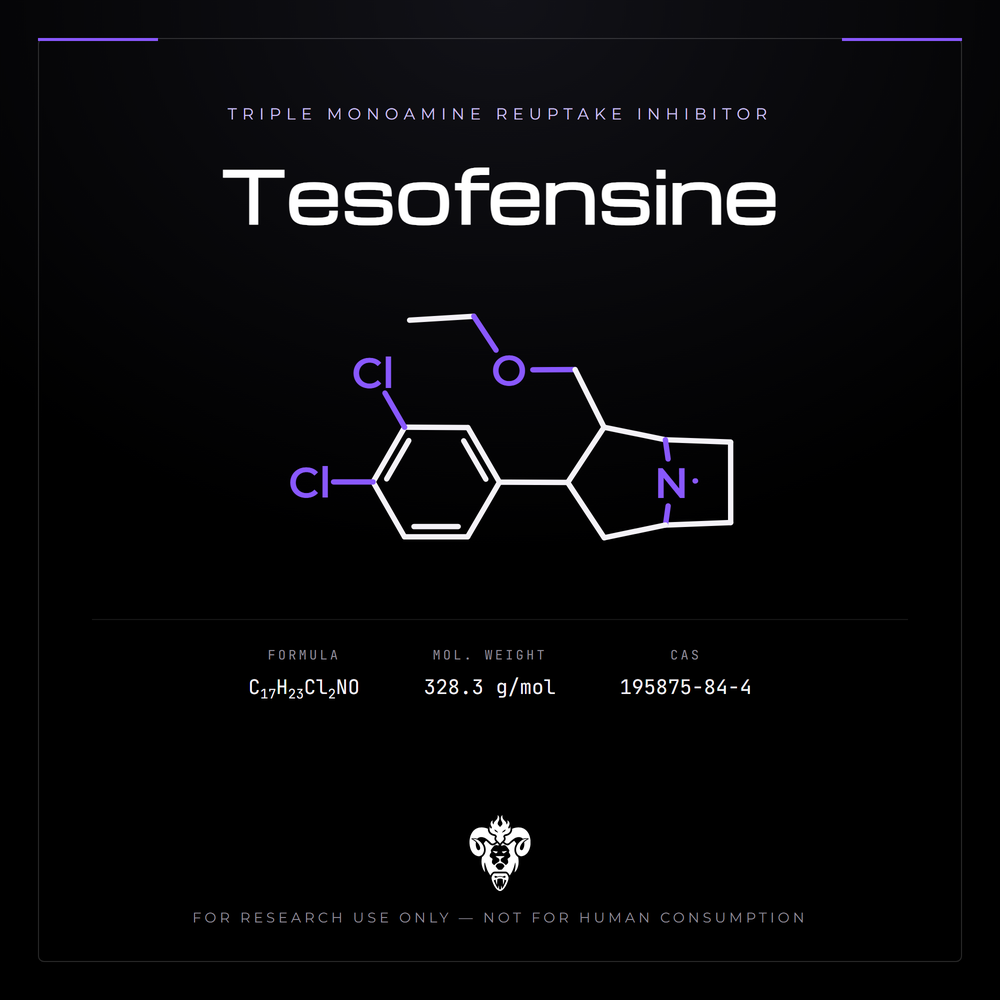

Tesofensine (NS2330) Research Standard
Tesofensine (NS2330) is a synthetic small-molecule central nervous system (CNS) modulator characterized as a potent triple monoamine reuptake inhibitor (TRI). By inhibiting the reuptake of dopamine (DAT), norepinephrine (NET), and serotonin (SERT), Tesofensine provides a balanced neurochemical profile that is distinct from more selective, single-transporter inhibitors. In laboratory and analytical research, it serves as a sophisticated chemical probe for investigating CNS signaling, the modulation of reward and motivation pathways, and the complex regulation of monoaminergic tone.
Additional Properties
| Property | Specification |
|---|---|
| PubChem CID | 9869025 |
| Physical Appearance | White to off-white solid |
| Solubility | Soluble in organic solvents; limited aqueous solubility |
| Solution Base | PEG400, DMSO |
Mechanism of Action & Research Context
Tesofensine is utilized in experimental models as a balanced modulator of the three primary monoamine neurotransmitter systems.
-
Triple Reuptake Inhibition: By concurrently inhibiting DAT, NET, and SERT, Tesofensine increases the synaptic concentration of dopamine, norepinephrine, and serotonin. This multi-target approach is distinct from selective reuptake inhibitors, allowing for the study of global monoaminergic tone.
-
CNS Pathway Modulation: Research focuses on how this balanced modulation impacts central reward, motivation, and arousal pathways. It serves as a tool for observing how alterations in monoamine concentration affect complex neural networks.
-
Balanced Pharmacology: Unlike single-transporter inhibitors, which may lead to compensatory receptor changes or unbalanced signaling, Tesofensine is studied for its ability to maintain a balanced modulation across these critical monoaminergic systems.
Research Applications
Tesofensine is a specialized reagent essential for modern neuropharmacological investigation.
Primary fields of in vitro and in vivo laboratory investigation include:
-
Monoaminergic Signaling Studies: Assessing the impact of multi-target inhibition on synaptic neurotransmitter levels in diverse neural tissue models.
-
Appetite & Energy Regulation: Modeling the central neural circuits that govern appetite, motivation, and energy expenditure in experimental frameworks.
-
CNS Network Modulation: Probing the interaction between monoamine systems and neural network activity.
-
Structure–Activity Relationship (SAR) Studies: Utilizing the compound’s bicyclic chlorinated structure to map the essential molecular features of multi-target reuptake inhibitors.
Storage & Handling Guidelines
Store at controlled room temperature. Keep tightly closed. Liquid formats: do not refrigerate or freeze. Cold storage may cause the solution to cloud or precipitate. If this occurs, return to room temperature and mix until clear.
Storage guidance is a house recommendation. Analytical documentation is per-lot release testing.
Analytical Documentation
Purity, identity, and composition vary by manufacturing lot. Kimera Chems does not publish a single fixed purity figure for this item; refer to the batch-specific Certificate of Analysis (COA) issued for the lot received, which reflects third-party analytical testing for that lot. Contact us if a COA for your lot is required.
Related Research Compounds
Research Use Disclaimer
Research Use Only Disclaimer: This product is labeled and sold “For Research Use Only — NOT FOR HUMAN CONSUMPTION.” It is not a drug, dietary supplement, food, cosmetic, or medical device, and it is not approved by the FDA or any other regulator for human or veterinary use. It is supplied to approved account holders as a research chemical for laboratory use and must be handled in accordance with applicable law.