
Emoxypine Succinate
Emoxypine succinate is a synthetic organic compound structurally derived from the combination of a 3-hydroxypyridine core and succinic acid. As a structural analogue to pyridoxine (Vitamin B6), the compound is widely recognized in the pharmacological literature under common investigational titles including Mexidol, Mexiprim, Mexicor, and Emicidine. Originally synthesized in the early 1980s at the Research Institute of Pharmacology of the Russian Academy of Medical Sciences, emoxypine succinate serves as a vital multi-mechanistic tool compound for investigating cellular antioxidant kinetics, membranotropic stabilization, and mitochondrial rescue pathways within preclinical and in vitro research environments.
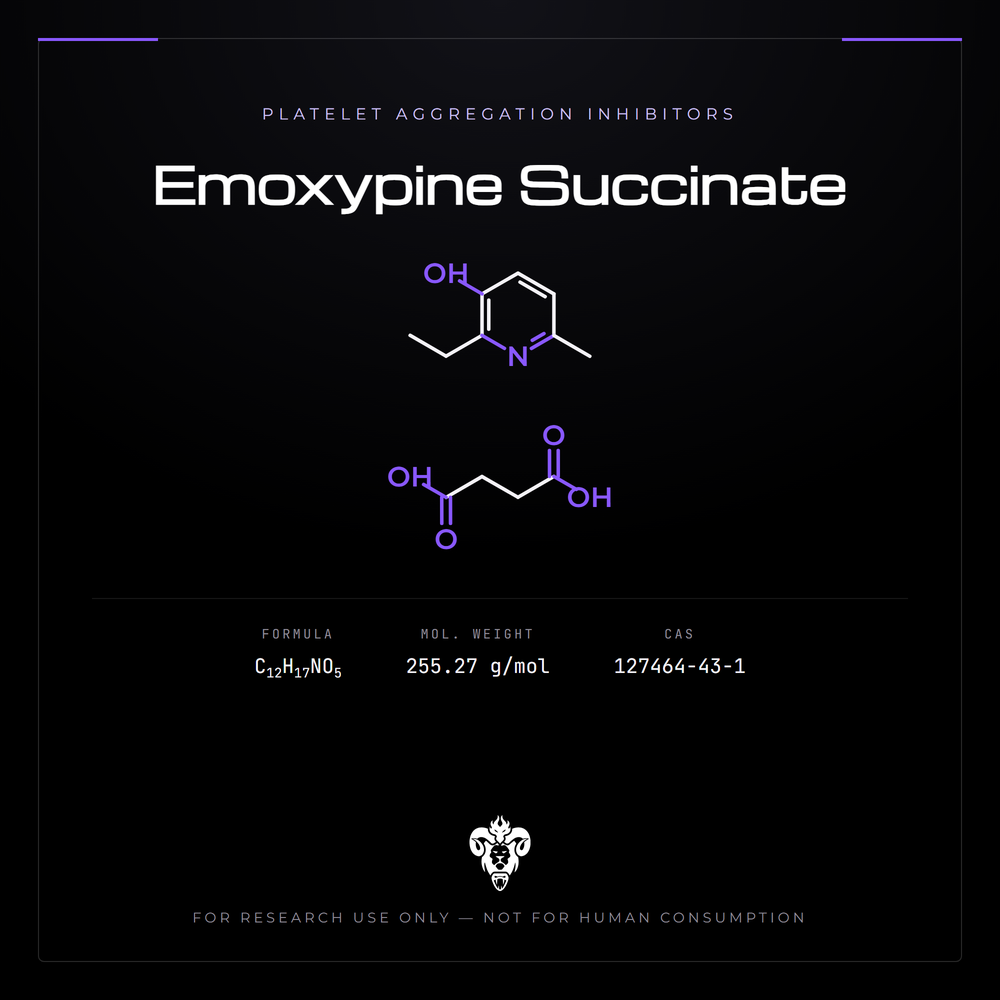
Structural Elements to Observe: The analytical diagram above highlights the unique dual-component architecture of emoxypine succinate. The structural configuration pairs a 2-ethyl-6-methyl-3-hydroxypyridine moiety with a butanedioic (succinic) acid counter-ion. In aqueous or polar solution assays, this chemical pairing dissociates to simultaneously engage separate biological targets—where the pyridine ring partitions directly into lipid bilayers to deliver protective membranotropic traits, while the free succinate molecule enters mitochondrial matrices to interact with metabolic enzyme machinery.
Technical Specifications
| Property | Specification |
|---|---|
| Product Name | Emoxypine Succinate |
| CAS Number | 127464-43-1 |
| IUPAC Name | butanedioic acid; 2-ethyl-6-methylpyridin-3-ol |
| Synonyms | Mexidol, Mexiprim, Mexicor, Emicidine |
| Molecular Formula | C₁₂H₁₇NO₅ |
| Molecular Weight | 255.27 g/mol |
| Chemical Class | 3-Hydroxypyridine Derivative / Dicarboxylic Acid Salt |
| Physical Appearance | White to off-white crystalline powder |
| Solubility Profile | Freely soluble in water and anhydrous ethanol |
Research Applications & Mechanism of Interest
The broad baseline of peer-reviewed data surrounding emoxypine succinate centers on its distinctive dual-action metabolism, which simultaneously limits oxidative degradation and augments internal energy production pathways.
Primary fields of preclinical and in vitro laboratory investigation include:
-
Antioxidant & Free Radical Suppression: The hydroxypyridine moiety acts as a direct inhibitor of free radical lipid oxidation. Researchers evaluate the compound to track its capacity to suppress oxidative protein modifications in ischemic tissue zones and downregulate reactive oxygen species (ROS) production.
-
Mitochondrial Energy Transduction: Under hypoxic or ischemic energy crises, the succinate component serves as an alternative metabolic substrate. This pathway enhances electron flow along the FAD-dependent succinate oxidase link of the Krebs cycle, counteracting the functional decline of Mitochondrial Enzyme Complex I (MEC I) and preserving cellular ATP synthesis.
-
Iron Chelation Pathways: In vitro assays document that both phosphorylated and unphosphorylated emoxypine derivatives possess iron-chelating capabilities. Investigators leverage this property to build screening models for neuroinflammatory and hematological conditions aggravated by excess free iron accumulation.
-
Neuroprotection & Blood-Brain Barrier (BBB) Penetration: Due to its low molecular weight and optimized lipophilic-hydrophilic balance, preclinical distribution studies show rapid penetration across the blood-brain barrier. Cerebral tissue analyses track its specific down-regulatory action on microglial pathways (such as CDK5/GSK3-beta and NLRP3 inflammasomes) in models of iron overload-induced neuroinflammation and conditioned reflex recovery.
-
Vascular Microcirculation Modeling: Evaluating the structural modifications of endothelial membranes to chart improvements in cerebral microcirculation, platelet aggregation boundaries, and localized vascular resistance under induced stress conditions.
Storage & Handling Guidelines
Store at controlled room temperature. Keep tightly closed.
Storage guidance is a house recommendation. Analytical documentation is per-lot release testing.
Related Research Compounds
Research Use Only Disclaimer: This product is developed, manufactured, and distributed strictly as a Research Use Only (RUO) laboratory reference material. It is not an FDA-approved drug formulation, licensed medication, active pharmaceutical ingredient, or dietary supplement, and is strictly prohibited for human or veterinary consumption. No clinical dosing schedules, safety parameters, or therapeutic evaluations are provided or implied.