
Mildronate (Meldonium Dihydrate)
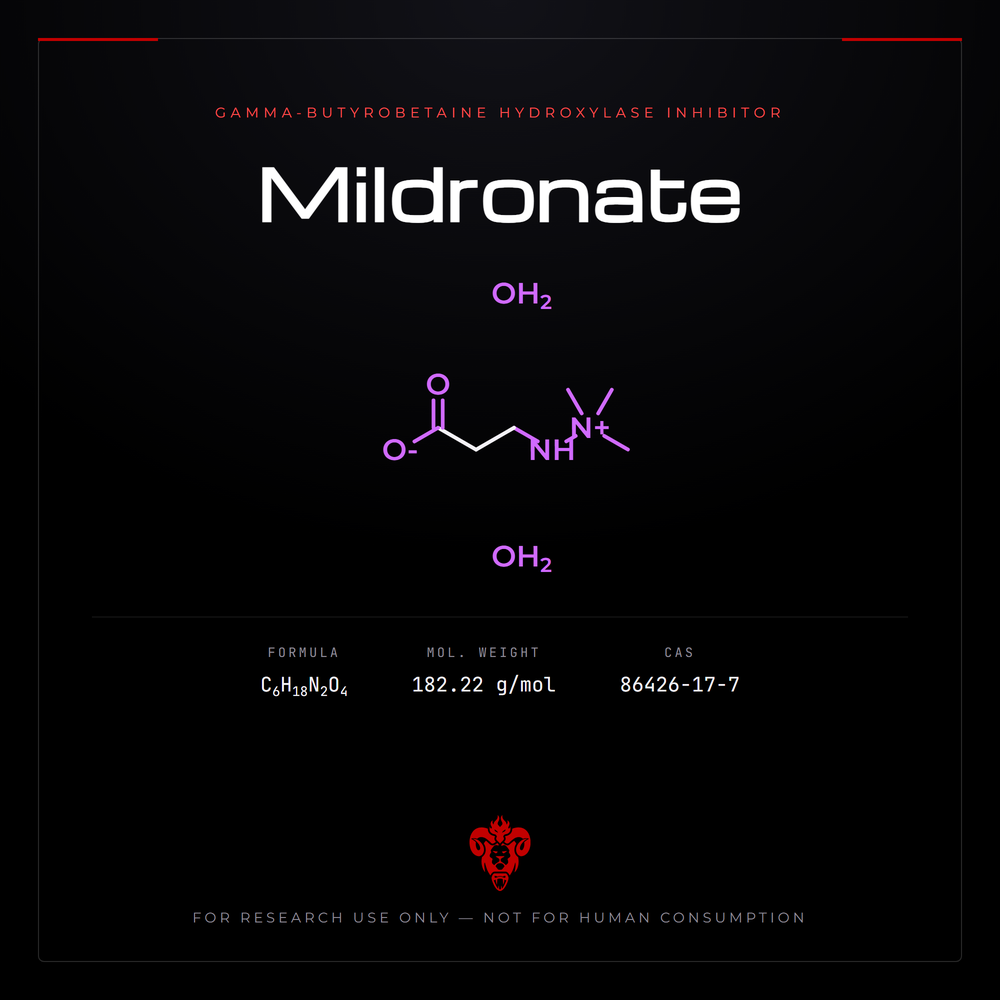
Mildronate is the dihydrate of meldonium, 3-(2,2,2-trimethylhydrazinium)propionate, a small zwitterionic molecule developed at the Latvian Institute of Organic Synthesis and also designated MET-88 in the pharmacology literature. Structurally it is a close analogue of gamma-butyrobetaine, the immediate biosynthetic precursor of L-carnitine, and that resemblance is the whole basis of its use as a research tool: it is one of the few well-characterised chemical means of lowering tissue carnitine without a genetic model.
It is consequently a standard probe in substrate-utilisation research, where the experimental question is what happens to a tissue when long-chain fatty acid transport into mitochondria is constrained. It is also a routine reference standard in doping-control analytical chemistry, having been added to the World Anti-Doping Agency Prohibited List in 2016.
Technical Specifications
| Property | Specification |
|---|---|
| Product Name | Mildronate (Meldonium Dihydrate) |
| Synonyms | Meldonium, MET-88, THP, quaterine |
| CAS Number | 86426-17-7 (dihydrate); 76144-81-5 (anhydrous) |
| IUPAC Name | 3-[(trimethylazaniumyl)amino]propanoate dihydrate |
| Molecular Formula | C₆H₁₈N₂O₄ (dihydrate) |
| Molecular Weight | 182.22 g/mol (dihydrate); 146.19 g/mol (anhydrous) |
| Chemical Class | Quaternary ammonium compound; gamma-butyrobetaine analogue |
| Molecular Target | Gamma-butyrobetaine dioxygenase (BBOX1); OCTN2 (SLC22A5) |
| Physical Appearance | White to off-white crystalline powder |
| Solubility Profile | Freely soluble in water; hygroscopic |
Research Applications & Mechanism of Action
Carnitine is synthesised in the final step by gamma-butyrobetaine dioxygenase, which hydroxylates gamma-butyrobetaine. Mildronate inhibits that enzyme. The result is a pair of changes that move in opposite directions and that are often measured together: free carnitine falls, and gamma-butyrobetaine, the accumulating substrate, rises. Because carnitine is required to shuttle long-chain fatty acids across the inner mitochondrial membrane, constraining its supply constrains that route.
A second, separable mechanism operates at the transporter level. Mildronate, carnitine, and gamma-butyrobetaine all compete for OCTN2, and that competition governs how the compound distributes into and clears out of tissue. Experiments that treat the compound purely as an enzyme inhibitor and ignore the transport arm tend to misattribute their washout kinetics.
Primary fields of in vitro and preclinical laboratory investigation include:
-
Carnitine Pathway Manipulation: Lowering tissue carnitine pharmacologically as an alternative to dietary or genetic models, then tracking the acylcarnitine profile that results.
-
Substrate-Switch Models: Examining how a tissue behaves when long-chain fatty acid oxidation is constrained, including accumulation of long-chain acylcarnitine intermediates.
-
Gamma-Butyrobetaine Biology: Using the compound as the standard way to raise gamma-butyrobetaine, a metabolite with signalling activity of its own that is otherwise hard to elevate selectively.
-
Transporter Pharmacology: Characterising OCTN2 handling and substrate competition in transport assays.
-
Doping-Control Method Development: Serving as a characterised reference standard for LC-MS/MS assay development, calibration, and retrospective screening work.
Selected Research Literature
Peer-reviewed preclinical literature indexed on PubMed, provided for scientific context only. These are animal and in-vitro studies; nothing here describes or implies a use for this material.
- Liepinsh E, Vilskersts R, Loca D, et al. Mildronate, an inhibitor of carnitine biosynthesis, induces an increase in gamma-butyrobetaine contents and cardioprotection in isolated rat heart infarction. J Cardiovasc Pharmacol. 2006;48(6):314-319. doi:10.1097/01.fjc.0000250077.07702.23
- Hayashi Y, Muranaka Y, Kirimoto T, Asaka N, Miyake H, Matsuura N. Effects of MET-88, a gamma-butyrobetaine hydroxylase inhibitor, on tissue carnitine and lipid levels in rats. Biol Pharm Bull. 2000;23(6):770-773. doi:10.1248/bpb.23.770
- Liepinsh E, Makarova E, Sevostjanovs E, et al. Carnitine and gamma-butyrobetaine stimulate elimination of meldonium due to competition for OCTN2-mediated transport. Basic Clin Pharmacol Toxicol. 2017;120(5):450-456. doi:10.1111/bcpt.12729
Assay note. Hayashi et al. report that tissue carnitine depletion in rats reaches a plateau rather than continuing to fall, and that heart and liver diverge in their lipid response. Sampling before that plateau, or reading one tissue as a proxy for the other, will misstate the effect.
Analytical Documentation
Purity, identity, and composition vary by manufacturing lot. Kimera Chems does not publish a single fixed purity figure for this item; refer to the batch-specific Certificate of Analysis (COA) issued for the lot received, which reflects third-party analytical testing for that lot. Contact us if a COA for your lot is required.
Storage & Handling
Store at controlled room temperature. Keep tightly closed.
Storage guidance is a house recommendation. Analytical documentation is per-lot release testing.
Related Research Compounds
Further reading: Mildronate research overview
Research Use Disclaimer
Research Use Only Disclaimer: This product is developed and distributed strictly as a Research Use Only (RUO) laboratory reference chemical intended exclusively for non-clinical analytical and scientific investigation. It is not an FDA-approved drug, medical treatment, dietary supplement, or food ingredient, and is strictly prohibited for human or animal consumption. Kimera Chems supplies this research material solely to qualified institutions and professional investigators for authorized laboratory research.