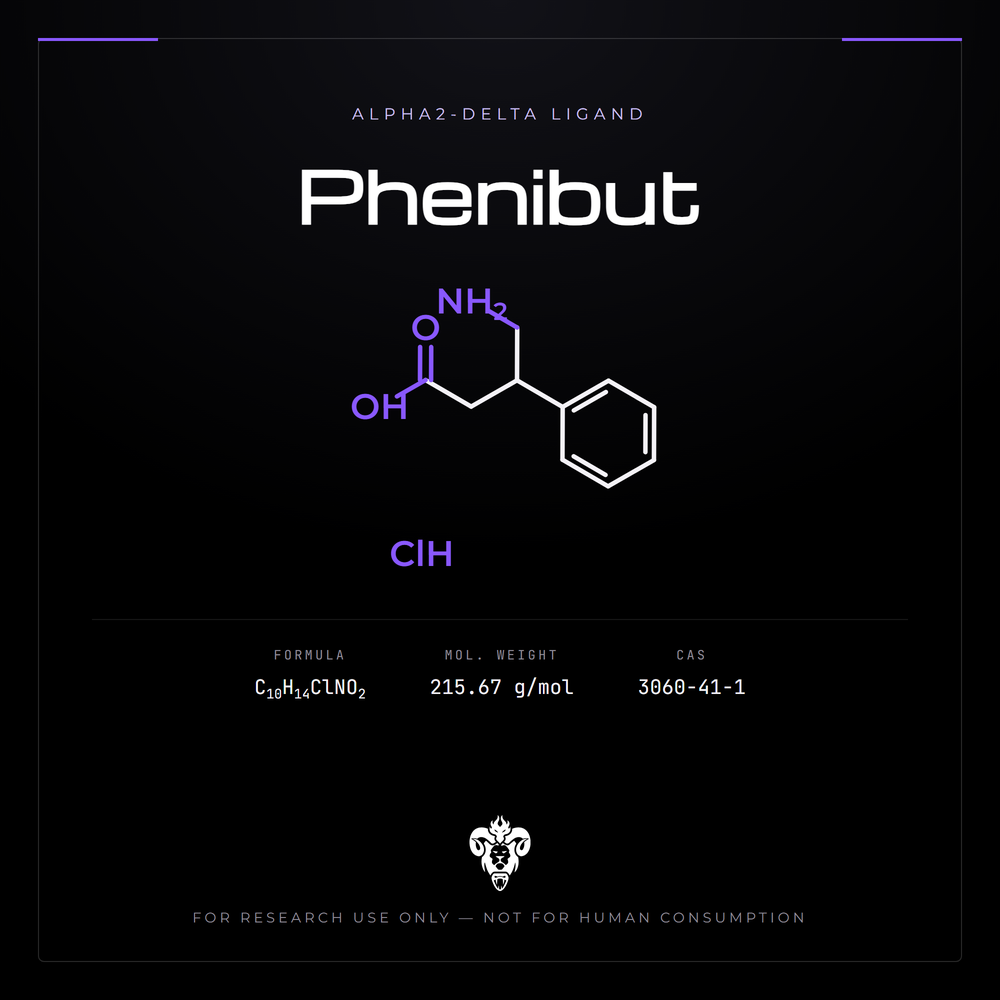

Phenibut Hydrochloride (β-Phenyl-GABA HCl) Research Standard
Phenibut Hydrochloride is a synthetic derivative of the naturally occurring inhibitory neurotransmitter γ-aminobutyric acid (GABA). By incorporating a phenyl ring onto the GABA backbone, the molecule gains lipophilic properties, enabling it to function as a potent GABA-mimetic in experimental models. In neurobiological research, Phenibut HCl is primarily utilized to investigate inhibitory signaling pathways within the central nervous system, specifically serving as an agonist for the GABA-B receptor and as a ligand for studying alpha-2-delta calcium channel subunits in isolated tissue models.
Physical & Handling Properties
| Property | Specification |
|---|---|
| Physical Appearance | Fine white to off-white crystalline powder |
Mechanism of Action & Research Context
Phenibut is engineered to traverse biological barriers in in vivo models, but its primary utility in in vitro laboratory settings lies in its distinct pharmacological activity at neurotransmitter receptors.
-
GABA-B Receptor Agonism: The molecule functions as an agonist at the GABA-B receptor. This interaction is central to studying inhibitory neurotransmission, as it modulates the release of other neurotransmitters—such as dopamine and acetylcholine—via the inhibition of voltage-gated calcium channels.
-
Alpha-2-Delta Interaction: Research also explores the compound’s activity at the alpha-2-delta (α₂δ) subunit of voltage-gated calcium channels, positioning it as a tool for comparing ligand affinity against other gabapentinoid research compounds.
-
Structural Role of the Phenyl Ring: The addition of the phenyl ring to the GABA structure is the primary focus of structure-activity relationship (SAR) studies, as it significantly alters the receptor binding profile compared to endogenous GABA.
Research Applications
Phenibut HCl is a specialized reagent used to map inhibitory circuitry and cellular stress responses.
Primary fields of in vitro and ex vivo laboratory investigation include:
-
Receptor Binding Assays: Quantifying the affinity of the molecule for GABA-B receptor sites in synaptic membrane preparations.
-
Neural Excitotoxicity Models: Studying the compound’s role in mitigating cellular stress or excitotoxicity in cultured neuronal models.
-
Inhibitory Signaling Research: Investigating the modulation of synaptic transmission in isolated neural tissues.
-
Circadian Rhythm Studies: Using the compound in controlled laboratory models to observe its influence on sleep-wake cycle regulation mechanisms.
Storage & Handling Guidelines
Store at controlled room temperature. Keep tightly closed.
Storage guidance is a house recommendation. Analytical documentation is per-lot release testing.
References
-
Lapin I. (2001) “Phenibut (β-phenyl-GABA): a tranquilizer and nootropic drug.” CNS Drug Reviews. 7(4): 471–481.
-
Bowery NG, et al. (1983) “Characteristics of GABAB receptor binding sites on rat whole brain synaptic membranes.” British Journal of Pharmacology. 78(1): 191–206.
-
Tyurenkov IN, et al. (2016) “Comparison of nootropic and neuroprotective features of aryl-substituted analogs of gamma-aminobutyric acid.” Bulletin of Experimental Biology and Medicine. 160(4): 465–469.
Related Research Compounds
Research Use Disclaimer
Research Use Only Disclaimer: This product is labeled and sold “For Research Use Only – NOT FOR HUMAN CONSUMPTION.” It is not a drug, dietary supplement, food, cosmetic, or medical device, and it is not approved by the FDA or any other regulator for human or veterinary use. It is supplied to approved account holders as a research chemical for laboratory use and must be handled in accordance with applicable law.