
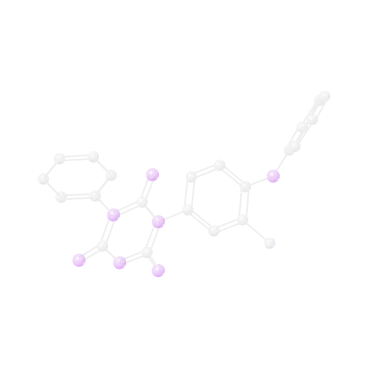
Calculated reference model · not an experimental or batch-certified structure. All 29 atoms shown.
Model data & sources
- Heavy atoms only; hydrogens are omitted from the reference display.
- Source-defined stereochemistry is checked against the calculated coordinates; no energy-minimum, crystal or solution-structure claim is made.
- Reference molecular species only; batch identity, purity, counterions and excipients are not certified.
- Formula
- C22H17N3O4
- Method
- RDKit ETKDGv3 / MMFF94s calculated reference conformer
ACD856: The Selectivity Is in the Efficacy, Not the Potency
The discovery study tested three receptor tyrosine kinases outside the neurotrophin family alongside the three inside it. The compound turned out to be about equally potent at all of them. What separated them was how much effect it could produce once bound.
The originating paper states it directly [1] (DOI). Potency toward TrkC, FGFR1 and IGF1R was similar, and the efficacy at FGFR1 and IGF1R was substantially less. Its authors read that as selectivity for neurotrophin receptors with respect to efficacy. Potency and efficacy point different ways in one experiment. That is the whole compound in one sentence, and it is the cleanest teaching case in this catalogue.
Kimera supplies ACD856 as an analytical reference standard.
Everything below reports findings from cell assays and rodent models. This material is for research use only, not for human or veterinary use. Indexed clinical papers exist [2][3] and [4]. Those human endpoints sit outside the scope of this profile.
What ACD856 is
A triazinetrione, which is an unusual scaffold for a kinase-directed molecule.
Identity and physical data
| Property | Value |
|---|---|
| Compound | ACD856, also written ACD-856 |
| Systematic name | 1-(3-Methyl-4-phenoxyphenyl)-3-phenyl-1,3,5-triazinane-2,4,6-trione |
| Other names | NeuroRestore ACD856, IGF-1R Modulator 1 |
| PubChem CID | 139434107 |
| CAS number | 2375424-89-6 |
| ChEMBL | CHEMBL4464037 |
| Molecular formula | C₂₂H₁₇N₃O₄ |
| Average molecular weight | 387.4 g/mol |
| Monoisotopic mass | 387.1219 Da |
| InChIKey | REYFGVMCUDWCML-UHFFFAOYSA-N |
| Chemical class | 1,3,5-Triazinane-2,4,6-trione |
| Originator | AlzeCure Pharma |
| Solution base | PEG400 |
One half of the product title resolves, the other does not
A PubChem query on ACD856 returns no record. Search instead on IGF-1R modulator 1 and CID 139434107 comes back, as it does for CAS 2375424-89-6, whose check digit is valid and which round-trips to that same record. The catalogue title carries both names, and only the second one is a public identifier.
That is worth knowing before searching. A development code is the name a database will not recognise, and the parenthetical is the one it will. That record also carries CHEMBL4464037.
The structure is a separate question. A 2026 review of allosteric kinase modulators reports that nobody has disclosed it [7] (DOI), and that holds for the peer-reviewed literature. It is not true of the patent, which describes this exact molecule in full. The section below sets out what each source does and does not establish.
Its predecessor was a veterinary antiparasitic
A screen of 25,000 molecules found this chemistry and produced ACD855, which is Ponazuril, a veterinary coccidiostat [1]. ACD856 came out of optimising that hit. A Trk screen that starts from an antiprotozoal is a scaffold story, and the papers say so plainly.
What a positive allosteric modulator of a kinase would mean
The concept is well established for other receptor classes and unusual here.
Where the idea comes from
G protein coupled receptors and ligand-gated channels made the term standard [17] (DOI). A modulator binds away from the orthosteric site and changes what the natural ligand does. A receptor tyrosine kinase is a different proposition. The machinery in question is a kinase domain, not a conformational switch feeding a G protein.
What the compound reportedly does to the enzyme
At 1 micromolar it significantly increased the apparent maximum rate of the TrkA reaction, measured on the full-length receptor [1]. Raising apparent Vmax rather than lowering apparent Km means more catalytic cycles per unit time. The authors read that as a rise in turnover number. They offer it to explain cellular activity climbing above the level the natural ligand alone produces.
Trk receptor biology in one paragraph
Nerve growth factor, brain derived neurotrophic factor and their relatives activate TrkA, TrkB and TrkC [8] (DOI) [9] (DOI). Later work mapped the downstream signalling in detail [10] (DOI). Crystallography solved the structural basis of neurotrophin recognition decades ago [11] (DOI). That structure is the ligand-binding domain of TrkA bound to nerve growth factor. It is not a structure of ACD856. It does not locate an allosteric site on the intracellular kinase. Use it to read the receptor, not the modulator.
The selectivity claim, stated correctly
This is where most secondary descriptions of ACD856 go wrong.
Two axes, not one
Potency answers how much compound a result takes. Efficacy answers how large an effect it can produce at saturation. A compound can be equally potent at two targets and far less efficacious at one of them. That is what the originating paper reports here [1].
What the paper measured
Cell-based assays covered TrkA, TrkB and TrkC on one line, FGFR1 on a second, and IGF1R on a third [1]. Activation by 30 ng/mL of the natural ligand was set as 100 percent. Both triazinetriones pushed Trk activity above that level, which is why the assay reports figures over 100 percent at all.
The sentence that matters
The Results section puts potency toward TrkC, FGFR1 and IGF1R at similar levels, and calls efficacy at the last two substantially lower [1]. The table is blunter than the sentence. FGFR1 and IGF1R are not merely comparable on potency, they are the most potent entries in the set. The compound reaches them soonest and does least once it arrives.
The patent claims both receptor families
The governing document is explicit. It describes these triazine derivatives as positive modulators of Trk receptors including TrkA, TrkB and TrkC, and of receptor tyrosine kinases such as IGF1R and/or FGFR1. IGF1R is named in the patent, not only in a product title, which is why a name citing that receptor has a source even though the papers describe pan-Trk activity.
Why the product name is not a contradiction
The catalogue title names IGF-1R. The published pharmacology describes a pan-Trk modulator. Both are consistent with the same table, because IGF1R is the second most potent target in it and the least efficacious. Check only the papers and the name looks wrong. Check only the name and the IGF1R activity looks larger than it is. The table supports neither reading on its own.
The binding result that does not match the potency
The most interesting number in the primary paper is the one that disagrees with the others.
177 micromolar against 0.38 micromolar
Surface plasmon resonance ran on the immobilised intracellular domain of TrkA [1]. It gave ACD856 an apparent dissociation constant of 177 plus or minus 18 micromolar, from two runs. Cellular potency at TrkA is 0.38 micromolar. More than two orders of magnitude separate those two numbers.
The authors say so themselves
The paper says the data do not support a high affinity site on that domain, biotinylated and bound to a sensor chip [1]. That is a candid statement of a mismatch rather than a gloss over one. It is worth more than a clean result would be.
The isolated kinase domain does nothing
The group also tried the intracellular kinase domain alone, residues 436 to 790 [1]. There they detected no positive modulation at all. The effect needed the full-length receptor. A modulator that works on the whole receptor and not on its isolated catalytic domain points at a site the fragment does not carry. Locating it is the experiment nobody has published.
Rodent work and its own negative
The behavioural literature is larger than the mechanistic one.
The pharmacological block
Effects on scopolamine-induced memory impairment were dose dependent and blocked by ANA-12, a reported TrkB antagonist [1]. Blocking a behavioural effect with a receptor antagonist ties the two together. That experiment is present here.
Combination and monoamine work
Later work from the same group examined ACD856 in models of depression-like behaviour, measuring hippocampal monoamines by microdialysis [5] (DOI). A companion study looked at mitochondrial and synaptic markers [6] (DOI).
The result usually quoted without its qualifier
The primary abstract puts age-induced cognitive dysfunction in 18-month-old mice back at the level of 2-month-old mice, after a single treatment [1]. The corresponding result paragraph reports a non-significant increase in retention latency against vehicle in old mice. Quote the abstract and you have overstated the paper. This is the specific place where a careless secondary source goes wrong, and there are several.
Disposition facts that stay in the file
Indexed early papers on ACD856 exist [3][4]. Human endpoints from those papers sit outside this profile. Two kinetic sentences remain because they are bound to the same reports.
The kinetic pair that is already in the literature
Maximum plasma exposure came 30 to 45 minutes after dosing [3] (DOI). Steady state arrived before day six, with an elimination half-life there of about 20 hours. No unchanged compound appeared in urine.
A separate paper covers the pharmacokinetic characterisation across the early studies [4] (DOI). A review from the same group sets ACD856 beside another Trk-directed molecule [2] (DOI). Use those papers as a map of what was indexed. Do not use them as a use document.
What this profile will not quote
It will not quote human dose ladders, volunteer counts, electroencephalographic shifts, or adverse-event language [3][4]. Those sentences turn a research article into a use document. The papers remain cited so a reader can find them.
How the rodent papers sit next to that file
The discovery group later ran ACD856 in models of depression-like behaviour and measured hippocampal monoamines by microdialysis [5] (DOI). A companion study looked at mitochondrial and synaptic markers [6] (DOI). Those are animal readouts. They do not close the kinetic file, and they do not license a claim about people.
Why neurotrophin ligands are hard to handle as reagents
This context explains why anyone tried an allosteric small molecule at all.
Protein ligands and delivery
Recombinant nerve growth factor is a protein ligand with a short half-life and a delivery problem [12] (DOI). Indexed papers on that protein exist [13][14]. Human endpoints from those papers sit outside this profile. The recurring laboratory obstacles are delivery, half-life and local irritation, not a missing receptor.
Small molecules at the same target
Other groups have pursued small molecules acting on TrkB signalling. One reports a binding site for monoamine ligands on the TrkB transmembrane domain [15] (DOI). Another screened compounds said to potentiate neurotrophin signalling [16] (DOI). Those are separate molecules with separate evidence. ACD856 is not either of them.
The comparison worth making
Insulin-like growth factor 1 receptor has a solved kinase structure and a long medicinal chemistry history [18] (DOI). A compound named for that receptor sits among well-characterised structures. That makes the absence of any published structural work on ACD856 at that target more conspicuous.
Where ACD856 sits against its own targets
| Receptor | Cell line | EC50, micromolar | Maximum effect |
|---|---|---|---|
| FGFR1 | U2OS-FGFR1 | 0.19 | 117% |
| IGF1R | HEK293-IGF1R | 0.25 | 104% |
| TrkB | U2OS-TrkB/p75 | 0.29 | 176% |
| TrkC | U2OS-TrkC/p75 | 0.33 | 328% |
| TrkA | U2OS-TrkA/p75 | 0.38 | 185% |
Read down the potency column and then down the effect column [1]. The two most potent entries are the two non-neurotrophin kinases, and they are also the two where the compound does least. FGFR1 is the most potent of all five at 0.19 micromolar, and its maximum effect is 117 percent. IGF1R sits at 0.25 micromolar and 104 percent, which is barely above the level the natural ligand reaches alone. The three Trk receptors are less potent and reach 176, 185 and 328 percent.
Ranking by potency puts the compound's targets in almost the opposite order to ranking by effect. That is the selectivity, and it lives entirely in the second column.
Only two of the five carry an error term
The body text gives TrkA as 382 plus or minus 28 nanomolar and TrkB as 295 plus or minus 35, each from forty or more replicates [1]. The table's other three columns carry no error term and no replicate count anywhere in the paper. A number without a spread is not the same kind of number as one with a spread, and the three that decide the selectivity story are the three without.
A tenfold error circulates for TrkC
Some secondary sources give the TrkC potency as 33 nanomolar. The paper's table says 0.33 micromolar, which is 330 nanomolar. The circulating figure is out by a factor of ten, and it makes the compound look an order of magnitude more potent at TrkC than its source claims. Check any nanomolar figure for this compound against the table's micromolar units.
The assay normalisation is doing work here
Activation by 30 ng/mL of the natural ligand was set at 100 percent, because no further increase appeared above that concentration [1]. So a figure above 100 percent means the compound pushed the receptor past what its own ligand achieves alone. That is the observation the Vmax result was offered to explain, and it is also why efficacy is the axis that separates these five receptors.
The identity chain, and where it actually stops
Two different claims get collapsed into one here, and separating them is worth a section.
The patent describes this molecule completely
Example 5 of WO2019162702A1, the AlzeCure application titled "Triazine derivatives for treating diseases relating to neurotrophins", is named in the document as 1-(3-methyl-4-phenoxyphenyl)-3-phenyl-1,3,5-triazinane-2,4,6-trione. That is the compound in the identity table above, and the patent gives its full preparation and characterisation:
| Datum | Value as the patent reports it |
|---|---|
| Route | Ethoxycarbonyl isocyanate plus 1-(3-methyl-4-phenoxyphenyl)-3-phenylurea, toluene, 110 C, 16 h |
| Yield | 0.050 g, 20 percent |
| 1H NMR (400 MHz, DMSO-d6) | 2.20 (s, 3H), 6.88-7.01 (m, 3H), 7.11-7.24 (m, 2H), 7.30-7.53 (m, 8H), 12.02 (s, 1H) |
| MS (ES+) | m/z 388 [M+H]+ |
Every one of those numbers is checkable against a vial. The singlet at 2.20 is the aryl methyl and the singlet at 12.02 is the free ring NH, which is the diagnostic signal named above. Thirteen aromatic protons plus three methyl protons plus one NH is seventeen, which is what C₂₂H₁₇N₃O₄ requires. An [M+H]+ of 388 puts the neutral molecule at 387, matching 387.4.
What the patent does not say
The patent never mentions ACD856. It describes Example 5, and a development code is not a patent example number. The claim that ACD856 is Example 5 is an inference, and no peer-reviewed source states it. That is the gap, and it is narrower than the reviews make it sound.
The internal evidence that points that way
Two things inside the document favour the identification. Example 5 heads both lists of compounds the patent singles out as particular. And Example 5 is the compound in the patent's only figure, a passive avoidance experiment in C57/Bl6 mice given scopolamine, which is the same behavioural model the discovery paper reports for ACD856 [1]. Neither is proof. Together they are the strongest available support.
How to write this down honestly
An experiment using this material should record the systematic name and its own measured identity data, not only the trade name. A methods section saying only ACD856 has recorded a label rather than a molecule. Recording the name, the mass and the NMR lets a later reader check what was actually used.
Physicochemical properties and handling
General laboratory information, not a protocol.
Solubility
The catalogue lists PEG400. A neutral triazinetrione carrying two aryl groups and a diaryl ether is rigid, lipophilic and poorly water soluble. The vehicle choice reflects that. Prepare a concentrated organic stock and check for precipitation at the working dilution before the assay rather than during it.
The ring is the stability question
A 1,3,5-triazinane-2,4,6-trione is an isocyanurate. The ring carries three carbonyls and one free NH. That proton is acidic enough to make strongly basic conditions worth avoiding. Neutral buffers and cold, dry, dark storage are the conservative choices.
The diaryl ether is not the liability
Diaryl ethers hold up well chemically, and the phenoxy linkage is unlikely to break first. If a stored solution develops a new peak, look at the ring rather than at the ether.
Stock and precipitation
The catalogue vehicle is PEG400 because a rigid, lipophilic triazinetrione does not stay in water. Make a concentrated organic stock. Dilute into assay buffer only at the last step. Check the working well for haze before the first time point. A precipitated well is a different concentration from the one written on the tube.
Store the solid cold, dry and dark. Keep stocks sealed against moisture. Storage guidance is a house recommendation. Analytical documentation is per-lot release testing.
What the rodent papers actually counted
The scopolamine passive-avoidance block with ANA-12 is the cleanest behavioural control in the file [1]. It ties a memory readout to a reported TrkB antagonist. The later microdialysis paper counted hippocampal monoamines, not receptor occupancy [5]. The companion paper counted mitochondrial and synaptic markers [6]. Those three readouts are not interchangeable. A notebook that writes "Trk activity" over a monoamine chromatogram has mixed two experiments.
Age is a fourth variable. The 18-month mouse result in the discovery paper is the one secondary sources quote from the abstract [1]. The result paragraph is weaker than that abstract. Quote the paragraph, not the press line.
Analytical characterization
Identity and purity need different methods, and here identity is the harder half.
Identity
High resolution mass gives the formula. Proton nuclear magnetic resonance settles the substitution pattern. The single ring NH is the diagnostic signal, since it exchanges and vanishes on adding deuterium oxide. No published paper discloses the structure. A certificate can therefore be checked only against the systematic name the supplier states, never against the literature.
The isocyanurate has isomers worth excluding
Triazinetriones accept substituents in several arrangements around the ring. A 1,3-disubstituted pattern is not the only one. Formula and mass do not distinguish those. Nuclear magnetic resonance does.
Purity
Reversed-phase HPLC with UV detection. Two aromatic rings and a diaryl ether give a strong chromophore. Quantitation is therefore straightforward, and a low-wavelength baseline does not limit it here.
What a certificate should carry
Method, purity with its detection wavelength, an intact mass result, and a nuclear magnetic resonance assignment given the identity situation. Third-party reports for supplied batches sit at the COA database. Related neurotrophic and neuropeptide compounds sit under nootropics, including Cerebrolysin, Semax and Dihexa, none of which shares this mechanism.
Test the full-length receptor, not the domain
The isolated kinase domain showed nothing [1]. Any binding or structural work that starts from the domain alone is starting from the preparation that already failed, and that is worth knowing before the protein is ordered.
Measure both axes, always
Reporting an EC50 without a maximal effect loses the only thing that separates ACD856 across its five reported targets [1]. A concentration response that is not carried to saturation cannot report efficacy at all.
What this literature does not establish
The gaps here are unusually specific.
A binding site
Surface plasmon resonance gave 177 micromolar on an isolated domain, and that same domain showed no modulation [1]. No structure of ACD856 bound to any receptor exists. Nobody has located the site.
A peer-reviewed structure, and a bound one
No paper draws the molecule [7], and no structure of it bound to any receptor exists [1]. The patent supplies the first of those in full for Example 5. It supplies nothing for the second.
Independent measurement
Every potency and efficacy figure descends from one table in one paper by the sponsor [1]. No laboratory outside that group has published a measurement at any of the five receptors.
Anything published about IGF-1R activity in its own right
No paper addresses this compound at IGF1R beyond the selectivity comparison in the discovery study. The receptor in the product name is the one with the least dedicated evidence.
A later efficacy paper
Indexed early papers exist [2][3] and [4]. This profile does not treat those papers as a use story, and it does not invent a later result that is not in the file.
Frequently asked questions
What is ACD856?
1-(3-Methyl-4-phenoxyphenyl)-3-phenyl-1,3,5-triazinane-2,4,6-trione, C₂₂H₁₇N₃O₄ at 387.4, a triazinetrione described as a pan-Trk positive allosteric modulator [1].
Is the product name wrong?
No. ACD856 is potent at IGF1R and weakly efficacious there. A name citing that receptor and a literature describing pan-Trk activity therefore describe one table [1].
What does selectivity mean here?
Efficacy selectivity. Potency at TrkC, FGFR1 and IGF1R was similar, and efficacy at the last two was substantially less [1].
Which receptor is it most potent at?
FGFR1, at 0.19 micromolar, then IGF1R at 0.25 [1]. The three Trk receptors are less potent and far more efficacious.
Why does the binding constant disagree with the potency?
Nobody knows. Surface plasmon resonance gave 177 micromolar on the isolated intracellular domain, against a cellular potency of 0.38 micromolar. The authors say the data do not support a high-affinity site there [1].
Can I look the structure up?
Not in a paper; a 2026 review records that nobody has disclosed it there [7]. The patent does, as Example 5, with 1H NMR and an MS value a certificate can be checked against. PubChem also holds the structure under CAS 2375424-89-6 and under the name IGF-1R modulator 1, though not under ACD856.
What was its predecessor?
ACD855, which is Ponazuril, a veterinary antiprotozoal [1].
What kinetic facts stay in this profile?
Time to peak plasma exposure of 30 to 45 minutes, and an elimination half-life of about 20 hours at steady state [3][4]. Human dose ladders and electroencephalographic readouts do not.
Is ACD856 definitely Example 5?
No source states it. Example 5 heads the patent's list of particular compounds and is the compound in its only figure, which is support rather than proof.
How should I search for it?
By CAS 2375424-89-6, or by the name IGF-1R modulator 1. The development code ACD856 returns nothing from PubChem.
What is the largest gap?
An independent measurement. Every number describing this compound comes from one group.
References
- Dahlstrom M, Madjid N, Nordvall G, et al. Identification of novel positive allosteric modulators of neurotrophin receptors for the treatment of cognitive dysfunction. Cells. 2021;10(8):1871. PubMed DOI
- Forsell P, Parrado Fernandez C, Nilsson B, et al. Positive allosteric modulators of Trk receptors for the treatment of Alzheimer's disease. Pharmaceuticals (Basel). 2024;17(8):997. PubMed DOI
- Onnestam K, Nilsson B, Rother M, et al. Safety, tolerability, pharmacokinetics and quantitative electroencephalography assessment of ACD856, a novel positive allosteric modulator of Trk-receptors following multiple doses in healthy subjects. J Prev Alzheimers Dis. 2023;10(4):778-789. PubMed DOI
- Nilsson B, et al. Pharmacokinetic characterisation of ACD856 in early clinical studies. Eur J Clin Pharmacol. 2024;80(5):717-727. PubMed DOI
- Madjid N, et al. Antidepressant-like effects of the positive allosteric modulator ACD856 and hippocampal monoamine measurements. Psychopharmacology (Berl). 2023;240(8):1789-1804. PubMed DOI
- Parrado Fernandez C, et al. Effects of the Trk positive allosteric modulator ACD856 on mitochondrial and synaptic markers. Int J Mol Sci. 2023;24(13):11159. PubMed DOI
- Roggiolani E, Rosini M, Minarini A, Basagni F. Probing allosteric kinase modulators as next game-changers in fighting neurodegeneration. J Med Chem. 2026;69(9):9815-9852. PubMed DOI
- Huang EJ, Reichardt LF. Trk receptors: roles in neuronal signal transduction. Annu Rev Biochem. 2003;72:609-42. PubMed DOI
- Reichardt LF. Neurotrophin-regulated signalling pathways. Philos Trans R Soc Lond B Biol Sci. 2006;361(1473):1545-64. PubMed DOI
- Minichiello L. TrkB signalling pathways in LTP and learning. Nat Rev Neurosci. 2009;10(12):850-60. PubMed DOI
- Wiesmann C, Ultsch MH, Bass SH, de Vos AM. Crystal structure of nerve growth factor in complex with the ligand-binding domain of the TrkA receptor. Nature. 1999;401(6749):184-8. PubMed DOI
- Longo FM, et al. Small-molecule modulation of neurotrophin receptors: a strategy for the treatment of neurological disease. Nat Rev Drug Discov. 2013;12(7):507-25. PubMed DOI
- Apfel SC, et al. Efficacy and safety of recombinant human nerve growth factor in patients with diabetic polyneuropathy: a randomized controlled trial. JAMA. 2000;284(17):2215-21. PubMed DOI
- Apfel SC, et al. Recombinant human nerve growth factor in the treatment of diabetic polyneuropathy. Neurology. 1998;51(3):695-702. PubMed DOI
- Casarotto PC, et al. Antidepressant drugs act by directly binding to TRKB neurotrophin receptors. Cell. 2021;184(5):1299-1313.e19. PubMed DOI
- Boltaev U, et al. Multiplex quantitative assays indicate a need for reevaluating reported small-molecule TrkB agonists. Sci Signal. 2017;10(493):eaal1670. PubMed DOI
- Nawaratne V, et al. New insights into the function of M4 muscarinic acetylcholine receptors gained using a novel allosteric modulator and a DREADD. Mol Pharmacol. 2008;74(4):1119-31. PubMed DOI
- Favelyukis S, Till JH, Hubbard SR, Miller WT. Structure and autoregulation of the insulin-like growth factor 1 receptor kinase. Nat Struct Biol. 2001;8(12):1058-63. PubMed DOI
