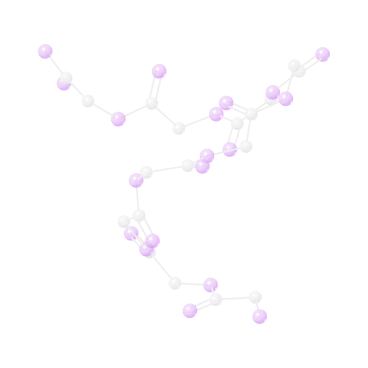
Calculated reference model · not an experimental or batch-certified structure. Backbone view: 37 of 60 atoms.
Model data & sources
- Peptide-ligand reference only. No zinc ion or experimentally defined zinc-coordination geometry is represented.
- The source record leaves Ser4 stereochemistry unspecified.
- Heavy atoms only; hydrogens are omitted from the reference display.
- Source-defined atom stereochemistry is checked against the calculated coordinates; no energy-minimum or observed-fold claim is made.
- The source graph leaves some stereochemistry unspecified. This calculated conformer does not establish a unique stereoisomer.
- Reference molecular species only; batch counterions, excipients and material composition are not certified.
- Sequence
- Pyr-Ala-Lys-Ser-Gln-Gly-Gly-Ser-Asn-OH
- Formula
- C33H54N12O15
- Method
- RDKit ETKDGv3 / MMFF94s calculated reference conformer
Thymulin
Thymulin is a zinc-binding thymic nonapeptide supplied as a lyophilized powder for laboratory research. Its sequence is Pyr-Ala-Lys-Ser-Gln-Gly-Gly-Ser-Asn (9 residues). Researchers study it in T-cell differentiation models, where short peptides are used as tools for examining sequence-specific binding and protein interactions. Kimera Chems supplies this material for controlled laboratory studies only.
Chemical Composition & Purity
Thymulin has the molecular formula C₃₃H₅₄N₁₂O₁₅ and a molecular weight of 858.86 g/mol. It appears as a white to off-white lyophilized powder. Purity for this lot is documented on its batch-specific Certificate of Analysis, available for batch KC-TYL-BLU1.
The certificates for batch KC-TYL-BLU1 are labelled Thymalin. That label is incorrect: mass spectrometry identifies this batch as Thymulin, which is the name it is sold under. This applies to batch KC-TYL-BLU1 only, until this stock is gone.
Research Applications
Thymulin is used as a reference peptide in cell-free and in vitro systems. Its 9-residue sequence gives a defined three-dimensional shape, and the side chain charges determine how it behaves in binding studies.
- Receptor Binding: Measuring peptide-protein affinity in cell-free systems.
- Competitive Assays: Examining displacement of labeled ligands.
- Structural Studies: Analyzing folding patterns in solution.
- Stability Testing: Monitoring degradation under various conditions.
Storage & Handling Protocol
Store at controlled room temperature, sealed and protected from light.
Storage guidance is a house recommendation. Analytical documentation is per-lot release testing.
Compliance & Usage Disclaimer
This product is for Research Use Only (RUO). It is not for human or animal consumption or clinical application. It is supplied to approved account holders as a research chemical for laboratory use and must be handled in accordance with applicable law.