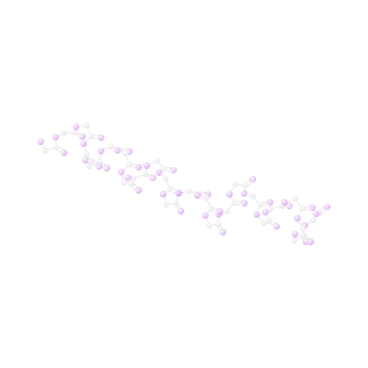
Calculated reference model · not an experimental or batch-certified structure. Backbone view: 97 of 185 atoms.
Model data & sources
- Sequence-derived S14G Humanin free-peptide reference matching the published formula. Counterions and batch-specific terminal composition are not certified.
- Heavy atoms only; hydrogens are omitted from the reference display.
- Source-defined atom stereochemistry is checked against the calculated coordinates; no energy-minimum or observed-fold claim is made.
- Reference molecular species only; batch counterions, excipients and material composition are not certified.
- Force-field relaxation reached its iteration limit. This is a geometry-checked reference, not a proven equilibrated or minimum-energy structure.
- Sequence
- MAPRGFSCLLLLTGEIDLPVKRRA
- Formula
- C118H202N34O31S2
- Method
- Source-identical PeptideBuilder idealized backbone / MMFF94s calculated reference conformer
Humanin HNG
Humanin HNG is the S14G analogue of humanin, a mitochondrial-derived peptide, supplied as a lyophilized powder for laboratory research. A single substitution replaces the serine at position 14 with glycine, giving the sequence Met-Ala-Pro-Arg-Gly-Phe-Ser-Cys-Leu-Leu-Leu-Leu-Thr-Gly-Glu-Ile-Asp-Leu-Pro-Val-Lys-Arg-Arg-Ala (24 residues). Kimera Chems supplies this material for controlled laboratory studies only.
Chemical Composition & Purity
Humanin HNG has the molecular formula C₁₁₈H₂₀₂N₃₄O₃₁S₂ and a molecular weight of 2657.21 g/mol. That is 30.03 g/mol lighter than humanin itself, the difference being the side chain removed at position 14. It appears as a white to off-white lyophilized powder. Purity will be documented on the batch-specific Certificate of Analysis once the first lot is released.
Research Applications
Position 14 has been reported as essential to the activity of the parent peptide, and the glycine substitution at that site is the most widely studied single-residue variant of humanin. Researchers use it as a comparator against the native sequence in binding and structural work.
- Comparative Binding: Measuring affinity alongside native humanin in cell-free systems.
- Structure-Activity Studies: Relating the position-14 substitution to conformation in solution.
- Competitive Assays: Examining displacement of labeled ligands.
- Stability Testing: Monitoring degradation under various conditions.
Storage & Handling Protocol
Store at controlled room temperature, sealed and protected from light.
Storage guidance is a house recommendation. Analytical documentation is per-lot release testing.
Compliance & Usage Disclaimer
This product is for Research Use Only (RUO). It is not for human or animal consumption or clinical application. It is supplied to approved account holders as a research chemical for laboratory use and must be handled in accordance with applicable law.